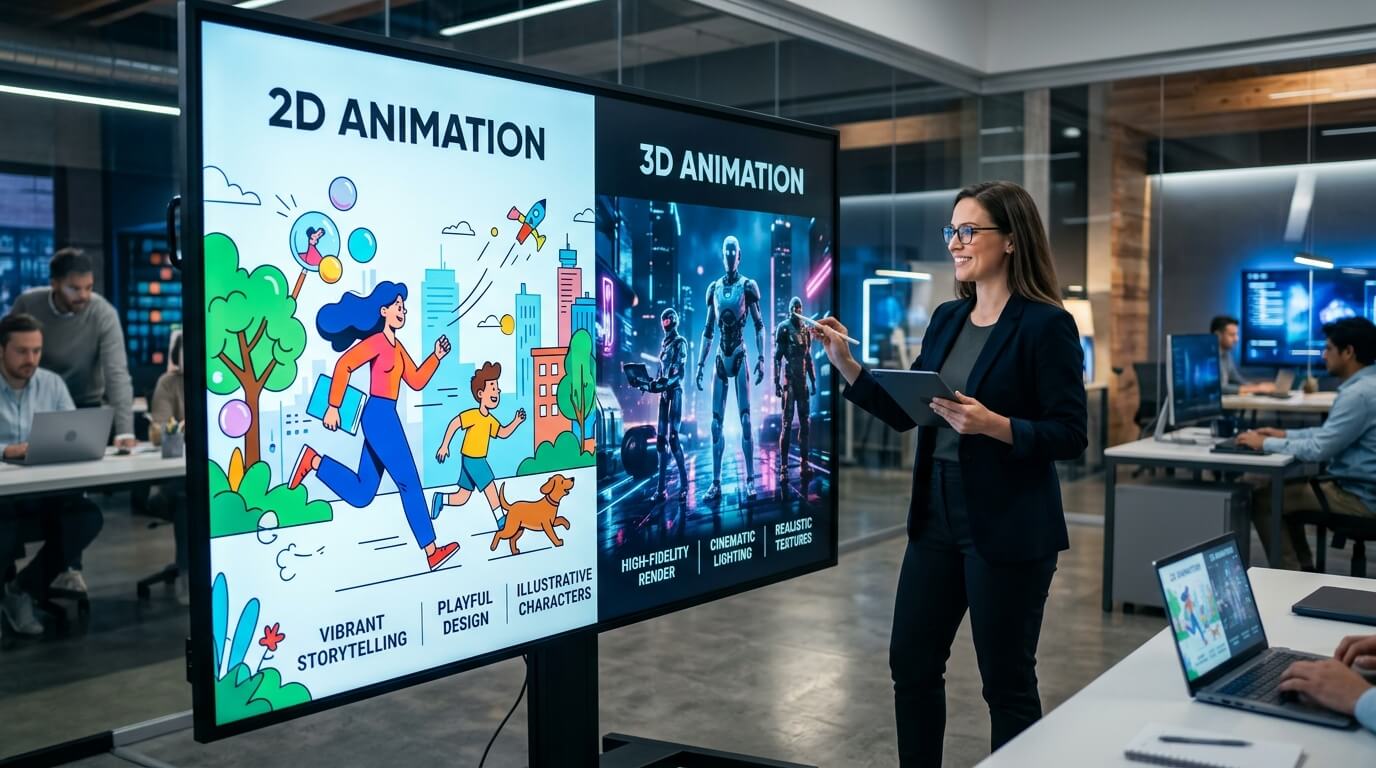
Animation has become one of the most influential forms of digital communication in modern marketing. As businesses compete for attention across websites, social media platforms, email campaigns, and digital advertisements, the ability to deliver information quickly and memorably has never been more important. Consumers now expect content that is engaging, visually appealing, and easy to understand. Long paragraphs of text or static images often struggle to capture attention, while animated videos can explain ideas within seconds and keep viewers interested until the end.
From startups introducing innovative products to multinational corporations launching global advertising campaigns, animation has evolved into a core marketing strategy rather than an optional creative element. It helps businesses tell stories, simplify complex concepts, demonstrate products, showcase services, and build stronger emotional connections with their audiences. Whether it is a 30-second social media advertisement, a two-minute explainer video, or an interactive product demonstration, animation has the power to increase engagement, improve brand recall, and encourage purchasing decisions.
One of the biggest decisions marketers face when planning animated content is choosing between 2D animation and 3D animation. While both formats are designed to communicate ideas through movement and visual storytelling, they differ greatly in appearance, production techniques, costs, and overall impact. Some businesses benefit from the simplicity and affordability of 2D animation, while others require the realism and immersive experience that only 3D animation can provide.
The debate over which style is “better” has continued for years, but the truth is that there is no universal answer. The best choice depends on your audience, campaign objectives, brand identity, available budget, production timeline, and the message you want to deliver.
In this guide, we’ll take an in-depth look at both animation styles, compare their strengths and weaknesses, examine their marketing applications, and help you determine which option is the right investment for your business.
Why Animation Matters in Modern Marketing
Before comparing 2D and 3D animation, it is important to understand why animation itself has become such a valuable marketing tool.
Today’s consumers are constantly surrounded by digital content. Every day, they scroll through hundreds of social media posts, online advertisements, product pages, emails, and videos. Capturing their attention has become increasingly difficult, especially when attention spans continue to shrink.
Animation addresses this challenge by combining motion, color, storytelling, sound, and visual design into a single engaging experience. Rather than asking audiences to read long explanations, businesses can communicate the same information in an entertaining and memorable way.
Marketing studies consistently show that people retain visual information far better than text alone. Animated videos simplify complicated subjects, making them easier to understand and remember. This is one reason why explainer videos have become a staple for software companies, healthcare organizations, educational institutions, financial services, and technology brands.
Animation also removes many of the limitations associated with live-action filming. Businesses can create imaginary environments, illustrate invisible processes, visualize future concepts, and explain abstract ideas without expensive filming locations or physical products. Whether introducing a brand-new invention or demonstrating an internal manufacturing process, animation makes almost anything possible.
Another major advantage is flexibility. Animated assets can be repurposed across websites, social media platforms, digital advertisements, presentations, email campaigns, and trade show displays. A single animation project can support multiple marketing channels, maximizing return on investment while maintaining consistent branding.
Understanding 2D Animation
What Is 2D Animation?
2D animation refers to creating moving visuals on a two-dimensional plane. Characters, illustrations, backgrounds, and objects have height and width but no actual depth. Movement is achieved by sequencing drawings, illustrations, or digital artwork to create the illusion of motion.
Traditional hand-drawn cartoons introduced generations of audiences to 2D animation, but today’s version has evolved significantly. Modern software enables designers to create sophisticated motion graphics, animated icons, character animations, typography, and explainer videos without drawing every frame manually.
Businesses across nearly every industry use 2D animation because it communicates information clearly while maintaining a clean and approachable appearance.
Unlike realistic simulations, 2D animation intentionally embraces illustration. This allows businesses to exaggerate expressions, simplify complicated ideas, and create memorable brand personalities that resonate with viewers.
How 2D Animation Works
Although every studio follows its own creative process, most 2D animation projects begin with strategy and planning before moving into design and production.
The process usually starts with identifying the marketing objective. Is the animation intended to educate customers, introduce a product, explain a service, or increase brand awareness? Once the objective is defined, a script is written to organize the message into a clear narrative.
Storyboards are then created to visualize each scene before production begins. These rough sketches act as a blueprint for the animation, ensuring that timing, transitions, and storytelling flow smoothly.
After approval, designers create illustrations, characters, backgrounds, icons, and visual elements. Animators then bring these assets to life using movement, transitions, facial expressions, camera effects, and motion graphics. Voiceovers, music, and sound effects are added during post-production to create the finished video.
Because the production pipeline is relatively straightforward, 2D animation projects often move from concept to completion much faster than their 3D counterparts.
Common Types of 2D Marketing Animation
The versatility of 2D animation allows businesses to create content for virtually every stage of the customer journey.
Explainer videos remain one of the most popular formats because they simplify products and services into easy-to-follow visual stories. Motion graphics are widely used in corporate presentations, digital advertising, website banners, and educational content. Character animation helps businesses build emotional connections with audiences, while animated infographics transform data into visually engaging presentations.
Whiteboard animation, although less common today than a decade ago, still serves educational and training purposes effectively. Kinetic typography, where animated text becomes the primary storytelling element, has also become increasingly popular on social media because it communicates messages even when videos are watched without sound.
Why Businesses Continue to Choose 2D Animation
One of the greatest strengths of 2D animation is accessibility.
Not every company needs cinematic realism. In many cases, marketing success depends more on clarity than visual complexity.
A software startup explaining how its platform saves time doesn’t necessarily benefit from photorealistic graphics. Instead, clean illustrations, animated icons, and simple transitions help audiences understand features more quickly.
Educational organizations face similar challenges. Teachers, universities, and online learning platforms often rely on 2D animation because simplified visuals reduce distractions and keep learners focused on the information itself.
Healthcare organizations also use 2D animation extensively when communicating with patients. Rather than overwhelming viewers with highly detailed medical imagery, illustrated animations explain procedures, treatments, and preventive care in a friendly, understandable way.
The approachable nature of 2D animation makes it especially valuable for brands seeking to appear helpful, relatable, and trustworthy.
Understanding 3D Animation
What Is 3D Animation?
Unlike 2D animation, 3D animation creates digital objects that exist within a virtual three-dimensional space. Every object has height, width, and depth, allowing it to rotate naturally and interact with realistic lighting, textures, and camera angles.
Three-dimensional animation combines artistic creativity with advanced computer graphics to produce visuals that often resemble live-action footage. Objects can be viewed from any perspective, making them ideal for product demonstrations, architectural visualization, engineering simulations, medical education, and premium advertising campaigns.
Many consumers associate 3D animation with blockbuster animated films or modern video games, but its marketing applications extend far beyond entertainment.
Today, businesses use 3D animation to showcase products before manufacturing begins, demonstrate machinery, visualize interior spaces, and create immersive digital experiences that photography alone cannot achieve.
How 3D Animation Is Created
Creating a 3D animation involves a considerably more technical production pipeline than 2D animation.
The process begins with concept development and storyboarding, just as it does with 2D projects. However, instead of drawing characters, artists build detailed three-dimensional models using specialized software.
Each object must then receive textures that define its appearance. Materials such as glass, metal, wood, fabric, or plastic are carefully designed to behave realistically under different lighting conditions.
Characters require rigging, which creates an internal digital skeleton that allows movement. Animators then manipulate these rigs to produce lifelike expressions, gestures, and body movements.
Lighting artists simulate realistic illumination, while virtual cameras determine composition and cinematic movement. Finally, rendering converts all of this information into finished video frames—a process that can take hours or even days for highly detailed projects.
Although the workflow is more time-consuming, it enables a level of realism impossible to achieve with traditional illustration alone.
Industries That Depend on 3D Animation
Many industries have adopted 3D animation because customers often need to understand products before purchasing them.
Manufacturers use 3D animation to explain how machinery operates internally without physically disassembling equipment. Automotive companies showcase engine technology, safety systems, and vehicle performance using detailed animated simulations.
Real estate developers increasingly rely on architectural visualization to sell properties before construction begins. Buyers can virtually walk through apartments, office buildings, hotels, and residential communities months before they exist in the real world.
Healthcare organizations use medical animations to explain surgeries, anatomy, pharmaceutical products, and treatment procedures with exceptional accuracy.
Technology companies frequently create 3D product launches that highlight design, engineering, and innovation while generating excitement among consumers.
These industries benefit because 3D animation combines education with visual realism, helping audiences better understand complex products and services.
The Fundamental Differences Between 2D and 3D Animation
Although both styles aim to communicate ideas visually, they differ in almost every stage of production and audience experience.
| Feature | 2D Animation | 3D Animation |
| Visual Appearance | Flat illustrations | Realistic depth and perspective |
| Style | Artistic and stylized | Realistic or cinematic |
| Production Time | Faster | Longer |
| Development Complexity | Moderate | High |
| Budget | Lower | Higher |
| Product Demonstrations | Good | Excellent |
| Character Animation | Highly expressive | Highly realistic |
| Lighting | Illustrated | Dynamic and realistic |
| Camera Movement | Limited | Unlimited virtual camera angles |
| Best For | Explainers, education, storytelling | Products, architecture, luxury branding |
One of the most noticeable differences lies in how audiences perceive each style.
2D animation encourages viewers to focus on the message rather than visual realism. Its simplicity reduces distractions, making it ideal for educational content and brand storytelling.
3D animation, on the other hand, creates immersive experiences that emphasize realism and product quality. Instead of simply explaining an idea, it often allows viewers to experience it visually from multiple perspectives.
Neither approach is inherently superior. The effectiveness of either style depends entirely on the marketing objective.
Advantages of 2D Animation for Marketing
Cost-Effective Without Sacrificing Creativity
For many businesses, budget plays a significant role in choosing an animation style. One of the biggest advantages of 2D animation is that it delivers professional, engaging content at a lower production cost than most 3D projects.
Since artists work with flat illustrations rather than detailed digital models, fewer technical resources are required. This reduces production expenses while allowing businesses to invest more in scripting, branding, and distribution.
Startups, small businesses, nonprofits, educational organizations, and growing brands often choose 2D animation because it provides exceptional value without compromising creativity.
Faster Production Timelines
Speed matters in marketing. Campaigns are often tied to seasonal promotions, product launches, industry events, or trending topics. Waiting several months for an animation may not always be practical.
Because 2D animation involves fewer technical stages than 3D production, businesses can often complete projects much more quickly. Faster turnaround enables marketing teams to respond to trends, launch campaigns sooner, and maintain a consistent publishing schedule across multiple platforms.
For organizations producing regular educational videos, social media content, or promotional advertisements, this efficiency becomes a major competitive advantage.
Creates Premium and High-Impact Visual Experiences
When businesses want to impress their audience, 3D animation often becomes the preferred choice. Unlike flat illustrations, three-dimensional visuals create depth, realistic lighting, textures, reflections, and camera movement that closely resemble real-world environments. This level of realism immediately captures attention and gives a brand a polished, premium appearance.
For luxury brands, technology companies, automobile manufacturers, and real estate developers, first impressions matter. A well-produced 3D animation can communicate innovation, professionalism, and quality before a customer even learns about the product itself. This is why major product launches from smartphone manufacturers, automotive companies, and consumer electronics brands frequently feature cinematic 3D animations instead of traditional promotional videos.
The realistic presentation also builds confidence among potential buyers. When customers can see every detail of a product from multiple angles, they often feel more informed and comfortable making a purchasing decision.
Ideal for Product Demonstrations
One of the greatest strengths of 3D animation is its ability to showcase products in ways that photography and live-action videos cannot.
Businesses can zoom inside a machine to reveal hidden components, demonstrate how internal mechanisms function, or show a product being assembled piece by piece. Complex technology becomes easier to understand because viewers can visualize exactly how it works.
This capability is particularly valuable for industries such as manufacturing, engineering, healthcare, aerospace, and automotive. For example, a medical device company can use 3D animation to demonstrate how a surgical instrument functions inside the human body without recording an actual procedure. Similarly, a furniture manufacturer can create realistic room settings that allow customers to visualize products in different environments before purchasing.
Instead of relying solely on technical specifications, businesses can show customers the value of their products through engaging visual demonstrations.
Strengthens Brand Perception
Consumers often associate high-quality visuals with high-quality products. Although great design alone cannot guarantee sales, it significantly influences how people perceive a business.
Professional 3D animation helps brands appear innovative, trustworthy, and technologically advanced. This perception can be especially important for companies introducing new products or competing in crowded industries where differentiation is essential.
A premium animation also communicates attention to detail. Customers may assume that if a company invests in presenting its products professionally, it is equally committed to product quality and customer satisfaction.
Long-Term Return on Investment
While 3D animation usually requires a larger upfront investment, it often delivers long-term value.
Once digital product models have been created, they can be reused across multiple marketing campaigns. A company can use the same 3D assets in website videos, social media advertisements, trade show displays, augmented reality applications, product configurators, and training materials.
Rather than recreating every visual from scratch, businesses simply modify lighting, camera angles, backgrounds, or animations for future campaigns. Over time, this flexibility can significantly reduce production costs for ongoing marketing efforts.
Limitations of 2D Animation
Although 2D animation offers many advantages, it is not the perfect solution for every business.
One limitation is the lack of realism. While illustrations can simplify information effectively, they cannot accurately represent physical products that customers want to examine closely. A luxury watch, sports car, or industrial machine often requires realistic visualization to communicate craftsmanship and engineering quality.
Another challenge arises when businesses want cinematic effects. Although talented animators can create visually stunning 2D work, it generally cannot replicate the depth, lighting, or immersive camera movement of 3D environments.
Additionally, certain technical industries require precise visual demonstrations that flat illustrations may oversimplify. Engineering firms, medical equipment manufacturers, and construction companies often need detailed visualizations that extend beyond the capabilities of traditional 2D animation.
Limitations of 3D Animation
Despite its impressive capabilities, 3D animation also has disadvantages.
The most obvious drawback is cost. Creating realistic models, textures, lighting, and animations requires specialized professionals and advanced software. Production timelines are often significantly longer than comparable 2D projects.
Rendering can also become time-consuming, particularly for high-resolution marketing videos with complex lighting effects. Large projects may require powerful hardware and extensive computing resources before final videos are completed.
Another consideration is communication. Highly realistic visuals can sometimes overwhelm viewers when the goal is simply to explain a concept. In educational or instructional videos, excessive visual detail may distract audiences from the primary message.
For businesses with limited budgets or tight deadlines, 3D animation may not always provide the best return on investment.
Comparing Marketing Performance
Brand Awareness
Both animation styles perform exceptionally well when increasing brand awareness, but they achieve this in different ways.
2D animation captures attention through creativity, memorable illustrations, and engaging storytelling. Brands often develop unique illustrated characters that become recognizable brand ambassadors over time.
3D animation creates memorable first impressions through visual realism and cinematic quality. High-end product launches frequently rely on 3D because audiences naturally associate premium visuals with premium products.
Customer Engagement
Engagement depends less on the animation style and more on the quality of the content itself.
A poorly written 3D advertisement will rarely outperform a well-crafted 2D explainer. Likewise, a compelling story told through simple illustrations can generate stronger emotional responses than an expensive animation with little substance.
Successful marketing combines strong storytelling with visuals that support—not overshadow—the message.
Conversion Rates
Animation often increases conversion rates by helping customers better understand products and services.
For service-based businesses, 2D explainers typically perform well because they simplify complicated processes and answer common customer questions.
For product-based businesses, particularly those selling high-value or technical products, 3D animation often increases buyer confidence by providing detailed visual demonstrations.
The best format depends on what customers need to see before making a purchasing decision.
Which Animation Style Works Best Across Different Marketing Channels?
Website Landing Pages
Landing pages often benefit from short animated videos that quickly communicate value.
A software company might use a 2D explainer video near the top of its homepage to introduce platform features, while a consumer electronics brand may showcase a rotating 3D product animation that highlights premium design.
Both approaches improve user engagement when aligned with customer expectations.
Social Media Marketing
Social media rewards content that captures attention within the first few seconds.
2D animation performs particularly well because of its bold colors, fast pacing, and clear messaging. Motion graphics, animated typography, and character-based storytelling are especially effective for Instagram, Facebook, LinkedIn, and TikTok.
However, cinematic 3D product teasers also perform exceptionally well during product launches, especially when introducing luxury goods, vehicles, gaming hardware, or consumer electronics.
Email Marketing
Animated content can significantly improve email engagement when used strategically.
Short GIF-style 2D animations draw attention to promotions without dramatically increasing file sizes. Businesses can also include links to longer animated videos hosted on landing pages.
For premium product announcements, animated thumbnails generated from 3D videos can encourage higher click-through rates.
Paid Advertising
Digital advertisements often compete within limited timeframes.
Because viewers make decisions within seconds, animation must communicate value immediately.
2D animation is excellent for educational advertisements, app promotions, SaaS marketing, and service-based businesses. It explains problems and solutions quickly without requiring extensive viewing time.
3D animation excels in product advertising where appearance, functionality, or innovation directly influences purchasing decisions.
Industry-Specific Use Cases
Technology and Software
Technology companies frequently use 2D animation for onboarding videos, product tutorials, feature announcements, and software explainers because simplicity improves understanding.
However, hardware manufacturers often rely on 3D animation to showcase product engineering, internal components, and premium industrial design.
Healthcare
Healthcare organizations often combine both animation styles.
Illustrated 2D videos explain wellness topics, preventive care, insurance information, and patient education in a friendly, approachable manner.
Three-dimensional animations visualize anatomy, pharmaceutical mechanisms, surgical procedures, and medical devices with scientific accuracy.
Real Estate
Architectural visualization has transformed the real estate industry.
Developers now sell properties before construction begins using immersive 3D walkthroughs that allow buyers to explore rooms, landscaping, amenities, and interior designs.
These experiences help customers imagine living in the finished property long before physical construction is complete.
Manufacturing and Engineering
Manufacturing companies rely heavily on 3D animation because machinery often contains internal systems that customers cannot see.
Animated demonstrations reveal mechanical processes, maintenance procedures, assembly instructions, and product functionality more effectively than live-action filming.
Education
Educational institutions continue to favor 2D animation because it simplifies learning.
Illustrated lessons reduce distractions while helping students focus on concepts rather than unnecessary visual detail. Subjects ranging from mathematics and science to history and language learning benefit from clean, engaging animation.
Can Businesses Combine 2D and 3D Animation?
Absolutely.
Many of today’s most successful marketing campaigns blend both styles to maximize impact.
For example, a product launch may begin with 2D motion graphics introducing key statistics before transitioning into realistic 3D product demonstrations. Similarly, animated icons and typography can overlay cinematic 3D footage to reinforce important messaging.
Hybrid animation provides the storytelling strengths of 2D while leveraging the realism and sophistication of 3D. This approach allows brands to maintain clarity without sacrificing visual quality.
As production technology continues to evolve, combining both animation styles is becoming increasingly common across industries.
Future Trends in Marketing Animation
Animation technology continues advancing at an extraordinary pace.
Artificial intelligence is streamlining repetitive production tasks, allowing artists to generate concepts, automate lip-syncing, accelerate rendering, and improve editing workflows. While AI increases efficiency, creativity and storytelling remain essential human strengths that continue to shape successful marketing campaigns.
Interactive animation is also becoming more popular. Instead of passively watching videos, customers increasingly expect interactive experiences where they can explore products, customize features, or navigate animated environments.
Augmented reality and virtual reality are expanding the possibilities even further. Businesses can now integrate 3D animation into immersive shopping experiences, virtual showrooms, training simulations, and product demonstrations.
At the same time, personalized animated marketing is gaining momentum. Companies can tailor videos to individual customers by incorporating names, preferences, purchase histories, or location-based information, creating more meaningful interactions.
Regardless of technological innovation, the purpose of animation remains unchanged: to communicate ideas clearly, build emotional connections, and inspire action.
How to Choose the Right Animation Style for Your Business
Choosing between 2D and 3D animation should begin with your marketing objectives rather than current design trends.
If your primary goal is educating customers, simplifying complex concepts, explaining services, or producing regular content within a limited budget, 2D animation is often the smartest investment. It is affordable, flexible, and highly effective for storytelling.
If your business depends on visual realism, product demonstrations, premium branding, or technical visualization, 3D animation offers advantages that flat illustrations simply cannot replicate.
Ask yourself several important questions before making a decision.
Who is your target audience?
What problem does the animation need to solve?
What level of realism is necessary?
How quickly does the campaign need to launch?
What budget is available?
Will the animation be reused in future campaigns?
Answering these questions will help determine which animation style provides the greatest return on investment.
Final Verdict: Is 2D or 3D Animation Better for Marketing?
The answer ultimately depends on your business goals.
2D animation excels at communicating ideas quickly, building emotional connections, simplifying information, and producing engaging content without requiring large production budgets. It is particularly effective for educational videos, software demonstrations, nonprofit campaigns, corporate training, and social media marketing.
3D animation shines when realism, product visualization, and premium branding are essential. Industries such as automotive, architecture, manufacturing, healthcare, and luxury retail often benefit from immersive visual experiences that showcase products in remarkable detail.
Rather than viewing the two styles as competitors, businesses should consider them complementary tools. Many successful marketing campaigns combine both formats, using each where it delivers the greatest value.
The most effective animation is not necessarily the most expensive or technologically advanced. It is the one that communicates your message clearly, resonates with your audience, strengthens your brand, and motivates viewers to take action.
Conclusion
The debate between 2D and 3D animation isn’t about declaring one format the winner—it’s about selecting the right tool for the right marketing objective. Both styles have transformed the way businesses communicate with customers, offering creative ways to educate, entertain, and inspire action.
If your priority is affordability, speed, and engaging storytelling, 2D animation is an excellent choice. Its clean visuals and flexibility make it ideal for explainers, educational content, and social media campaigns. On the other hand, if your goal is to showcase premium products, create immersive experiences, or demonstrate complex functionality, 3D animation delivers unmatched realism and visual impact.
Ultimately, successful marketing depends less on whether you choose 2D or 3D and more on how effectively your animation supports your message, brand identity, and audience needs. By aligning your animation strategy with your business goals, you can create compelling visual content that captures attention, builds trust, and drives meaningful results.
Frequently Asked Questions
Q1. Is 2D animation always more affordable than 3D animation?
In most cases, yes. Because 2D animation involves fewer technical production stages and simpler workflows, it generally costs less and can be completed more quickly than 3D animation.
Q2. Which animation style is better for small businesses?
Small businesses often benefit from 2D animation because it provides an excellent balance of affordability, creativity, and effectiveness. However, businesses selling premium or highly technical products may still find value in investing in 3D animation.
Q3. Does 3D animation improve marketing ROI?
It can. For products that require realistic demonstrations or detailed visualization, 3D animation often increases customer confidence, engagement, and conversions, leading to a stronger return on investment over time.
Q4. Can I use both 2D and 3D animation in the same campaign?
Yes. Many successful marketing campaigns combine 2D motion graphics, typography, and illustrations with 3D product visualizations to create engaging, informative, and visually appealing content.
Q5. How do I decide which animation style is right for my brand?
Consider your marketing goals, target audience, budget, timeline, and the type of message you want to communicate. If storytelling and simplicity are your priorities, 2D animation is often ideal. If realism and product visualization are essential, 3D animation is usually the better choice.