Video has become one of the most influential forms of digital communication. Whether you’re scrolling through social media, shopping online, learning a new skill, or exploring a company’s website, video content is everywhere. Businesses of all sizes now rely on videos to introduce products, educate customers, train employees, increase brand awareness, and drive sales. In fact, video has evolved from being an optional marketing tool to an essential part of modern business strategies.
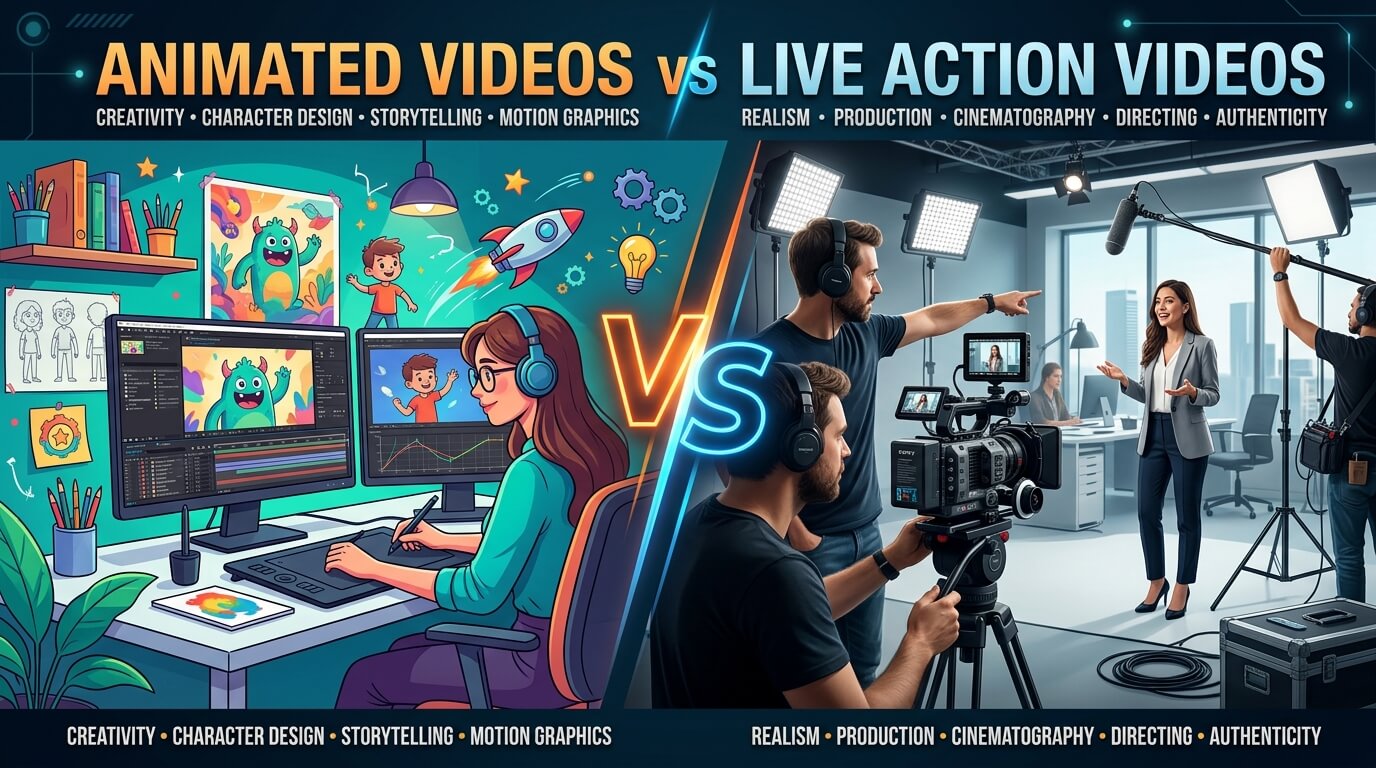
As organizations invest more heavily in video marketing, one question consistently arises: Should you create animated videos or live action videos? Both formats are highly effective, but they serve different purposes and deliver unique advantages. Animated videos can simplify complex ideas, showcase creativity, and communicate messages that would be difficult or expensive to film. Live action videos, on the other hand, feature real people, real products, and authentic experiences that help brands establish trust and emotional connections with their audiences.
Choosing between the two isn’t simply about aesthetics. The decision depends on your marketing goals, target audience, budget, timeline, and the type of story you want to tell. A software company explaining a cloud-based platform may benefit more from animation, while a luxury hotel promoting its guest experience may achieve better results with live footage of its property and satisfied customers.
Another important consideration is how audiences consume content today. Attention spans are shorter than ever, making it essential to capture interest within the first few seconds. Both animated and live action videos can accomplish this when produced thoughtfully, but each does so in different ways. Animation attracts viewers with colorful visuals, dynamic movement, and creative storytelling, while live action builds credibility by showing real people and genuine interactions.
This comprehensive guide explores the key differences between animated videos and live action videos, comparing them across factors such as production process, costs, flexibility, audience engagement, branding, storytelling, marketing performance, and long-term value. By understanding the strengths and limitations of each format, you’ll be better equipped to decide which style aligns with your business objectives and helps you communicate your message more effectively.
Understanding Animated Videos
Animated videos are created digitally using illustrations, motion graphics, characters, typography, icons, visual effects, or three-dimensional models instead of recording footage with a camera. Every movement, object, and transition is designed by artists and animators, allowing businesses to present ideas that may be impossible or impractical to capture in real life.
Animation has come a long way from traditional cartoons. Today, businesses use sophisticated animation techniques to create highly professional content for websites, advertising campaigns, product launches, employee onboarding, customer education, and social media marketing. Motion graphics, whiteboard animation, 2D explainer videos, 3D product visualization, and kinetic typography are just a few examples of styles commonly used in modern business communication.
One of animation’s greatest strengths is its ability to simplify complex information. Instead of relying on lengthy explanations, animation transforms abstract concepts into engaging visual stories that viewers can understand quickly. A cybersecurity company, for example, can illustrate how hackers attack networks using animated graphics, making technical information far more accessible than text alone.
Another advantage is complete creative freedom. Animators are not limited by physical locations, weather conditions, or camera angles. They can create futuristic cities, microscopic environments, or imaginary worlds that perfectly support the message. This level of flexibility makes animation especially valuable for industries such as technology, healthcare, finance, education, and engineering.
Because every visual element is intentionally designed, animated videos also offer excellent brand consistency. Colors, typography, icons, and character styles can all be customized to reflect a company’s visual identity, helping reinforce brand recognition across different marketing channels.
Popular Types of Animated Videos
2D Animation
Two-dimensional animation remains one of the most popular styles for businesses because it balances affordability with visual appeal. Characters, icons, and illustrations move smoothly across the screen while explaining products, services, or concepts in a simple and engaging manner.
Motion Graphics
Motion graphics focus on animated shapes, text, charts, and icons rather than characters. They are commonly used for corporate presentations, software demonstrations, financial reports, data visualization, and educational content where clarity is more important than storytelling.
Whiteboard Animation
Whiteboard videos simulate hand-drawn illustrations appearing on a white background while a narrator explains the topic. This format is particularly effective for educational videos, training sessions, and instructional content because it keeps viewers focused on the learning process.
3D Animation
Three-dimensional animation creates realistic objects, environments, and product visualizations with depth and detail. Industries such as architecture, manufacturing, healthcare, and engineering frequently use 3D animation to demonstrate products or processes before they exist physically.
Understanding Live Action Videos
Live action videos involve filming real people, products, locations, and events using cameras. Unlike animation, which creates digital visuals from scratch, live action captures genuine moments and authentic experiences that audiences can relate to immediately.
This format has been used for decades in television, cinema, advertising, and corporate communication because people naturally connect with human faces, emotions, and real-world environments. Businesses often choose live action when authenticity and credibility are priorities.
Examples of live action videos include company introductions, customer testimonials, product demonstrations, interviews, documentaries, recruitment campaigns, event coverage, and behind-the-scenes content. These videos allow brands to showcase their people, workplace culture, and expertise while building trust with potential customers.
For instance, a fitness center can film members achieving their goals, trainers providing guidance, and classes in action. This creates a realistic impression of the experience, helping potential customers imagine themselves as part of the community.
Similarly, a restaurant may use live action footage to highlight freshly prepared dishes, the atmosphere of the dining area, and interactions between staff and guests. These authentic visuals often influence purchasing decisions more effectively than static photographs.
Common Types of Live Action Videos
Brand Commercials
Brand commercials combine storytelling, cinematography, music, and professional editing to promote a company’s products or services while strengthening its overall image.
Customer Testimonials
Nothing builds trust quite like genuine customer experiences. Testimonial videos feature satisfied clients sharing their success stories, making them especially valuable for service-based businesses.
Product Demonstrations
Live demonstrations show products being used in real situations, helping customers understand features, functionality, and practical benefits before making a purchase.
Corporate Videos
Organizations use corporate videos to introduce their mission, values, leadership team, workplace culture, and business operations to employees, investors, and customers.
Animated Videos vs Live Action Videos: The Core Differences
Although both formats communicate information through moving visuals, they achieve their goals in fundamentally different ways.
Animation creates an entirely controlled environment where every object, movement, and scene is intentionally designed. Since there are no physical limitations, creators can visualize ideas that cameras cannot capture, such as internal machinery, microscopic biological processes, or futuristic technology. This makes animation particularly effective for explaining technical subjects and presenting abstract concepts in an engaging way.
Live action, by contrast, focuses on capturing reality. It relies on real people, authentic locations, and natural interactions to create an emotional connection with viewers. Facial expressions, body language, and genuine experiences help audiences trust what they see, making live action ideal for brand storytelling, testimonials, and lifestyle marketing.
The production process also differs significantly. Animation begins with concept development, scriptwriting, storyboarding, illustration, and motion design before progressing to voiceovers and sound design. Every detail is created digitally, providing complete control over the final product.
Live action production involves location scouting, casting, filming, lighting, directing, and editing. While this process captures authentic moments, it also introduces variables such as weather, scheduling conflicts, equipment availability, and location restrictions.
Ultimately, neither approach is inherently better. The effectiveness of each depends on how well it aligns with the video’s purpose, audience, and message.
Visual Appeal and Creativity
Why Animation Stands Out
Animation offers nearly limitless creative possibilities. Businesses can transform ordinary information into visually engaging stories using vibrant colors, custom illustrations, animated characters, and dynamic motion. Unlike live action, which is limited by the physical world, animation allows creators to design anything they can imagine.
For example, a fintech company explaining cryptocurrency can illustrate digital transactions moving across virtual networks, while a healthcare organization can show the human circulatory system functioning inside the body. These concepts would be difficult—or even impossible—to capture through traditional filming.
Animation also allows businesses to establish a unique visual identity. Every design element, from character style to color palette and typography, can be customized to match the brand’s personality. As a result, animated videos often feel distinctive and memorable, helping companies stand out in competitive markets.
The Authentic Appeal of Live Action
While animation excels in creativity, live action shines through realism. Audiences naturally connect with genuine people, real workplaces, and authentic interactions. Seeing employees collaborate, customers share experiences, or founders explain their vision creates a sense of transparency that builds confidence in a brand.
This emotional connection is especially valuable for industries where trust influences purchasing decisions, such as healthcare, education, finance, hospitality, and professional services. A heartfelt customer testimonial or behind-the-scenes company video can often leave a stronger impression than even the most visually impressive animation.
For brands focused on relationships and authenticity, live action provides an opportunity to show—not just tell—what makes them different.
Cost Comparison
One of the first questions businesses ask before starting a video project is, “How much will it cost?” The answer depends on numerous factors, including video length, production quality, complexity, talent, equipment, and post-production requirements. While both animated and live action videos can range from affordable to premium-priced, their costs are structured very differently.
The Cost of Animated Videos
Animation doesn’t require cameras, actors, travel, or physical locations, but it does require skilled designers, illustrators, animators, voice artists, scriptwriters, and editors. Every visual element is created from scratch, making animation a labor-intensive process.
Simple motion graphics or whiteboard videos are generally more budget-friendly because they involve fewer design elements. However, highly detailed 3D animation with custom characters, realistic environments, and advanced visual effects can require hundreds of hours of work, making it one of the more expensive forms of video production.
Despite the upfront investment, animated videos often provide excellent long-term value. If a business updates its logo, changes pricing, or launches a new feature, designers can modify specific scenes without recreating the entire project. This flexibility reduces future production costs.
The Cost of Live Action Videos
Live action videos involve a different set of expenses. A typical production may include cameras, lighting equipment, microphones, directors, camera operators, editors, actors, presenters, makeup artists, wardrobe, location rentals, transportation, and catering.
Large commercial productions with multiple filming locations naturally require bigger budgets. On the other hand, smaller businesses can create effective live action videos using minimal equipment, especially for interviews, behind-the-scenes content, or social media updates.
While live action can sometimes be produced more quickly than animation, reshooting scenes due to mistakes, weather conditions, or changes in messaging can increase costs significantly.
Ultimately, neither format is automatically cheaper. The total investment depends on the project’s complexity and production quality rather than whether it is animated or filmed.
Production Time
Time is another important factor when selecting a video format. Businesses launching new products or responding to market trends often need content quickly, making production speed an essential consideration.
Animation Requires Detailed Planning
Animation follows a structured workflow that begins long before any movement appears on screen. Every project typically moves through scriptwriting, storyboarding, illustration, animation, voice recording, sound design, revisions, and final rendering.
Because every scene is created manually, production timelines can extend over several weeks or even months for complex projects. However, the workflow is highly predictable since there are no weather disruptions, travel delays, or scheduling conflicts with actors.
Live Action Depends on Logistics
Live action production includes pre-production planning, location scouting, casting, filming, editing, and color correction. While filming itself may take only a few days, organizing locations, equipment, and participants often requires considerable preparation.
Unexpected challenges such as poor weather, unavailable talent, equipment issues, or location restrictions can delay the schedule. Nevertheless, for straightforward projects like interviews or product demonstrations, live action can often be completed faster than custom animation.
Flexibility and Scalability
Businesses frequently update products, services, pricing, branding, or messaging. The ability to modify existing videos can save significant time and money.
Why Animation Offers Greater Flexibility
Animated videos are relatively easy to revise. If a company introduces a new logo, changes pricing, or adds product features, designers can update individual graphics or scenes without rebuilding the entire video.
Voiceovers can also be replaced for different languages while keeping the visuals intact. This makes animation especially valuable for global businesses serving multilingual audiences.
Animation also scales efficiently across multiple platforms. Individual scenes can be resized, repurposed, or shortened for websites, presentations, YouTube, LinkedIn, Instagram, or TikTok without requiring another production shoot.
Updating Live Action Content
Making changes to live action videos is often more complicated. If an employee leaves the company, a product changes, or branding is updated, businesses may need to organize another filming session to replace outdated footage.
Although editing software can add new graphics or text overlays, substantial revisions frequently require additional production, increasing both costs and timelines.
Storytelling and Emotional Impact
Great videos do more than share information—they create memorable experiences. Storytelling plays a central role in determining how audiences perceive a brand and whether they remember its message.
Animation Simplifies Complex Stories
Animation excels at turning complicated information into engaging narratives. Abstract concepts such as artificial intelligence, cybersecurity, financial planning, software architecture, or medical procedures become easier to understand through visual metaphors and motion graphics.
Instead of overwhelming viewers with technical jargon, animation guides them through each concept step by step using creative visuals that improve understanding and retention.
This makes animated videos particularly effective for educational content, product explainers, onboarding materials, and technical presentations.
Live Action Creates Human Connection
People naturally relate to other people. Seeing genuine facial expressions, body language, and emotions creates empathy that is difficult to replicate through animation alone.
A heartfelt customer testimonial, an employee sharing their experience, or a founder explaining the company’s mission can inspire trust and credibility in ways that resonate deeply with viewers.
Brands focused on building relationships often rely on live action because it reinforces authenticity and transparency.
Audience Engagement
Capturing attention is only the first step. Successful videos also encourage viewers to continue watching, remember the message, and take action.
Animated videos are particularly effective at maintaining attention because movement, colors, and creative transitions stimulate curiosity. They also help simplify information, making viewers less likely to lose interest during educational or technical topics.
Live action engages audiences differently. Instead of relying primarily on visual creativity, it builds interest through authentic conversations, emotional storytelling, and relatable experiences.
Research consistently shows that viewers respond most strongly to videos that solve problems, answer questions, or tell meaningful stories regardless of whether they are animated or live action.
Marketing Performance
Video marketing has become one of the highest-performing forms of digital content across websites, email campaigns, search engines, and social media.
When Animation Performs Best
Animated videos are especially effective for explaining products and services that cannot easily be demonstrated through traditional filming.
Technology companies frequently use animation to explain software platforms, cloud computing, mobile applications, and artificial intelligence. Financial organizations rely on animation to simplify investment strategies and insurance policies, while educational institutions use it to improve online learning experiences.
Animation also performs well in paid advertising because colorful visuals immediately stand out in crowded social media feeds.
When Live Action Performs Best
Live action is often the preferred choice when businesses need to establish trust or showcase real experiences.
Customer testimonials, product demonstrations, hospitality marketing, healthcare services, real estate tours, and recruitment campaigns benefit significantly from authentic visuals.
Potential customers are often more confident when they see real employees, genuine clients, and actual products rather than illustrations.
SEO and Online Visibility
Search engines increasingly prioritize engaging multimedia content. Adding videos to landing pages and blog posts can improve user engagement, increase time spent on a website, and reduce bounce rates.
Animated and live action videos both contribute to stronger SEO when optimized correctly. Success depends on factors such as descriptive titles, keyword-rich metadata, captions, transcripts, and fast-loading pages rather than the production style itself.
Social media platforms also reward engaging videos with greater visibility. Animated videos often generate higher initial attention because of their vibrant visuals, while live action videos frequently encourage more comments and shares through emotional storytelling.
Best Industries for Animated Videos
Animation works particularly well for businesses that need to explain products, processes, or ideas that are difficult to visualize.
Technology companies use animation to introduce software platforms and digital services. Healthcare organizations rely on animated visuals to explain medical procedures and anatomy. Educational institutions simplify lessons through engaging graphics, while financial firms use animation to clarify complex investment concepts.
Engineering, manufacturing, logistics, cybersecurity, and scientific organizations also benefit because animation makes technical information more accessible.
Best Industries for Live Action Videos
Live action is especially valuable when customer relationships and authenticity influence purchasing decisions.
Restaurants, hotels, travel agencies, fitness centers, healthcare providers, universities, retail businesses, and real estate agencies all benefit from showcasing real people and genuine experiences.
Recruitment campaigns also perform better with live action because prospective employees want to see the actual workplace, leadership team, and company culture.
Similarly, nonprofit organizations often use live footage to highlight their impact, making emotional stories more compelling for donors and supporters.
Can Animated and Live Action Videos Work Together?
Absolutely. In fact, many of today’s most successful marketing campaigns combine both styles.
A live action interview can include animated charts that explain statistics. A product demonstration may feature motion graphics highlighting key features. Corporate presentations often combine footage of executives with animated icons and transitions that reinforce important information.
This hybrid approach allows businesses to enjoy the authenticity of live action while benefiting from the clarity and creativity of animation.
As production technology continues to evolve, blending the two formats has become increasingly common across industries.
Common Misconceptions
Many people assume animation is only suitable for children or entertainment. In reality, global corporations, healthcare providers, universities, banks, and software companies rely heavily on animation for professional communication.
Another misconception is that live action is always more authentic. Authenticity comes from honest storytelling, not simply from filming real people. A poorly scripted live action video can feel less genuine than a thoughtfully produced animated explainer.
Similarly, many believe animation is always less expensive. While simple animations can be affordable, high-quality custom 3D productions often require larger budgets than straightforward live action shoots.
How to Choose the Right Format
Choosing between animated videos and live action videos starts with identifying your primary objective.
If your goal is to explain a complicated process, introduce software, educate customers, or visualize concepts that cannot be filmed, animation is usually the stronger option.
If your objective is to build trust, showcase employees, demonstrate products, or create emotional connections with your audience, live action is often more effective.
Budget, production timeline, branding requirements, future updates, and audience preferences should also influence your decision.
Businesses planning long-term educational content may benefit from animation’s flexibility, while organizations focused on personal relationships may achieve better results through authentic live action storytelling.
For many brands, the ideal solution is not choosing one over the other but strategically combining both formats.
The Future of Business Video
Video production continues to evolve with advancements in artificial intelligence, virtual production, augmented reality, and cloud-based collaboration tools. Businesses now have more creative options than ever before.
AI-assisted animation is reducing production time, while virtual production techniques are making live action filmmaking more efficient. Interactive videos, personalized customer experiences, and immersive storytelling are also becoming increasingly popular across digital platforms.
Despite these technological changes, one principle remains constant: audiences value content that is useful, engaging, and authentic. Whether a video is animated, live action, or a combination of both, its success ultimately depends on how effectively it communicates with viewers.
Conclusion
The debate between animated videos and live action videos doesn’t have a universal winner because each format serves different purposes. Animated videos excel at simplifying complex information, maintaining consistent branding, and offering creative freedom that traditional filming cannot match. They are particularly valuable for educational content, software demonstrations, technical explanations, and long-term marketing assets that require easy updates.
Live action videos, on the other hand, create authentic human connections through real people, genuine experiences, and emotional storytelling. They are ideal for testimonials, company culture, product demonstrations, hospitality marketing, recruitment, and brand-building campaigns where trust is essential.
Rather than viewing these formats as competitors, businesses should consider them complementary tools within a broader content strategy. By understanding the strengths of each approach and aligning them with specific marketing goals, organizations can create videos that educate, inspire, and convert audiences more effectively. In many cases, combining animation with live action provides the perfect balance of creativity, clarity, and authenticity, resulting in engaging content that delivers measurable business results.
Frequently Asked Questions
Q1. Which is better for explaining complex products?
Animated videos are generally better because they can visualize abstract concepts, processes, and technical information in a simple and engaging way.
Q2. Are live action videos more trustworthy?
Live action videos often build stronger trust because they feature real people, real products, and authentic experiences that audiences can relate to.
Q3. Which format is more cost-effective?
It depends on the project’s complexity. Simple animations can be affordable, while high-end 3D animation may cost more than a basic live action production. Likewise, large-scale live action shoots can be significantly more expensive than animated videos.
Q4. Can small businesses benefit from both video styles?
Yes. Small businesses can use animation for explainers and educational content while using live action for testimonials, social media updates, and behind-the-scenes videos to create a balanced marketing strategy.
Q5. Should businesses choose one format or combine both?
For many organizations, combining animation and live action delivers the best results. A hybrid approach blends the authenticity of real footage with the clarity and creativity of animated graphics, creating videos that are both engaging and informative.