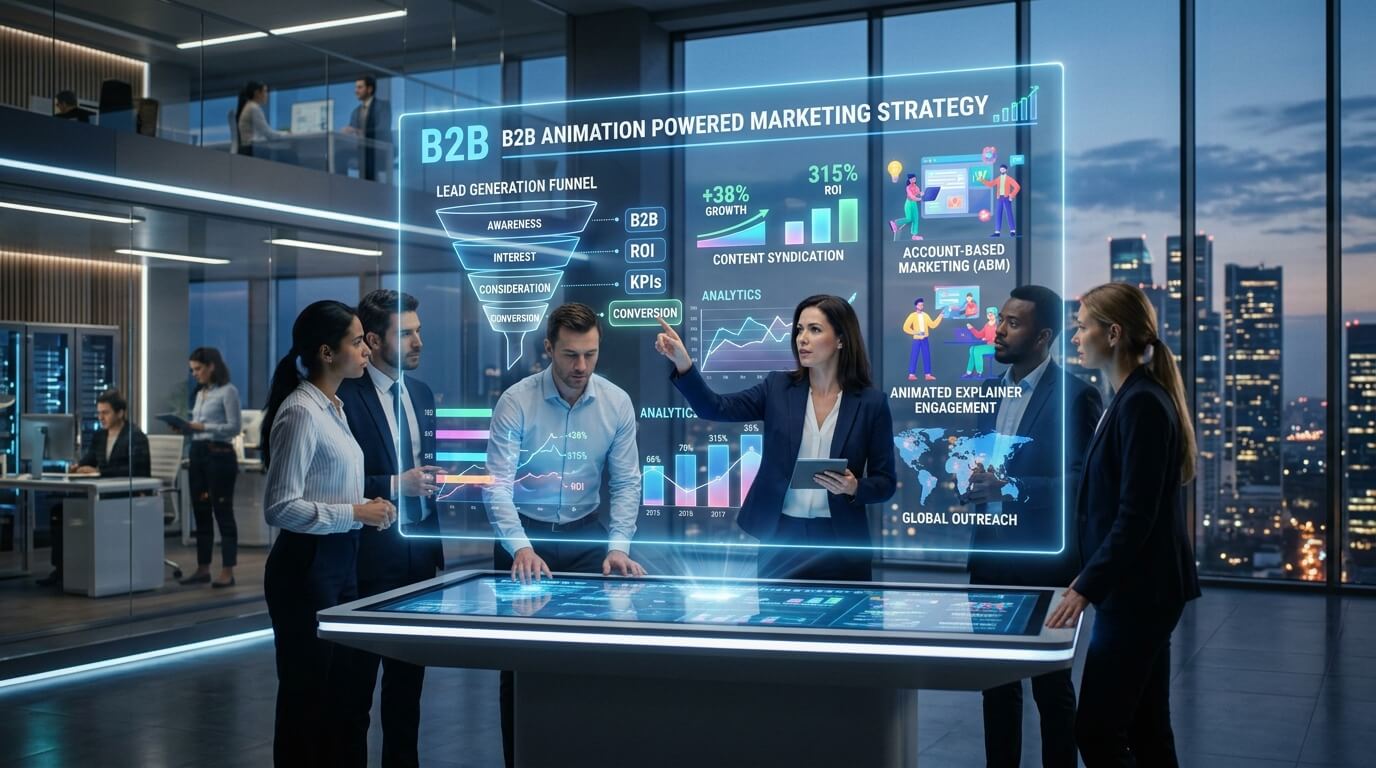
Business-to-business (B2B) marketing has changed dramatically over the last decade. Buyers are no longer influenced by lengthy brochures, generic presentations, or complicated product descriptions alone. Instead, decision-makers expect engaging, educational, and visually compelling content that helps them understand complex solutions quickly. Since B2B purchases often involve multiple stakeholders, longer sales cycles, and significant financial investments, companies need marketing materials that simplify information while building trust. This is where animation has become one of the most effective communication tools.
Many people still associate animation with entertainment or children’s content, but modern businesses have proven otherwise. Today, animation plays a vital role in explaining technical products, showcasing software platforms, demonstrating industrial processes, presenting business data, and communicating brand values. Rather than overwhelming potential clients with dense documentation, animated content transforms complicated ideas into clear visual stories that are easier to understand and remember.
One of the greatest strengths of animation in B2B marketing is its ability to simplify complexity. Whether a company offers cloud-based software, cybersecurity services, manufacturing equipment, financial technology, healthcare solutions, or engineering products, animation allows businesses to communicate detailed concepts without confusing their audience. Instead of reading pages of technical specifications, prospects can watch a short animated video that clearly demonstrates how a solution works and the value it provides.
Another reason animation continues to gain popularity is the increasing importance of digital marketing. Buyers now spend significant time researching products online before ever contacting a sales representative. Company websites, LinkedIn campaigns, webinars, email marketing, landing pages, and social media have become primary sources of information during the buying journey. Animated content performs exceptionally well across these channels because it captures attention quickly, keeps viewers engaged, and encourages them to continue exploring a company’s offerings.
Animation also creates consistency across every stage of the customer journey. A business can use the same visual style, characters, colors, typography, and messaging in awareness campaigns, product demonstrations, customer onboarding, employee training, and customer support. This consistency strengthens brand recognition while making communication more professional and memorable.
However, simply creating an animated video does not guarantee marketing success. The effectiveness of animation depends on having a well-planned strategy that aligns with business objectives, target audiences, and customer needs. Companies must understand what type of animation works best, where it should be used, how it supports the sales funnel, and how its performance can be measured over time.
In this guide, we’ll explore the most effective animation strategies for B2B marketing, how businesses can integrate animation into their marketing plans, and why animation has become one of the most valuable tools for attracting, educating, and converting professional buyers.
Why Animation Works So Well in B2B Marketing
Unlike business-to-consumer marketing, B2B marketing rarely relies on impulse purchases. Buying decisions often involve department managers, executives, procurement teams, technical specialists, and financial stakeholders. Each person evaluates a product from a different perspective, making communication significantly more challenging.
Animation bridges this communication gap by presenting information in a format that everyone can understand regardless of their technical background. Rather than relying on industry jargon or complicated documentation, animated visuals explain workflows, product features, integrations, and business benefits in an intuitive way.
Visual learning also plays a major role in information retention. People generally process visuals much faster than written text, making animated videos ideal for explaining sophisticated business solutions. Instead of expecting prospects to interpret complex diagrams or lengthy manuals, companies can illustrate processes through motion graphics, icons, diagrams, and storytelling that naturally guide viewers from problem to solution.
Animation also provides creative flexibility that live-action videos cannot always achieve. Businesses can visualize abstract ideas such as cybersecurity protection, cloud infrastructure, artificial intelligence, blockchain technology, data analytics, automation, and digital transformation without needing expensive filming locations or physical demonstrations. Concepts that are impossible to capture on camera become easy to understand through animated visuals.
Equally important is professionalism. High-quality animation reflects a company’s commitment to clear communication and innovation. Well-designed animations create a polished brand image that reinforces credibility, especially in competitive industries where trust influences purchasing decisions.
Understanding the B2B Buyer’s Journey Before Creating Animation
Successful animation begins with understanding the audience rather than choosing visual effects or artistic styles. Every piece of animated content should address a specific stage of the buyer’s journey.
Many businesses make the mistake of creating one generic animation and expecting it to serve every marketing objective. In reality, different buyers require different information depending on where they are in the decision-making process.
Awareness Stage
At the beginning of the buying journey, prospects may not even realize they have a specific problem. They simply notice inefficiencies, rising costs, workflow issues, security risks, or declining productivity.
Animation at this stage should focus on educating viewers rather than selling products. The objective is to introduce industry challenges, highlight common business problems, and position the company as a knowledgeable resource.
Short explainer animations, educational motion graphics, industry trend videos, and thought leadership content perform particularly well during this stage because they build awareness without overwhelming viewers with product features.
Rather than discussing every technical capability, awareness-stage animations answer questions like:
“What problem exists?”
“Why does it matter?”
“What challenges are businesses currently facing?”
This educational approach establishes credibility while encouraging prospects to continue learning.
Consideration Stage
Once buyers recognize their challenges, they begin evaluating possible solutions.
This is where animation becomes even more valuable.
Prospects want detailed explanations about how products work, what makes one solution different from another, and how implementation fits within existing business operations.
Animated product demonstrations simplify complicated workflows while showcasing software interfaces, manufacturing processes, automation systems, cloud architecture, or consulting methodologies in an engaging manner.
Instead of overwhelming viewers with technical documentation, animated explainers guide them through each feature using visual storytelling that maintains attention from beginning to end.
This stage also benefits from comparison animations that explain why one approach delivers greater efficiency, security, cost savings, or scalability than traditional alternatives.
Decision Stage
By the final stage, buyers are looking for reassurance.
They understand the problem.
They understand the solution.
Now they need confidence before making an investment.
Animation at this stage often focuses on customer success stories, implementation overviews, onboarding experiences, ROI demonstrations, and workflow simulations.
Animated case studies effectively show measurable business improvements while maintaining confidentiality when client information cannot be publicly disclosed.
Similarly, ROI animations illustrate cost reductions, productivity improvements, and long-term business benefits through engaging visual scenarios that make financial outcomes easier to understand.
Choosing the Right Animation Style for Your Business
Not every animation style suits every B2B company. Selecting the right visual approach depends on your industry, audience, marketing goals, and brand personality.
2D Explainer Animation
Two-dimensional animation remains the most popular choice for B2B marketing because it balances affordability, flexibility, and clarity.
Businesses use 2D animation to explain software platforms, professional services, consulting processes, healthcare solutions, logistics operations, financial services, and customer support systems.
Its clean visuals allow viewers to focus on the message rather than distracting visual effects.
When combined with professional voiceovers and well-written scripts, 2D animation becomes an extremely effective educational tool.
Motion Graphics
Motion graphics are particularly valuable for businesses that communicate through data.
Companies involved in finance, technology, analytics, cybersecurity, telecommunications, engineering, and research often rely on statistics, charts, dashboards, and reports.
Motion graphics transform static information into dynamic visual presentations that make numbers easier to interpret.
Instead of presenting complicated spreadsheets, animated charts illustrate trends, comparisons, growth metrics, market performance, customer behavior, and operational improvements in ways that keep audiences engaged.
Because motion graphics emphasize design rather than character storytelling, they often appeal to executive audiences looking for concise, professional presentations.
3D Animation
Some industries require visual realism that goes beyond traditional illustration.
Manufacturing companies, engineering firms, automotive businesses, architecture firms, healthcare organizations, robotics companies, and industrial equipment manufacturers frequently use 3D animation to demonstrate products that are difficult to film.
Three-dimensional animation can reveal internal mechanisms, production processes, product assembly, equipment functionality, or architectural walkthroughs with remarkable precision.
It allows businesses to present machinery before production begins, demonstrate prototypes, or showcase products that would otherwise require expensive physical demonstrations.
Although 3D animation requires a larger investment, it often delivers exceptional value for companies selling high-ticket industrial solutions.
Creating Customer-Centered Animated Content
One of the biggest mistakes businesses make is creating animations that focus entirely on themselves.
Prospective customers are rarely interested in hearing that a company has been operating for twenty years, employs hundreds of professionals, or has won multiple industry awards. While credibility matters, buyers are primarily focused on solving their own challenges.
Effective B2B animation begins with the customer’s perspective. Instead of asking, “What do we want to say?” marketers should ask, “What does our audience need to understand?”
This shift changes the entire structure of an animation. Rather than opening with a lengthy company introduction, successful videos immediately identify a common business problem. They acknowledge the frustrations decision-makers face, whether it’s inefficient workflows, rising operational costs, security concerns, slow project delivery, or outdated technology. Once the audience recognizes their own situation in the story, they are far more likely to stay engaged.
Customer-centered animation also uses relatable scenarios instead of abstract claims. Showing how a solution improves a team’s daily workflow, reduces manual tasks, or speeds up collaboration makes the message more meaningful than simply listing features. By illustrating real business outcomes, animation helps prospects visualize how the solution fits into their own organization.
When viewers feel that a company understands their challenges and offers practical solutions, trust begins to develop naturally. This emotional connection, even in a B2B environment, is often what separates memorable brands from competitors with similar products.
Integrating Animation Into B2B Marketing Channels
Creating a high-quality animated video is only the first step. To achieve meaningful marketing results, businesses must strategically distribute their animated content across the channels where their target audience spends time. A well-planned distribution strategy ensures that animation supports broader marketing goals instead of becoming a standalone asset that receives limited visibility.
Modern B2B marketing involves multiple touchpoints, including websites, social media platforms, email campaigns, webinars, sales presentations, and digital advertising. Animation can strengthen each of these areas by making communication more engaging and easier to understand.
Animation on Business Websites
A company’s website is often the first major interaction between a potential customer and a brand. Visitors usually decide within seconds whether they want to explore further or leave the page. This makes the homepage and key landing pages critical areas where animation can create a strong first impression.
An animated explainer video placed on a homepage can quickly communicate what a company offers, who it serves, and why its solution matters. Instead of forcing visitors to read lengthy descriptions, businesses can use animation to introduce their value proposition within a few minutes.
For complex industries, this approach is especially effective. A software company offering enterprise solutions, for example, may struggle to explain its platform through text alone. Animation can visually demonstrate how the software works, how teams interact with it, and what improvements customers can expect.
Product pages can also benefit from animated demonstrations. Showing a product’s functionality through motion allows visitors to understand features more clearly and increases confidence during the research stage of the buying process.
Landing pages created for specific campaigns can also use animation to improve engagement. Whether the goal is generating leads, promoting a webinar, or encouraging software demonstrations, animated content can make the page more attractive and persuasive.
Animation in LinkedIn and Social Media Marketing
Social media has become an essential channel for B2B companies, particularly platforms where professionals actively discuss industry trends, business challenges, and technology solutions.
Among these platforms, LinkedIn has become one of the most valuable spaces for B2B marketing because it allows businesses to reach decision-makers directly. However, professional audiences are constantly exposed to large amounts of content, making attention difficult to capture.
Animation helps companies stand out by providing visually interesting content that encourages users to stop scrolling. Short animated videos explaining industry insights, sharing company updates, highlighting product benefits, or simplifying complex topics can perform well because they deliver value quickly.
Social media animation should focus on concise storytelling rather than trying to communicate everything at once. A short video that explains one important idea is often more effective than a longer animation attempting to cover multiple topics.
Businesses can also use animated content as part of thought leadership campaigns. For example, a cybersecurity company might create short animations explaining common security threats, while a financial technology company might use motion graphics to explain market trends.
When animation consistently provides useful information, it helps position a company as an industry expert rather than simply a business promoting its products.
Animation for Email Marketing Campaigns
Email remains one of the most powerful tools in B2B marketing, especially for nurturing leads and maintaining relationships with potential customers.
However, many business emails struggle with low engagement because they contain too much text and fail to capture attention. Including animated content can make emails more visually appealing and encourage recipients to interact with the message.
Animated previews, short product demonstrations, event invitations, and customer success stories can make email campaigns more effective. Instead of describing a new feature through paragraphs of text, companies can provide a short animation that immediately communicates its value.
Animation also works well in automated email sequences. During a long sales cycle, businesses can use different animated videos to educate prospects at each stage. An introductory animation can explain the company’s solution, while later videos can demonstrate advanced features or share customer experiences.
This approach creates a more personalized and engaging customer journey.
Using Storytelling as the Foundation of B2B Animation
Great animation is not created through visuals alone. The strongest animated marketing videos are built around powerful storytelling.
Even in professional industries, people respond to stories because stories create emotional connections and make information easier to remember. While B2B buyers make logical decisions based on budgets, performance, and business outcomes, emotions still influence how they perceive brands and solutions.
A successful B2B animation usually follows a simple storytelling structure. It begins by introducing a challenge that the target audience understands. It then explores the impact of that challenge before presenting the company’s solution as the path toward improvement.
This structure works because it mirrors the buyer’s actual experience. Businesses are not searching for products randomly; they are searching for answers to specific problems.
For example, an enterprise software animation might begin by showing employees struggling with disconnected systems and inefficient processes. Instead of immediately introducing product features, the story first highlights the frustration caused by the existing problem. Once viewers recognize the challenge, the solution becomes much more meaningful.
Strong storytelling also requires understanding the audience’s motivations. Different decision-makers care about different outcomes. A chief financial officer may focus on cost savings, while a technology manager may prioritize security and integration. A successful animation considers these perspectives and communicates benefits that matter to each audience.
Personalization in B2B Animation Strategies
As B2B marketing becomes more competitive, personalization has become increasingly important. Generic content often fails because different customers have different challenges, industries, and expectations.
Animation provides unique opportunities for personalized marketing because visuals, characters, messaging, and scenarios can be adapted for specific audiences.
For example, a technology company serving healthcare organizations can create one animation focused on improving patient data management, while another version can focus on operational efficiency for manufacturing clients.
Personalized animations help prospects feel that a company understands their specific needs. Instead of presenting a general solution, the content speaks directly to their industry and challenges.
Account-based marketing (ABM) campaigns can also benefit significantly from personalized animation. Businesses targeting high-value accounts can create customized videos addressing the unique goals and pain points of specific organizations.
Although personalized animation requires additional planning, it can create stronger engagement and improve conversion opportunities because the audience receives content that feels relevant rather than generic.
Measuring the Success of B2B Animation Campaigns
Like any marketing investment, animation should be evaluated based on measurable results. While creative quality is important, businesses need to understand whether their animated content is helping achieve marketing and sales objectives.
One of the most important metrics is engagement. Video views, watch time, completion rates, and audience interactions provide insight into whether viewers find the content valuable. A high number of views with low completion rates may indicate that the video fails to maintain interest, while strong completion rates suggest that the message effectively connects with the audience.
Website performance is another important measurement area. Businesses can analyze whether animated videos increase time spent on pages, reduce bounce rates, or encourage visitors to take desired actions such as requesting consultations, downloading resources, or scheduling demonstrations.
Lead generation is also a major indicator of success. When animation is used on landing pages, email campaigns, or advertising platforms, companies can track whether it contributes to more inquiries and qualified prospects.
Sales teams can also provide valuable feedback. If prospects frequently mention that an animated video helped them understand a product or service, it demonstrates that the content is supporting the sales process.
Return on investment should ultimately be evaluated by comparing the cost of creating animation with the business outcomes it generates. A successful animation campaign may reduce sales friction, shorten decision-making timelines, increase customer understanding, and improve conversion rates.
Common Mistakes Businesses Should Avoid When Using Animation
Although animation offers many benefits, poor planning can reduce its effectiveness. One common mistake is focusing too heavily on visual effects while neglecting the message. An impressive animation without a clear purpose can confuse viewers instead of helping them.
The script should always come before design decisions. Companies need to define the problem, audience, message, and desired action before beginning production. A clear strategy ensures that every visual element supports the overall goal.
Another mistake is creating content that is too focused on features rather than benefits. Customers do not simply want to know what a product does; they want to understand how it improves their business. Animation should highlight outcomes such as increased efficiency, reduced costs, improved productivity, or better customer experiences.
Length is another important consideration. While complex B2B solutions may require detailed explanations, attention spans are limited. Companies should communicate the most important information clearly without adding unnecessary details.
Poor-quality production can also damage credibility. Since animation represents a company’s brand, low-quality visuals, unclear voiceovers, weak storytelling, or outdated design can create a negative impression.
Finally, businesses should avoid creating animation without a distribution plan. Even the best animated video will have limited impact if the target audience never sees it. Effective marketing requires strategic promotion across appropriate channels.
The Future of Animation in B2B Marketing
The role of animation in B2B marketing will continue to expand as businesses search for better ways to communicate in an increasingly digital environment.
Advancements in artificial intelligence, interactive design, augmented reality, and personalized content creation are creating new opportunities for animated marketing experiences. Companies will increasingly use dynamic animations that adapt based on viewer behavior, industry, or customer preferences.
Interactive animation is another emerging trend. Instead of passively watching videos, customers may engage with animated experiences where they explore products, customize solutions, or navigate digital demonstrations.
Artificial intelligence is also making animation production more efficient by helping businesses streamline scripting, design processes, and content variations. This allows companies to create more targeted content while reducing production challenges.
As B2B buyers continue demanding faster and clearer information, animation will remain a valuable tool for explaining complex ideas, strengthening brand communication, and supporting customer relationships.
Conclusion
Animation has become one of the most effective strategies for modern B2B marketing because it transforms complex information into engaging and memorable experiences. Businesses across industries are using animation to explain products, educate customers, improve sales communication, and strengthen brand identity.
The success of B2B animation depends on more than attractive visuals. Companies must focus on understanding their audience, creating meaningful stories, selecting the right animation style, distributing content strategically, and measuring performance.
When developed with a clear purpose, animation becomes more than a marketing asset. It becomes a powerful communication tool that helps businesses build trust, simplify decision-making, and connect with professional audiences in a way that traditional content often cannot achieve.
Frequently Asked Questions (FAQs)
Q. What is the role of animation in B2B marketing?
Animation helps B2B companies explain complex products, services, and ideas through engaging visual storytelling. It improves understanding, increases engagement, and helps businesses communicate value more effectively.
Q. Why should B2B companies use animated videos?
B2B companies should use animated videos because they simplify complicated information, capture attention, improve customer education, and support marketing campaigns across multiple digital channels.
Q. Which type of animation works best for B2B marketing?
The best animation style depends on the business goal. Explainer animations work well for education, motion graphics are effective for data presentation, and 3D animation is useful for demonstrating complex physical products or processes.
Q. How long should a B2B animated video be?
Most successful B2B animated videos are between one and three minutes long. The ideal length depends on the complexity of the message and the audience’s level of interest.
Q. How can businesses measure the success of animated marketing videos?
Businesses can measure success through metrics such as viewer engagement, watch time, website conversions, lead generation, customer feedback, and overall return on investment.