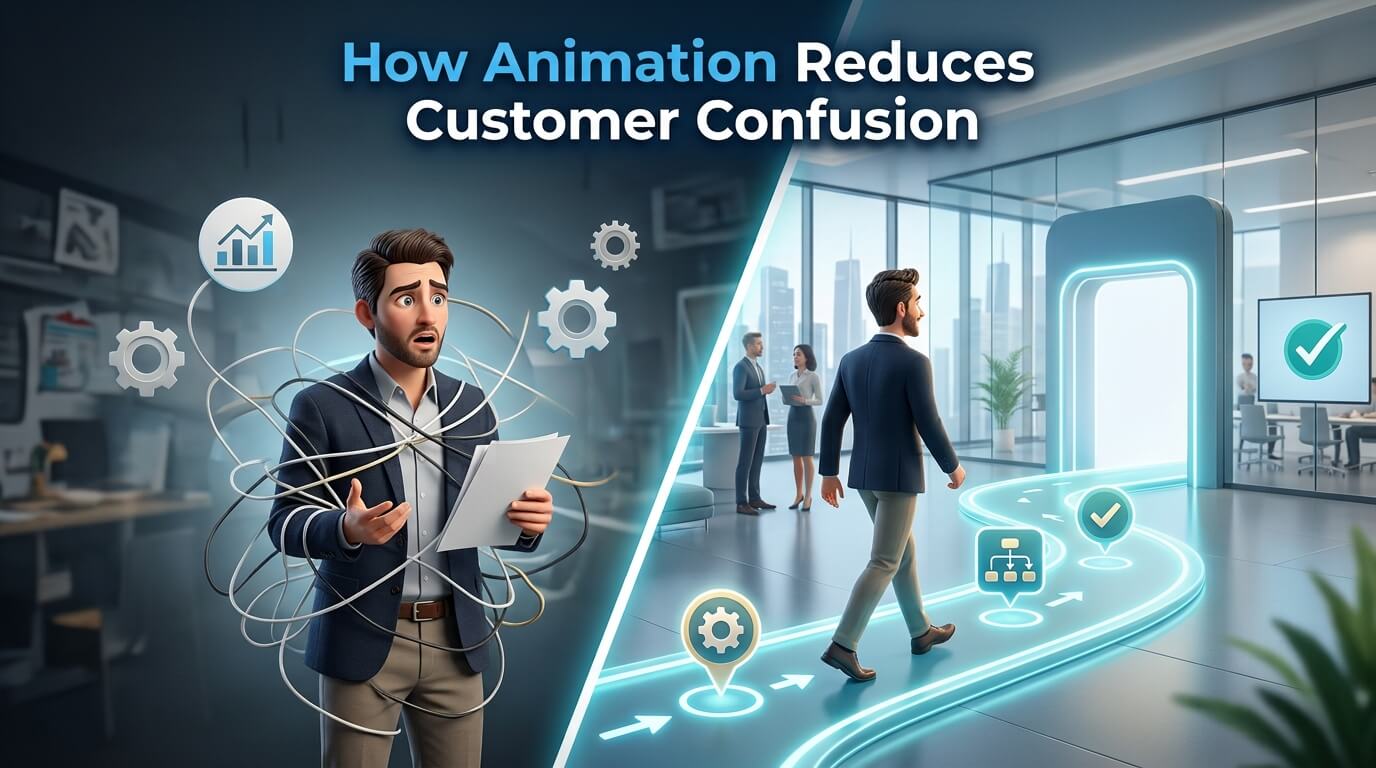
In a crowded digital marketplace, customers are constantly being asked to understand new products, services, technologies, processes, and ideas. The challenge is that businesses often know their offerings so well that they unintentionally explain them in ways that make sense to experts but confuse ordinary customers. Long paragraphs, technical terminology, complicated diagrams, dense product pages, and unclear instructions can quickly create uncertainty. When customers do not understand what a business offers or how it works, they are less likely to trust it, complete a purchase, or move forward with a decision.
Animation provides a practical way to make complicated information easier to understand. Instead of relying entirely on written explanations, animation can demonstrate how something works, show the relationship between different elements, and guide viewers through information one step at a time. Explainer videos commonly combine voiceover with illustrations, graphics, movement, and storytelling to focus attention on the most important information. Research on explainer videos suggests that this combination can make abstract information easier to process because verbal and visual information can complement one another.
The value of animation is not simply that it looks attractive. Its real strength comes from its ability to organize information. A well-designed animation can turn an unfamiliar process into a visual story that customers can follow naturally. It can show what happens first, what happens next, where a problem occurs, and how a product or service solves it. When businesses use animation strategically, they can remove unnecessary complexity and create a clearer customer experience.
Why Customer Confusion Is a Serious Business Problem
Customers Do Not Have Unlimited Attention
Customers rarely approach a website, advertisement, product page, or service explanation with the same level of knowledge as the business providing it. They may be encountering the product for the first time, comparing several alternatives, or trying to solve a problem quickly. If the explanation requires too much mental effort, customers may simply leave.
This is particularly important for businesses selling products or services that are difficult to explain through text alone. Software platforms, financial services, healthcare technologies, industrial equipment, online services, educational products, and professional solutions can contain several interconnected concepts. Explaining all of those concepts through paragraphs can make the customer journey feel unnecessarily complicated.
Animation gives businesses an opportunity to reduce that complexity by showing rather than merely telling. Instead of asking customers to imagine how a process works, an animation can visually demonstrate it.
Confusion Can Delay Purchasing Decisions
A customer who does not understand a product cannot confidently evaluate it. Even when the product is genuinely useful, uncertainty can create hesitation.
For example, imagine a software company offering an automated customer-support platform. A written description might explain that the platform integrates with existing systems, categorizes customer requests, routes conversations, analyzes data, and generates reports. Every statement may be accurate, but the customer could still struggle to understand how the entire system fits together.
An animation could show a customer message entering the system, being categorized automatically, moving to the appropriate department, receiving a response, and eventually becoming part of an analytics dashboard. The customer does not have to construct the entire process mentally. The animation constructs it visually.
That difference can be significant because customers are not simply looking for information. They are looking for understanding.
How Animation Makes Complex Information Easier to Understand
Animation Shows Processes in Motion
One of the biggest advantages of animation is its ability to represent movement and sequence. Static content can explain individual steps, but animation can connect those steps.
Consider a business that sells a delivery-management platform. A static graphic might show icons representing an order, warehouse, driver, and customer. Animation can show the order moving from one stage to another. The customer can see when the order is received, how it is processed, how the delivery is assigned, and how tracking information reaches the customer.
This creates a visual sequence. Instead of memorizing separate pieces of information, the viewer understands the relationship between them.
Research into instructional animation has found that signaling and attention-guiding techniques can support comprehension, particularly when viewers need to understand relationships between multiple elements. This is important for businesses because customer confusion often comes from relationships that are difficult to explain with isolated statements.
Animation Turns Abstract Ideas Into Visual Concepts
Some products cannot be easily photographed because what they sell is intangible. Cloud software, cybersecurity, artificial intelligence, consulting, financial planning, data management, subscription services, and digital platforms are examples.
Animation can give these invisible concepts a visual form.
A cybersecurity company, for instance, can represent incoming data as moving streams, security checks as gates, threats as warning symbols, and protected information as secured files. The visuals do not need to represent the technology literally. They simply need to create an understandable mental model.
This is one reason explainer videos are frequently used to communicate abstract concepts. Academic research describes them as short videos designed to explain concepts and relationships while focusing attention on relevant facts through visualizations.
Animation Breaks Large Ideas Into Smaller Pieces
A major source of customer confusion is information overload. Businesses sometimes attempt to explain everything at once because they want customers to have complete information. Unfortunately, completeness without organization can make information harder to process.
Animation allows information to be segmented.
A video might first introduce the customer’s problem, then show the solution, then explain how the product works, and finally demonstrate the outcome. Each stage can appear at the right moment rather than competing for attention simultaneously.
Research on instructional animations has found that segmenting information into smaller chunks can reduce cognitive load and improve learning from complex visualizations.
For customers, this means animation can create a more manageable learning experience.
Animation Guides Customer Attention
Movement Can Direct the Eye
A customer looking at a webpage has many things competing for attention. Headlines, images, buttons, menus, product descriptions, icons, and notifications can all compete for visual focus.
Animation can guide attention toward the information that matters most.
For example, an animated product demonstration can highlight one component while the rest of the interface remains visually quiet. The highlighted component can then move or change as the narration explains its purpose. This creates a natural connection between what the viewer hears and what the viewer sees.
The key is intentional design. Animation should not make everything move at once. Excessive motion can produce the opposite effect and make content harder to understand. Research has found that decorative animation can increase extraneous cognitive load and impair recall compared with simpler presentation.
Therefore, effective business animation is not about adding movement everywhere. It is about using movement where movement communicates something.
Visual Cues Make Important Information Stand Out
Color changes, zooming, arrows, transitions, highlighting, and controlled movement can help customers recognize what deserves attention.
Imagine an animation explaining how to use a mobile banking application. Instead of displaying an entire phone interface and describing every button, the animation can zoom into the payment option, highlight it, show the customer selecting it, and then move to the next stage.
The viewer is guided through the interface instead of being asked to figure it out independently.
This principle is especially useful for onboarding, tutorials, product demonstrations, and customer-service content.
Animation Simplifies Technical Information
Technical Products Often Create Communication Gaps
Technical businesses face a unique communication challenge. Their employees may understand their products deeply, but customers may not share that technical knowledge.
A software engineer may naturally use terms that are perfectly familiar within the industry but unfamiliar to a first-time customer. A medical technology company may describe mechanisms using specialized terminology. An engineering company may explain equipment through specifications rather than everyday benefits.
Animation can bridge this communication gap.
Instead of explaining every technical detail, an animation can focus on what customers actually need to understand. It can demonstrate the problem, introduce the solution, show how the solution works, and explain the practical result.
This does not mean technical accuracy should be sacrificed. Rather, technical information can be translated into a visual story without overwhelming the audience.
Animation Creates a Shared Mental Model
When a customer and business understand a product in completely different ways, communication becomes difficult. Animation can create a shared visual reference.
Suppose a company sells a complicated subscription service. A customer-service representative can say, “As you can see in the animation, your account moves through these three stages.” Suddenly, both parties are discussing the same visual sequence.
This can make customer support conversations easier because the animation provides a common frame of reference.
How Animation Reduces Confusion at Different Customer Journey Stages
Animation can help customers at nearly every stage of their interaction with a business. The specific purpose changes depending on where the customer is in the journey.
| Customer Journey Stage | Common Source of Confusion | How Animation Helps |
| Awareness | What the product actually does | Introduces the problem and solution visually |
| Consideration | How the product works | Demonstrates the process step by step |
| Purchase | What the customer receives | Clarifies features, benefits, and expectations |
| Onboarding | How to get started | Provides visual instructions |
| Product Use | How to complete specific tasks | Demonstrates actions and workflows |
| Support | How to solve a problem | Shows troubleshooting steps |
| Retention | Why the product remains valuable | Demonstrates useful features and outcomes |
This versatility makes animation more than an advertising format. It can become part of the entire customer communication strategy.
Animation Improves Product Demonstrations
Customers Can See Features in Context
A product feature can sound impressive in writing while remaining difficult to understand. Animation can place the feature into context.
For example, instead of saying that a project-management platform has “automated workflow prioritization,” an animation can show several tasks entering the system, demonstrate how priorities are assigned, and show the organized result.
The customer sees the feature performing its function.
This is particularly useful because customers often care less about what a feature is called and more about what it actually does for them.
Animation Can Demonstrate Invisible Benefits
Some benefits are difficult to photograph or demonstrate physically. Faster processing, improved organization, automation, data protection, personalization, and workflow efficiency are examples.
Animation can represent these outcomes visually.
A chaotic workspace can transform into an organized dashboard. A long manual process can become a shorter automated sequence. A confusing customer journey can become a clear path.
The visuals provide customers with a way to imagine the difference the product can make.
Animation Helps Customers Remember Important Information
Understanding and remembering are closely connected. A customer may understand an explanation while watching it but forget the details shortly afterward.
Animation can strengthen memory when visual elements are directly connected to the information being communicated. Research on multimedia communication suggests that combining verbal explanations with clear visualizations can support processing because information can be presented through complementary channels.
However, businesses should avoid assuming that any animation automatically improves retention. The animation needs to reinforce the message.
A moving character dancing beside a product explanation may attract attention but contribute nothing to understanding. A simple animated diagram showing how the product solves the customer’s problem may be much more valuable.
The goal is meaningful visual communication.
Animation Makes Customer Education More Accessible
Different Customers Learn in Different Ways
Not every customer prefers to read a long product explanation. Some people prefer watching a demonstration. Others may want to see an example before reading detailed information.
Animation provides another communication format.
A customer can watch an explainer video before reading the product documentation. The animation can establish the basic concept, while the written documentation provides deeper detail.
Research has also found that explainer videos can support comprehension when used alongside other forms of information, although their effectiveness depends heavily on design and context.
This makes animation particularly valuable when businesses serve audiences with different levels of familiarity.
Animation Can Reduce Language Barriers
Visual storytelling can also make information more accessible across language differences. Although voiceover and text still matter, a well-designed visual sequence can communicate basic actions and relationships without requiring every concept to be explained through complex sentences.
For global companies, this can make animation a useful part of multilingual communication strategies.
A visual demonstration of how to operate a product may remain understandable even when the accompanying narration is translated into another language.
Animation Builds Confidence by Making Things Feel Clear
Customer confusion often produces another problem: uncertainty.
When people do not understand what they are buying, they may question whether the product is reliable, whether they can use it correctly, or whether the service is appropriate for their needs.
Clear animation can reduce some of this uncertainty by making the experience more predictable.
A customer can see what happens after signing up. They can understand how the product is used. They can see what the process looks like and what result to expect.
This sense of predictability can make a complicated product feel more approachable.
Research involving whiteboard animations has also found evidence that viewers can experience greater cognitive absorption while watching animations than while reading brochures, with absorption associated with deeper processing of information.
Animation Is Especially Valuable for Onboarding
After a customer makes a purchase, confusion does not disappear. In many cases, it becomes more important.
A new customer may not know how to create an account, configure settings, use a feature, submit a request, or complete the next step.
Long instruction manuals can feel intimidating. Animation can provide a short visual walkthrough.
For example, an onboarding animation can show a new software user how to log in, create a profile, connect an account, choose settings, and begin using the platform. The customer can watch the process and then repeat it.
This can reduce the number of basic questions customer-support teams receive while giving customers greater confidence during their first interaction with the product.
Animation Can Improve Customer Support
Customer support is another area where confusion can become expensive. When customers cannot understand how to solve a problem, they may contact support repeatedly or become frustrated.
Short animated troubleshooting videos can explain solutions visually.
Instead of writing, “Navigate to settings, select account preferences, locate the synchronization option, and enable it,” a short animation can show exactly where each option appears.
This is especially helpful when software interfaces, devices, or processes contain multiple steps.
The animation becomes a visual instruction manual that customers can replay whenever necessary.
Creating Animation That Actually Reduces Confusion
Start With the Customer’s Question
The most effective animations begin with a communication problem rather than a visual style.
Businesses should first ask what customers commonly misunderstand. Is the product difficult to explain? Is the buying process complicated? Do customers frequently ask the same support question? Is a technical feature misunderstood?
The animation should address that specific problem.
Keep One Main Idea at the Center
An animation that attempts to explain everything can become just as confusing as a long webpage.
The viewer should know what the animation is trying to communicate. Supporting information can be included, but the central message should remain clear.
If a business has several complicated concepts, it may be better to create several short animations rather than one extremely long video.
Match Visuals With the Narration
The visuals should support what the narrator is saying.
If the voiceover explains a particular feature, that feature should appear on screen. If the narration describes a process, the animation should show the process. If the narrator moves to a new idea, the visual presentation should move with it.
This alignment helps viewers connect the spoken explanation with the visual representation.
Avoid Unnecessary Motion
More animation does not necessarily mean more clarity.
Decorative effects, constant transitions, excessive character movement, and unrelated visual elements can compete with the actual message. Studies on animated instructional content show why unnecessary animation can become an additional cognitive burden.
Good animation knows when to move and when to remain still.
Measuring Whether Animation Has Reduced Confusion
Businesses should not judge an animation only by views or completion rates. The more important question is whether customers understand the information better afterward.
Customer-support teams can monitor whether repeated questions decline after an animation is introduced. Marketing teams can compare engagement and conversion behavior. Product teams can examine whether onboarding completion improves. Businesses can also ask customers whether they understand the product more clearly after watching the animation.
Simple customer feedback can reveal whether the animation has solved the original communication problem.
For example, if customers previously asked, “How does this service work?” hundreds of times each month and those questions decline after the introduction of a clear explainer video, that provides meaningful evidence that the animation is doing its job.
The Future of Animation in Customer Communication
As businesses continue to offer increasingly complex digital products and services, the need for clear communication will become even more important. Artificial intelligence, automation, cloud computing, cybersecurity, financial technology, and other emerging technologies can be difficult to explain using traditional marketing formats.
Animation gives businesses a flexible way to translate complexity into understandable stories.
At the same time, companies need to use animation responsibly. Making information look simple does not automatically make it accurate. Recent research on animated science communication illustrates that simplified animated content can improve perceived comprehensibility while also creating risks around overconfidence in understanding.
The best business animation therefore balances simplicity with accuracy. It removes unnecessary complexity without hiding important limitations or conditions.
Conclusion
Animation reduces customer confusion by turning complicated information into visual, structured, and easier-to-follow experiences. It can demonstrate processes, simplify technical concepts, guide attention, improve product education, support onboarding, and make customer-service instructions easier to follow. Its greatest value is not simply entertainment but communication.
When animation is designed around a genuine customer question and uses movement purposefully, it can reduce the mental effort required to understand a product or service. Businesses that communicate complex ideas clearly can make customers feel more confident, informed, and prepared to take action. The result is a smoother customer experience in which people spend less time trying to figure out what something means and more time understanding why it matters.
Frequently Asked Questions
Q1. How does animation reduce customer confusion?
Animation reduces confusion by presenting complex information visually, breaking processes into smaller steps, and showing relationships that may be difficult to understand through text alone.
Q2. Is animation better than written content for explaining products?
Animation is not always better than written content, but it can be particularly effective for explaining processes, interfaces, abstract concepts, and products that are difficult to demonstrate through static images or text.
Q3. Can animation help with customer onboarding?
Yes. Animated onboarding videos can demonstrate account setup, product features, workflows, and common tasks, helping new customers understand how to begin using a product.
Q4. Can too much animation increase confusion?
Yes. Unnecessary movement, decorative effects, and excessive visual information can increase cognitive load and distract viewers from the main message. Effective animation uses movement purposefully.
Q5. What makes an animation easy for customers to understand?
A clear central message, simple visuals, logical sequencing, synchronized narration, purposeful movement, and appropriate pacing all contribute to easier understanding. The animation should simplify the customer’s problem without sacrificing accuracy.