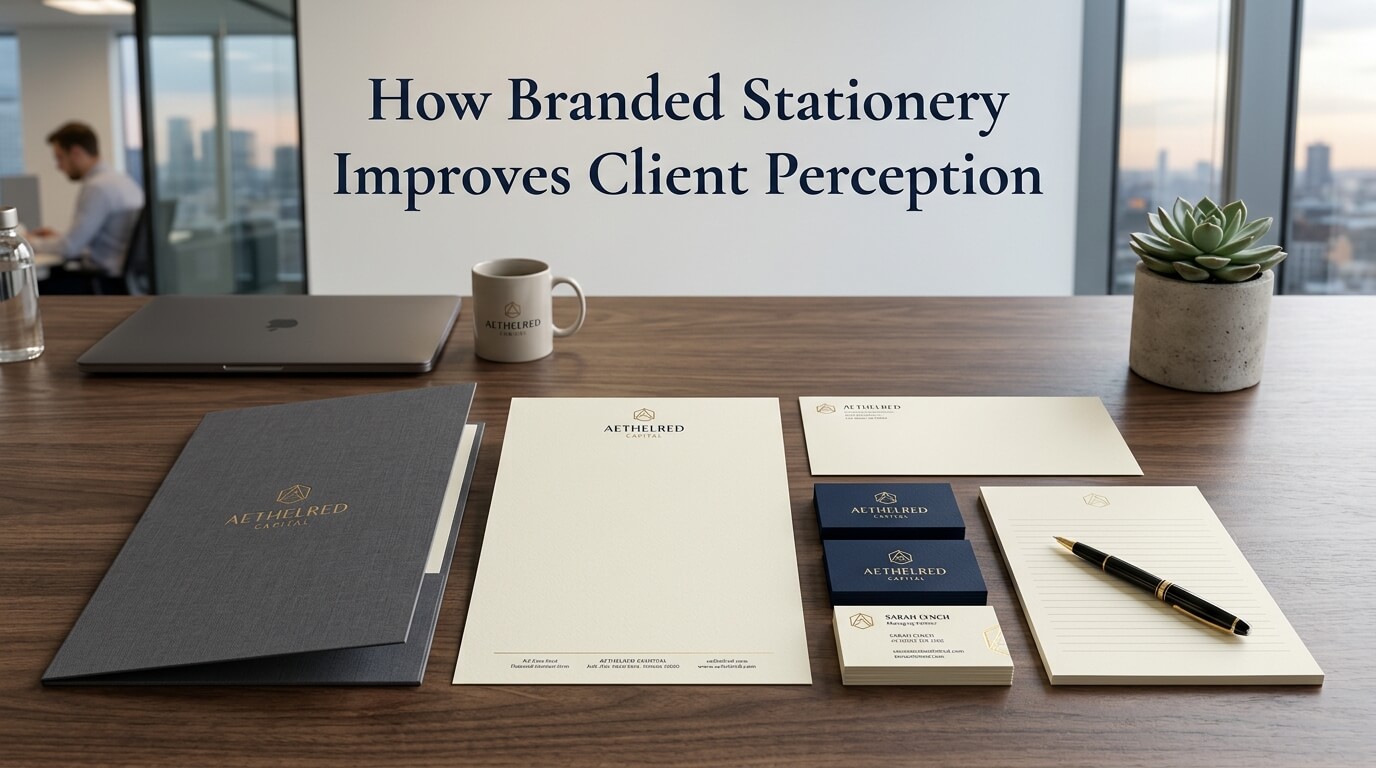
In a business environment where clients interact with brands through websites, emails, social media, presentations, and digital advertisements, physical stationery can seem like a small detail. Yet, when thoughtfully designed and consistently used, branded stationery can have a meaningful influence on how clients perceive a company. A professionally designed letterhead, business card, envelope, folder, notepad, or printed proposal does more than carry information. It communicates something about the organization behind the message.
Client perception is shaped by countless details. The way a company answers an email, presents a proposal, welcomes a new customer, or hands over a business card can influence whether that company appears reliable, organized, established, and trustworthy. Branded stationery contributes to this perception by giving business communication a recognizable visual identity. Current discussions around business stationery continue to emphasize its role in professionalism, consistency, credibility, and brand recognition.
For businesses competing in crowded markets, these impressions matter. Clients often compare several companies before deciding whom to trust. A consistent and polished brand experience can help a business appear more prepared and intentional. Branded stationery cannot replace excellent products, customer service, or communication, but it can strengthen the presentation of all three.
What Is Branded Stationery?
Branded stationery refers to printed or digital business materials that incorporate a company’s established visual identity. This can include letterheads, business cards, envelopes, presentation folders, compliment slips, notepads, invoices, certificates, proposal templates, and other forms of business correspondence. The purpose is not simply to place a logo on every document. Effective stationery uses design elements such as typography, colors, spacing, imagery, and layout to create a unified representation of the brand.
A strong stationery system should feel connected to the company’s wider identity. If a business has a modern website with a clean visual style but sends clients a cluttered letterhead using unrelated colors and fonts, the experience can feel disconnected. On the other hand, when printed and digital materials share a recognizable visual language, clients receive a more cohesive impression of the organization. Brand consistency across stationery can reinforce familiarity and make communications easier to recognize.
This is especially important when stationery is used during meaningful client interactions. A proposal, contract, welcome letter, thank-you note, or presentation folder often represents an important stage of the customer relationship. The document itself may contain the most important information, but its presentation also communicates the company’s standards.
Why Client Perception Matters in Business
Perception Influences Trust
Clients rarely have complete information about a company when they first encounter it. They may not yet know the quality of its work, how responsive its team will be, or whether it will deliver on its promises. As a result, they use available signals to form an initial opinion.
Professional presentation is one of those signals. A carefully prepared document can suggest that the company is organized and attentive. A poorly formatted document, inconsistent branding, or low-quality printed material may create the opposite impression. Branded stationery therefore works as a supporting signal of professionalism rather than as a substitute for actual business quality.
The physical nature of stationery can make this effect particularly noticeable. A client holding a professionally printed business card or receiving a carefully packaged proposal experiences the brand in a tangible way. Unlike an email that can disappear into an inbox, a physical piece of stationery can remain on a desk, in a folder, or in a client’s records.
Small Details Can Influence Larger Impressions
Business reputation is rarely built through one dramatic moment. More often, it develops through a collection of smaller experiences. A client may notice the design of an invoice, the appearance of a business card, the organization of a proposal, and the quality of a printed presentation folder.
Each detail contributes to an overall impression.
This is why stationery should be considered part of the broader customer experience. When small visual details are coordinated, the company can appear more deliberate and professional. Research and industry commentary on stationery repeatedly highlight attention to detail and consistency as important elements of perceived professionalism.
How Branded Stationery Improves Client Perception
It Creates a Stronger First Impression
First impressions are particularly important when a business is trying to establish a new client relationship. A business card exchanged during a meeting, a printed proposal delivered after a consultation, or a formal letter sent to a prospective customer can become an early physical representation of the company.
Branded stationery gives these interactions a sense of completeness. Instead of presenting information on generic paper, the company presents it through an established visual identity. The logo, typography, colors, paper quality, and layout work together to create a professional presentation.
A high-quality first impression does not guarantee that a client will choose a company, but it can help establish the right expectations. A business that presents itself carefully may appear more prepared and committed to quality. This can be particularly valuable in professional services, consulting, finance, legal services, design, real estate, publishing, and other industries where credibility strongly influences purchasing decisions.
It Communicates Professionalism
Professionalism is one of the strongest associations created by effective branded stationery. When business materials are well designed, correctly formatted, and consistent with the company’s identity, they demonstrate that attention has been given to the details.
Consider the difference between receiving a formal proposal printed on a carefully designed letterhead and receiving the same information in an unformatted document. The words may be identical, but the experience is different. The branded version can feel more official and considered.
Professional stationery also helps create a sense of structure. Clients can quickly identify who sent a document, understand the company’s identity, and associate the communication with previous interactions. This visual organization can make business communication feel more dependable.
It Builds Brand Recognition
Brand recognition develops when people repeatedly encounter the same visual and verbal elements. Branded stationery provides another opportunity for a company to reinforce those elements.
A client may first discover a business through its website. Later, they may receive an email, attend a meeting, receive a business card, and eventually receive a proposal. If each interaction uses consistent branding, the client repeatedly encounters the same identity.
Over time, the logo, colors, typography, and design style become familiar. That familiarity can make future communications easier to recognize. Consistent stationery therefore becomes part of a broader brand recognition strategy rather than an isolated printing expense.
It Demonstrates Attention to Detail
Clients often associate attention to detail with the quality of a company’s overall work. This does not mean that attractive stationery automatically proves that a business provides excellent services. However, careful presentation can reinforce the impression that the organization takes its responsibilities seriously.
For example, an architectural firm may use sophisticated stationery that reflects precision and structure. A luxury consultancy may choose refined typography and premium materials. A creative agency might use a more expressive design. The stationery becomes an extension of the company’s personality.
The important point is alignment. The design should reflect what the business wants clients to expect from it.
It Makes Communication Feel More Official
Some forms of communication carry more weight than others. Contracts, formal notices, proposals, certificates, invoices, and official letters are examples of documents where presentation can influence how seriously the recipient treats the information.
Branded letterheads and coordinated envelopes can make these communications feel more formal and complete. Matching stationery can create continuity from the outside of the communication to the document itself, reinforcing the identity of the sender.
This can be particularly useful when documents need to be saved, shared, reviewed, or presented to other decision-makers within an organization.
The Role of Different Stationery Items
Different stationery pieces can influence client perception in different ways. A business card often supports personal networking, while letterhead is associated with formal correspondence. Presentation folders can influence how proposals are received, while notepads can reinforce brand visibility during meetings.
| Stationery Item | Client Perception It Can Support | Typical Business Use |
| Letterhead | Professionalism, credibility, formality | Letters, proposals, contracts |
| Business Cards | Recognition, preparedness, professionalism | Meetings and networking |
| Envelopes | Organization, credibility, consistency | Formal correspondence |
| Presentation Folders | Quality, structure, attention to detail | Proposals and presentations |
| Branded Notepads | Memorability, consistency, visibility | Meetings and client gifts |
| Compliment Slips | Thoughtfulness, personalization | Thank-you notes and packages |
| Document Templates | Organization, consistency, professionalism | Reports and digital documents |
When these pieces share the same design system, they create a stronger overall impression. Instead of looking like separate materials created at different times, they appear to belong to the same organization.
Branded Stationery Makes a Business Look More Established
Consistency Creates a Sense of Stability
A company does not necessarily need to be large to appear established. Consistent branding can help smaller businesses present themselves with the same level of visual discipline expected from larger organizations.
When a client sees matching business cards, letterheads, envelopes, presentation materials, and digital documents, the company can appear organized and stable. The stationery communicates that the business has taken time to establish standards for its communication.
This is particularly useful for newer businesses. While stationery cannot manufacture experience or reputation, it can help a young company present itself confidently while it develops those qualities.
It Reduces Visual Confusion
Inconsistent branding can make a company look disorganized. A different logo on every document, inconsistent colors, unrelated fonts, or changing layouts can make clients question whether materials actually come from the same business.
A defined stationery system eliminates much of this visual confusion. Once a company establishes rules for its logo placement, typography, colors, spacing, and contact information, employees can use those standards consistently.
The result is a smoother experience for the client. Every document looks familiar, making the business easier to identify.
Quality Matters as Much as Design
Branded stationery should not be judged only by its appearance on a computer screen. Physical quality also contributes to the experience. Paper thickness, texture, printing quality, finishing, alignment, and durability can influence how a printed piece feels.
A beautifully designed business card printed poorly may undermine the intended impression. Similarly, an attractive letterhead can lose its impact if the layout is crowded or the printing is unclear.
This does not mean every company needs expensive or luxurious materials. The goal is to select quality that matches the brand’s positioning. A minimalist startup may benefit from clean, economical stationery, while a luxury professional service may choose heavier paper and refined finishes.
The most important factor is intentionality. The materials should feel appropriate for the brand and the expectations of its clients.
Branded Stationery Strengthens Personal Client Relationships
Business communication can sometimes feel impersonal, especially when most interactions happen through email and messaging platforms. A handwritten note on branded stationery can introduce a more personal element into the relationship.
A thank-you card after a major project, a handwritten message accompanying a client gift, or a personalized note following a meeting can show that the company values the relationship beyond the transaction.
The branding remains present, but the handwritten message creates warmth. This combination can be especially effective for businesses that depend heavily on long-term relationships and referrals.
The value is not simply in making the communication attractive. It is in showing that the company has made an effort to create a thoughtful interaction. Industry discussions on branded stationery similarly emphasize personalized notes and physical materials as ways of strengthening relationships.
Stationery Can Reinforce a Company’s Personality
Corporate Brands Can Communicate Authority
A financial company, legal practice, or corporate consultancy may want clients to associate its brand with stability and authority. Clean layouts, restrained colors, structured typography, and high-quality printing can support those associations.
Creative Brands Can Communicate Personality
A design studio, publishing company, fashion business, or creative agency may have more freedom to experiment. Distinctive typography, creative layouts, unusual paper choices, or memorable visual details can help communicate originality.
Premium Brands Can Communicate Exclusivity
Luxury businesses often depend heavily on perceived quality. In such cases, the physical experience of stationery can become part of the premium brand experience. Paper texture, understated design, elegant typography, and refined finishing can support the sense of exclusivity the brand wants clients to experience.
The central principle is that stationery should communicate the same personality as the rest of the business. A brand that claims to be innovative should not necessarily rely on generic materials. A company that emphasizes simplicity should avoid excessive visual decoration.
Common Branded Stationery Mistakes
One common mistake is treating stationery as an opportunity to display as much information as possible. A letterhead crowded with logos, phone numbers, addresses, social media handles, slogans, and decorative elements can become difficult to read. Effective design usually gives the main communication enough space to remain the focus.
Another mistake is inconsistent branding. Changing fonts, colors, logo proportions, or layouts across different stationery items can weaken recognition. A stationery system works best when its core visual elements remain consistent.
Poor-quality printing is another issue. Even a strong design can look unprofessional if images are pixelated, text is poorly aligned, or colors reproduce inaccurately.
Businesses should also avoid copying trends without considering their identity. A fashionable design may look impressive today but fail to represent the company’s personality or remain effective over time. Stationery should be distinctive enough to be memorable while remaining practical and professional.
How to Create Stationery That Leaves a Positive Impression
The process should begin with the brand itself. Before designing stationery, businesses should identify their core visual identity, including approved colors, typography, logo usage, imagery, and overall design direction.
The next step is to consider the client experience. A business should ask where and when clients will encounter each piece of stationery. A business card used at networking events has different requirements from a proposal folder used during high-value sales meetings.
Practicality should also remain central. Contact details need to be readable. Important information should be easy to locate. Letterheads should leave enough space for written communication. Envelopes should remain functional. Business cards should be easy to carry and store.
The best stationery balances aesthetics with usability. It should look professional without distracting from the message it carries.
Branded Stationery in a Digital Business World
The growth of digital communication has not made physical branding irrelevant. Instead, stationery can complement digital brand experiences. Many documents that were traditionally printed are now shared electronically, meaning the principles of stationery design can also influence digital templates.
A branded proposal PDF, invoice, presentation, or report can use the same visual system as printed stationery. This creates continuity between physical and digital communication. Current branding guidance increasingly treats stationery as part of a wider system that can extend across both printed and digital documents.
Physical stationery is particularly valuable during moments where businesses want communication to feel more significant. A printed contract, welcome package, thank-you card, or premium presentation can provide a tangible experience that a routine email cannot replicate.
The strongest approach is therefore not to choose between digital and physical branding. It is to make both work together.
Measuring the Value of Branded Stationery
The effect of stationery is not always easy to measure directly. A business card may contribute to a relationship that eventually produces a client months later. A well-designed proposal may support a sale alongside many other factors.
Businesses can still evaluate its effectiveness by looking at broader indicators. Client feedback, brand recognition, referral patterns, presentation quality, repeat business, and internal consistency can provide useful signals.
More importantly, companies should evaluate stationery as part of the entire brand experience rather than expecting one printed item to generate immediate sales. Its purpose is to reinforce credibility, recognition, professionalism, and consistency across interactions.
When stationery supports a strong product, excellent service, and clear communication, it becomes another layer of the client experience.
Why Branded Stationery Remains a Valuable Business Investment
Branded stationery is a relatively simple branding tool, but its influence can extend across many stages of the client relationship. It can shape first impressions, reinforce recognition, support professionalism, and demonstrate attention to detail.
The greatest value comes from consistency. A single attractive business card may create a good impression, but a coordinated stationery system creates a recognizable experience. When clients repeatedly encounter the same visual identity across letters, proposals, business cards, envelopes, folders, and documents, the brand becomes more familiar.
In competitive markets, familiarity and professionalism can make a meaningful difference. Businesses are constantly searching for ways to distinguish themselves, but differentiation does not always require something complicated. Sometimes it comes from doing ordinary things exceptionally well.
Branded stationery is one example of that principle. It turns everyday communication into another opportunity to demonstrate what the company stands for.
Conclusion
Branded stationery is much more than paper carrying a logo. It is a physical expression of a company’s identity and an important supporting element of the client experience. Thoughtfully designed stationery can strengthen first impressions, communicate professionalism, improve brand recognition, demonstrate attention to detail, and make business communication feel more organized and credible.
The most effective stationery does not try to dominate the message. Instead, it supports the message through consistent design, appropriate materials, clear information, and a visual identity that reflects the company’s personality. When these elements work together, even routine correspondence can become an opportunity to reinforce trust and strengthen client relationships.
Frequently Asked Questions
Q1. What is branded stationery?
Branded stationery includes business cards, letterheads, envelopes, folders, notepads, document templates, and other business materials designed around a company’s visual identity.
Q2. How does branded stationery affect client perception?
It can make a company appear more professional, organized, credible, consistent, and attentive to detail, particularly during important client interactions.
Q3. Is branded stationery still important in the digital age?
Yes. Physical stationery remains useful for proposals, contracts, business cards, thank-you notes, presentations, and other meaningful interactions, while the same branding principles can also be applied to digital documents.
Q4. Does expensive stationery create a better impression?
Not necessarily. Quality should match the company’s positioning. Good design, clear communication, appropriate materials, and consistency are generally more important than simply choosing the most expensive paper or finishes.
Q5. What stationery should a business start with?
A business can begin with essential materials such as a professional letterhead, business card, envelope, and consistent digital document template, then expand into folders, notepads, compliment slips, and other materials as its communication needs grow.