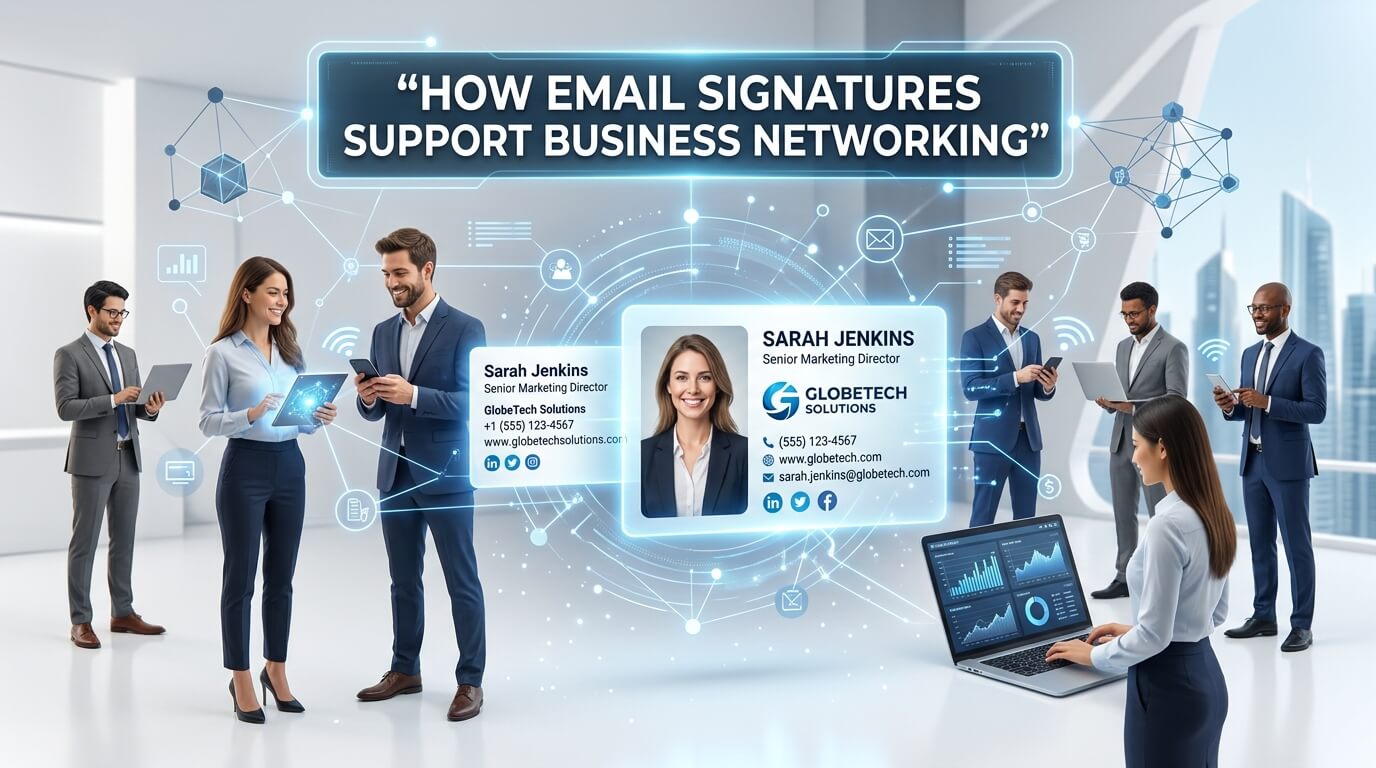
Business networking has changed significantly as professional communication has moved from face-to-face meetings and printed business cards to digital conversations. Today, a networking relationship may begin with an email introduction, continue through several follow-ups, and eventually develop into a partnership, referral, client relationship, or professional friendship. In this environment, every small detail of an email can influence how a person is remembered. One of the most overlooked details is the email signature.
An email signature may appear to be nothing more than a professional sign-off containing a name, job title, company information, and contact details. In reality, it can function as a compact digital introduction that accompanies every professional message. Research examining organizational email signatures has found that signatures communicate information about a sender’s identity, role, organization, and ways to make contact, while also potentially influencing impressions of professionalism and status.
For professionals who regularly communicate with prospects, partners, suppliers, colleagues, investors, consultants, or industry contacts, this small block of information can make networking easier. A well-designed signature gives recipients immediate context, makes follow-up convenient, reinforces professional identity, and creates opportunities for people to continue the relationship beyond the original email.
Email Signatures Act Like Digital Business Cards
Turning Every Email Into a Networking Opportunity
Traditional business cards have long played an important role in networking because they give people a simple way to remember who they met and how to contact them later. Email signatures serve a similar purpose in digital communication. Instead of handing someone a physical card during a meeting, a professional can provide their name, position, company, website, telephone number, and other relevant information automatically whenever they send an email.
This is particularly useful because networking relationships do not always develop during formal networking events. A connection may begin when someone responds to a LinkedIn conversation, introduces a colleague through email, requests information about a service, or replies to a business inquiry. The recipient may know the sender’s name but not remember the organization or exact professional role. A clear signature fills that gap immediately.
A professional email signature can therefore function as a persistent identity marker. Each time an email is exchanged, the recipient has another opportunity to associate the person’s name with their company, role, expertise, and contact information. Over time, this repetition can make professional identities easier to recognize and remember.
Providing Context Without Repeating an Introduction
Networking conversations often involve people who have little previous interaction. A recipient may receive an email from someone they vaguely remember meeting at a conference or speaking with several weeks earlier. Instead of forcing the recipient to search through old messages or ask who the sender represents, the signature provides immediate context.
The combination of a person’s name, professional title, company, and contact information can quickly answer basic questions. Who is this person? What organization do they represent? What is their professional role? How can they be contacted through another channel?
That clarity is especially valuable when emails are forwarded. An email that reaches a new recipient may be separated from the original introduction. A complete signature allows the new reader to understand the sender’s identity without relying entirely on the surrounding conversation.
Email Signatures Strengthen Professional Identity
Making People More Recognizable
Successful networking depends heavily on recognition. People are more likely to develop relationships with professionals whose names, roles, and organizations they can easily remember. Email signatures help reinforce this identity every time a message is sent.
A consistent signature can create a connection between an individual’s name and the organization they represent. If the same professional formatting appears across emails, the recipient gradually becomes familiar with the sender’s identity. The signature becomes part of the person’s digital professional presence rather than an isolated piece of contact information.
Academic research has described email signatures as a form of identity information and impression management within organizational communication. The study found that signatures commonly included names, work telephone numbers, organizations, professional titles, and other contact information, creating a standardized introduction to the sender.
Demonstrating Professionalism
Networking is not only about exchanging contact details. It is also about creating a positive impression. A poorly formatted email signature can make communication look careless, while a clean and consistent signature can make a professional interaction feel more organized.
Professionalism does not require an elaborate design. In fact, excessive graphics, too many colors, unnecessary quotations, and long blocks of information can make a signature harder to read. The strongest signatures generally prioritize clarity. The recipient should be able to identify the sender and understand how to contact them without searching through visual clutter.
A professional signature therefore supports the overall quality of an email. It adds structure to the message and creates a clear ending, helping distinguish professional correspondence from casual communication.
Making Follow-Up Easier After Networking Conversations
Removing Friction From Communication
One of the biggest challenges in business networking is maintaining momentum after an initial interaction. A person may meet a potential partner at an event, exchange email addresses, and intend to follow up later. If contact information is difficult to find, that relationship can lose momentum.
A well-designed email signature reduces this friction. When a professional sends a follow-up message, the recipient does not need to search for a phone number or website elsewhere. The relevant information is already attached to the communication.
This becomes particularly useful when the recipient wants to move the conversation to another channel. Someone may prefer a phone call rather than an email. Another person may want to review a company’s website before responding. A professional contact may want to connect through LinkedIn. By providing appropriate options, the signature allows the recipient to choose the next step that feels most convenient.
Supporting Long-Term Relationships
Networking is rarely about one conversation. Strong professional relationships develop through repeated interactions. Email signatures help maintain continuity during this process because each message carries the sender’s professional identity.
Imagine a potential client who first contacts a company about a service. After the initial response, several weeks pass before the client returns with another question. The signature in the new email reminds the recipient exactly who the sender is and what organization they represent. This seemingly small reminder can make long-term communication more seamless.
The signature essentially becomes a recurring point of recognition. It remains present even when the original introduction is no longer fresh in the recipient’s memory.
Creating More Opportunities for Professional Discovery
Connecting Email With Digital Profiles
Modern networking does not stop at email. Professionals often maintain LinkedIn profiles, company websites, portfolios, professional publications, event pages, or other digital resources. A thoughtfully designed email signature can connect these different parts of a professional identity.
For example, someone who receives an email from a consultant may want to learn more about that consultant before discussing a potential project. A website link or professional profile in the signature gives the recipient an easy way to explore further.
This makes the signature more than a static identification tool. It becomes a bridge between direct communication and a broader professional presence.
Encouraging Recipients to Learn More
Networking opportunities can develop when people become curious about a professional’s expertise. A signature can support that curiosity by directing recipients toward relevant information.
A company website may explain its services. A professional portfolio may demonstrate previous work. A LinkedIn profile may provide additional career context. A carefully selected call to action may also direct people toward an upcoming webinar, professional event, case study, or other resource.
The key is relevance. A signature should not attempt to promote everything at once. Its purpose is to make valuable next steps easy without overwhelming the recipient.
Supporting Personal and Corporate Branding
Creating Consistency Across Business Communications
Networking becomes stronger when a company presents a recognizable identity. If every employee uses completely different email formatting, recipients may struggle to associate individual conversations with the same organization.
Consistent signatures solve this problem by creating a shared visual and informational structure. Names and roles remain personal, while branding elements such as company colors, logos, typography, website details, and formatting can remain consistent.
Business communication guidance also emphasizes consistency, accessibility, and clear contact information as important characteristics of professional email signatures.
A consistent signature does not mean every employee needs an identical block of information. Different roles may require different contact details or calls to action. The important point is that the overall identity remains recognizable.
Combining Individual Identity With Company Identity
Good business networking requires both personal and organizational recognition. People generally want to know who they are speaking with, but they may also want to understand the organization behind that person.
An effective signature balances both. The individual’s name and role create personal recognition, while the company name, logo, website, and other brand elements establish organizational context.
This combination is particularly valuable for sales professionals, consultants, agency owners, executives, recruiters, and business development teams. Their networking success depends partly on building trust in themselves and partly on establishing confidence in the organization they represent.
How Different Signature Elements Support Networking
| Email Signature Element | Networking Purpose | Potential Benefit |
| Full name | Makes the sender immediately identifiable | Improves recognition and recall |
| Job title | Explains the sender’s professional role | Provides context for the relationship |
| Company name | Identifies the organization represented | Strengthens organizational credibility |
| Phone number | Offers an alternative communication channel | Makes direct follow-up easier |
| Website | Provides additional company information | Encourages professional discovery |
| Professional social profile | Connects the recipient with another professional channel | Supports relationship development |
| Company logo | Reinforces visual identity | Improves brand recognition |
| Relevant call to action | Gives the recipient a clear next step | Encourages continued engagement |
| Physical location, when relevant | Provides geographic context | Helps establish business presence |
| Professional credentials | Highlights appropriate expertise | Adds useful context to the relationship |
Email Signatures Can Help Build Trust
Giving Recipients More Confidence
Trust is central to successful networking. Before entering into a partnership, making an introduction, purchasing a service, or sharing business information, people often want reassurance that they are communicating with a legitimate professional.
An email signature cannot create trust by itself, but it can support credibility by providing clear and verifiable professional information. When a recipient can see the sender’s full name, role, company, website, and appropriate contact details, the communication can feel more transparent.
Research into electronic signatures and online negotiations has also demonstrated that the content of signature information can influence perceptions of trustworthiness, showing that signature design and wording are not completely neutral elements of professional communication.
This is an important reason to avoid unnecessary or confusing information. A signature should strengthen confidence rather than introduce doubt.
Using Contact Information Strategically
More information does not automatically mean more credibility. A signature containing five phone numbers, multiple addresses, several social profiles, long quotations, promotional banners, and unrelated links can make it difficult to determine what matters.
Networking works better when recipients can quickly identify the most useful contact options. For many professionals, this may mean a direct phone number, company website, and one relevant professional profile.
The objective is to make communication convenient. The recipient should never have to work hard to determine how to continue the conversation.
Supporting Referrals and Introductions
Helping New Contacts Understand Who You Are
Referrals are one of the most valuable outcomes of business networking. A professional who has developed a positive relationship with someone may introduce that person to another business contact.
When the introduction happens by email, the recipient may have no previous knowledge of the person being introduced. The signature can immediately provide context.
For example, if a business owner introduces a marketing consultant to another company, the consultant’s signature can reinforce the introduction by clearly identifying the consultant’s role and organization. The recipient can then decide whether to continue the conversation, visit the consultant’s website, or explore another professional channel.
This makes the signature especially valuable in referral-driven industries where introductions frequently happen through email.
Making Forwarded Emails More Useful
Email forwarding is common in professional environments. A recipient may forward a useful message to a colleague or decision-maker who was not included in the original exchange.
A complete signature makes the forwarded message more useful because the new recipient can see the sender’s identity and contact details without having to request them separately. This can increase the likelihood that a forwarded conversation turns into a new professional connection.
Using Email Signatures in Networking Campaigns
Supporting Events, Webinars, and Professional Activities
Businesses often use networking campaigns around conferences, seminars, webinars, industry events, and professional meetings. Email signatures can reinforce these campaigns by communicating a relevant message at the bottom of everyday correspondence.
For example, a business preparing for an industry conference could temporarily include an event-related call to action in employee signatures. Someone who receives an unrelated email may notice the event and become interested in attending or connecting with the company.
This approach works because the signature reaches people who are already receiving communication from the business. It does not require a separate promotional email for every message.
Keeping Promotional Content Relevant
However, promotional elements should be used carefully. Networking is fundamentally relational, and recipients may become frustrated if every professional interaction feels like an advertisement.
The strongest approach is to make promotional content secondary to the sender’s identity and contact information. The recipient should first understand who sent the message. Any campaign, event, resource, or announcement should support the communication rather than dominate it.
Common Email Signature Mistakes That Hurt Networking
Overloading the Signature
A signature that contains too much information can weaken the very clarity it is intended to provide. Networking depends on quick recognition, so the most important details should remain easy to locate.
Large graphics, excessive text, multiple slogans, unnecessary awards, and too many links can distract from the sender’s name and contact information. Simplicity generally creates a more professional experience.
Using Outdated Information
An outdated job title, incorrect phone number, old website, or inactive social profile can create confusion. Networking contacts may attempt to follow a link only to discover that it no longer works.
Businesses should periodically review their signatures to make sure important information remains accurate. When employees change roles or departments, their signatures should be updated promptly.
Ignoring Mobile Readers
Many professionals read email on smartphones. A signature that looks attractive on a large desktop screen may become difficult to read on a small display if it uses oversized images, complicated layouts, or excessively long lines.
A mobile-friendly signature should remain readable without requiring excessive scrolling or zooming. Clear typography and restrained design make professional information easier to access regardless of device.
Adding Unnecessary Personal Messages
Personal quotations or slogans may occasionally add personality, but they can also create unintended impressions. Research into email signature “bumper stickers” has found that people use such messages for different interpersonal purposes, meaning these additions can communicate more than simple contact information.
For business networking, relevance should remain the priority. A professional signature should reflect the image a person wants to establish in a business context.
Making Email Signatures More Effective for Networking
Think Beyond Contact Information
The most effective approach is to view the signature as part of a broader networking strategy. It should answer the recipient’s basic questions while making future communication easier.
A professional should consider what they want recipients to remember after reading an email. Perhaps it is their role as a business consultant. Perhaps it is their connection to a particular company. Perhaps it is their specialist expertise. The signature can reinforce that positioning consistently.
Match the Signature to the Audience
Not every professional needs the same signature. An executive may prioritize company identity and direct contact information. A freelancer may emphasize a portfolio and professional profile. A salesperson may use a carefully selected campaign call to action. A consultant may highlight credentials or a booking option.
The best signature is therefore not necessarily the most visually impressive one. It is the one that supports the professional’s networking objectives and makes sense for the people receiving the emails.
Review and Update It Regularly
Businesses should treat email signatures as living communication assets rather than permanent templates. Contact details, job titles, websites, campaigns, social profiles, and company branding can change.
A periodic review ensures that signatures continue to represent the business accurately. Organizations with multiple employees can also benefit from maintaining a consistent signature standard so that every employee contributes to a recognizable professional identity.
The Long-Term Networking Value of a Simple Email Signature
Email signatures are easy to underestimate because they appear at the end of a message. Yet their position is precisely what makes them valuable. The recipient has already read the email and is considering what to do next. At that moment, the signature provides identity, contact information, professional context, and potentially a path toward further interaction.
Modern research continues to recognize email signatures as more than simple sign-offs. A 2024 study of professional email signatures described them as a space for identity work, positioning, reputation building, and digital presence, demonstrating how this small communication format can contribute to professional branding.
For businesses focused on networking, this means the signature should be designed with intention. It should make people easier to remember, easier to contact, and easier to learn more about. It should support the company’s identity while preserving the personal element that makes professional relationships meaningful.
Most importantly, an email signature works continuously. A salesperson may send hundreds of messages in a month. A consultant may communicate with dozens of potential partners. An executive may exchange emails with clients, suppliers, investors, and industry leaders. Every one of those conversations creates another opportunity for the signature to reinforce identity and encourage future contact.
Conclusion
Email signatures support business networking by turning ordinary email communication into a consistent opportunity for professional identification, recognition, and follow-up. They act like digital business cards, strengthen personal and corporate branding, simplify referrals, support professional discovery, and provide convenient ways for contacts to continue conversations.
The strongest signatures are not necessarily the most elaborate. They are clear, relevant, professional, accurate, and aligned with the sender’s networking goals. When thoughtfully designed and consistently maintained, an email signature becomes a small but valuable part of a larger business networking strategy.
Frequently Asked Questions
Q1. How does an email signature help with business networking?
An email signature provides recipients with important information such as the sender’s name, role, company, and contact details, making it easier to remember and reconnect with the professional.
Q2. Should an email signature include a LinkedIn profile?
A relevant professional social profile can be useful because it gives networking contacts another way to learn about the sender and maintain the relationship.
Q3. Can an email signature improve professional credibility?
Yes. A clear and consistent signature can provide professional context and reinforce a company’s identity, although credibility ultimately depends on the quality and reliability of the overall communication.
Q4. What information is most important in a networking-focused email signature?
A full name, professional role, company name, direct contact information, and an appropriate website or professional profile are generally among the most useful elements.
Q5. How often should a business update its email signatures?
Businesses should review signatures regularly and update them whenever contact details, job roles, branding, websites, campaigns, or other important information changes.