Social media marketing has become one of the most important ways for businesses to connect with potential customers, build brand awareness, and generate sales. Yet one question comes up almost immediately when a business begins investing in social media: How long does social media marketing take to show results?
The honest answer is that there is no universal timeline. Some businesses may notice improvements in reach, engagement, website visits, or inquiries within a few weeks, while others may need several months before social media begins producing consistent leads and sales. The difference depends on the business, industry, platform, audience, content quality, marketing budget, competition, and the goals being measured.
Current industry guidance commonly places early organic social media signals within the first few weeks, with more meaningful and consistent results often developing over three to six months of sustained activity. Paid social campaigns can produce traffic and leads considerably faster, although campaigns still need time for testing, optimization, and accurate performance evaluation.
Understanding this timeline is important because social media is rarely an overnight marketing solution. It is a process of building visibility, earning attention, developing trust, learning what resonates with an audience, and eventually turning that attention into business results.
Why Social Media Marketing Results Take Time
Social media platforms can make marketing look instantaneous. A business can publish a post within minutes and potentially reach thousands of people. However, visibility is only one stage of the customer journey.
A person may see a company’s Instagram post today but not follow the account. They may encounter another post a week later, visit the profile, and still not make a purchase. A month later, they may see a customer review, click the website, and finally become interested in the company’s services. This means the first interaction and the final conversion can happen at very different times.
Social media also depends heavily on accumulated signals. Platforms learn which audiences interact with particular content, while businesses learn which subjects, formats, messages, and offers generate the strongest responses. This learning process becomes more valuable as more content is published and more performance data becomes available.
For this reason, businesses should avoid judging a complete social media strategy based on the performance of a handful of posts. A single post can go viral and produce little commercial value, while a less spectacular post can attract a highly relevant customer who eventually makes a purchase.
Social Media Results Are Not the Same as Sales
One of the biggest reasons businesses become frustrated with social media is that they define “results” too narrowly.
Results can include increased reach, stronger engagement, more profile visits, website traffic, email sign-ups, direct messages, inquiries, leads, bookings, or sales. Each of these outcomes can appear at a different stage.
For example, reach and impressions may increase relatively quickly. Engagement can follow as the audience becomes familiar with the content. Website traffic may grow after the business establishes stronger calls to action. Leads may take longer because customers usually need more information and trust before contacting a company. Sales may take even longer when the business has a complicated purchasing process.
Therefore, a social media campaign should be evaluated according to its specific objectives rather than simply asking whether sales have increased.
A Realistic Social Media Marketing Timeline
There is no fixed schedule that applies to every company, but a realistic timeline can help businesses establish better expectations. Organic marketing generally takes longer than paid advertising, while highly targeted campaigns can sometimes produce meaningful activity within weeks.
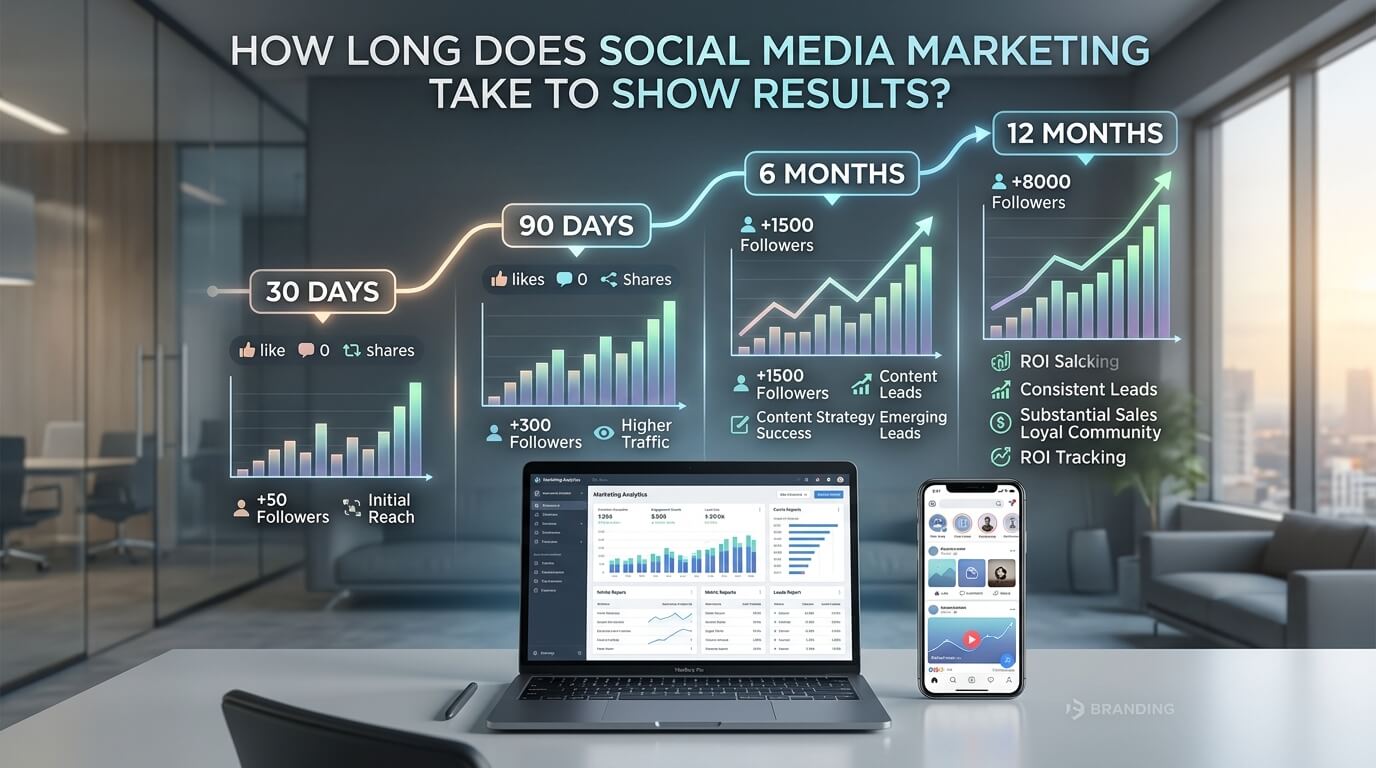
| Social Media Stage | Typical Timeframe | What Businesses May See |
| Initial setup and testing | 1–4 weeks | Early reach, impressions, engagement data and audience insights |
| Early momentum | 1–3 months | More profile visits, engagement, website traffic and content patterns |
| Developing consistency | 3–6 months | Stronger audience recognition, recurring engagement and potential lead growth |
| Established performance | 6–12 months | More predictable traffic, leads and customer activity |
| Long-term growth | 12+ months | Stronger brand authority, audience loyalty and compounding results |
These timeframes should be treated as general planning ranges rather than guarantees. Recent industry guidance similarly describes organic social as a multi-month process, while paid campaigns can begin generating measurable activity much sooner.
What to Expect During the First 30 Days
The first month of social media marketing is usually about establishing a foundation rather than achieving maximum revenue.
A business may be creating new profiles, improving its branding, developing content categories, testing posting schedules, researching audiences, and determining which topics generate engagement. During this stage, the marketing team is also collecting valuable information about what the audience responds to.
A new account may experience inconsistent reach during the first few weeks. Some posts may perform better than others, and follower growth may be modest. This does not necessarily indicate failure.
The first month should instead answer questions such as whether the content attracts the intended audience, which formats generate the strongest engagement, what subjects encourage conversations, and whether people are clicking through to the website.
Paid campaigns can produce activity more quickly because advertising immediately places content in front of selected audiences. However, early campaign numbers should still be interpreted carefully because advertisers often need time to test creative, audiences, offers, placements, and messaging.
What Matters More Than Follower Count
Follower growth can be useful, but it should not be the only measure of success during the first month.
A company with 2,000 highly relevant followers may have more commercial value than a company with 20,000 followers who have little interest in its products or services.
Businesses should therefore pay attention to the quality of engagement. Comments, shares, saves, direct messages, profile visits, link clicks, and relevant website traffic can reveal more about audience interest than follower numbers alone.
What Happens Between 30 and 90 Days?
The second and third months are often when a social media strategy begins becoming more informative.
By this stage, there is more historical data available. Businesses can compare different types of content and identify recurring patterns. Perhaps educational posts consistently receive more saves, short videos attract more profile visits, customer stories generate more comments, or product demonstrations produce more website clicks.
This information allows the strategy to become more precise.
Instead of posting content simply because it looks attractive, a business can begin creating content based on evidence. Successful themes can be developed further, while weak approaches can be adjusted or removed.
This is also the stage when audience recognition can begin developing. People who have repeatedly encountered a company may start recognizing its visual identity, tone, subject matter, and expertise. That recognition is an important part of brand building because customers are often more comfortable considering businesses they already know.
Why the 90-Day Period Is Important
The 90-day mark is useful because it provides enough time to evaluate trends instead of isolated results.
Industry discussions frequently describe three months as an important checkpoint for determining whether a social media strategy is moving in the right direction. By this point, businesses should be able to identify their strongest content categories, understand audience behavior more clearly, and determine whether engagement and traffic are improving.
However, reaching 90 days does not mean a company should automatically expect dramatic sales. For businesses with long sales cycles, expensive products, or specialized B2B services, the path from social interaction to customer can take considerably longer.
What Happens After Three to Six Months?
Three to six months is often when consistent social media activity begins producing more meaningful momentum.
A business that has been publishing useful content regularly now has a larger library of posts. New visitors can explore previous content and develop a better understanding of the brand. The business also has more information about its audience and can make smarter decisions about content.
Organic social media growth can be particularly powerful during this stage because successful content can continue attracting attention after its initial publication. Educational posts, videos, guides, customer stories, and other useful content can remain discoverable and continue generating interactions.
At the same time, businesses can improve their conversion process. If social media is producing website visitors but few inquiries, the problem may not be social media itself. The website, landing page, offer, pricing, call to action, or follow-up process may need improvement.
This is why social media should be viewed as part of a larger marketing system rather than an isolated activity.
How Long Does Paid Social Media Marketing Take?
Paid social media marketing generally produces faster initial signals than organic marketing because businesses are paying for targeted distribution.
Once an advertisement is approved and begins running, impressions, clicks, and other interactions can appear quickly. Leads may also begin arriving within the first few weeks if the offer, audience, creative, and conversion process are strong. Industry estimates commonly place early paid results within one to several weeks, with more reliable performance often developing over 60 to 90 days of testing and optimization.
However, fast visibility does not automatically mean profitable advertising.
A campaign can generate thousands of impressions and hundreds of clicks while producing very few qualified customers. Businesses must therefore measure the entire journey from advertising exposure to conversion.
Paid campaigns should be optimized based on meaningful business outcomes rather than vanity metrics alone.
Why Paid Campaigns Still Need Testing
Even when a business has a clear audience, there is no guarantee that the first advertisement will be the best advertisement.
Different headlines, images, videos, offers, landing pages, audiences, and calls to action can produce very different results. Testing helps marketers discover which combination works most effectively.
This is why stopping a paid campaign after only a few days can be misleading. There may not be enough data to determine whether the campaign is genuinely unsuccessful or simply still being optimized.
How Long Does Organic Social Media Marketing Take?
Organic social media marketing normally requires more patience because businesses are not paying for guaranteed distribution.
A company has to earn attention through content quality, consistency, relevance, community interaction, and audience trust. Recent industry guidance commonly places meaningful organic social results in the three-to-six-month range, although some businesses may see earlier signs and others may need considerably longer.
Organic growth can also vary dramatically between platforms. A visually compelling consumer brand may grow quickly on Instagram or TikTok, while a professional consulting company may receive better results from LinkedIn. A local service business may benefit from Facebook communities and location-based content.
The right platform is therefore more important than simply being present everywhere.
Factors That Affect How Quickly Social Media Produces Results
The timeline is influenced by several interconnected factors, beginning with the quality of the strategy.
A business with clearly defined goals, a well-understood audience, consistent branding, useful content, and a strong offer is likely to progress more efficiently than a business that posts randomly.
Industry competition also matters. In a highly competitive market, audiences may see hundreds of similar posts every week. Standing out requires stronger creative ideas and clearer positioning.
Budget matters for paid marketing as well. A larger and well-targeted budget can generate useful data faster, while a very small budget may take longer to produce enough conversions for confident decision-making.
The quality of the offer is equally important. Excellent social media cannot compensate for a confusing service, weak product positioning, poor pricing, or an ineffective website.
Finally, consistency plays a major role. Posting for two weeks and disappearing for a month makes it difficult to build momentum. Social media marketing works best when businesses maintain a sustainable publishing and engagement routine.
How to Know Whether Your Social Media Strategy Is Working
Instead of asking only, “Are we getting sales?”, businesses should monitor several stages of performance.
At the awareness level, look at reach, impressions, video views, and audience growth. At the engagement level, consider comments, shares, saves, reactions, and meaningful conversations. At the consideration level, track profile visits, website sessions, link clicks, downloads, inquiries, and direct messages.
Finally, measure leads, purchases, bookings, revenue, and return on investment.
Website analytics can help connect social activity with website behavior. Google Analytics provides traffic-source dimensions that identify where visitors originate and can distinguish sources such as social media, referrals, search, and other channels.
Attribution is particularly important because customers rarely interact with a business through only one marketing channel. Google Analytics supports different attribution approaches for understanding how multiple touchpoints contribute to important actions.
What If You See No Results After Three Months?
Three months without improvement does not automatically mean social media marketing is ineffective. It does mean the strategy deserves a serious review.
The first question should be whether the correct metrics are being measured. A company may have strong brand awareness and website traffic even though direct sales remain limited.
The next question is whether the content is reaching the right people. High reach with low-quality engagement may indicate an audience-targeting problem.
Content itself should also be examined. If posts are overly promotional, repetitive, generic, or disconnected from customer needs, audiences may have little reason to engage.
The conversion process deserves attention too. If social media generates clicks but the website fails to convert those visitors, improving social content alone may not solve the problem.
In many cases, the solution is not to abandon social media but to refine the strategy.
Why Consistency Matters More Than Overnight Virality
Viral content is attractive because it can create huge numbers quickly. However, viral reach does not always create sustainable business growth.
A post can receive thousands of views because it is entertaining while attracting almost no potential customers. Meanwhile, a smaller post that reaches the right audience may generate several valuable inquiries.
Long-term social media marketing is therefore less about producing one extraordinary post and more about consistently communicating a clear brand message.
Over time, useful content can establish familiarity, authority, and trust. Those qualities are difficult to create through a single viral moment.
How Businesses Can Improve Their Results Timeline
Businesses can often improve their chances of seeing results sooner by starting with a clearly defined audience and a specific goal.
Content should address real customer questions rather than simply filling a posting calendar. Strong visual presentation, clear messaging, useful information, authentic storytelling, and compelling calls to action can make social content more effective.
Businesses should also analyze performance regularly. Instead of treating every post equally, they can identify high-performing themes and create more content around them.
Paid advertising can complement organic efforts when appropriate. Organic content builds credibility and community, while paid campaigns can accelerate reach and testing.
Most importantly, businesses should allow enough time for the strategy to produce meaningful data. Constantly changing direction makes it difficult to know what is actually working.
Conclusion
So, how long does social media marketing take to show results? Early signs can appear within a few weeks, particularly with paid campaigns, while meaningful organic progress commonly takes three to six months. More predictable lead generation, sales growth, and strong brand authority can take six months or longer.
The most important consideration is not a specific number of days but the direction of performance. A strategy that steadily improves its reach, engagement, traffic, leads, and conversion quality is usually moving in the right direction.
Social media marketing is a long-term investment in visibility and relationships. Businesses that combine good content, consistent publishing, audience understanding, measurement, testing, and patience are much more likely to turn social activity into sustainable business growth.
Frequently Asked Questions
Q1. How quickly can social media marketing produce results?
Early results such as increased reach, engagement, profile visits, and clicks can appear within several weeks. More consistent leads and sales generally require several months of strategic activity.
Q2. Is paid social media faster than organic social media?
Usually, yes. Paid campaigns can generate impressions and clicks quickly, while organic marketing generally requires more time to build audience recognition and sustained reach. However, paid campaigns still require testing and optimization.
Q3. How long should a business try social media before giving up?
A business should generally allow at least three months to collect meaningful performance data before making major conclusions. Organic strategies often benefit from six months or more of consistent execution.
Q4. Why am I getting engagement but no sales?
Engagement indicates attention, but it does not guarantee purchase intent. The problem may involve the offer, audience targeting, website, landing page, pricing, calls to action, or sales follow-up rather than the social content itself.
Q5. What is the most important social media metric?
There is no single metric that is best for every business. The most important metric is the one connected to the campaign’s objective. For brand awareness, reach and engagement may matter most, while lead-generation campaigns should focus more heavily on qualified leads, conversion rates, customer acquisition costs, and revenue.