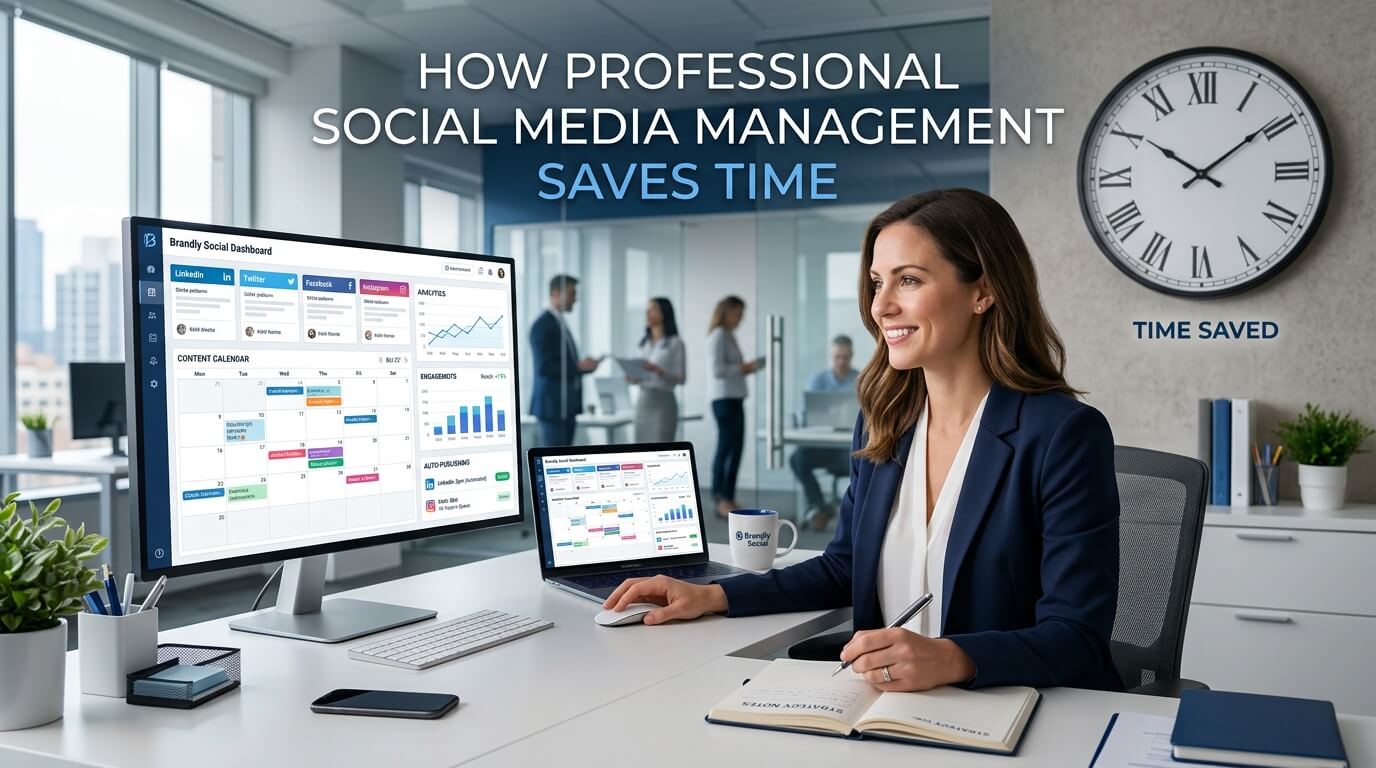
Social media has become one of the most important communication channels for modern businesses. Whether a company is trying to attract new customers, build brand awareness, promote products, or maintain relationships with existing clients, social platforms can play a central role in its marketing strategy. However, managing social media effectively is rarely as simple as publishing a post and waiting for people to respond. It involves planning, content creation, scheduling, community engagement, monitoring, analytics, reporting, and constant adaptation.
For business owners and small marketing teams, these responsibilities can quickly become overwhelming. A few minutes spent checking one platform can turn into an hour of scrolling, replying, creating content, and researching trends. When several platforms are involved, the amount of time required increases even further. This is where professional social media management can make a meaningful difference.
Professional social media management brings structure to an otherwise fragmented process. Instead of handling every social media task whenever there is free time, businesses can use a planned workflow that organizes content creation, publishing, engagement, and performance analysis. Modern management platforms can also centralize scheduling, analytics, engagement, collaboration, and reporting, reducing the need to switch between different platforms and repetitive tasks.
The real value is not simply that someone else publishes posts. Professional management saves time by reducing unnecessary decisions, preventing repetitive work, creating predictable workflows, and allowing business owners to concentrate on activities that require their direct attention.
Understanding the Time Demands of Social Media Management
Many business owners underestimate how much time social media actually requires. The visible part of social media marketing is the finished post, but considerable work happens before and after that post appears online. A single social media update may require research, writing, graphic design, editing, approval, scheduling, publishing, comment monitoring, and performance analysis.
When a business manages multiple platforms manually, the process becomes even more complicated. Content that works on Instagram may need a different format for LinkedIn. A Facebook post may require a different tone from a short-form video caption. Images may need different dimensions, while videos may require platform-specific editing. Trying to manage these differences without a structured system can create unnecessary administrative work.
Professional social media management turns these scattered activities into an organized workflow. Current social media management platforms increasingly combine content planning, publishing, engagement, listening, analytics, and collaboration in one place. This means businesses can spend less time moving information from one platform to another and more time focusing on the quality and purpose of their marketing.
The Hidden Cost of Doing Everything Manually
Manual social media management does not only consume working hours. It also interrupts concentration. A business owner who repeatedly stops working to publish a post, answer a comment, check a notification, or look for an image is constantly switching between tasks.
These interruptions may appear harmless individually, but they can make the working day considerably less productive. A professional social media workflow reduces this problem by grouping similar activities together. Content can be created in batches, scheduled in advance, and reviewed according to a predetermined calendar.
This approach changes social media from a constant interruption into a controlled marketing process.
Content Planning Reduces Daily Decision-Making
One of the simplest ways professional social media management saves time is through advance planning. Without a content calendar, businesses often face the same question every day: “What should we post today?”
That question can consume surprisingly large amounts of time. The person responsible for social media may spend twenty minutes thinking of an idea, another thirty minutes searching for a suitable image, and additional time writing and editing the caption. If the content does not feel right, the process may start again.
Professional management replaces this daily uncertainty with a content strategy. Posts are planned around business objectives, seasonal events, promotions, educational topics, customer questions, industry trends, and brand messages. Once the calendar is prepared, the team has a clear understanding of what needs to be created and when it needs to be published.
Content Calendars Create a Predictable Workflow
A content calendar allows social media work to be handled in batches. Instead of creating one post every morning, a business can dedicate a specific period to developing several pieces of content at once.
This creates efficiency because the person creating the content remains focused on one type of task. Research, writing, design, editing, and scheduling can be organized into repeatable stages. The result is less mental switching and fewer interruptions.
A planned calendar also makes it easier to identify gaps before they become urgent. If a promotional campaign needs ten posts, the team can see that requirement weeks in advance rather than discovering it two days before the campaign begins.
Scheduling Eliminates Repetitive Publishing Tasks
Publishing content manually across several platforms is one of the clearest examples of unnecessary repetitive work. A marketer may have to log into multiple accounts, upload images or videos, paste captions, add hashtags, select dates and times, and repeat the process for every channel.
Social media scheduling tools are designed to reduce this burden. They allow businesses to plan and queue content from a centralized dashboard rather than manually publishing every post in real time.
This does not mean social media becomes completely automatic. Professional management still requires human judgment, particularly for conversations, trends, sensitive topics, and unexpected events. However, routine publishing can be handled in advance.
Batch Scheduling Saves Valuable Hours
Imagine a company needs to publish five posts each week on three different platforms. Without scheduling, someone may repeatedly spend time preparing and publishing those posts throughout the week.
With a professional workflow, the content can be prepared, reviewed, and scheduled during one dedicated session. Once approved, the posts can publish automatically according to the content calendar.
The time savings become increasingly significant as the number of platforms and posts grows. What starts as a small convenience can become a major productivity improvement for growing businesses.
Professional Management Makes Content Repurposing Faster
Creating original content for every social platform can be exhausting. Professional social media management solves part of this problem through content repurposing.
A single idea can often become several pieces of social content. A long blog post might inspire a LinkedIn post, a Facebook update, an Instagram carousel, a short video script, and several short educational posts. A customer question can become an FAQ post. A product demonstration can become a short-form video, an image post, and a story.
The key is not copying the exact same content everywhere. Instead, the central idea is adapted to suit each platform.
One Idea Can Support Multiple Posts
Repurposing reduces the amount of time spent constantly generating ideas from scratch. Professional managers can maintain a content library containing successful topics, evergreen posts, brand assets, customer questions, testimonials, educational themes, and previous campaigns.
This gives the business a reusable foundation. Rather than starting with a blank page every morning, the social media team can build from existing material and improve it for different audiences.
Modern management tools increasingly support content reuse, cross-platform publishing, and AI-assisted content creation, making the process even more efficient.
A Centralized Dashboard Reduces Platform Switching
Another major source of wasted time is constantly switching between social media platforms. When a business manages Facebook, Instagram, LinkedIn, TikTok, Pinterest, or other networks separately, each platform creates another login, interface, notification system, analytics dashboard, and publishing process.
A centralized management platform can bring many of these functions together. Instead of checking several individual dashboards, the social media manager can work from a single environment.
This saves more than a few clicks. It creates a more coherent workflow because content, conversations, scheduling, and performance information are easier to access.
Centralization Improves Organization
A centralized system can also reduce the risk of losing important information. Content calendars, creative assets, approval processes, scheduled posts, and performance reports can be organized within a defined workflow.
For teams, this becomes particularly useful because different people may be responsible for writing, designing, reviewing, approving, and publishing content. Collaboration features and approval workflows help prevent unnecessary back-and-forth communication.
Professional Social Media Management Simplifies Engagement
Posting content is only one part of social media management. Businesses also need to respond to comments, answer questions, monitor messages, and participate in relevant conversations.
When engagement is handled without a system, it can become another source of constant interruption. A business owner may check notifications dozens of times throughout the day, often without a clear process for deciding what requires immediate attention.
Professional management creates boundaries around this activity. Engagement can be monitored during designated periods while urgent issues are escalated when necessary.
Faster Responses Without Constant Monitoring
A professional manager can establish response procedures for common questions and routine interactions. Frequently asked questions can be answered efficiently while more complicated customer issues can be directed to the appropriate team member.
This approach saves time without sacrificing responsiveness. The goal is not to automate every interaction but to ensure that repetitive communication does not consume disproportionate amounts of the workday.
A unified inbox can also help businesses manage comments, direct messages, and mentions from a more centralized location, reducing the need to search through separate platforms.
Analytics and Reporting Become More Efficient
Another time-consuming area of social media marketing is performance reporting. Without a structured system, marketers may need to collect information from several platforms and manually compare metrics.
Professional social media management can simplify this process through centralized analytics dashboards and reporting tools. Instead of spending hours collecting numbers, the team can focus on understanding what those numbers mean.
Important measurements may include reach, engagement, clicks, audience growth, video views, conversions, and content performance. The exact metrics should depend on the company’s objectives.
Better Reporting Leads to Faster Decisions
Time savings do not come only from producing reports faster. Better reporting can also make decision-making more efficient.
If a business can quickly identify which topics generate strong engagement, which formats receive the most attention, and which campaigns produce meaningful traffic, it can make adjustments without spending days reviewing scattered information.
The result is a more responsive marketing strategy. Professional management helps businesses move from collecting data to using data.
A Professional Workflow Reduces Last-Minute Stress
Last-minute social media work is often one of the biggest causes of wasted time. When there is no plan, important dates can arrive unexpectedly. A promotion may need to be announced tomorrow, a holiday campaign may need creative assets, or a product launch may require several posts.
Professional management reduces these emergencies through advance preparation.
The social media manager can identify important dates, prepare campaigns ahead of time, organize assets, write captions, obtain approvals, and schedule content before the deadline arrives. This creates breathing room and reduces the pressure associated with urgent publishing.
Consistency Becomes Easier to Maintain
Consistency is another benefit of advance planning. A business does not have to disappear from social media simply because the owner becomes busy.
A structured calendar ensures that content continues to move forward even during particularly demanding periods. Scheduling tools can maintain a planned publishing rhythm while the social media manager remains available to monitor engagement and make adjustments when necessary.
Comparing Manual and Professional Social Media Management
The difference between manual social media work and professional management becomes clearer when the major activities are compared.
| Social Media Task | Manual Approach | Professional Management Approach | Time-Saving Benefit |
| Content planning | Ideas created whenever needed | Content calendar planned in advance | Less daily decision-making |
| Publishing | Posts uploaded individually | Content scheduled in batches | Fewer repetitive tasks |
| Platform management | Separate accounts checked individually | Multiple channels managed centrally | Less platform switching |
| Content creation | New ideas created from scratch | Content pillars and repurposing used | Faster content development |
| Engagement | Notifications checked constantly | Dedicated monitoring and response workflow | Fewer interruptions |
| Approvals | Messages and files passed back and forth | Organized approval process | Faster collaboration |
| Analytics | Data collected manually | Centralized reporting dashboards | Less administrative work |
| Campaigns | Often prepared near deadlines | Campaigns planned ahead | Less last-minute pressure |
The table demonstrates that professional management saves time throughout the entire social media process rather than in one isolated area.
Automation Helps, but Human Oversight Still Matters
Automation is one of the strongest advantages of modern social media management, but it should not be confused with complete hands-off marketing.
Automated scheduling is excellent for predictable activities. It can publish planned content at selected times and reduce repetitive administrative work. Analytics can automatically collect performance data. Some systems can assist with caption creation, content suggestions, and optimal publishing times.
However, social media remains a human environment. Trends change quickly, customers ask unexpected questions, public conversations develop, and sensitive situations can arise. Professional management combines automation with human judgment.
Human Strategy Makes Automation More Valuable
The most effective approach is to automate repetitive work while keeping important decisions under human control.
A manager can use automation to handle scheduling but personally review the content before publication. Analytics can identify high-performing topics, but a human can decide why those topics resonated. AI can assist with a first draft, but an experienced professional can adjust the language to match the brand’s personality.
This balance makes automation useful without making the brand feel robotic.
Professional Management Frees Business Owners to Focus on Core Work
Perhaps the greatest time-saving advantage is that professional social media management allows business owners to return their attention to the work only they can do.
Entrepreneurs need to make strategic decisions, speak with customers, manage operations, develop products, oversee employees, build partnerships, and plan for growth. Spending hours every week manually creating and publishing social media content can take attention away from these priorities.
Delegating social media management does not mean giving up control. A business owner can still approve campaigns, provide brand guidance, review reports, and contribute ideas. The difference is that the daily administrative workload is handled through a professional system.
Time Becomes a Business Resource
For a small business, time is often more valuable than money. There are only so many hours available in a working day, and every hour spent on repetitive administrative tasks is an hour that cannot be spent elsewhere.
Professional social media management turns time into a more productive resource. Instead of constantly asking what to post, when to publish, how to respond, and where to find performance data, business owners can rely on a defined process.
That process creates predictability, and predictability is one of the foundations of efficient business operations.
Choosing the Right Social Media Management Approach
Not every business requires the same level of social media management. A small company with two platforms may need a relatively simple scheduling and reporting system, while a growing organization with multiple brands and channels may need advanced collaboration, approval, analytics, and listening capabilities.
The right approach should therefore be based on the company’s workload, objectives, audience, team structure, and number of social platforms.
A business should also avoid choosing a management tool simply because it has the largest number of features. The best solution is the one that genuinely reduces complexity. Modern recommendations increasingly emphasize matching the platform to the workflow rather than choosing the most feature-heavy option.
Measure Time Savings Regularly
Businesses can determine whether professional management is actually saving time by tracking the hours spent on social media before and after introducing a structured workflow.
It is useful to consider how long content creation takes, how much time is spent scheduling, how frequently employees switch between platforms, how long reporting takes, and how many hours are spent answering repetitive questions.
The goal should not simply be to spend less time on social media. The goal is to spend less time on low-value administrative work while spending more time on strategy, creativity, relationships, and activities that contribute to business growth.
Why Time Savings Can Improve Social Media Results
Saving time and improving performance are not separate goals. In many cases, they support each other.
When social media becomes easier to manage, businesses are more likely to remain consistent. When content is planned ahead, campaigns can be more carefully coordinated. When analytics are easier to access, marketers can make decisions faster. When repetitive work is reduced, managers have more time for creative thinking and meaningful engagement.
This creates a positive cycle. Better organization leads to greater consistency, consistency creates more reliable data, reliable data supports better decisions, and better decisions improve future content.
Professional social media management therefore does more than give businesses additional free hours. It can create a more disciplined marketing operation.
Conclusion
Professional social media management saves time by replacing scattered, repetitive activities with a structured and efficient workflow. Content can be planned in advance, posts can be scheduled in batches, multiple platforms can be managed from centralized systems, content can be repurposed, engagement can be organized, and analytics can be collected more efficiently.
The biggest benefit is not simply publishing faster. It is reducing the amount of attention businesses have to spend on routine social media administration. With the right strategy, tools, and professional oversight, social media becomes a planned business activity rather than a daily distraction.
For business owners, that recovered time can be redirected toward customers, operations, strategy, innovation, and growth. In an environment where every working hour matters, professional social media management can make the difference between constantly trying to keep up and having a social media system that works efficiently in the background.
FAQ
Q1. How does professional social media management save time?
It saves time by organizing content planning, creation, scheduling, engagement, analytics, and reporting into a structured workflow, reducing repetitive manual tasks.
Q2. Can social media posts be scheduled in advance?
Yes. Scheduling tools allow businesses to prepare content in advance and automatically publish posts at selected times across supported platforms.
Q3. Does professional social media management reduce the need for business owners to post daily?
Yes. A professional manager can plan and schedule content ahead of time, allowing business owners to focus on their core responsibilities while maintaining a consistent social presence.
Q4. Can one social media management system handle multiple platforms?
Many modern social media management platforms allow businesses to manage multiple social networks from a centralized dashboard, reducing platform switching and repetitive publishing work.
Q5. Does saving time mean social media becomes fully automated?
No. Automation can handle repetitive tasks such as scheduling and reporting, but human oversight remains important for strategy, customer interactions, brand voice, and responding to unexpected events.