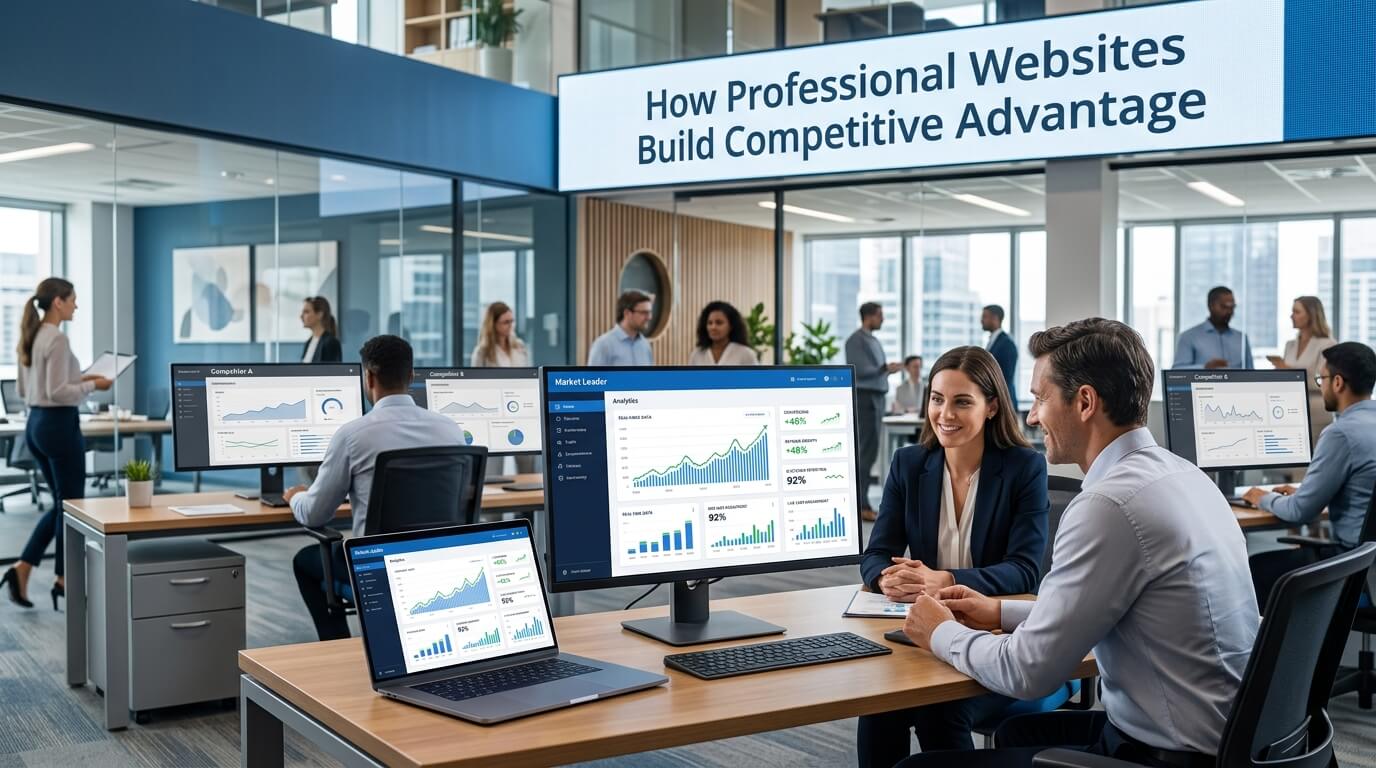
In a crowded marketplace, businesses are constantly looking for ways to stand apart. They may compete through better pricing, stronger products, faster service, experienced employees, or innovative marketing. Yet one of the most important competitive advantages often sits right in front of customers every day: the company website.
A professional website is no longer simply an online brochure. It is a central business asset that influences how customers discover a company, judge its credibility, understand its offerings, compare it with competitors, and ultimately decide whether to make contact or buy. Recent website guidance continues to emphasize that effective professional design combines visual presentation with usability, credibility, performance, clear communication, and conversion goals.
For businesses operating in competitive industries, this matters because customers rarely evaluate companies in isolation. They compare options. If one business has a polished, informative, easy-to-use website while another has an outdated or confusing online presence, the difference can influence the customer’s perception before either company has a chance to speak directly with them.
A professional website can therefore become a meaningful competitive advantage. It helps businesses appear more credible, communicate their value more effectively, reach customers through search, improve the customer experience, generate leads, strengthen branding, and support growth around the clock.
What Makes a Website a Competitive Advantage?
A competitive advantage exists when a business has something that helps it perform better or become more attractive to its target customers than competing businesses. Traditionally, competitive advantage has been associated with pricing, product quality, customer service, intellectual property, location, or operational efficiency.
In the digital marketplace, however, the customer experience itself has become increasingly important. A website sits at the center of that experience for many businesses.
A professional website is designed around business objectives rather than simply appearance. It communicates what the company does, identifies who it serves, explains why customers should choose it, and makes the next step obvious. It also provides a consistent experience across devices and supports visibility through search engines.
This means the website can influence several stages of the customer journey simultaneously. It can attract someone who has never heard of the company, educate someone who is researching a purchase, reassure someone comparing competitors, and convert a qualified visitor into a lead or customer.
The strongest websites therefore do not merely compete visually. They compete through clarity, trust, convenience, accessibility, content, and overall experience.
Professional Websites Create Strong First Impressions
Your Website Often Speaks Before Your Team Does
When someone discovers a business online, the website may be one of the first places they visit. Before sending an inquiry, requesting a quotation, booking an appointment, or making a purchase, visitors may look at the company’s services, reviews, portfolio, contact information, and overall presentation.
This creates an important opportunity.
A professional website can communicate competence before a salesperson ever speaks with the prospect. Clean design, thoughtful layouts, consistent branding, readable content, quality imagery, and straightforward navigation can make the business feel organized and established.
Research and industry guidance consistently connect website design with perceptions of credibility and professionalism. Poor design, confusing navigation, outdated information, and technical problems can have the opposite effect.
This is particularly important for smaller businesses. A small company may not have the same advertising budget, physical presence, or brand recognition as a large competitor. A strong website can help close some of that perceived gap by presenting the business professionally.
Professionalism Can Influence Buying Decisions
Imagine two companies offering similar services. Company A has a modern website that clearly explains its services, displays testimonials, answers common questions, and makes contacting the company simple. Company B has an outdated website with limited information, broken pages, inconsistent branding, and no obvious way to request a quote.
Even if Company B provides an excellent service, many prospects may feel more comfortable contacting Company A.
The website has influenced the comparison before the actual service experience has taken place.
That is one of the most important ways professional websites create competitive advantage: they shape perception at the beginning of the buying journey.
Professional Websites Strengthen Brand Credibility
Consistent Branding Builds Recognition
A website is one of the most important places to establish a company’s visual identity. Logo usage, typography, colors, photography, tone of voice, page layouts, and messaging should work together to create a recognizable brand.
Consistency makes a business feel more established. When the website matches the company’s social media, marketing materials, advertisements, email communications, and other customer touchpoints, customers receive a more unified experience.
This consistency can also help a business become memorable. A customer may encounter dozens of companies offering similar products or services, but strong branding gives the business a distinctive identity.
Trust Signals Reduce Customer Uncertainty
Customers naturally have questions before committing to a business. They may wonder whether the company is legitimate, whether it has experience, whether previous customers were satisfied, or whether their information will be handled safely.
A professional website can address these concerns through testimonials, case studies, company information, portfolio examples, policies, clear contact details, secure browsing, and transparent service information.
Educational content also helps. Service pages, FAQs, guides, and articles can demonstrate knowledge while answering questions that customers may otherwise need to ask directly.
The result is a reduction in uncertainty. Instead of asking prospects to trust the company based only on an advertisement, the website provides evidence that supports the company’s claims.
A Professional Website Improves Customer Experience
Easy Navigation Gives Businesses an Advantage
A customer should not have to work hard to understand a website.
Visitors should be able to find important information without repeatedly clicking through confusing menus or searching through large blocks of irrelevant text. Navigation should reflect the way customers think about the business.
For example, a service company might organize its website around its main services, industries, solutions, case studies, and contact options. An e-commerce business might prioritize categories, product information, search, reviews, and checkout.
Good structure reduces friction.
When visitors can quickly find what they need, the business creates a smoother experience than competitors whose websites make information difficult to access.
Mobile Experience Is No Longer Optional
Customers do not visit websites only from desktop computers. They use smartphones and tablets while commuting, shopping, researching, comparing companies, and communicating with businesses.
A professional website must therefore adapt to different screen sizes. Text should remain readable, buttons should be easy to tap, images should display correctly, and important information should not become difficult to access.
Mobile responsiveness is now a fundamental part of professional web design, alongside performance and accessibility.
A competitor with a better mobile experience can easily capture customers who become frustrated with a difficult-to-use website.
Professional Websites Increase Online Visibility
SEO Turns a Website Into a Discovery Channel
A website’s competitive value becomes much greater when potential customers can find it through search engines.
Search engine optimization helps businesses create pages around topics, questions, products, services, and problems that their target audiences are actively searching for. A professional website can provide the technical structure and content foundation needed to support this process.
Instead of relying entirely on paid advertising or social media algorithms, a business can build an organic presence that continues attracting relevant visitors over time.
For example, a company offering website design might create detailed pages targeting website design services, business website development, e-commerce design, mobile website development, and related questions. Each useful page creates another opportunity to reach potential customers.
Valuable Content Supports Authority
Content is another way a professional website can outperform competitors.
A website that regularly provides useful information can become a resource rather than simply a sales page. Articles, guides, FAQs, case studies, and educational resources allow a business to demonstrate expertise while helping prospective customers.
This approach is especially powerful for professional services where customers often need education before making a decision.
Someone searching for an answer today may not be ready to buy. However, if that person repeatedly finds useful information from the same business, familiarity and trust can develop. When the person eventually needs the service, that company may already be the preferred option.
Professional Websites Communicate Unique Value
Your Website Should Explain Why You Are Different
Many businesses make the mistake of describing themselves with generic statements such as “high-quality service,” “customer-focused solutions,” or “industry-leading expertise.”
The problem is that competitors can say exactly the same thing.
A professional website gives businesses the opportunity to communicate specific differences. It can explain a company’s process, specialization, experience, technology, guarantees, turnaround times, customer support, geographic coverage, or unique approach.
The goal is not simply to say that the business is better. The website should show why it is different and why that difference matters to customers.
Clear Messaging Makes Comparison Easier
Customers often compare multiple companies before making a decision. If a website explains its value clearly, it becomes easier for visitors to understand the business’s position in the market.
A strong homepage should quickly answer three fundamental questions: What does the company offer? Who is it for? Why should someone choose it?
When those answers are immediately understandable, the business has an advantage over competitors whose websites require visitors to search for basic information.
Professional Websites Support Lead Generation
A website can operate as a lead-generation system rather than simply a digital business card.
Strategic calls to action can guide visitors toward useful next steps. Depending on the business, that could mean requesting a quotation, scheduling a consultation, purchasing a product, subscribing to a newsletter, downloading a resource, or submitting an inquiry.
The key is relevance.
A visitor reading about a service should have an obvious way to learn more or make contact. A person viewing a case study might be encouraged to discuss a similar project. Someone reading an educational article might be offered a related service or resource.
This turns website traffic into potential business opportunities.
Conversion-focused design specifically considers how page structure, value propositions, trust signals, navigation, and calls to action can reduce friction and encourage desired actions.
Professional Websites Help Businesses Compete With Larger Companies
One of the most interesting advantages of a professional website is that it can help smaller companies appear more competitive.
A small business cannot always match a multinational company’s advertising budget. It may not have hundreds of employees or offices around the world. But online, a well-designed website can create a strong professional presence.
Digital Presentation Can Level the Playing Field
A customer visiting a website does not necessarily know how large the company is. What they see is the brand’s presentation.
A small business with excellent content, strong branding, clear expertise, testimonials, case studies, and a smooth user experience can create a level of confidence that allows it to compete for attention with larger organizations.
This does not mean the website replaces genuine business quality. It means the website gives that quality an opportunity to be seen.
A great business with a weak website may struggle to communicate its strengths. A great business with a strong website can make those strengths much more visible.
Website Performance Can Become a Competitive Differentiator
A professional website should not only look good. It should perform well.
Slow-loading pages, broken links, poorly optimized images, confusing forms, and technical errors create friction. Visitors may leave before they ever discover what the business offers.
Performance is therefore connected directly to customer experience.
Modern website development increasingly treats speed, responsive design, accessibility, security, and technical reliability as fundamental elements rather than optional extras.
A fast, reliable website also gives marketing campaigns a stronger foundation. Businesses can direct visitors from social media, email campaigns, advertising, search results, and other channels to a destination designed to handle those visitors effectively.
How Different Website Features Create Competitive Advantage
| Website Feature | Competitive Advantage | Business Impact |
| Professional design | Creates a stronger first impression | Builds credibility |
| Mobile responsiveness | Makes the website accessible across devices | Improves customer experience |
| SEO-friendly structure | Helps customers discover the business | Increases organic visibility |
| Clear messaging | Makes the value proposition easier to understand | Supports faster decisions |
| Testimonials and case studies | Provides social proof | Reduces hesitation |
| Fast performance | Reduces friction during browsing | Supports engagement |
| Clear calls to action | Guides visitors toward the next step | Improves lead generation |
| Useful content | Demonstrates knowledge and expertise | Builds authority |
| Consistent branding | Creates recognition | Strengthens brand identity |
| Secure functionality | Reassures users about online interactions | Supports trust |
Professional Websites Turn Marketing Into a Connected System
A major advantage of a professional website is that it provides a central destination for other marketing activities.
Social media posts can direct users to articles or services. Email campaigns can lead subscribers to landing pages. Online advertisements can send prospects to targeted offers. Search engine optimization can bring organic visitors to informative pages.
Without a strong website, these channels have nowhere effective to send interested prospects.
With a professional website, marketing efforts become connected.
For example, a company might publish an educational article, promote it through social media, attract search traffic to it, and then guide interested readers toward a relevant service page. The website becomes the bridge connecting awareness, education, consideration, and conversion.
This makes the website more valuable than any individual marketing channel.
Professional Websites Provide a 24/7 Business Presence
A physical office has operating hours. Employees eventually go home. Sales representatives cannot answer every question immediately.
A website, however, remains accessible around the clock.
Potential customers can research the company at night, review services over the weekend, read case studies before a meeting, or submit an inquiry when the business team is unavailable.
This does not mean a website replaces human interaction. Instead, it makes human interaction more productive by giving customers useful information before they contact the business.
By the time a prospect reaches out, they may already understand the company’s services and have developed a basic level of trust.
A Professional Website Creates Long-Term Competitive Value
One of the biggest mistakes businesses make is treating website development as a one-time project.
A website should evolve alongside the business.
Services change. Customer expectations change. Search behavior changes. Competitors improve their online presence. New technologies become available. Content becomes outdated.
Regular updates allow a website to remain useful and competitive.
Businesses can analyze which pages attract visitors, which content generates inquiries, where users leave the website, and which services receive the most interest. These insights can then guide improvements.
This creates a cycle of continuous optimization.
Instead of building a website once and forgetting about it, successful businesses treat their website as an evolving digital asset.
How to Build a Website That Creates Real Competitive Advantage
Creating competitive advantage through a website starts with strategy rather than aesthetics.
The first step is understanding the target audience. A business needs to know what customers want, what problems they experience, what questions they ask, and what factors influence their buying decisions.
The next step is defining the company’s positioning. The website should communicate what makes the business different and why that difference matters.
Content should then be developed around customer needs rather than simply company announcements. Every major page should have a clear purpose, whether that is educating, building trust, demonstrating expertise, or encouraging an action.
Design and development should support those objectives. Navigation should be intuitive, pages should work across devices, content should be easy to read, and important calls to action should be easy to find.
Finally, performance should be measured over time. Analytics, search performance, conversion data, customer feedback, and usability observations can reveal where improvements are needed.
A website becomes a competitive advantage when strategy, design, content, technology, and customer experience work together.
The Difference Between Having a Website and Having a Competitive Website
Simply having a domain name and several pages does not automatically create an advantage.
A website can actually become a disadvantage if it is outdated, difficult to use, unclear, insecure, or poorly maintained.
The competitive value comes from how effectively the website serves both the customer and the business.
A competitive website helps visitors understand the company quickly. It makes the business credible. It answers important questions. It demonstrates expertise. It provides a smooth experience. It attracts relevant traffic. It encourages meaningful action.
Most importantly, it gives customers a reason to choose the business instead of continuing their search.
That is why professional web design should be viewed as a business investment rather than simply a visual upgrade.
Conclusion
A professional website can become one of the strongest competitive assets a modern business owns. It influences first impressions, builds credibility, improves customer experience, strengthens branding, supports SEO, generates leads, communicates differentiation, and connects multiple marketing channels.
In competitive markets, customers have more choices than ever. They can compare companies within minutes, read reviews, examine websites, and move to another provider if something creates doubt or frustration.
A professional website gives a business an opportunity to win that comparison.
The real advantage is not simply having a beautiful website. It is having a website that makes the business easier to discover, understand, trust, and choose. When designed strategically and maintained consistently, a website becomes more than an online presence. It becomes a long-term platform for differentiation, customer engagement, and sustainable growth.
Frequently Asked Questions
Q1. How does a professional website give a business a competitive advantage?
A professional website helps businesses build credibility, improve customer experience, increase online visibility, communicate their unique value, and generate leads more effectively than a poorly designed online presence.
Q2. Can a small business compete with larger companies through its website?
Yes. A strategically designed website can help smaller businesses present their expertise, services, testimonials, and brand professionally, allowing them to compete for online attention with larger organizations.
Q3. Does professional website design improve customer trust?
Yes. Clear information, consistent branding, professional design, testimonials, case studies, secure functionality, and easy navigation can all contribute to a stronger perception of credibility and reliability.
Q4. How does SEO make a website more competitive?
SEO helps a website appear when potential customers search for relevant products, services, questions, or solutions. Better visibility can increase qualified traffic and create more opportunities to attract customers organically.
Q5. Should a professional website be updated regularly?
Yes. Businesses should regularly review their content, security, performance, design, technology, and customer experience. Continuous improvement helps the website remain useful and competitive as customer expectations and digital trends change.