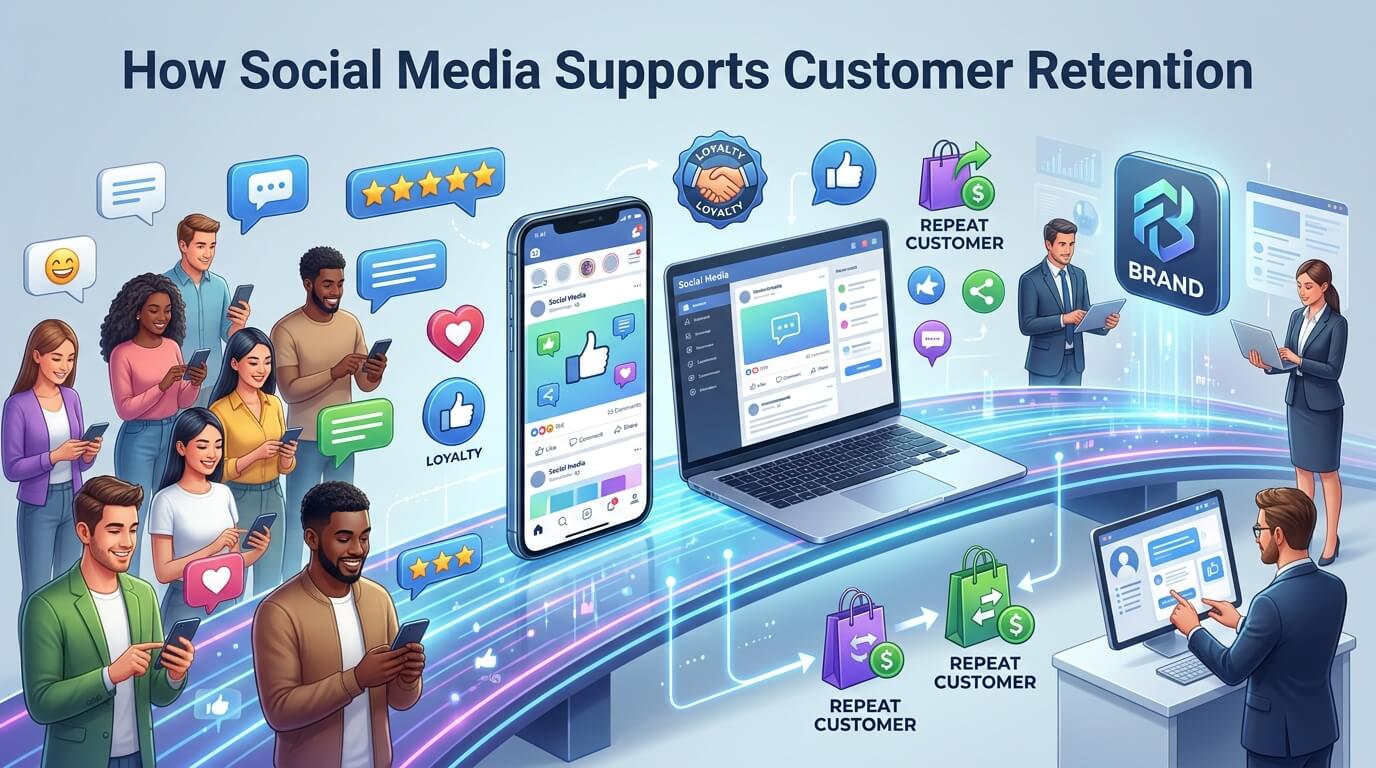
Customer retention has become one of the most important priorities for modern businesses. Attracting a new customer requires marketing, advertising, awareness, and often several interactions before a purchase happens. Retaining an existing customer, however, depends on something deeper: the quality of the relationship a business builds after the sale. This is where social media can play a powerful role.
Social media is no longer simply a place for businesses to publish promotional content. Platforms such as Facebook, Instagram, LinkedIn, TikTok, YouTube, and X give businesses opportunities to communicate with customers regularly, answer questions, provide support, share useful information, collect feedback, and create communities around their brands. When used strategically, these interactions can help customers feel connected to a business rather than treating every purchase as a one-time transaction.
Research into social media engagement has found meaningful connections between customer engagement, satisfaction, trust, loyalty, and business outcomes. A large meta-analysis covering 97 studies and more than 161,000 respondents found that satisfaction, positive emotions, and trust are important drivers of customer engagement on social media. Other research has also found that social media interactions can be associated with longer customer lifetimes and lower termination rates.
For businesses, the central lesson is simple: social media can help keep a brand present in customers’ lives. When customers continue to receive value, attention, useful communication, and responsive service, they have more reasons to stay.
Understanding the Connection Between Social Media and Customer Retention
Customer retention refers to a business’s ability to keep existing customers and encourage them to continue purchasing its products or services over time. Retention is closely connected to customer satisfaction, trust, loyalty, customer experience, and perceived value.
Social media supports these areas by creating an ongoing communication channel between a business and its audience. Traditional advertising often focuses on convincing someone to make a purchase. Social media can continue the relationship after that purchase has already happened.
Social Media Keeps the Brand Visible
One of the simplest ways social media supports retention is by keeping a business visible. Customers are exposed to countless brands every day, and a business that disappears after a transaction can easily become forgotten.
Regular social media communication helps a brand remain familiar. A customer might see a useful tip from a company on Instagram, a product demonstration on Facebook, a behind-the-scenes video on TikTok, or an educational LinkedIn post. These repeated but meaningful interactions reinforce brand familiarity without requiring the customer to make another purchase immediately.
This continued visibility matters because customers often choose brands they already recognize and trust. Social media gives businesses an opportunity to stay relevant between purchases rather than appearing only when they want to sell something.
Retention Is About Relationships, Not Just Transactions
A customer may make a purchase because of price, convenience, advertising, or a specific need. Retention requires a stronger reason to return.
Social media can transform a transactional relationship into a more personal relationship. Customers can comment on posts, ask questions, share experiences, participate in discussions, and communicate directly with businesses. These interactions create opportunities for brands to demonstrate that they value customers beyond their immediate purchase.
Research on social customer relationship management suggests that social media-based customer engagement can contribute to customer satisfaction, loyalty, and retention.
When customers feel that a business listens and responds, they are more likely to view the brand as a relationship rather than simply another seller.
Social Media Improves Customer Communication
Communication is at the heart of customer retention. Customers are more likely to remain with companies that communicate clearly, consistently, and helpfully.
Social media makes communication faster and more accessible. Instead of waiting for a customer to visit a website or send a formal email, businesses can provide updates and respond through channels customers already use.
Customers Can Ask Questions Easily
Customers often have questions before, during, and after a purchase. They may want to know how a product works, whether an item is available, how long delivery will take, or how to resolve a problem.
When businesses answer these questions through social media, they reduce frustration and demonstrate responsiveness. A helpful response can turn a potentially negative experience into a positive one.
This is particularly valuable because customers frequently judge businesses not only by the product they purchase but also by what happens when they need assistance.
Consistent Communication Builds Familiarity
Social media also creates opportunities for businesses to communicate consistently. A brand that regularly shares useful content can establish a recognizable voice and personality.
Customers begin to understand what the business represents, what it values, and how it communicates. Over time, this familiarity can strengthen trust.
However, consistency does not mean posting endlessly. The objective should be to maintain a meaningful presence. A business that posts frequently but provides little value may eventually become noise in the customer’s feed.
Social Media Strengthens Customer Service
Customer service is one of the strongest ways social media can influence retention. Customers increasingly expect brands to be accessible through digital channels, and social platforms provide an immediate environment for conversations.
Quick Responses Can Prevent Customer Churn
A frustrated customer may be willing to remain loyal if a problem is addressed quickly. On the other hand, an unanswered complaint can damage the relationship.
Social media allows businesses to identify questions and complaints while they are still fresh. A timely response can acknowledge the customer’s concern, explain what happened, and provide a path toward resolution.
This does not mean every customer issue should be solved publicly. Sensitive matters can be moved into private messages or other support channels. What matters is that the customer receives acknowledgement and knows the business is taking the issue seriously.
Public Responses Demonstrate Accountability
When a company responds professionally to public questions or complaints, other customers can see that interaction. This creates an important secondary benefit.
A potential customer observing a complaint does not necessarily conclude that the company is bad. If the business responds respectfully and demonstrates a genuine effort to resolve the issue, the interaction can actually strengthen perceptions of the brand.
Research on social media interactions and customer relationship management has found that customers who interact with companies through social media can have longer customer lifetimes, although the effects depend heavily on the nature and quality of those interactions.
Social Media Creates a Sense of Community
Customer retention becomes stronger when customers feel that they belong to something. Social media is particularly effective at creating communities because it allows people with similar interests to interact with each other as well as with the brand.
Customers Can Connect With Other Customers
A business can encourage customers to share experiences, ask questions, participate in discussions, and showcase how they use a product.
For example, a fitness company might create content around healthy routines and encourage customers to share progress. A clothing brand can feature customer styling ideas. A software company can encourage users to exchange productivity tips.
These interactions create a community surrounding the product or service.
Community Can Increase Emotional Connection
A customer who feels connected to a brand community may have reasons to remain loyal that go beyond price.
They may enjoy the content, identify with other customers, appreciate the brand’s values, or simply enjoy being part of the conversation. These emotional connections can make switching to a competitor less appealing.
Academic research has identified different levels of social media engagement, moving from connection and interaction toward loyalty and advocacy.
Social Media Helps Businesses Deliver Ongoing Value
Retention becomes easier when customers continue receiving value after the purchase.
Social media gives businesses a practical way to provide this value through educational, entertaining, inspirational, and informative content.
Educational Content Keeps Customers Engaged
A company can use social media to teach customers how to get more from its products or services. Tutorials, demonstrations, tips, explanations, and troubleshooting content can extend the usefulness of a purchase.
For example, a software company might publish tutorials showing customers how to use advanced features. A skincare company might explain how to build a routine. A professional service provider might share educational advice related to the customer’s industry.
This type of content does more than generate engagement. It helps customers succeed with what they have already purchased.
Useful Content Gives Customers a Reason to Return
If customers know that a brand regularly provides useful information, they have a reason to continue following it.
The relationship therefore becomes less dependent on promotional offers. Customers return because the content itself has value.
Research into social media-based customer engagement has found that relational and informational forms of content can contribute to meaningful engagement and downstream outcomes such as loyalty.
Social Media Personalizes the Customer Experience
Customers generally appreciate communication that feels relevant to their interests rather than generic advertising.
Social media gives businesses opportunities to understand audience preferences through comments, messages, reactions, questions, and content performance.
Listening Reveals Customer Preferences
Customer comments can reveal what people like, dislike, misunderstand, or want from a business.
For example, if customers repeatedly ask for tutorials about a particular feature, the company can create content addressing that topic. If customers consistently request a particular product variation, the business can investigate whether there is sufficient demand.
This makes social media more than a publishing platform. It becomes a source of customer insight.
Personalized Interactions Feel More Human
A customer who receives a thoughtful response is more likely to feel recognized than one who receives an automated message.
Even small details can make communication more personal. Addressing the customer’s question directly, acknowledging their concern, and providing a relevant solution can create a stronger impression.
For customer retention, these moments matter because loyalty is often built through a series of small positive experiences rather than one major marketing campaign.
How Different Social Media Activities Support Retention
| Social Media Activity | Customer Benefit | Retention Impact |
| Customer service responses | Faster problem resolution | Reduces frustration and churn |
| Educational content | Helps customers use products effectively | Increases perceived value |
| Behind-the-scenes content | Makes the brand feel more human | Strengthens emotional connection |
| Customer-generated content | Builds trust and community | Encourages belonging |
| Product updates | Keeps customers informed | Maintains relevance |
| Polls and questions | Gives customers a voice | Improves engagement |
| Exclusive content | Makes followers feel valued | Strengthens loyalty |
| Community discussions | Connects customers with each other | Builds brand attachment |
| Feedback conversations | Shows customers they are heard | Improves relationships |
| Loyalty campaigns | Rewards continued engagement | Encourages repeat purchases |
Social Media Encourages Customer Feedback
Businesses cannot improve retention without understanding why customers stay or leave. Social media makes feedback easier to collect.
Customers can share opinions through comments, direct messages, polls, reviews, and other interactions. While not every piece of feedback is representative, patterns can reveal important issues.
Feedback Helps Businesses Identify Problems
Suppose customers repeatedly complain about confusing instructions. The business can improve the instructions. If customers frequently ask about delivery updates, the company can improve its communication process.
This creates a valuable cycle: customers provide information, the company responds, and the improved experience gives customers another reason to stay.
Customers Feel Valued When Businesses Listen
Asking customers for opinions can also create a psychological benefit. People appreciate knowing that their experiences matter.
A business does not need to implement every suggestion. What matters is acknowledging useful feedback and communicating when changes are made.
A customer who sees that their feedback contributes to improvements may develop a stronger sense of connection with the business.
Social Media Supports Loyalty Programs
Social media can also complement traditional loyalty programs.
Businesses can announce rewards, special events, product launches, customer appreciation campaigns, and exclusive offers through social platforms.
Exclusive Experiences Can Strengthen Loyalty
Customers may respond positively when they receive something that feels designed specifically for existing followers or customers.
An early product announcement, special educational session, exclusive content, or limited-time customer appreciation campaign can reinforce the idea that continuing to engage with the brand has benefits.
However, retention should not depend entirely on discounts. If customers remain loyal only because a company is constantly offering lower prices, the relationship can become vulnerable when a competitor provides a better deal.
The strongest loyalty strategies combine incentives with trust, service, quality, convenience, and emotional connection.
Social Media Encourages Advocacy From Existing Customers
Customer retention and customer advocacy often support each other.
A satisfied customer may recommend a business to friends, post about a purchase, leave a review, or share branded content. These actions can introduce the company to new audiences while reinforcing the existing customer’s relationship with the brand.
Research has found that social media communication aimed at retaining customers can contribute to customer advocacy.
User-Generated Content Builds Trust
When customers share genuine experiences, their content can feel more authentic than traditional advertising.
A customer photograph, testimonial, review, video, or social media mention can demonstrate how a product or service fits into real life.
Businesses can encourage this behavior by recognizing customers and sharing appropriate user-generated content with permission.
Advocacy Can Reinforce the Customer’s Own Loyalty
There is another interesting effect. When customers publicly recommend a business, they are not simply influencing other people. They are also publicly expressing a positive relationship with the brand.
That can strengthen their own psychological connection to the business.
Social Media Helps Brands Stay Relevant Between Purchases
Not every product is purchased every week or month. Some businesses naturally have long periods between transactions.
Social media can help maintain the relationship during these gaps.
A customer who purchased furniture several years ago may not need another product immediately, but useful home-design content can keep the company familiar. A customer who completed a professional course may not buy another course immediately, but educational posts can maintain the relationship.
This ongoing communication means the business does not have to rebuild awareness from zero when the customer’s next purchasing opportunity arrives.
Social Media Can Support Retention Across the Customer Journey
Social media can contribute at multiple stages of the customer journey. Before purchasing, it can help build awareness and trust. During the buying process, it can answer questions. After purchase, it can provide support and education. Later, it can encourage continued engagement and repeat purchases.
This makes social media particularly useful as a relationship-building channel.
A business should therefore avoid viewing social media exclusively through the lens of immediate sales. Some of the most valuable interactions may not produce a purchase that day. Their value can appear later through repeat purchases, reduced churn, stronger loyalty, recommendations, and higher customer lifetime value.
Measuring Whether Social Media Is Actually Supporting Retention
A business cannot determine the effectiveness of its retention strategy simply by counting likes and followers.
Current research also cautions against treating social engagement metrics as direct measures of loyalty. Qualtrics reported in 2026 that likes, comments, and other social engagement signals are becoming weaker indicators of customer loyalty, while trust, repeat behavior, and experience quality provide more meaningful signals.
Look Beyond Likes and Followers
Businesses should connect social media activity with broader customer outcomes. Repeat purchase rates, customer retention rates, customer lifetime value, support resolution, sentiment, customer feedback, and referral behavior can provide a clearer picture.
A post with modest engagement may still be valuable if it helps existing customers solve a problem. Conversely, a viral post may generate thousands of interactions without contributing meaningfully to retention.
Track Quality of Engagement
The quality of customer interactions matters.
A thoughtful product question, positive testimonial, service inquiry, or repeat interaction may be more meaningful than a simple reaction. Businesses should therefore examine what customers are actually saying and doing rather than relying entirely on surface-level metrics.
Common Mistakes Businesses Should Avoid
Social media can support retention, but it does not automatically create loyalty.
One common mistake is treating every post as an advertisement. Customers do not follow brands because they want to see constant sales messages. They follow because they expect some combination of information, entertainment, assistance, inspiration, community, or value.
Another mistake is ignoring negative comments. Deleting criticism without addressing the underlying problem can make customers feel dismissed. A professional response combined with genuine problem-solving is usually more valuable.
Businesses can also make the mistake of being inconsistent. A company that responds quickly one week and ignores customers the next creates uncertainty. Retention depends on reliability, so customer communication should be managed as an ongoing responsibility rather than an occasional campaign.
Finally, businesses should not assume that high engagement automatically equals high loyalty. Social media can contribute to retention, but product quality, pricing, customer service, reliability, and the overall customer experience remain fundamental.
How Businesses Can Build a Retention-Focused Social Media Strategy
A retention-focused strategy begins by understanding existing customers rather than simply trying to reach more people.
The business should identify what customers need after purchasing, what questions they frequently ask, what problems they encounter, and what type of content helps them succeed.
The next step is to create a consistent mix of useful content, customer support, conversations, community activity, and brand storytelling. The exact mix will depend on the business and its audience.
Most importantly, the company should treat social media as an extension of customer relationship management. Research on social customer relationship management has found that customer engagement can connect social interactions with satisfaction, loyalty, and retention outcomes.
When businesses use social media to listen as carefully as they publish, the platform becomes much more valuable.
The Future of Social Media and Customer Retention
Social media will continue to evolve, but the basic principle behind retention is unlikely to change: customers stay with businesses that consistently provide value and positive experiences.
New technologies may make social interactions faster and more personalized. Businesses can increasingly use data and automation to identify customer needs, deliver relevant information, and respond efficiently. However, technology should support relationships rather than replace genuine customer care.
The strongest brands will likely be those that combine automation with human judgment. Automated tools can help identify questions or organize conversations, while trained people can handle complex problems, sensitive situations, and meaningful relationship-building.
This balance is especially important because customers can quickly recognize communication that feels generic or purely promotional.
Conclusion
Social media supports customer retention by helping businesses maintain relationships long after the initial purchase. Through consistent communication, responsive customer service, educational content, community building, feedback, personalization, loyalty initiatives, and customer advocacy, social platforms give companies more opportunities to remain relevant and valuable.
However, social media should not be viewed as a shortcut to loyalty. Likes and followers alone do not guarantee that customers will stay. Retention comes from the broader experience a customer has with a business, while social media provides an important channel for strengthening that experience.
When businesses use social media to genuinely listen, help, educate, recognize, and communicate with customers, they create more reasons for those customers to return. Over time, those individual interactions can develop into trust, loyalty, repeat purchases, and long-term customer relationships.
Frequently Asked Questions
Q1. How does social media improve customer retention?
Social media improves retention by keeping customers connected to a brand through communication, customer service, useful content, community engagement, and personalized interactions.
Q2. Can social media reduce customer churn?
Yes. Responsive social media communication can help identify customer problems, resolve issues, and maintain engagement, which can reduce some causes of customer churn. Research has found associations between social media interactions and longer customer lifetimes.
Q3. What type of social media content helps retain customers?
Educational, informative, entertaining, community-focused, and customer-centered content can help retain customers because it provides value beyond direct promotion.
Q4. Are likes and comments good measures of customer loyalty?
Not necessarily. Likes and comments measure engagement, but they do not always indicate loyalty. Repeat purchases, trust, satisfaction, customer experience, and retention behavior can provide stronger indicators.
Q5. How often should a business use social media for customer retention?
There is no universal posting frequency. Businesses should focus on maintaining a consistent presence while prioritizing useful content, meaningful conversations, and responsive customer service rather than posting simply to increase volume.