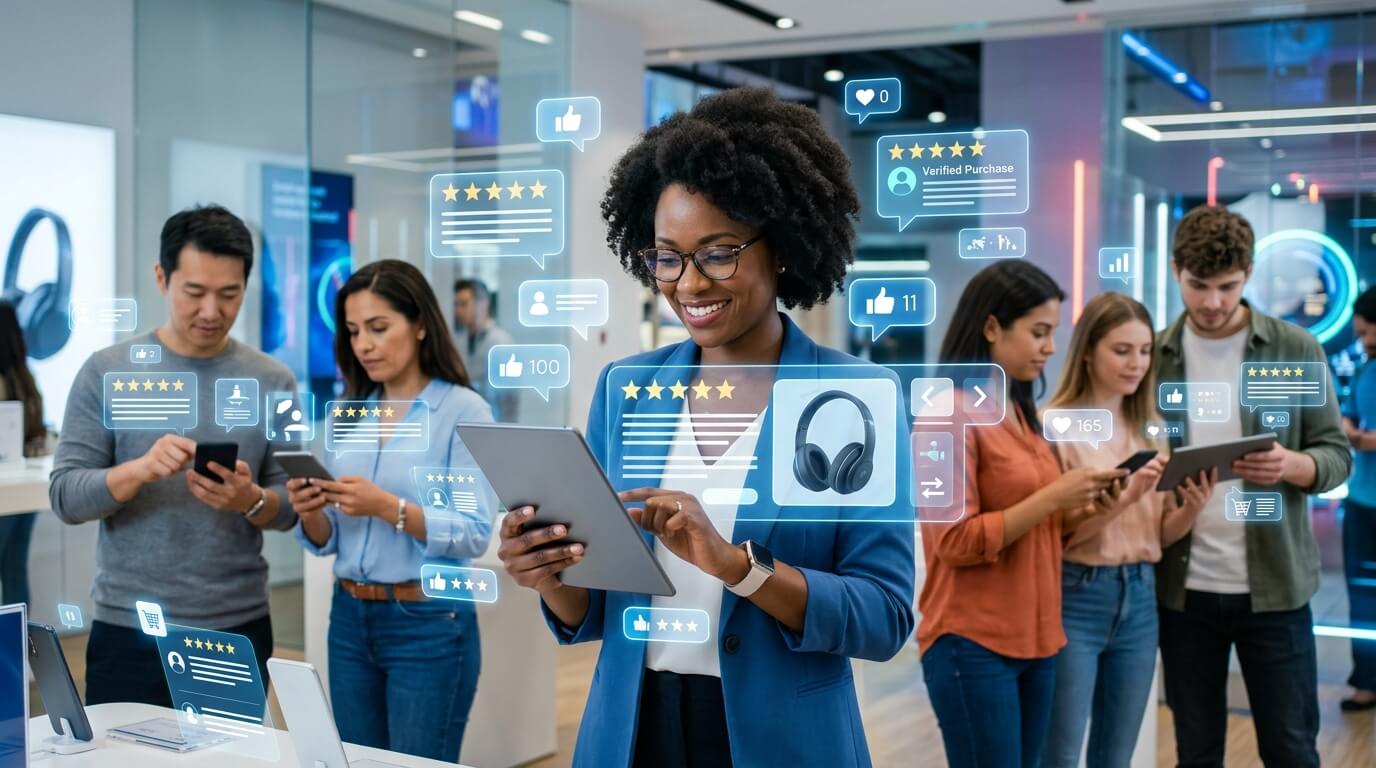
In a marketplace filled with advertisements, promotions, product claims, and competing brands, consumers rarely make purchasing decisions based only on what a business says about itself. They want reassurance. They want to know whether other people have purchased the product, whether those customers were satisfied, and whether the brand can actually deliver what it promises. This is where social proof becomes a powerful influence on buying decisions.
Social proof refers to the psychological tendency to look at the behavior, opinions, and experiences of others when deciding what to do. In marketing, it appears in many forms, including customer reviews, testimonials, ratings, user-generated content, influencer recommendations, case studies, social media engagement, customer numbers, and visible purchase activity. These signals can make an unfamiliar company appear more trustworthy and can reduce the uncertainty that often prevents people from completing a purchase.
The influence of social proof is particularly important online because consumers cannot physically inspect many products or speak directly with a salesperson. Instead, they depend on information provided by previous customers and other members of the community. Recent research continues to demonstrate the importance of this behavior. A 2024 meta-analysis covering 156 studies, 214 effect sizes, and 69,006 observations found that online review factors significantly influence purchase intention, with review sentiment showing a particularly strong effect.
Understanding how social proof works can therefore help businesses build credibility, strengthen their marketing strategies, and make the customer journey more persuasive without relying entirely on aggressive sales tactics.
What Is Social Proof in Marketing?
Social proof is essentially the idea that people often use the actions and opinions of others as evidence when making decisions. When consumers are uncertain about a product or service, seeing that other people have already chosen it can provide reassurance.
For example, imagine that a customer is comparing two unfamiliar online stores selling similar products. One website has no customer reviews, no testimonials, and little evidence of previous customers. The other displays hundreds of detailed reviews, customer photographs, ratings, and testimonials. Even if both businesses offer similar products at similar prices, the second store may feel safer.
The customer is not necessarily assuming that the second company is perfect. Instead, the visible experiences of other customers reduce perceived risk. The buyer can think, consciously or unconsciously, that if many other people have purchased the product and had positive experiences, the decision may be less risky.
This is why social proof works particularly well when consumers face uncertainty. Academic research has found that online reviews can influence purchase likelihood even after accounting for a product’s overall average rating. Individual reviews can be especially influential when they help shoppers resolve uncertainty about the product.
Why Social Proof Has Such a Strong Psychological Effect
People Look to Others When They Are Uncertain
One of the most important reasons social proof works is that purchasing often involves uncertainty. Customers may wonder whether a product will perform as advertised, whether a company is reliable, whether customer service will be helpful, or whether their money will be wasted.
Social proof provides external evidence that helps answer these questions.
A brand can say, “Our product is high quality,” but that statement is naturally viewed as promotional. A customer saying, “I purchased this product and it worked well for me,” can feel more independent and believable.
This distinction matters because consumers understand that businesses have a financial interest in presenting themselves positively. Customer experiences, meanwhile, are perceived as coming from someone who has already gone through the purchasing process.
Social Proof Reduces Perceived Risk
Every purchase contains some level of risk. For an inexpensive product, the risk may be relatively small. For an expensive service, software subscription, holiday, course, vehicle, or professional service, the perceived risk can be much greater.
Reviews and testimonials can reduce this feeling of uncertainty by giving potential customers additional information.
A shopper considering a $20 product may need only a few positive reviews before purchasing. Someone considering a $2,000 service may need testimonials, case studies, detailed reviews, demonstrations, and evidence of previous results.
The principle remains the same: the experiences of previous customers help future customers feel more confident.
The Major Types of Social Proof That Influence Buyers
Social proof is not limited to five-star ratings. Different forms of social proof can influence different stages of the buying journey.
| Type of Social Proof | How It Influences Buyers | Best Use |
| Customer Reviews | Provides direct experiences from previous buyers | Product and service pages |
| Star Ratings | Gives shoppers a quick quality signal | E-commerce and local businesses |
| Testimonials | Builds emotional and personal trust | Service businesses and landing pages |
| User-Generated Content | Shows products being used by real customers | Social media and e-commerce |
| Influencer Recommendations | Transfers credibility from a recognized personality | Awareness and discovery |
| Case Studies | Demonstrates specific results and outcomes | B2B and high-value services |
| Customer Numbers | Creates a sense of popularity and acceptance | SaaS and subscription businesses |
| Media Mentions | Adds authority and third-party validation | Brand-building campaigns |
| Social Engagement | Demonstrates public interest and activity | Social media and content marketing |
The effectiveness of each type depends on the product, audience, industry, and stage of the buying process.
Customer Reviews Are One of the Strongest Forms of Social Proof
Reviews Provide Real-World Experiences
Customer reviews are among the most familiar forms of social proof because they provide information from people who have actually interacted with a product or business.
A product description might explain features, specifications, materials, or benefits. A review can explain what those features are like in everyday use.
For instance, a clothing brand might describe a jacket as “lightweight and comfortable.” A customer review might explain whether the jacket is suitable for cold weather, whether the sizing is accurate, or whether the material feels durable.
That practical information can be more valuable than promotional language because it helps potential customers imagine their own experience.
Recent BrightLocal research found that 85% of consumers are more likely to use a business after reading positive reviews, while 77% say negative reviews make them less likely to choose a business. The same research found that 93% of consumers have made a purchase after reading reviews.
Negative Reviews Can Also Build Trust
Interestingly, social proof does not necessarily require a page filled with perfect five-star comments.
A collection of exclusively glowing reviews can sometimes appear unrealistic. Consumers understand that genuine products and businesses occasionally disappoint customers. Seeing a few reasonable negative reviews alongside predominantly positive feedback can make the overall review profile seem more authentic.
The important factor is how a company responds.
A professional response to a negative review can demonstrate accountability, empathy, and a willingness to solve problems. Instead of damaging credibility automatically, a well-managed negative review can sometimes show potential customers how the company behaves when something goes wrong.
Testimonials Turn Customer Experiences Into Persuasive Stories
Testimonials are another powerful form of social proof, particularly for service businesses.
Unlike short ratings, testimonials can explain the customer’s situation before purchasing, the problem they wanted to solve, and how the business helped them.
For example, a digital marketing agency could display a testimonial explaining how a client struggled to generate qualified leads, what strategy the agency implemented, and what changed afterward.
This gives prospective customers something they can relate to.
Specific Testimonials Are More Convincing
A vague testimonial such as “Great service! Highly recommended!” provides limited information.
A stronger testimonial explains what the customer actually experienced.
Specificity gives social proof greater informational value. Details about the problem, process, experience, and outcome make the testimonial feel more authentic and useful.
This is especially important for professional services because customers often cannot evaluate quality before purchasing. A potential client hiring a consultant, designer, writer, developer, or marketing agency may use testimonials as a substitute for firsthand experience.
Influencers and Experts Can Transfer Trust
Influencer marketing is another form of social proof. When people follow an influencer, creator, expert, or industry personality, they may already have an established level of trust in that person’s opinions.
An endorsement can therefore introduce a brand to a new audience while borrowing some of the credibility associated with the individual.
However, influence is not simply about follower count.
An influencer with a smaller but highly relevant audience may be more persuasive than a celebrity whose followers have little interest in the product. Authenticity and relevance are important because consumers increasingly recognize promotional content.
Social proof is strongest when the recommendation appears natural and relevant to the person’s existing interests.
User-Generated Content Makes Products Feel More Real
Professional product photography can make an item look attractive, but user-generated content can show consumers what the product actually looks like in real life.
Customer photographs, videos, social posts, unboxing videos, demonstrations, and before-and-after content can provide visual evidence that a product exists outside the brand’s own marketing environment.
This is particularly useful for products where appearance, scale, texture, fit, or practical use matters.
A potential customer may see a professionally photographed piece of furniture on a website and like it. Seeing the same furniture in a real customer’s home can help them imagine how it might look in their own space.
Social Proof Helps Customers During Different Stages of the Buying Journey
Social proof does not necessarily have the same function throughout the customer journey.
During the awareness stage, media mentions, influencer recommendations, and social engagement may help introduce a brand.
During the research stage, customers may focus more heavily on reviews, ratings, demonstrations, and comparisons.
During the final decision stage, testimonials, guarantees, case studies, and detailed customer experiences can provide the final reassurance needed to purchase.
Research from Trustpilot has similarly found that consumers respond to different trust signals at different stages of the buying process.
This means businesses should not simply place one testimonial at the bottom of their website and assume that social proof is complete. Trust signals should appear where customers naturally experience uncertainty.
How Social Proof Influences E-Commerce Purchases
E-commerce is one of the clearest environments for understanding social proof.
Online shoppers cannot physically touch products, speak to other shoppers, or examine merchandise in person. Reviews and ratings therefore become important sources of information.
A customer may initially discover a product through an advertisement, but before purchasing, they might look at its rating, read recent reviews, examine customer photographs, compare alternatives, and search for opinions on social media.
This behavior demonstrates that social proof does not necessarily replace other marketing activities. Instead, it works alongside them.
An advertisement can create awareness. A product page can explain features. Social proof can then provide reassurance.
Social Proof Is Especially Important for Expensive Purchases
The more expensive or complicated the purchase, the more information consumers often want before committing.
Someone purchasing a low-cost accessory may make a decision within minutes. Someone choosing a business software platform, professional service, home renovation company, university course, or financial product may conduct extensive research.
For these purchases, case studies and detailed testimonials can be particularly effective.
A case study allows a business to demonstrate how it solved a real customer’s problem. It can explain the situation, approach, challenges, implementation, and results.
This transforms an abstract promise into a concrete example.
The Importance of Authenticity
Fake Social Proof Can Damage Trust
Social proof only works when consumers believe it is genuine.
Fake reviews, fabricated testimonials, purchased followers, misleading customer numbers, or artificially generated engagement can create serious credibility problems.
Consumers are becoming increasingly aware of suspicious review patterns. BrightLocal’s research indicates that consumers actively look for signs that reviews may be fake.
Authenticity should therefore be treated as a fundamental part of social proof rather than an optional feature.
Businesses should encourage genuine customers to share honest experiences rather than attempting to manufacture positive feedback.
Transparency Strengthens Social Proof
Transparency can make social proof more credible.
Businesses can identify testimonials with customer names, roles, companies, photographs, or other relevant context when permission has been provided. They can explain how reviews are collected and respond honestly to criticism.
The goal should not be to make every customer appear perfectly satisfied. The goal should be to show that real people have interacted with the business and that the company takes those experiences seriously.
Social Proof and the Fear of Missing Out
Social proof can also create urgency through a psychological phenomenon often associated with the fear of missing out, or FOMO.
Messages such as “Thousands of customers have already purchased this product” or “This item is popular among shoppers” can communicate that other people are already taking action.
However, urgency should be truthful.
Artificial scarcity or fabricated purchase notifications may generate short-term clicks but can damage trust if customers discover that the claims are misleading.
Authentic popularity signals work better because they provide reassurance without manipulating the customer.
Social Proof in B2B Buying Decisions
Social proof is not limited to consumer products.
Businesses also look for evidence that other organizations have trusted a particular provider.
A B2B company may use client logos, industry awards, case studies, customer testimonials, research reports, and implementation results to demonstrate credibility.
For B2B buyers, the perceived consequences of making the wrong decision can be significant. Choosing an unreliable software provider, consultant, agency, or technology partner can affect budgets, productivity, employees, and customers.
Consequently, evidence from comparable companies can carry considerable weight.
A business owner may feel more comfortable choosing a service provider when they see that similar companies have already used the service successfully.
How Businesses Can Use Social Proof Effectively
The most effective approach is to make social proof relevant to the customer’s actual concerns.
If customers worry about product quality, emphasize detailed reviews and demonstrations. If they worry about reliability, show customer experiences and service testimonials. If they worry about results, provide case studies. If they are unfamiliar with the brand, third-party mentions and customer stories can help establish credibility.
Businesses should also place social proof close to important decision points.
Product ratings should appear near product information. Testimonials can appear near service descriptions. Case studies can support pricing or consultation pages. Customer logos can reinforce trust on B2B landing pages.
The objective is to answer the customer’s unspoken question: “Has someone like me trusted this business before?”
Why Quality Matters More Than Quantity
It can be tempting to assume that more reviews automatically create more trust. Quantity certainly provides useful evidence of popularity, but the quality and relevance of social proof matter too.
A hundred vague reviews may provide less useful information than twenty detailed reviews that explain real customer experiences.
Consumers also consider the recency of reviews, the credibility of reviewers, the consistency of feedback, and whether reviews address the issues they personally care about.
Research involving Pakistani online shoppers, for example, found that review credibility and quality had particularly strong influence on purchasing decisions, while negative reviews received significant attention from consumers making decisions cautiously.
The lesson is straightforward: businesses should focus on credible, relevant, detailed, and authentic social proof, not simply collecting the largest possible number of ratings.
The Future of Social Proof
As digital shopping continues to evolve, social proof is likely to become even more integrated into online experiences.
Consumers increasingly encounter recommendations through social media, creator content, community discussions, customer videos, reviews, and interactive shopping experiences. Instead of relying solely on traditional testimonials, brands can use multiple forms of customer-generated evidence throughout the buying journey.
At the same time, authenticity will become increasingly important. As artificial intelligence makes it easier to generate text, images, and engagement, consumers may become more skeptical of content that feels overly polished or generic.
Brands that build social proof through genuine customer experiences will therefore have an advantage over businesses that simply manufacture the appearance of popularity.
Conclusion
Social proof influences buying decisions because people naturally seek reassurance when making choices. Reviews, testimonials, ratings, customer stories, influencer recommendations, case studies, and user-generated content can reduce uncertainty and help potential buyers feel more confident.
The strongest social proof is not necessarily the loudest or most impressive. It is the evidence that feels relevant, credible, specific, and authentic. When businesses consistently deliver good experiences and make it easy for customers to share those experiences, social proof becomes a natural extension of their reputation.
Ultimately, consumers do not just want businesses to tell them that a product or service is valuable. They want to see evidence that other people have trusted it, used it, and benefited from it. That is what makes social proof such a powerful part of modern buying behavior.
FAQ
Q1. What is social proof in marketing?
Social proof is evidence that other people have purchased, used, recommended, or approved a product, service, or brand. Common examples include reviews, ratings, testimonials, customer stories, influencer recommendations, and user-generated content.
Q2. Why does social proof influence buying decisions?
Social proof reduces uncertainty and perceived risk. When consumers see positive experiences from other people, they may feel more confident that the product or business is trustworthy and worth choosing.
Q3. What is the most effective type of social proof?
Customer reviews and testimonials are among the most widely used forms, but effectiveness depends on the product and buying stage. Detailed reviews, authentic customer experiences, relevant case studies, and user-generated content can all be highly persuasive.
Q4. Can negative reviews influence customers?
Yes. Negative reviews can discourage purchases, but they can also make a review profile appear more authentic. How a business responds to criticism can influence how potential customers perceive its reliability and customer service.
Q5. How can a business improve its social proof?
A business can encourage genuine customers to leave reviews, collect detailed testimonials, publish case studies, showcase user-generated content, display relevant ratings, and respond professionally to customer feedback. The emphasis should always be on authenticity rather than manufactured popularity.