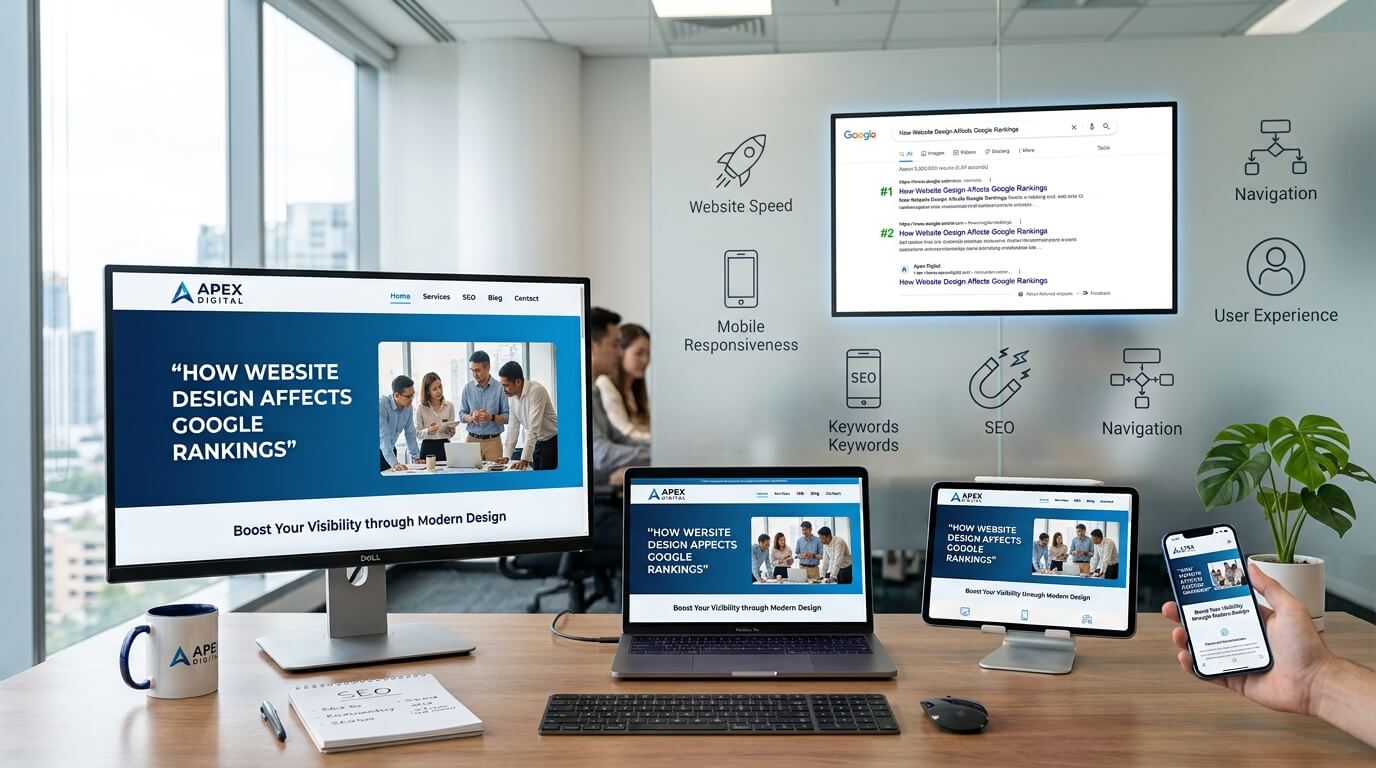
Introduction:
Website design is often discussed as a matter of visual appeal, branding, and user experience. However, its influence goes much further than how attractive a website looks. The structure, usability, speed, responsiveness, navigation, and technical foundation of a website can all affect how effectively search engines discover, understand, and evaluate its pages.
Google does not simply rank websites because they have attractive colors, modern graphics, or impressive layouts. Instead, search visibility depends on many interconnected factors, including relevance, content quality, technical accessibility, page experience, mobile usability, and how easily users can interact with the site. Good website design helps bring these elements together into a website that works well for both visitors and search engines.
A thoughtfully designed website can make content easier to discover, improve engagement, support mobile users, strengthen internal linking, and reduce technical problems that interfere with crawling and indexing. On the other hand, a visually impressive website can still perform poorly in search results if it is slow, difficult to navigate, poorly structured, or inaccessible on mobile devices.
Understanding the connection between web design and Google rankings can help businesses make better decisions when creating a new website or redesigning an existing one.
Website Design and Search Engine Optimization Are Closely Connected
Website design and SEO were once treated as separate areas of digital marketing. Designers focused primarily on appearance and usability, while SEO professionals concentrated on keywords, backlinks, metadata, and search visibility. Modern websites require these disciplines to work together.
The design of a website determines how information is organized and presented. This affects how visitors move from one page to another and how search engine crawlers discover different sections of the site. A well-structured design gives important pages clear visibility and creates logical relationships between related content.
For example, a business website might have a homepage, service pages, industry pages, location pages, blog articles, and contact information. If these pages are organized through clear navigation and contextual internal links, users and search engines can understand how the website is structured.
Poor design can create the opposite situation. Important pages may become buried several clicks deep, navigation may be confusing, or content may be loaded in ways that make it difficult for search engines to interpret. In these cases, design decisions can indirectly create SEO problems.
Design Supports the Overall Search Experience
Google’s goal is to provide users with useful results that satisfy their search intent. Website design contributes to what happens after someone clicks a search result.
If visitors arrive at a website and immediately encounter slow loading, intrusive elements, tiny text, confusing navigation, or an unusable mobile layout, the overall experience is weakened. Although individual user behavior metrics should not be oversimplified as direct ranking factors, poor experience can still affect business outcomes such as engagement, conversions, repeat visits, and the likelihood that users will continue interacting with the site.
Good design therefore supports SEO by creating an environment in which useful content can actually be consumed.
Mobile-Friendly Design Can Influence Search Performance
Mobile responsiveness is one of the most important connections between website design and search visibility. A large portion of internet activity takes place on smartphones, making mobile usability essential for modern websites.
Google uses mobile-first indexing, which means Google primarily uses the mobile version of a site’s content for indexing and ranking. This makes responsive design particularly important.
A responsive website automatically adjusts its layout to different screen sizes. Text remains readable, images fit within the screen, navigation remains usable, and important buttons can be accessed without excessive zooming or horizontal scrolling.
Why Responsive Layouts Matter
Imagine a potential customer searching for a local service on a smartphone. They click a result and discover that the website was designed primarily for desktop computers. Text is difficult to read, menus are awkward, and important information extends beyond the edge of the screen.
The visitor may leave quickly and search elsewhere.
A responsive layout creates a much smoother experience. It allows the same core content to remain available across phones, tablets, laptops, and desktop computers while adapting the presentation to the available screen space.
Mobile-friendly design also reduces the need to maintain separate desktop and mobile versions of the same website, which can simplify content management and technical SEO.
Website Speed Has an Important Role in Page Experience
Website speed is another major area where design and SEO overlap. A website may look impressive, but if its pages take too long to become usable, visitors may become frustrated.
Heavy images, excessive animations, unnecessary scripts, poorly optimized fonts, and inefficient code can all contribute to slower loading times.
Google has developed page experience metrics, including Core Web Vitals, to help evaluate aspects of loading performance, interactivity, and visual stability. These metrics are part of a broader search system rather than a simple ranking formula, but they highlight the importance of creating pages that perform well for users.
How Design Choices Affect Loading Time
Every design element has a performance cost. Large background videos, high-resolution images, animated graphics, third-party widgets, and elaborate effects can increase the amount of data a browser needs to process.
This does not mean websites should avoid visual elements altogether. Instead, designers should consider whether each element contributes meaningful value.
Images can be compressed and served in modern formats. Videos can be loaded efficiently. Unnecessary scripts can be removed. Fonts can be optimized. Content that is not immediately visible can sometimes be loaded more strategically.
The goal is not to create a plain website. The goal is to create a visually effective website without sacrificing performance.
Navigation Helps Google Understand Website Structure
Navigation is one of the clearest examples of design influencing SEO.
A good navigation system helps visitors quickly understand what a website offers. At the same time, it creates pathways through which search engine crawlers can discover important pages.
A business offering web design, SEO, branding, and digital marketing services might organize its primary navigation around those core services. Each service can then lead to a detailed page containing relevant information and links to related resources.
This creates a logical hierarchy.
Clear Navigation Improves Discoverability
Important pages should not be hidden behind confusing menus or complicated interaction patterns. Visitors should be able to identify where they are and where they can go next.
Search engines also benefit from logical website architecture because internal links help communicate relationships between pages.
For example, a blog article discussing responsive web design could link naturally to a broader web design service page. Another article about website performance could connect to a technical optimization resource.
These connections help establish topical relationships throughout the website.
Internal Linking Is Part of Effective Website Architecture
Internal links are often considered an SEO strategy, but they are also a design and usability feature.
A well-designed website naturally connects related information. When a page discusses a topic in detail, links to relevant supporting pages give users an opportunity to explore further.
Internal links can also help search engines discover content and understand which pages are related.
A website with hundreds of articles but no logical connections between them can become difficult to navigate. A website with a carefully planned internal linking structure creates a stronger information architecture.
Design Should Encourage Natural Content Discovery
Internal links should not be added randomly. They work best when they are relevant to the surrounding content.
For example, an article about choosing a website platform could naturally reference a related page explaining content management systems. A page about website redesign could connect to resources discussing website speed, responsive design, or conversion optimization.
This approach improves both usability and the logical structure of the site.
Readability Makes Content Easier to Consume
Website design directly affects how people consume written content.
Even excellent content can become difficult to read when paragraphs are excessively long, font sizes are too small, line spacing is cramped, or text is placed against distracting backgrounds.
Readable typography allows visitors to process information comfortably.
Headings, subheadings, short sections, appropriate spacing, and clear visual hierarchy can make long-form content much easier to navigate.
Visual Hierarchy Helps Search Intent
When someone lands on a page, they often scan before reading everything. Clear headings help them determine whether the page answers their question.
For SEO-focused content, headings also provide organizational context. Search engines can use page structure as one of many signals for understanding content, although headings should not be treated as a shortcut to rankings.
A properly organized article can therefore support both human readers and search engines.
Intrusive Design Elements Can Damage User Experience
Website design can also become excessive.
Pop-ups, full-screen promotional messages, autoplay videos, sticky elements, advertisements, and other overlays can interfere with the visitor’s ability to access the main content.
Google has policies and guidance concerning intrusive interstitials, particularly when they make content difficult to access on mobile devices.
Balance Promotion With Usability
Businesses naturally want visitors to subscribe, contact them, request quotes, or make purchases. However, promotional elements should not overwhelm the actual content.
A good design places calls to action where they are useful without preventing visitors from accessing the information they came to find.
The more naturally these elements fit into the user journey, the more professional and usable the website becomes.
Visual Design Can Influence Trust and Engagement
Visual credibility is another important consideration.
Visitors often form an initial impression of a business based on its website. An outdated, inconsistent, or difficult-to-use website can make an organization appear less established, even if the underlying business is reputable.
Professional design establishes consistency through typography, colors, imagery, spacing, branding, and layout.
While visual attractiveness itself is not a direct guarantee of higher Google rankings, a trustworthy and usable design can contribute to better visitor experiences and stronger business performance.
Consistency Strengthens Brand Experience
Consistent design makes websites easier to understand.
Navigation should behave predictably. Buttons should look like buttons. Headings should follow a logical hierarchy. Important information should appear in recognizable locations.
These seemingly small choices reduce cognitive effort and help visitors move through a website more confidently.
Accessible Design Supports Better Website Usability
Accessibility should also be considered during website design.
Accessible websites aim to ensure that people with different abilities can navigate and understand their content. Proper color contrast, meaningful alternative text for images, keyboard accessibility, readable typography, descriptive link text, and logical heading structures can improve usability.
Accessibility and SEO are not identical disciplines, but they frequently overlap.
For example, meaningful alternative text helps users who rely on screen readers understand relevant images. Logical headings make pages easier to navigate. Descriptive links provide context about destinations.
Designing with accessibility in mind can therefore improve the overall quality of a website.
Images and Multimedia Need Thoughtful Optimization
Images can make websites more engaging, but poorly optimized media can create technical problems.
A website containing enormous image files may load slowly, particularly for mobile users with limited bandwidth. Designers and developers should consider image dimensions, compression, modern file formats, lazy loading where appropriate, and responsive image delivery.
At the same time, images should have useful alternative text when they convey meaningful information.
Design Should Not Depend Entirely on Images
Some websites place important information exclusively inside graphics. This can make the information harder for search engines and accessibility technologies to interpret.
Whenever possible, important textual information should remain available as actual HTML text. Images should support the content rather than replace essential information.
Website Structure Can Affect Crawling and Indexing
Google needs to crawl pages before it can generally index and rank them. Website design and development choices can influence how easily crawlers access important content.
Complicated JavaScript implementations, broken links, poor internal linking, improper redirects, and inaccessible resources can all create technical challenges. A clean website architecture makes it easier to identify important pages and understand relationships among them.
A Strong Technical Foundation Matters
Designers and developers should work together to ensure that visual features do not interfere with technical accessibility. The website should have logical URLs, appropriate status codes, crawlable links, useful metadata, and a structure that allows important content to be discovered efficiently.
SEO should therefore be considered during the design stage rather than added after the website has already been built.
Website Design Factors and Their SEO Relationship
| Website Design Factor | Effect on User Experience | Potential SEO Connection |
| Mobile responsiveness | Makes websites easier to use on smartphones | Supports mobile-first indexing and usability |
| Page speed | Reduces waiting and frustration | Supports page experience and Core Web Vitals |
| Clear navigation | Helps visitors find information | Supports crawling and content discovery |
| Internal linking | Guides users to related content | Helps search engines discover and understand pages |
| Readable typography | Makes content easier to consume | Supports overall page usability |
| Image optimization | Improves loading performance | Reduces unnecessary page weight |
| Accessible design | Makes content usable by more people | Supports broader usability and content interpretation |
| Clean architecture | Creates predictable page relationships | Supports crawling and indexing |
| Limited intrusive elements | Keeps primary content accessible | Supports a better page experience |
| Consistent visual hierarchy | Makes pages easier to scan | Helps organize and communicate content |
Website Redesigns Should Consider Existing SEO Value
A redesign can improve a website considerably, but it can also create SEO problems if it is handled without planning.
Changing URLs, removing pages, restructuring navigation, changing content, or replacing internal links can affect how search engines understand an existing website.
Before redesigning a site, businesses should identify important existing pages and understand which URLs receive organic traffic or backlinks. If URLs must change, appropriate redirects should be implemented.
SEO Should Be Included Before Launch
SEO should not be treated as a final inspection after the new website is already live.
Designers, developers, content teams, and SEO specialists can collaborate during planning to establish the site architecture, navigation, content hierarchy, mobile experience, and technical requirements.
Testing before launch can identify broken links, missing metadata, indexing issues, slow pages, mobile usability problems, and other technical concerns.
This approach reduces the risk of discovering major SEO problems after the redesign has already replaced the old site.
Good Website Design Works Together With Quality Content
Design cannot compensate for poor content.
A fast and attractive website may still struggle to rank if its pages do not provide useful information relevant to what people are searching for. Google evaluates many aspects of content and relevance, so design should support a strong content strategy rather than replace one.
The best results generally come when useful content and thoughtful design work together.
A well-designed page makes valuable information easier to discover, read, understand, and act upon. Content tells visitors why the page matters, while design determines how effectively they can interact with that information.
How Businesses Can Build an SEO-Friendly Website Design
Creating an SEO-friendly website begins with understanding the audience and the information they need. From there, the site architecture can be planned around meaningful topics and services rather than purely visual preferences.
Responsive design should be established from the beginning. Performance should be considered during the selection of images, animations, fonts, scripts, and other elements. Navigation should remain straightforward, while internal links should connect related pages naturally.
Content should use a logical heading structure and provide genuine value. Images should be optimized, important information should remain accessible as text, and intrusive elements should be used carefully.
Most importantly, website design should be evaluated as an ongoing process. Search technology, user expectations, devices, and business goals change over time. Regular technical reviews and usability improvements can help a website remain effective.
Conclusion
Website design affects Google rankings through a combination of technical accessibility, usability, performance, mobile responsiveness, information architecture, and content presentation. Design is not simply about making a website look attractive. It helps determine how easily visitors can use the site and how effectively search engines can discover and understand its content.
A responsive layout, fast-loading pages, clear navigation, logical internal linking, readable content, accessible elements, and a strong technical structure can create a better foundation for organic search performance. At the same time, design works best when combined with relevant, useful, well-organized content.
For businesses investing in SEO, website design should therefore be considered part of the overall search strategy. A website built with both users and search engines in mind can provide a stronger foundation for visibility, engagement, and long-term digital growth.
FAQ
Q1. Does website design directly affect Google rankings?
Website design can influence several factors connected to search performance, including mobile usability, page experience, speed, crawlability, navigation, and content accessibility. However, rankings depend on many factors, so design alone does not determine where a page appears.
Q2. Is mobile-friendly design important for SEO?
Yes. Google uses mobile-first indexing, making it important for websites to provide their primary content and functionality effectively on mobile devices.
Q3. Can a slow website hurt SEO?
Slow performance can create a poor user experience and may affect page experience signals. Optimizing images, scripts, fonts, and other resources can help improve loading and responsiveness.
Q4. Does website navigation affect SEO?
Navigation can help users and search engines discover important pages. A logical structure with descriptive links and clear relationships between pages can support effective crawling and content discovery.
Q5. Should SEO be considered when designing a new website?
Yes. SEO is most effective when considered during the planning and development stages. Website architecture, mobile responsiveness, performance, content structure, internal linking, and technical accessibility can all be incorporated before launch.