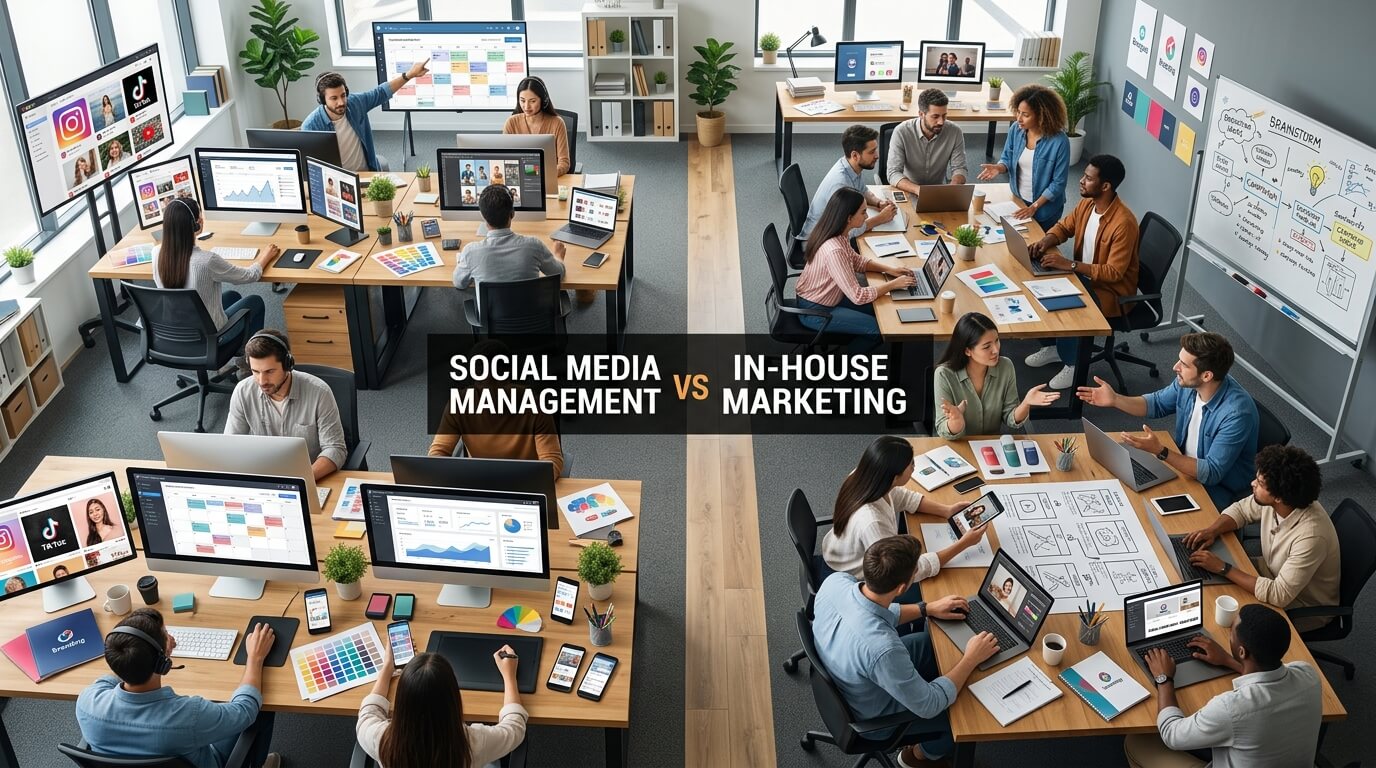
Social media has become an important part of how modern businesses communicate with customers, build credibility, generate leads, and stay competitive. For many companies, maintaining an active presence across platforms such as Facebook, Instagram, LinkedIn, TikTok, and X is no longer optional. However, simply deciding to invest in social media is only the beginning. Businesses also need to determine who should manage that presence.
Two common approaches are social media management through an external professional or agency and managing marketing activities with an in-house team. Both approaches can work well, but they offer different advantages, challenges, costs, and levels of control. The right choice depends on the company’s goals, available resources, internal expertise, industry, and expected growth.
Understanding the difference between social media management and in-house marketing can help businesses make a more informed decision. While outsourced social media management can provide specialized knowledge and flexibility, an in-house marketing team can offer deeper familiarity with the company and greater day-to-day control. In some situations, a combination of both approaches may provide the strongest results.
Understanding Social Media Management
Social media management involves planning, creating, publishing, monitoring, and improving a company’s social media presence. Professional social media managers may work independently or as part of an agency, handling responsibilities that range from content planning to community engagement and performance analysis.
A social media manager typically develops content around the company’s audience and marketing objectives. This can include educational posts, promotional campaigns, visual content, short-form videos, customer-focused stories, industry insights, and engagement-driven material. The goal is not simply to post frequently but to create content that supports broader business objectives.
External social media management can be particularly useful for businesses that do not have enough internal expertise or time to maintain consistent social channels. Instead of asking existing employees to add social media to an already demanding workload, the company can rely on specialists who focus on digital communication.
What Professional Social Media Management Includes
The responsibilities can vary considerably depending on the provider and the company’s requirements. A comprehensive social media management service may involve developing a content strategy, researching audiences, creating content calendars, writing captions, producing graphics, scheduling posts, responding to comments, monitoring brand mentions, analyzing performance, and adjusting campaigns.
Professional managers may also understand platform-specific differences. Content that works well on LinkedIn may not produce the same results on Instagram, while a video that performs strongly on TikTok may require a different presentation on Facebook. Understanding these distinctions can make a significant difference in social media performance.
Understanding In-House Marketing
In-house marketing means that a company’s marketing activities are handled by employees who work directly for the organization. An in-house team might include a marketing manager, social media specialist, content writer, graphic designer, SEO specialist, paid advertising professional, or several people with overlapping responsibilities.
One of the biggest strengths of an internal marketing team is its familiarity with the company. Employees can become deeply knowledgeable about the brand’s products, customers, culture, history, goals, and internal processes. This familiarity can make it easier to create content that reflects the company’s personality accurately.
In-house marketing also allows businesses to maintain direct control over priorities. Managers can communicate with team members immediately, make changes quickly, and coordinate social media with other marketing activities such as email campaigns, website updates, sales promotions, and events.
The Cost of Building an Internal Team
Although in-house marketing offers control, building a capable team can require substantial investment. Businesses need to consider salaries, benefits, software, equipment, training, recruitment, management, and professional development.
A company that wants a complete digital marketing operation may need several specialists rather than one employee. Expecting a single marketing professional to handle strategy, copywriting, graphic design, video editing, paid advertising, analytics, SEO, and community management can quickly become unrealistic.
This is one reason smaller businesses often consider outsourced social media management instead of immediately building a large internal department.
Social Media Management vs In-House Marketing: Key Differences
The primary difference between the two approaches is where expertise and responsibility are located. With external social media management, specialized knowledge is provided by an outside professional or agency. With in-house marketing, expertise is developed within the organization.
| Factor | Social Media Management | In-House Marketing |
| Expertise | Access to specialized professionals | Depends on internal employees |
| Control | Shared with an external provider | High internal control |
| Cost structure | Usually service-based or monthly | Salaries, benefits, tools, and training |
| Brand familiarity | Develops over time | Usually very strong |
| Scalability | Often easier to increase services | May require additional hiring |
| Flexibility | Can adapt service levels | Dependent on team capacity |
| Management | Requires external coordination | Direct internal management |
| Tools | Provider may already have professional tools | Business must provide software and resources |
| Recruitment | Usually unnecessary | Required to build the team |
| Specialized skills | Often available immediately | May take time to develop |
The Advantages of Social Media Management
One of the strongest advantages of professional social media management is access to specialized expertise. Experienced professionals work with social platforms regularly and are more likely to understand content formats, audience behavior, publishing strategies, engagement practices, and performance measurement.
For a business without an established digital marketing department, this can shorten the learning curve considerably. Instead of spending months learning how different platforms work, the business can begin with an established strategy and refine it based on results.
Access to Multiple Skills
Another advantage is that a social media agency or professional may provide access to several skills through one service. A business might receive strategic planning, content writing, graphic design, scheduling, community management, and analytics without hiring a separate full-time employee for every function.
This can be especially valuable for small and medium-sized businesses. They may need professional marketing support but may not have enough work to justify several full-time specialist positions.
Greater Scalability
External social media management can also make it easier to scale marketing activity. A business launching a new product, entering a new market, or running a seasonal campaign may temporarily need more marketing support.
An external provider may be able to increase production during these periods without requiring the company to permanently expand its workforce. This flexibility can be useful when marketing requirements fluctuate throughout the year.
The Challenges of Outsourced Social Media Management
External management is not automatically the perfect solution. One potential challenge is the distance between the business and the person managing its social presence. An outside professional may initially lack the detailed knowledge that an employee develops through daily interaction with the organization.
Effective communication is therefore important. The business needs to provide clear brand guidelines, audience information, product details, messaging priorities, and approval processes. Without sufficient communication, even a skilled social media manager may create content that feels generic or disconnected from the company’s identity.
Another concern can be consistency of collaboration. If a business works with a provider that handles many clients, communication schedules and response times may differ from those of an internal employee. Choosing an experienced provider with a clear workflow can reduce this risk.
The Advantages of In-House Marketing
The biggest advantage of an internal marketing team is proximity. Employees are part of the company every day, giving them direct exposure to new products, customer questions, internal discussions, company culture, and business priorities.
This can make content feel more authentic. An in-house marketer can quickly ask a sales representative about a common customer objection, speak with a product specialist about a new feature, or coordinate with leadership about an upcoming announcement.
Faster Internal Communication
An internal team can also make communication easier. If a campaign needs to change quickly, a marketing manager can discuss the issue with the responsible employee immediately. There is no need to communicate through an external account manager or schedule a separate meeting.
This can be particularly valuable in industries where information changes frequently or where marketing depends heavily on internal expertise.
Strong Brand Knowledge
Over time, in-house marketers can develop an exceptionally detailed understanding of a company’s brand voice. They learn what language customers respond to, which products generate the most questions, what differentiates the company from competitors, and which internal stories can be turned into valuable content.
That institutional knowledge can become a major marketing asset.
The Challenges of In-House Marketing
Despite its benefits, in-house marketing can become expensive and demanding. Hiring the right people is only the beginning. Employees need suitable software, equipment, training, management, creative resources, and opportunities to develop their skills.
Marketing also changes quickly. Social platforms introduce new formats, algorithms, advertising options, analytics tools, and content trends. An internal team needs to keep learning to remain effective.
The Risk of Limited Expertise
A small in-house team may also have skill gaps. A social media specialist might be excellent at content creation but less experienced with paid advertising. A marketing manager might understand strategy but not have strong video production skills.
Hiring multiple specialists can solve these problems but increases costs. For some businesses, outsourcing specialized tasks can therefore be more practical than building every capability internally.
Which Option Is More Cost-Effective?
Cost should be considered carefully, but it should not be the only deciding factor. Businesses sometimes compare an agency fee directly with one employee’s salary and conclude that hiring internally is cheaper. However, the actual cost of an employee includes more than salary.
Recruitment, benefits, training, software, equipment, management time, paid leave, and professional development can all contribute to the total cost. Businesses also need to consider whether one employee can realistically perform all the functions they expect.
External management can provide access to a broader range of capabilities without requiring the company to build an entire department. On the other hand, businesses with extensive marketing needs may eventually find that an internal team provides better long-term value.
Choosing Based on Business Size
Small businesses often benefit from external social media management because they may not have enough resources to hire a complete marketing team. Outsourcing allows them to establish a professional presence while keeping internal staffing relatively lean.
Growing companies may use a hybrid approach. They might have an internal marketing manager who understands the company’s strategy while working with external specialists for content production, social media management, paid advertising, or video.
Larger organizations are more likely to maintain substantial internal marketing departments because they have enough activity to justify multiple specialized roles. Even then, external agencies and freelancers can remain useful for specific campaigns or specialist projects.
Choosing Based on Marketing Goals
The right approach also depends on what a company wants to achieve. If the primary goal is consistent social media publishing and engagement, professional social media management may be sufficient.
If marketing needs to coordinate closely with product development, sales, customer service, public relations, and internal communications, an in-house team may have stronger advantages.
Companies pursuing aggressive growth may combine both. An internal team can maintain strategic control while external specialists provide additional creative or technical capacity.
When Outsourcing May Make More Sense
Outsourcing can make sense when a business lacks marketing expertise, wants to improve consistency, needs specialized skills, or wants to scale activity without hiring several employees. It can also be useful when leadership does not have enough time to manage social media effectively.
Businesses that repeatedly struggle to maintain posting schedules may benefit from professional support because consistency is often difficult when social media is treated as an occasional task rather than a dedicated responsibility.
When In-House Marketing May Make More Sense
An internal team may be preferable when marketing requires constant collaboration with other departments, when the company has complex products, or when brand knowledge is particularly important.
Companies with established marketing budgets and sufficient workloads may also benefit from building long-term internal expertise. Over time, an experienced internal team can become deeply connected to the organization’s overall strategy.
The Hybrid Marketing Model
Businesses do not necessarily have to choose one approach exclusively. A hybrid model can combine the strengths of both.
For example, an internal marketing manager can establish brand strategy, approve messaging, coordinate campaigns, and communicate with leadership. An external social media team can then handle content production, platform management, analytics, or specialized campaigns.
This arrangement gives the business internal ownership while providing access to external expertise. It can also prevent internal employees from becoming overloaded with tasks that require specialized production skills.
The key is to establish clear responsibilities. When both internal and external teams are involved, everyone should understand who controls strategy, who creates content, who approves posts, who responds to customers, and who evaluates performance.
How to Make the Right Decision
Businesses should begin by evaluating their current resources rather than choosing based purely on trends. Consider how much marketing work is required, what skills already exist internally, how much budget is available, and how closely marketing needs to interact with other departments.
It is also useful to evaluate the company’s long-term plans. A business preparing for rapid expansion may need more internal marketing ownership in the future, while a smaller organization may prefer to remain flexible and outsource specialized work.
The quality of the people involved matters just as much as the structure itself. A highly capable in-house marketer can outperform a poorly managed agency, while an experienced social media team can deliver stronger results than an understaffed internal department.
Ultimately, the decision should focus on capability, consistency, communication, and measurable outcomes rather than simply choosing the option with the lowest immediate cost.
Conclusion
Social media management and in-house marketing both offer meaningful advantages, but they solve different business needs. External social media management provides access to specialized skills, flexibility, scalability, and potentially broader expertise without requiring a company to build a large internal team. In-house marketing provides control, deep brand knowledge, faster internal communication, and long-term institutional expertise.
There is no universal answer for every business. Smaller companies may benefit from outsourcing, established organizations may prefer internal teams, and growing businesses may find a hybrid approach most effective. The best choice is the one that provides the expertise, consistency, communication, and strategic support needed to turn social media activity into meaningful business results.
Frequently Asked Questions
Q. Is social media management the same as marketing?
No. Social media management is one part of broader marketing. It focuses primarily on managing social platforms, content, engagement, and social performance, while marketing can include SEO, email, advertising, branding, market research, sales support, and other activities.
Q. Is in-house marketing more expensive than social media management?
It can be, particularly when a business needs several specialists. In-house marketing may involve salaries, benefits, software, equipment, training, and management costs. External social media management typically uses a service-based pricing structure, although costs vary considerably by provider and scope.
Q. Can a small business manage social media in-house?
Yes. A small business can manage its social media internally if it has sufficient time, knowledge, and resources. However, businesses should avoid assigning social media to an employee without providing adequate time and training, as inconsistent management can limit results.
Q. What is a hybrid marketing approach?
A hybrid approach combines internal and external marketing resources. For example, an internal team may manage strategy and brand direction while an external social media specialist handles content creation, publishing, community management, or analytics.
Q. How should a business decide between outsourcing and hiring internally?
A business should consider its budget, marketing workload, internal expertise, growth plans, need for specialized skills, and desired level of control. Comparing these factors can reveal whether external support, an internal team, or a combination of both is the most practical solution.