Introduction
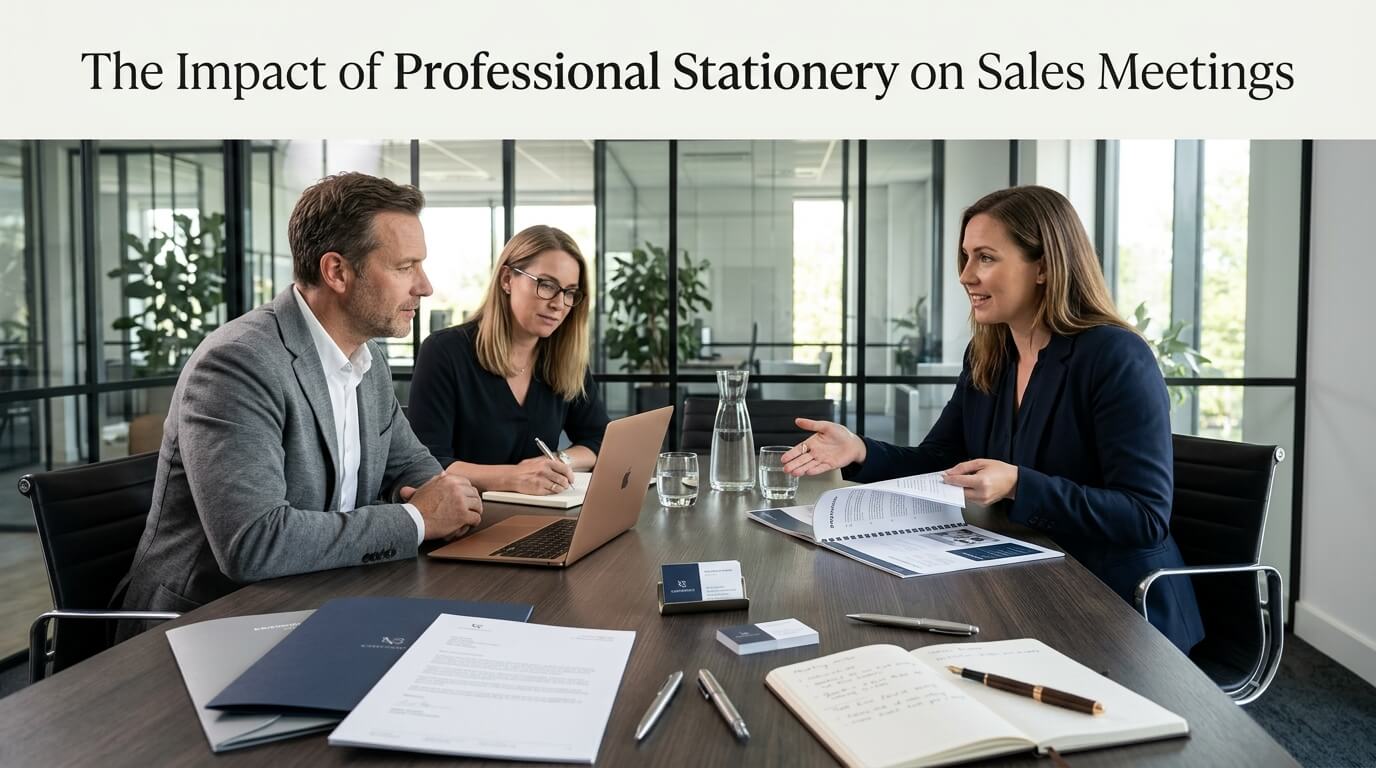
Sales meetings are important opportunities for businesses to build relationships, present solutions, demonstrate expertise, and turn potential customers into long-term clients. While sales professionals often focus on presentations, pricing strategies, product demonstrations, and negotiation techniques, smaller details can also influence how a business is perceived. Professional stationery is one such detail. From branded letterheads and business cards to presentation folders, notepads, envelopes, and printed proposals, stationery contributes to the overall impression a company creates during a meeting.
In a competitive business environment, customers evaluate more than the product or service being offered. They also consider the professionalism, organization, reliability, and attention to detail demonstrated by the people representing the company. Well-designed stationery can reinforce these qualities by making business materials look consistent, organized, and credible. Although stationery alone cannot guarantee a successful sale, it can support a salesperson’s efforts by strengthening brand recognition and creating a more polished customer experience.
Professional stationery also serves practical purposes during sales discussions. It helps organize documents, provides convenient spaces for taking notes, presents important information clearly, and gives prospects tangible materials to review after a meeting. When these materials reflect a consistent brand identity, they help connect the meeting experience with the company’s broader image.
Understanding the impact of professional stationery on sales meetings allows businesses to make more thoughtful decisions about their marketing materials. By combining effective communication with professional design, companies can create a more memorable impression and support the development of productive business relationships.
What Is Professional Stationery in a Sales Environment?
Professional stationery refers to printed or digitally prepared business materials that communicate a company’s identity and support its daily operations. In sales meetings, these materials often include business cards, letterheads, branded notebooks, presentation folders, proposal covers, printed brochures, and customized notepads. Each item serves a particular purpose, but together they create a consistent visual experience for potential customers.
Unlike generic office supplies, professionally designed stationery reflects the company’s visual identity through its logo, colors, typography, layout, and overall presentation. These elements should align with the brand’s website, marketing materials, sales presentations, and other customer-facing communications. Consistency helps prospects recognize the company and understand that its communications follow an organized standard.
For example, a consulting firm presenting a business improvement strategy might use a branded folder containing its proposal, service overview, and contact information. A real estate company might provide clients with a professional information pack containing property details, meeting notes, and a business card. In both situations, the stationery supports the sales conversation while giving the prospect something useful to keep.
Professional stationery is most effective when it combines appearance with functionality. Attractive materials can capture attention, but their real value comes from making information easier to understand, helping customers remember the business, and supporting the salesperson’s message.
How Professional Stationery Creates a Strong First Impression
Establishing Credibility Before the Sales Pitch
First impressions often develop before a salesperson begins discussing a product or service. Customers notice how a representative arrives, organizes documents, introduces the company, and presents information. Clean, well-designed stationery can contribute to an impression of preparation and professionalism.
When a salesperson distributes neatly arranged documents in a branded folder or provides a business card with clear contact information, the presentation appears deliberate. These details suggest that the company has considered how it communicates with customers. This can be especially valuable when meeting prospects who have little previous experience with the business.
However, credibility depends on more than appearance. Sales representatives must also demonstrate product knowledge, honesty, responsiveness, and a genuine understanding of customer needs. Stationery should reinforce these qualities rather than attempt to replace them. A polished proposal containing relevant information and realistic recommendations is more convincing than an expensive folder filled with vague sales claims.
Demonstrating Attention to Detail
Attention to detail matters in many business relationships, particularly when customers are considering significant investments or long-term contracts. Errors in a proposal, inconsistent branding, poorly printed documents, or illegible contact information may distract prospects from the value being offered.
Professional stationery helps establish a standard for how business materials are prepared. Consistent formatting, readable typography, appropriate paper quality, and accurate information show that the company takes its presentation seriously. These details may encourage prospects to approach the sales discussion with greater confidence.
For businesses offering design, consulting, financial, legal, or corporate services, this consistency can be particularly relevant. Customers may expect the same care in the final service that they observe in the sales process. Although stationery cannot prove operational quality by itself, it can support the company’s broader reputation for careful and organized work.
Strengthening Brand Recognition During Sales Meetings
Creating a Consistent Visual Identity
Brand recognition develops when customers repeatedly encounter consistent visual and verbal elements associated with a business. A logo, color palette, typography system, and recognizable layout can help prospects connect different interactions with the same organization.
Professional stationery introduces these elements into the physical sales environment. A branded notebook, proposal folder, business card, and letterhead can all communicate the same identity without requiring a salesperson to explain the company’s branding. When prospects see these materials alongside a presentation or product demonstration, the business becomes easier to identify and remember.
Consistency is particularly useful for companies participating in trade shows, corporate networking events, client consultations, and multi-stage sales processes. A prospect may meet a representative at an event, receive a printed proposal several days later, and exchange follow-up correspondence the following week. If every communication looks consistent, it becomes easier to recognize that each interaction belongs to the same company.
Making the Business More Memorable
Sales meetings often involve several competing vendors. Prospects may review similar proposals, compare prices, and speak with multiple representatives before making a decision. In these circumstances, a clear and consistent presentation can help a business remain recognizable after the meeting ends.
Useful stationery provides a physical reminder of the interaction. A well-designed business card can preserve contact details, while a branded notepad or folder may remain on the customer’s desk. A proposal cover featuring the company’s identity can also help distinguish the document from other materials the prospect receives.
Memorability should not be confused with visual extravagance. Bright colors, unusual finishes, and elaborate graphics are not always appropriate for every industry. A simple, professional design may be more effective when the business wants to communicate reliability, clarity, and sophistication. The goal is to create a recognizable identity that supports the company’s message rather than distracts from it.
Improving the Organization and Flow of Sales Discussions
Keeping Sales Materials Structured
A productive sales meeting requires a clear flow of information. Representatives may need to explain the customer’s problem, introduce a proposed solution, discuss pricing, review timelines, and answer questions. When documents are disorganized, the conversation can become interrupted by unnecessary searching and page turning.
Professional stationery helps establish a consistent structure for sales materials. Presentation folders can separate proposals from brochures, pricing documents, case studies, and supporting information. Clearly labeled sections make it easier for representatives to locate relevant details during the discussion.
A prospect who can follow the information without difficulty may find it easier to evaluate the proposed solution. The organization of the materials also allows salespeople to move between topics more smoothly, keeping the discussion focused on the customer’s priorities.
Supporting Note-Taking and Collaboration
Sales meetings are not simply opportunities for businesses to deliver information. They are also occasions for listening, asking questions, and identifying customer requirements. Branded notebooks and notepads can provide a convenient space for recording concerns, deadlines, preferences, and agreed-upon next steps.
When a representative takes notes during a discussion, it can demonstrate attentiveness and help prevent important details from being overlooked. A notebook also allows the salesperson and prospect to work through ideas together, record potential solutions, or clarify the responsibilities involved in a proposed project.
For instance, a software sales representative might use a meeting notepad to record the prospect’s current systems, integration requirements, and implementation concerns. These notes can then inform a more relevant follow-up proposal. In this situation, stationery supports the quality of the sales process by helping the representative gather and organize useful information.
The Role of Professional Stationery in Building Customer Trust
Trust is a central factor in purchasing decisions, especially when customers must commit significant money, share sensitive information, or enter into long-term agreements. Prospects want to understand whether a company is dependable, communicates clearly, and takes its commitments seriously.
Professional stationery can contribute to this perception by presenting information in a consistent and organized way. A formal proposal on branded letterhead, for example, can make the document easier to identify and associate with the business. Clear contact details and consistent company information can also help customers understand whom they are dealing with.
Nevertheless, trust cannot be created through design alone. Misleading claims, hidden charges, unrealistic delivery promises, or poor communication can undermine even the most polished presentation. Stationery works best when it supports transparent sales practices and accurate information.
Presenting Proposals With Greater Professionalism
A sales proposal often becomes one of the most important documents a prospect receives. It may contain the recommended solution, pricing, scope of work, expected results, project schedule, and terms of engagement. Its presentation influences how easily the customer can review and evaluate the offer.
A professionally designed proposal cover, consistent headings, readable typography, and carefully arranged pages can make the document easier to navigate. Branded letterheads and footers can identify the company, while restrained use of color can highlight important sections without overwhelming the content.
The quality of the proposal’s substance remains essential. Customers need specific recommendations, understandable pricing, realistic timelines, and clear explanations of how the solution addresses their needs. Professional stationery makes this information easier to present, but the value of the proposal ultimately depends on the strength of its content.
How Different Types of Stationery Support Sales Performance
Different stationery items contribute to sales meetings in different ways. Businesses should choose materials according to their industry, customer expectations, meeting format, and budget rather than purchasing every available item.
| Stationery item | Primary purpose in sales meetings | Potential business benefit |
| Business cards | Sharing contact details | Supports networking and follow-up communication |
| Branded letterheads | Presenting formal correspondence and proposals | Creates consistent company identification |
| Presentation folders | Organizing proposals and supporting documents | Keeps sales materials structured and accessible |
| Branded notepads | Recording customer needs and meeting outcomes | Supports listening, collaboration, and organization |
| Printed brochures | Explaining products and services | Gives prospects reference material to review later |
| Proposal covers | Presenting customized offers | Makes important documents easier to identify and navigate |
| Envelopes | Delivering printed business correspondence | Maintains branding across formal communications |
| Thank-you cards | Following up after a meeting | Adds a personal touch to the customer relationship |
Business Cards That Encourage Follow-Up
Business cards remain useful in face-to-face sales meetings because they provide a straightforward way to exchange contact information. A card should include the representative’s name, professional role, company name, and relevant contact details. Depending on the business, a website address or QR code may also help prospects access additional information.
Readability is more important than including every possible detail. Extremely small text, excessive graphics, and crowded layouts can make a card difficult to use. A clear design helps recipients find the information they need without effort.
A business card also creates an opportunity for a salesperson to reinforce the meeting’s key message. Offering the card while summarizing the next step, such as arranging a demonstration or sending a detailed proposal, connects the physical item with a meaningful business interaction.
Branded Folders and Printed Proposals
Presentation folders are especially helpful when a meeting involves multiple documents. They can hold a customized proposal, service descriptions, supporting research, pricing information, and contact details in one organized package. This makes the information easier to transport and review.
Folders should be designed to accommodate the actual materials being used. A folder that is too small may damage documents, while one with unnecessary inserts can become bulky. Thoughtful organization and suitable paper quality generally contribute more to usability than decorative features alone.
Letterheads and Formal Business Communication
Letterheads are useful when sales representatives provide quotations, partnership proposals, formal summaries, or written commitments. A consistent letterhead establishes a recognizable framework for business correspondence and can make it easier for recipients to identify the sender.
The design should leave sufficient space for the document’s content while displaying the company’s identity clearly. Contact details should be accurate, and the logo should remain legible when the document is printed or viewed digitally. A letterhead that overwhelms the page can reduce readability, so a balanced design is preferable.
Professional Stationery and the Customer Experience
The customer experience includes every interaction a prospect has with a business, from the first introduction to the final purchase decision. Although sales conversations and service quality have the greatest influence, the materials used during those interactions can make the process more convenient and coherent.
Professional stationery contributes to this experience by reducing friction. Organized folders help prospects locate documents, clearly formatted proposals simplify comparisons, and branded notes can help preserve the details of a discussion. When the materials are easy to use, customers can spend more time evaluating the solution and less time trying to interpret the information.
Personalizing Materials for Individual Prospects
Personalization can make stationery and sales documents more relevant to a particular customer. A proposal that includes the prospect’s company name, business challenges, objectives, and recommended approach demonstrates that the representative has prepared for the discussion.
This does not mean every item needs to be custom printed. Businesses can use standardized branded stationery while personalizing the documents placed inside it. This approach balances consistency with flexibility and can be more cost-effective than producing completely customized materials for every meeting.
Personalized content must also be accurate. Using the wrong company name, outdated figures, or details from another prospect can damage credibility. A review process before each meeting helps ensure that customized materials reflect the customer’s actual needs.
Creating a Professional Follow-Up Experience
The sales process often continues after the meeting. Representatives may send proposals, confirm agreed-upon details, answer questions, or provide additional documentation. Stationery that maintains a consistent identity across these communications can help create a connected experience.
For example, a representative might send a formal summary on branded letterhead, followed by a detailed proposal and a personalized thank-you message. Each communication should refer to the meeting accurately and provide a clear next step.
Printed materials are not always necessary for follow-up. Email and digital proposals may be more convenient for customers who work remotely or prefer electronic records. The important consideration is consistency. Whether a document is printed or digital, its design and content should reinforce the same professional standards.
Choosing the Right Stationery for Different Sales Meetings
The most suitable stationery depends on the purpose of the meeting and the expectations of the audience. A high-level executive presentation may require a concise proposal and a well-organized folder, while a creative consultation might benefit from notebooks, visual samples, and working documents that encourage collaboration.
| Sales meeting type | Recommended stationery | Design priority |
| First client introduction | Business cards and a concise company overview | Clarity and brand recognition |
| Corporate proposal meeting | Proposal folder, letterhead, and pricing document | Structure and credibility |
| Product demonstration | Notepad, product information sheet, and business card | Practicality and clear information |
| Creative consultation | Branded notebook and printed concept samples | Collaboration and visual clarity |
| Partnership negotiation | Formal proposal and supporting documents | Accuracy and consistency |
| Trade show or networking event | Business cards and concise brochures | Recognition and easy distribution |
| Follow-up meeting | Updated proposal and meeting summary | Continuity and relevance |
Matching Materials to the Industry
Industry expectations should guide stationery decisions. A law firm or financial consultancy may benefit from understated typography, neutral colors, and high-quality paper that communicates formality. A creative agency may prefer more expressive layouts, distinctive colors, or unconventional paper finishes that reflect its design capabilities.
Technology companies may rely more heavily on digital presentations, but printed summaries can still help during in-person discussions. Manufacturers and product suppliers may benefit from technical sheets, specification documents, or sample cards that allow customers to examine details.
The best stationery is not necessarily the most expensive or visually elaborate. It is the stationery that supports the meeting’s purpose, suits the audience, and makes the company’s information easier to use.
The Financial Value of Investing in Professional Stationery
Professional stationery involves design, printing, materials, and ongoing replenishment costs. Businesses should therefore evaluate it as part of their broader sales and marketing budget rather than treating it as an isolated expense.
The financial value depends on how stationery supports sales activities. Reusable templates can reduce the time required to prepare documents, standardized folders can improve organization, and consistent branding can strengthen the presentation of customer-facing materials. These operational benefits may justify the investment even when it is difficult to measure the direct influence of stationery on individual sales.
Balancing Quality and Cost
A practical stationery budget begins with identifying which items sales representatives use regularly. Business cards, proposal templates, and digital letterheads may be essential, while premium folders or specialty paper may only be necessary for certain client meetings.
Businesses can control costs by standardizing designs, ordering reasonable quantities, using versatile templates, and reviewing printing requirements before committing to large production runs. It is also important to consider waste. Ordering excessive stationery can lead to outdated materials when contact details, branding, or company information changes.
Quality should be judged by suitability and usability rather than price alone. A moderately priced, well-designed business card may be more effective than an expensive card with unreadable text. Similarly, a clear digital proposal may serve a customer better than a costly printed document that contains little useful information.
Measuring the Contribution to Sales Outcomes
Because stationery is only one element of a sales interaction, businesses should avoid assuming that polished materials automatically increase revenue. Instead, they can evaluate whether changes improve the overall sales process.
For example, a company can gather feedback from sales representatives about document organization, track how frequently printed materials are requested, and review whether prospects find proposals easy to understand. It can also compare the time required to prepare documents before and after introducing standardized templates.
Sales conversion rates, follow-up response rates, and proposal acceptance rates may provide useful context, but these measures are influenced by many factors, including pricing, product fit, sales skills, and market conditions. Stationery’s contribution should therefore be assessed alongside the wider sales strategy rather than credited with results it cannot independently explain.
Common Mistakes to Avoid When Using Professional Stationery
One common mistake is prioritizing appearance over usefulness. A folder may look impressive but fail to accommodate important documents, while a business card may feature an elaborate design that makes contact details difficult to read. Stationery should always serve a clear purpose.
Another mistake is using inconsistent branding across different materials. When business cards, proposal covers, letterheads, and brochures use different logos, colors, or company details, the overall presentation can appear fragmented. Establishing basic brand guidelines helps prevent these inconsistencies.
Poor-quality printing can also undermine the intended effect. Blurred logos, uneven margins, faded colors, and incorrect paper sizes can make materials look unfinished. Reviewing digital proofs and checking printed samples before placing a large order can reduce these problems.
Businesses should also avoid overwhelming prospects with excessive documentation. A sales meeting is more productive when representatives provide relevant information in a logical order rather than distributing every brochure, service description, and promotional item available. Materials should support the conversation and respect the prospect’s time.
Finally, stationery should not replace preparation. Sales representatives must understand the customer’s requirements, anticipate questions, communicate honestly, and explain how the proposed solution creates value. Professional materials can strengthen these efforts, but they cannot compensate for an irrelevant offer or an unprepared representative.
The Future of Professional Stationery in Modern Sales Meetings
Sales meetings increasingly combine in-person discussions with video calls, digital presentations, and electronic document sharing. As businesses adopt these hybrid approaches, professional stationery is evolving rather than disappearing.
Digital letterheads, branded proposal templates, interactive business cards, and QR-enabled printed materials can connect physical documents with online resources. A business card, for instance, may direct a prospect to a service portfolio, while a printed proposal can include a QR code linking to a product demonstration. These features make it possible to combine the familiarity of physical materials with the convenience of digital communication.
Sustainability is also becoming an important consideration for businesses choosing stationery. Recycled paper, responsibly sourced materials, recyclable packaging, and smaller print runs can reduce waste. Companies can reserve printed materials for meetings where they provide clear value and use digital versions when electronic delivery is more convenient.
The future of stationery will likely depend on thoughtful integration rather than a choice between print and digital communication. Businesses that understand their customers’ preferences can create a consistent experience across both formats while keeping materials practical, accessible, and aligned with their brand identity.
Conclusion
Professional stationery can play a valuable supporting role in successful sales meetings. It helps businesses create a credible first impression, reinforce brand recognition, organize information, and provide customers with useful materials to review after a discussion. Business cards, branded folders, letterheads, notepads, and proposals each contribute to a more consistent and organized sales experience.
However, stationery is most effective when it complements strong communication, relevant solutions, honest pricing, and attentive customer service. Businesses do not need extravagant materials to make an impression. They need stationery that reflects their identity, meets their customers’ needs, and makes important information easy to understand.
By investing in thoughtful design, consistent branding, and practical materials, companies can strengthen their sales presentations and support more productive client relationships.
Frequently Asked Questions
Q1. How Does Professional Stationery Improve Sales Meetings?
Professional stationery helps sales representatives present information clearly, organize documents, reinforce brand identity, and create a polished impression. It supports the sales conversation by making materials easier to recognize, review, and retain.
Q2. Which Stationery Items Are Most Important for Sales Meetings?
Business cards, branded letterheads, presentation folders, notepads, and professionally formatted proposals are among the most useful items. The best selection depends on the meeting’s purpose, the industry, and the customer’s preferences.
Q3. Can Professional Stationery Help Build Customer Trust?
Yes, professional stationery can support trust by demonstrating consistency, organization, and attention to detail. However, genuine trust also depends on honest communication, reliable service, accurate information, and delivering on commitments.
Q4. Is Expensive Stationery Necessary for Successful Sales Meetings?
No. Effective stationery does not have to be expensive. Clear typography, consistent branding, appropriate materials, and useful information are generally more important than costly finishes or elaborate designs.
Q5. Is Printed Stationery Still Relevant in Digital Sales Environments?
Yes. Printed stationery remains useful for face-to-face meetings, networking events, formal proposals, and product consultations. Businesses can combine printed materials with digital documents and QR codes to provide a consistent experience across communication channels.