Introduction
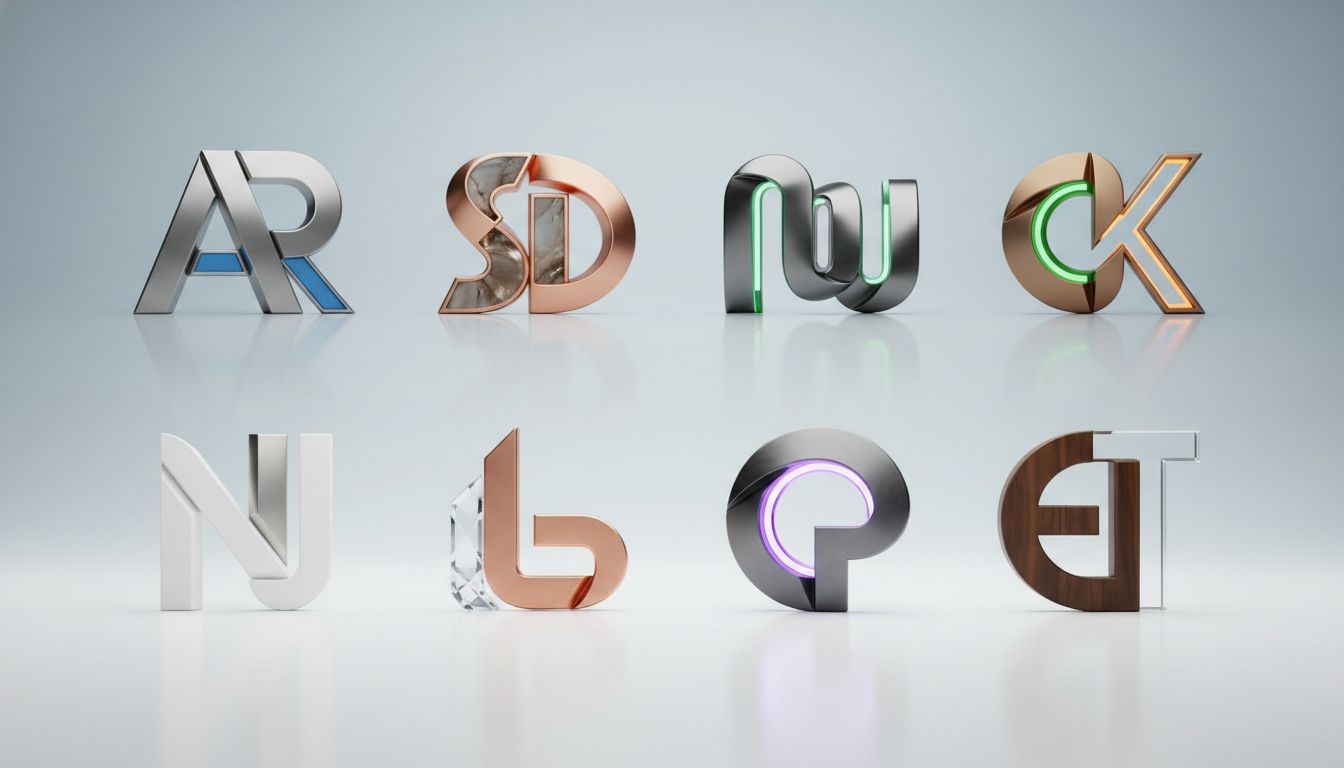
In the highly competitive and ever-evolving landscape of brand identity, achieving instant recognition is the ultimate goal for any business. One of the most effective ways to establish this immediate visual connection is through a lettermark or monogram logo. From the iconic golden arches of McDonald’s to the interlocking “CC” of Chanel, single letters and initials have proven time and again to be powerful, scalable, and timeless assets in a brand’s arsenal. If you are looking to revitalize your brand identity or build a new one from scratch, exploring exactly how to manipulate typography is a critical first step. In this comprehensive guide, we will delve deeply into 8 Creative Letter Logo Design Ideas For Inspiration, providing you with actionable insights and industry trends to help you craft a truly unforgettable logo.
The beauty of a letter logo lies in its inherent simplicity combined with its boundless potential for creativity. Unlike complex illustrative logos that can lose detail when scaled down for mobile screens or social media avatars, letter logos maintain their crispness and legibility across all mediums. Current industry trends lean heavily toward minimalism, negative space manipulation, and bespoke typography. Consumers today are bombarded with thousands of brand messages daily; therefore, a logo must communicate its core message in a fraction of a second. By stripping away extraneous graphical elements and focusing on the core initials of a business name, brands can create a sleek, modern, and highly adaptable visual identity.
Throughout this article, we will explore the psychology behind typographic choices, the structural execution of monogram designs, and how various industries leverage different letterform styles to attract their target audiences. Whether you are a startup tech firm, a luxury fashion boutique, or a corporate consultancy, the definitive 8 Creative Letter Logo Design Ideas For Inspiration outlined below will serve as a foundational blueprint for your next branding project.
Why Choose a Letter Logo for Your Business?
Before diving into the specific design ideas, it is crucial to understand why letter logos (also known as lettermarks or monograms) are so highly revered in the design community. A lettermark is a typography-based logo that is comprised of a few letters, usually a company’s initials. This design strategy is not just an aesthetic choice; it is a strategic business decision rooted in cognitive psychology and market scalability.
First and foremost, letter logos excel in brand name reinforcement. If your business has a long, multi-word name (such as International Business Machines), condensing it into a memorable acronym (IBM) makes it significantly easier for consumers to recall. The visual representation of these initials becomes a shorthand for the entire corporate entity.
Secondly, letter logos offer unparalleled versatility and scalability. In today’s digital-first world, your logo must look as striking on a tiny smartwatch screen or a browser favicon as it does on a massive highway billboard. Because letter logos rely on bold typographic forms rather than intricate illustrations, they do not lose their impact or legibility when drastically reduced in size.
Finally, a well-executed letter logo communicates authority and established trust. Many of the world’s oldest and most prestigious institutions—from universities to luxury fashion houses—utilize monograms. Adopting this style can subconsciously signal to your audience that your brand is premium, professional, and built to last.
8 Creative Letter Logo Design Ideas For Inspiration
Creating a letter logo is far more complex than simply typing out an initial in a standard font. It requires a deep understanding of negative space, geometry, and visual weight. Below, we explore the top 8 Creative Letter Logo Design Ideas For Inspiration to guide your branding journey.
1. The Power of Negative Space
Negative space, or the empty space around and between the subject of an image, is one of the most brilliant tools a logo designer can utilize. Instead of just focusing on the letter itself, designers look at the spaces inside the letterforms to hide secondary symbols or meanings. This technique relies on the Gestalt principle of figure-ground organization, where the human brain naturally seeks to make sense of background shapes.
A classic example is the FedEx logo, which famously hides an arrow in the negative space between the “E” and the “x”. When applying this to a single letter logo, you might carve a subtle shape out of the stem of a “P” or use the empty space inside an “O” to represent a globe or a coffee bean. Negative space logos are highly engaging because they offer a “eureka” moment for the viewer. Once the hidden element is discovered, it creates a lasting cognitive bond between the consumer and the brand.
2. Minimalist and Geometric Lettermarks
Minimalism continues to dominate the world of corporate branding. The geometric lettermark strips a letter down to its absolute barest essentials—perfect circles, precise squares, and exact triangles. By designing a letter entirely on a mathematical grid, the resulting logo feels incredibly modern, stable, and balanced.
This design idea is highly recommended for technology companies, architectural firms, and financial institutions. Geometric letters communicate precision, order, and logic. For example, creating an “M” out of three perfect, interlocking triangles, or a “C” from a mathematically perfect semi-circle, projects an image of a company that is forward-thinking and detail-oriented. The starkness of the geometry also ensures maximum legibility across all digital platforms.
3. Interlocking and Overlapping Initials
If your brand relies on two or three initials, interlocking them into a single, cohesive unit is a timeless strategy. This is the classic “monogram” approach, heavily utilized by luxury fashion brands (like Yves Saint Laurent or Louis Vuitton) and professional sports teams. By weaving the letters together, you create a new, distinct symbol that is greater than the sum of its parts.
When executing an interlocking letter logo, designers must carefully manage visual hierarchy and legibility. The overlapping intersections can be handled by creating subtle drop shadows, cutting away small gaps where the lines meet to create an illusion of depth, or using contrasting colors. This style exudes heritage, luxury, and exclusivity, making it perfect for high-end real estate, bespoke tailoring, and boutique hospitality brands.
4. Custom Typography and Hand-Lettered Logos
In a digital world saturated with pristine, computer-generated graphics, hand-lettered logos offer a breath of fresh air. Custom typography ensures that your letter logo is 100% unique and cannot be replicated by simply downloading a commercial font. This approach involves a designer sketching the letterforms by hand before digitizing them, resulting in organic, flowing lines that possess genuine character.
Hand-lettered initials are exceptionally effective for artisanal brands, organic food companies, independent cafes, and creative freelancers. The slight imperfections and human touch inherent in custom lettering communicate approachability, warmth, and authenticity. Furthermore, custom typography offers superior trademark protection, as the exact curves and swashes of the letterform are entirely proprietary to your business.
5. Gradient and 3D Letter Designs
As screen technologies advance, the limitations of flat design are being pushed aside in favor of vibrant, dynamic gradients and subtle 3D effects. While flat design is safe, a beautifully executed gradient can make a letter logo pop off the screen, giving it volume, lighting, and texture. This trend is particularly popular in the Web3, app development, and digital marketing sectors.
When using gradients in a letter logo, the key is subtlety. Transitioning from a deep, rich violet to a vibrant magenta can give a simple “V” a sense of forward momentum and energy. Similarly, applying an isometric 3D grid to a letterform can make it look like a physical, tangible object. It is vital, however, to ensure that the logo still functions in a single-color format for instances where gradient printing is not possible, such as on physical receipts or embossed materials.
6. Spliced and Cropped Letters
The human brain is a powerful pattern-recognition machine. The psychological principle of “closure” states that when we see an incomplete image, our minds automatically fill in the missing visual information to create a whole. Logo designers leverage this by intentionally slicing, cropping, or removing portions of a letterform.
A spliced letter logo might feature an “A” with the crossbar removed, or an “S” sliced horizontally with the two halves slightly offset. This creates an edgy, contemporary look that demands a second glance from the viewer. The intentional visual disruption communicates innovation, disruption, and a break from tradition. This creative idea is highly suited for modern fashion labels, disruptive tech startups, and avant-garde creative agencies.
7. Continuous Line and Monoline Letters
Monoline logos are constructed using a single, continuous line of uniform thickness. This design style resembles a wire bent into the shape of a letter, or a neon sign. The elegance of the monoline letter logo lies in its fluidity and simplicity. Because the line weight never changes, the design feels incredibly balanced, light, and approachable.
Continuous line letters often evoke a sense of connectivity and flow. For this reason, they are phenomenal choices for networking groups, logistics companies, and telecommunications brands. The unbroken line subconsciously communicates smooth processes, uninterrupted service, and holistic solutions. When paired with a vibrant accent color, a monoline lettermark stands out as both playful and highly professional.
8. Combining Letters with Brand Symbols
Sometimes, a letter alone isn’t quite enough to tell the full story of your brand. In these cases, designers embed a relevant symbol or icon directly into the anatomy of the letter. This is a brilliant way to communicate your industry or niche without having to add a separate, disconnected icon next to your wordmark.
For instance, a landscaping company might design a letter “G” where the top terminal blossoms into a subtle leaf. A music production company might manipulate the stems of an “M” to resemble the peaks and valleys of an audio waveform. By fusing the letter and the symbol into one cohesive graphic, you achieve a compact, highly communicative logo that works exceptionally well as a social media profile picture or an app icon.
The Psychology Behind Letter Logo Designs
Understanding the psychological impact of typography is essential when developing a letter logo. The style of the letterform you choose will subconsciously dictate how consumers perceive your brand’s personality, pricing, and trustworthiness. Every curve, angle, and serif carries psychological weight.
Serif Letterforms: Letters with serifs (the small, decorative strokes at the ends of the main lines) are deeply rooted in history and tradition. A serif letter logo communicates authority, reliability, and sophistication. Law firms, financial advisors, and legacy luxury brands often use serif letters to project an image of established trustworthiness and high-end quality.
Sans-Serif Letterforms: Sans-serif letters lack these decorative strokes, resulting in clean, crisp, and modern lines. These letter logos communicate approachability, innovation, and straightforwardness. The vast majority of modern technology companies use sans-serif typography because it feels democratic, futuristic, and is highly legible on low-resolution digital displays.
Script and Cursive Letterforms: Script letters mimic handwriting and calligraphy. They are inherently elegant, fluid, and artistic. A script letter logo is ideal for brands that want to communicate grace, creativity, and personal touch, such as wedding photographers, boutique bakeries, and high-end salons.
Slab Serif Letterforms: Slab serifs feature thick, block-like serifs that project immense strength, durability, and confidence. These heavy letterforms are perfectly suited for construction companies, athletic wear brands, and manufacturing businesses that need to communicate ruggedness and steadfast reliability.
How to Execute Your Letter Logo Perfectly
Having a great idea is only half the battle; flawless execution is what separates amateur branding from world-class corporate identity. The process of creating a standout letter logo involves rigorous sketching, vectorization, and stress-testing.
Start with extensive pencil sketching. Do not jump straight into design software. Sketching allows the brain to explore dozens of iterations, combinations, and spatial relationships rapidly. Once you have a solid concept, move to a vector graphics editor. Vector formats ensure that your logo can be scaled to any size without losing resolution.
During the digital phase, pay close attention to the grid and alignment. Even a millimeter of misalignment in a minimalist letter logo can make the entire design look unprofessional. Test the logo in pure black and white before adding color. If the lettermark does not work in a single color, it is not a strong design.
Finally, consider partnering with professionals. Developing a brand identity that captures your company’s essence while adhering to the strict rules of typography is a complex task. When seeking professional execution, partnering with an expert agency like London Logo Designs ensures that your vision is translated into a technically flawless, market-ready brand asset that resonates with your target audience.
Key Takeaways
- Scalability is Crucial: Letter logos are highly adaptable and maintain their visual integrity across all digital and physical mediums, from tiny app icons to large billboards.
- Negative Space is Powerful: Utilizing the empty space within and around a letterform can hide clever symbols, creating a memorable “aha” moment for your audience.
- Psychology Matters: The style of your letter (serif, sans-serif, script, or geometric) dictates the subconscious emotional response of your potential customers.
- Minimalism Reigns Supreme: Stripping a letter down to its basic geometric components creates a modern, timeless, and highly legible brand identity.
- Customization is Key: Avoid standard, off-the-shelf fonts. Hand-lettering, splicing, or interlocking initials ensures your logo is unique and legally protectable.
- Professional Execution: A great concept requires flawless vector execution to ensure perfect alignment, balance, and adaptability in both color and black-and-white formats.
Frequently Asked Questions
What is a lettermark or letter logo?
A lettermark, or letter logo, is a typography-based logo that utilizes a single letter or a few initials to represent a brand. Instead of relying on complex illustrative symbols, it uses stylized, custom typography to create a recognizable visual identity. Famous examples include the logos for McDonald’s (M), Netflix (N), and HBO.
Are letter logos better than symbol logos?
Neither is objectively “better,” but letter logos offer distinct advantages for certain businesses. Letter logos are excellent for companies with long or difficult-to-pronounce names, as they simplify the brand identity into a memorable acronym. They also tend to be highly scalable and easier to reproduce across various marketing materials compared to intricate symbol logos.
How many letters should a lettermark logo have?
Ideally, a lettermark should consist of one to three letters. A single letter logo (like the Pinterest “P”) is incredibly bold and concise. Two or three letters work well for overlapping monograms (like CNN or YSL). If you exceed four letters, the design starts to transition from a lettermark into a full wordmark, which requires a different design approach.
Can a small business or startup use a letter logo?
Absolutely. In fact, a letter logo can help a small business appear more established, professional, and authoritative. However, because a new business does not yet have widespread brand recognition, it is highly recommended to pair the custom lettermark with the full company name (a combination mark) until the audience learns to associate the single letter with the brand.
How do I make my letter logo stand out?
To make your letter logo stand out, avoid using standard, unmodified fonts. Employ creative techniques such as negative space manipulation, custom geometric construction, or splicing. Embedding a subtle symbol relevant to your industry within the letterform is another excellent way to add depth, meaning, and uniqueness to your brand’s visual identity.
Conclusion
The journey to finding the perfect brand identity is both exciting and challenging. As we have explored in these 8 Creative Letter Logo Design Ideas For Inspiration, a single letter or a set of initials holds immense communicative power. By leveraging techniques like negative space, geometric minimalism, interlocking shapes, and custom typography, you can transform a simple character into a profound symbol of your business’s values and ambitions.
Remember that a successful logo is not just about aesthetics; it is about strategy, scalability, and psychological impact. The typography you choose will become the silent ambassador of your brand, speaking to your audience long before they read your website copy or purchase your products. By carefully considering the design ideas and industry best practices outlined in this guide, you are well-equipped to develop a letter logo that is not only visually stunning but also timelessly effective in driving your business forward.