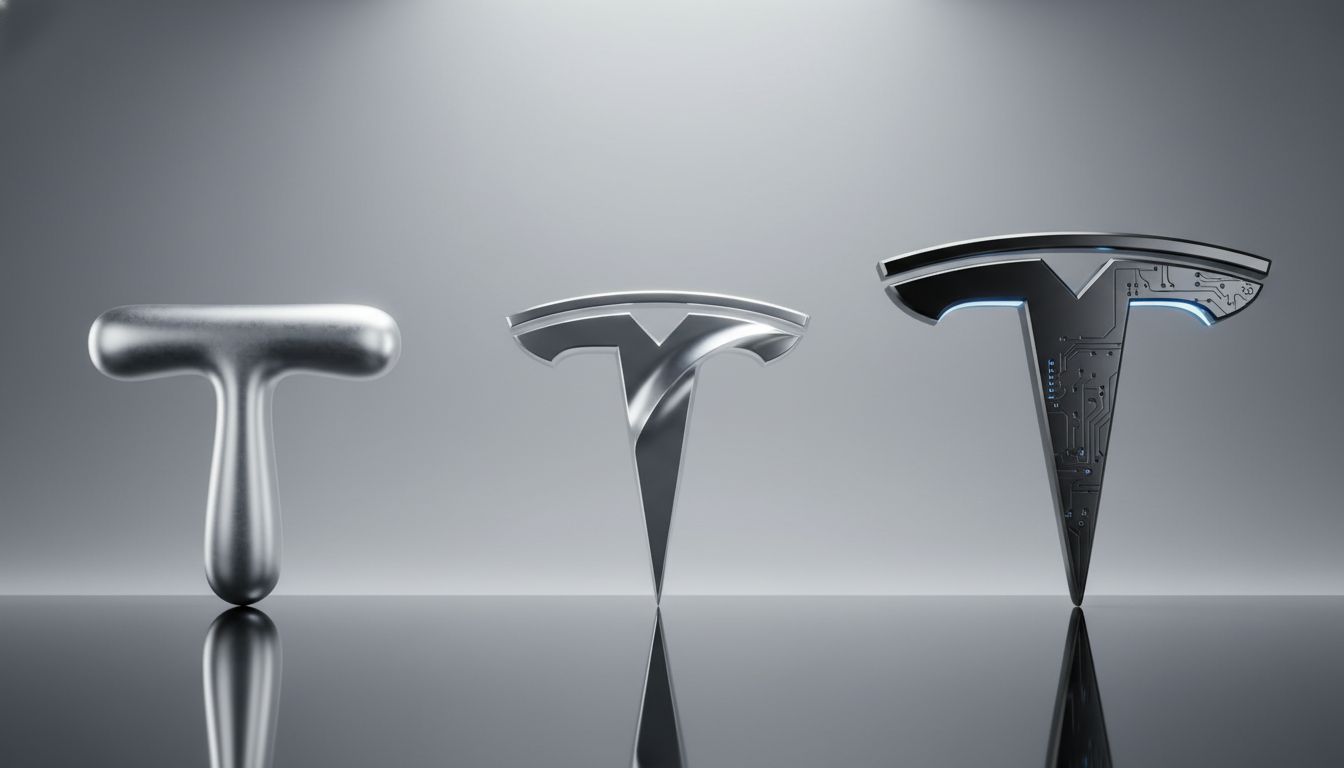
Introduction
In the modern era of automotive engineering and sustainable energy, few brands command as much universal recognition and fervent loyalty as Tesla, Inc. Founded in 2003, the company has completely revolutionized the way the world perceives electric vehicles (EVs), transitioning them from niche, environmentally-conscious novelties to highly desirable, high-performance luxury machines. However, behind the cutting-edge technology, the autonomous driving features, and the charismatic leadership of Elon Musk lies a critical element of the brand’s meteoric success: its visual identity. To truly understand the power of this brand, one must explore the Tesla Logo Evolution: Meaning Behind The Iconic Symbol.
At first glance, the Tesla emblem appears to be a stylized, futuristic letter “T.” It is minimalist, sharp, and highly memorable. Yet, like the incredibly complex engineering hidden beneath the sleek exterior of a Tesla Model S, the logo contains layers of profound meaning. It is a brilliant intersection of historical homage, mechanical engineering, and modern brand psychology. In this comprehensive guide, we will delve deeply into the origins of the Tesla brand, analyze the structural evolution of its visual identity, and decode the exact mechanical representations hidden within its iconic logo.
Whether you are a graphic designer seeking inspiration, a branding expert analyzing market dominance, or an automotive enthusiast fascinated by corporate histories, understanding the careful thought process behind the Tesla logo offers a masterclass in how visual design can encapsulate a company’s entire mission and technological ethos.
Key Takeaways
- Mechanical Inspiration: The Tesla “T” is not just a letter; it represents the cross-section of an electric motor, specifically the rotor and the stator.
- Historical Homage: The logo and the company name serve as a direct tribute to Nikola Tesla, the brilliant inventor of the alternating current (AC) induction motor.
- Minimalist Evolution: The original logo featured the “T” housed inside a traditional heraldic shield, which was later dropped to embrace a sleeker, more modern, and scalable minimalist aesthetic.
- Strategic Typography: The custom font used for the Tesla wordmark features missing vertical lines in the “E” and “A,” visually mimicking magnetic fields and futuristic engineering.
- Color Psychology: The deliberate use of red, silver, and black conveys passion, technological supremacy, and premium luxury.
The Birth of an Automotive Giant: Contextualizing the Brand
Before we can fully appreciate the Tesla Logo Evolution: Meaning Behind The Iconic Symbol, it is essential to understand the foundation of the company itself. Tesla Motors was incorporated in July 2003 by Martin Eberhard and Marc Tarpenning, who were later joined by Ian Wright, Elon Musk, and J.B. Straubel. The founders shared a unified vision: to prove that electric vehicles could be better, quicker, and more fun to drive than gasoline cars.
The name “Tesla” was chosen to honor Nikola Tesla, the Serbian-American engineer and physicist whose 1888 patent for the alternating current (AC) induction motor forms the technological foundation of the vehicles the company produces today. Unlike traditional internal combustion engine (ICE) vehicles that rely on thousands of moving parts, explosions, and exhaust, the AC induction motor relies on electromagnetism to generate torque. This fundamental difference in engineering philosophy required a brand identity that completely divorced itself from traditional automotive tropes.
The company needed a logo that communicated speed, efficiency, electricity, and the future. They required an emblem that could sit proudly on the hood of a luxury sports car (the original Tesla Roadster) while simultaneously representing solar panels, battery storage systems, and the broader concept of sustainable energy.
Tesla Logo Evolution: Meaning Behind The Iconic Symbol
Unlike legacy automakers such as Ford, Volkswagen, or Peugeot, which have undergone dozens of logo redesigns over a century of existence, Tesla is a relatively young company. Consequently, the physical evolution of its logo has been subtle, focused entirely on refinement rather than reinvention. The core concept has remained untouched, but the execution has been modernized.
The Original Shield Emblem (2003 – 2017)
When the Tesla Roadster was first introduced to the public, the iconic stylized “T” was housed within a traditional emblem. The original design featured a silver shield with a black background. The “T” was placed squarely in the center of this shield, with the word “TESLA” positioned directly above the crest.
The use of a shield is a classic motif in automotive branding, utilized by giants like Porsche, Lamborghini, and Cadillac. For a disruptive startup trying to convince consumers to trust a completely new technology, the shield provided a sense of heritage, safety, and reliability. It was a psychological bridge, offering traditional automotive visual cues while introducing revolutionary technology.
The Transition to the Minimalist ‘T’ (Current Logo)
As Tesla grew from a niche Roadster manufacturer to a mass-market powerhouse with the introduction of the Model S, Model X, Model 3, and Model Y, the brand’s confidence grew. They no longer needed to rely on traditional automotive tropes to prove their legitimacy. Tesla was no longer just a car company; it was a technology and energy company.
In a move reflecting broader design trends toward flat, minimalist aesthetics, Tesla eventually dropped the shield. The logo was stripped down to its core essence: the stylized “T.” By removing the confining borders of the shield, the logo became infinitely more scalable and versatile. It looked just as striking on the steering wheel of a car as it did on the digital interface of the Tesla smartphone app, or stamped onto the side of a massive Megapack battery installation. This evolution perfectly encapsulates the brand’s shift toward limitless, unconfined innovation.
Deconstructing the Emblem: What Does the ‘T’ Really Stand For?
For years, automotive fans and design critics speculated about the true meaning behind the sharp, futuristic “T.” Some theorized it looked like a stylized sword, symbolizing Tesla’s fight against the fossil fuel industry. Others thought it resembled a pickaxe, nodding to energy mining. However, the true meaning is much more literal and deeply rooted in electrical engineering.
The Cross-Section of an Electric Motor
In a 2017 exchange on Twitter (now X), a curious fan directly asked CEO Elon Musk what the logo represented. Musk confirmed a long-held theory by responding: “Similar to SpaceX, the T is like a cross section of an electric motor, just as the X is like a rocket trajectory.”
To visualize this, one must look at the internal architecture of an AC induction motor. An electric motor consists of two primary components: the rotor (the moving part) and the stator (the stationary part that surrounds the rotor).
- The Rotor Pole: The main vertical body of the “T” represents one of the poles that protrude from the motor’s rotor.
- The Stator: The curved horizontal line hovering just above the main body of the “T” represents a cross-section of the stator.
- The Air Gap: The negative space between the top curve and the vertical body is incredibly significant. In mechanical engineering, this represents the magnetic air gap between the stator and the rotor. It is within this invisible gap that magnetic fields interact to create the torque that propels the vehicle forward.
By transforming a highly technical mechanical schematic into a sleek, elegant typographic letter, Tesla achieved a pinnacle of logo design. The logo tells the entire story of how the car functions, hidden in plain sight.
Design Elements and Brand Psychology
A logo is more than just its shape; it is an amalgamation of form, typography, and color theory. Every aspect of the Tesla logo has been meticulously crafted to evoke specific emotional responses from the consumer.
Color Palette: Silver, Red, and Black
The Tesla logo typically utilizes a specific tri-color palette, depending on its application:
- Tesla Red: Red is the brand’s primary corporate color. In color psychology, red represents passion, energy, power, and revolution. It is an aggressive, forward-moving color that commands attention. For a company seeking to completely disrupt a century-old industry, red is the perfect choice. It signals that Tesla is not a passive, quiet alternative, but a dominant force in performance.
- Silver/Chrome: When applied to the physical vehicles, the logo is usually rendered in chrome or silver. Silver conveys a sense of premium luxury, high technology, and futuristic innovation. It aligns Tesla with high-end consumer electronics and aerospace engineering.
- Black: Often used in the wordmark or as a background, black represents sophistication, elegance, and authority. It provides a stark, high-contrast backdrop that allows the red and silver elements to visually “pop.”
Typography: Futuristic and Sleek
The visual identity of Tesla extends heavily into its typography. The custom font used for the “TESLA” wordmark is just as iconic as the “T” emblem itself. The font is characterized by its sharp angles, wide letterforms, and most notably, the deliberate omission of vertical strokes in the letters “E” and “A.”
These missing strokes are not merely a stylistic choice; they serve a conceptual purpose. The negative space created by the missing lines mimics the visual representation of magnetic fields, electric currents, and the slots in an electric motor’s stator. Furthermore, the font resembles the aesthetic of 1980s sci-fi and retro-futurism, perfectly aligning with Elon Musk’s well-documented affinity for science fiction and technological utopianism.
The Role of RO Studio in the Tesla Logo Design
While Elon Musk is heavily involved in the aesthetic decisions of his companies, the actual design of the Tesla logo was executed by RO Studio, a prominent design and branding firm based in New Jersey. RO Studio is also responsible for designing the logo for Musk’s aerospace company, SpaceX.
The synergy between the two logos is evident. Both utilize custom, futuristic typography, and both embed deep engineering concepts into their designs (the motor cross-section for Tesla, and the rocket trajectory for SpaceX). RO Studio’s ability to distill complex, highly technical concepts into clean, minimalist vector graphics is a testament to the power of professional corporate branding.
A meticulously designed logo acts as the silent ambassador of a brand. It communicates value, builds trust, and establishes market positioning before a consumer ever interacts with the product. For businesses looking to establish a similarly powerful brand identity, partnering with a premier agency like London Logo Designs can provide the strategic vision and creative execution necessary to stand out in a crowded marketplace.
Why the Tesla Logo is a Masterclass in Branding
As we analyze the Tesla Logo Evolution: Meaning Behind The Iconic Symbol, it becomes clear why this emblem is considered a triumph of modern corporate design. A great logo must be memorable, versatile, relevant, and timeless. Tesla achieves all four.
1. Unprecedented Scalability: The minimalist nature of the logo allows it to be scaled infinitely. It is legible when scaled down to a tiny favicon on a web browser, and it maintains its structural integrity when cast as a massive metallic badge on a corporate headquarters.
2. Cultivating Mystique: By embedding a hidden meaning (the electric motor cross-section) within the logo, Tesla created a sense of mystique and exclusivity. When fans and customers learn the “secret” behind the logo, they feel a deeper, almost tribal connection to the brand. It rewards curiosity.
3. Future-Proofing: Because the logo is an abstract representation of electricity and electromagnetism rather than a literal picture of a car, it allows the company to expand its product line without outgrowing its logo. Today, that same “T” sits on solar roof tiles, domestic battery storage units, and heavy-duty semi-trucks with perfect contextual relevance.
Frequently Asked Questions
What does the Tesla logo represent?
The Tesla logo represents the cross-section of an electric alternating current (AC) induction motor. The main vertical body of the “T” symbolizes the rotor pole, while the horizontal line above it represents a section of the stator. The gap between the two signifies the magnetic air gap that generates torque.
Did Elon Musk design the Tesla logo?
No, Elon Musk did not personally design the logo. The emblem and wordmark were created by RO Studio, a professional design firm based in New Jersey. However, Musk was heavily involved in the conceptual approval process. RO Studio is also the agency behind the SpaceX logo.
Has the Tesla logo ever changed?
The core shape of the “T” has not changed since the company’s founding. However, the logo has evolved. Originally, the “T” was encased within a traditional silver and black heraldic shield. Over time, Tesla dropped the shield to embrace a cleaner, minimalist, and more modern aesthetic.
Why is the Tesla logo red and silver?
The color red is used to denote energy, passion, power, and revolution, perfectly aligning with Tesla’s mission to disrupt the fossil fuel industry. Silver and chrome are utilized to convey high technology, premium luxury, and futuristic engineering.
What font is used in the Tesla logo?
Tesla uses a proprietary, custom-designed typeface for its wordmark. The font is unique because it intentionally omits certain vertical strokes in the letters “E” and “A.” This design choice visually mimics magnetic fields and electric currents, reinforcing the brand’s technological focus.
Conclusion
The narrative of the Tesla Logo Evolution: Meaning Behind The Iconic Symbol is a brilliant illustration of how visual identity can transcend mere aesthetics to become a profound statement of purpose. Tesla did not just create a car company; they engineered a global movement toward sustainable energy. To represent this monumental shift, they required an emblem that was equally revolutionary.
By taking the complex mechanical reality of Nikola Tesla’s AC induction motor and distilling it into a sleek, aggressive, and elegant typographic symbol, the brand achieved visual perfection. The logo honors the past while pointing definitively toward the future. It serves as a constant reminder that true innovation happens not just in the broad strokes, but in the meticulous, hidden details. For modern enterprises aiming to make a lasting impact, the Tesla emblem stands as the ultimate benchmark for intelligent, meaningful, and deeply strategic logo design.