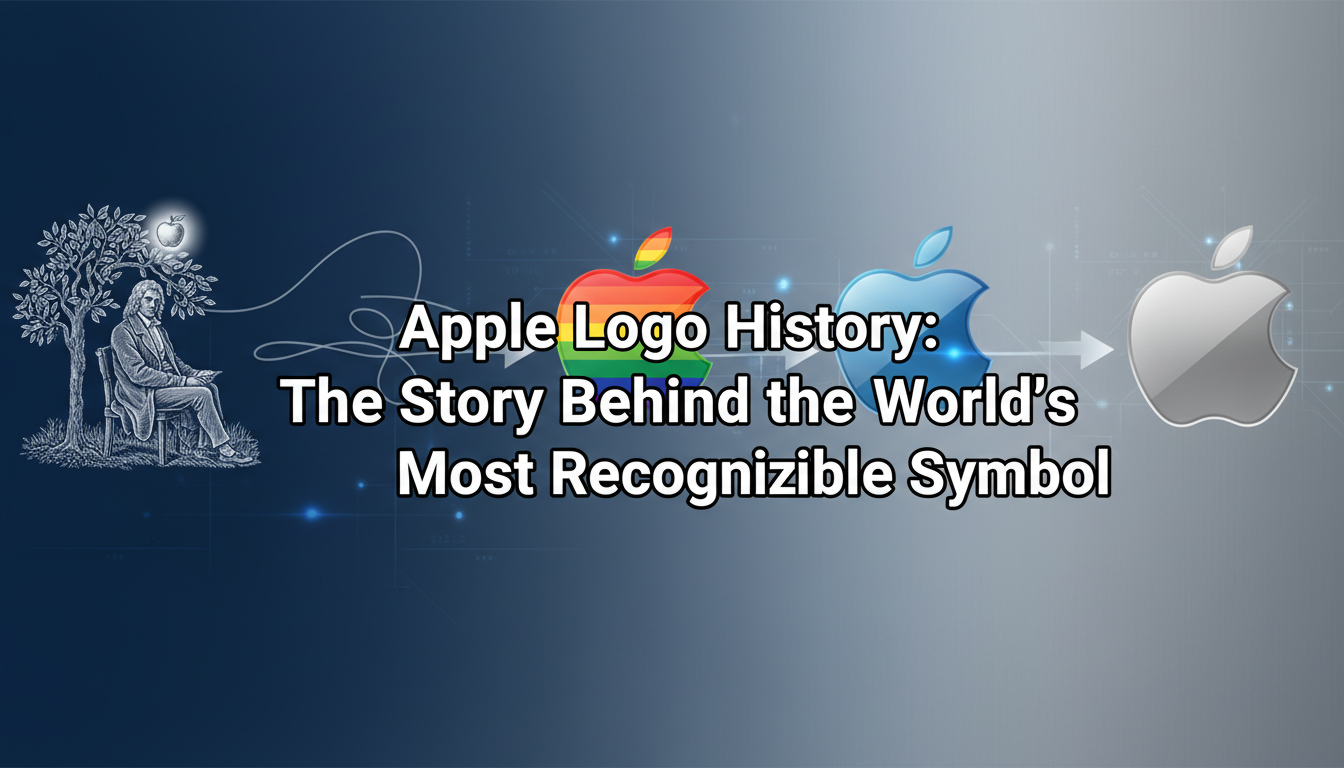
In the vast landscape of corporate branding, few symbols command the immediate recognition and reverence of the Apple logo. It is more than just a trademark; it is a cultural icon representing innovation, luxury, and a user-centric philosophy. For designers, marketers, and historians alike, the evolution of the Apple logo offers a masterclass in the principles of visual identity. From its complex, Victorian-style origins to the sleek, flat design that graces billions of devices today, the history of the Apple logo is a reflection of the technology industry’s own maturation.
Understanding this evolution requires more than a timeline of changes; it necessitates a deep dive into the strategic decisions, design philosophies, and happy accidents that shaped one of history’s most powerful brands. This article explores the comprehensive history of the Apple logo, dissecting the “why” and “how” behind every iteration of this bitten fruit.
The 1976 Origin: The Newton Crest
Contrary to popular belief, the famous bitten apple was not the company’s first logo. When Steve Jobs, Steve Wozniak, and Ronald Wayne established Apple Computer Co. in 1976, their visual identity was vastly different from the minimalism we associate with the brand today. The inaugural logo was designed by Ronald Wayne, the lesser-known third co-founder who famously sold his share of the company for $800 shortly after its inception.
Wayne’s design was not a logo in the modern sense but rather an intricate pen-and-ink drawing reminiscent of a Victorian-era woodcut. The image depicted the physicist Isaac Newton sitting contemplatively beneath an apple tree, blissfully unaware of the apple dangling precariously above his head—a direct reference to the discovery of gravity. Wrapping around the frame of the image was a quote from William Wordsworth: “Newton… A mind forever voyaging through strange seas of thought… alone.”
Why the First Design Failed
While Wayne’s illustration was artistic and rich in intellectual symbolism, it failed as a corporate logo for several practical reasons:
- Scalability Issues: The design contained fine lines and small text. When reduced to a size suitable for a product bezel or letterhead, the details turned into an illegible smudge.
- Anachronistic Style: Apple was attempting to pioneer the future of personal computing. A logo rooted in 19th-century aesthetics contradicted the futuristic, innovative nature of the Apple I and II computers.
- Brand Confusion: The complexity of the image lacked the immediacy required for effective branding. It told a story, but it did not provide a quick visual stamp of identity.
Steve Jobs, possessing an innate sense for marketing and aesthetics, quickly realized that the Newton crest was holding the brand back. Within a year, he sought a complete overhaul, demanding something “not cute” and far more modern.
1977-1998: Rob Janoff and the Rainbow Apple
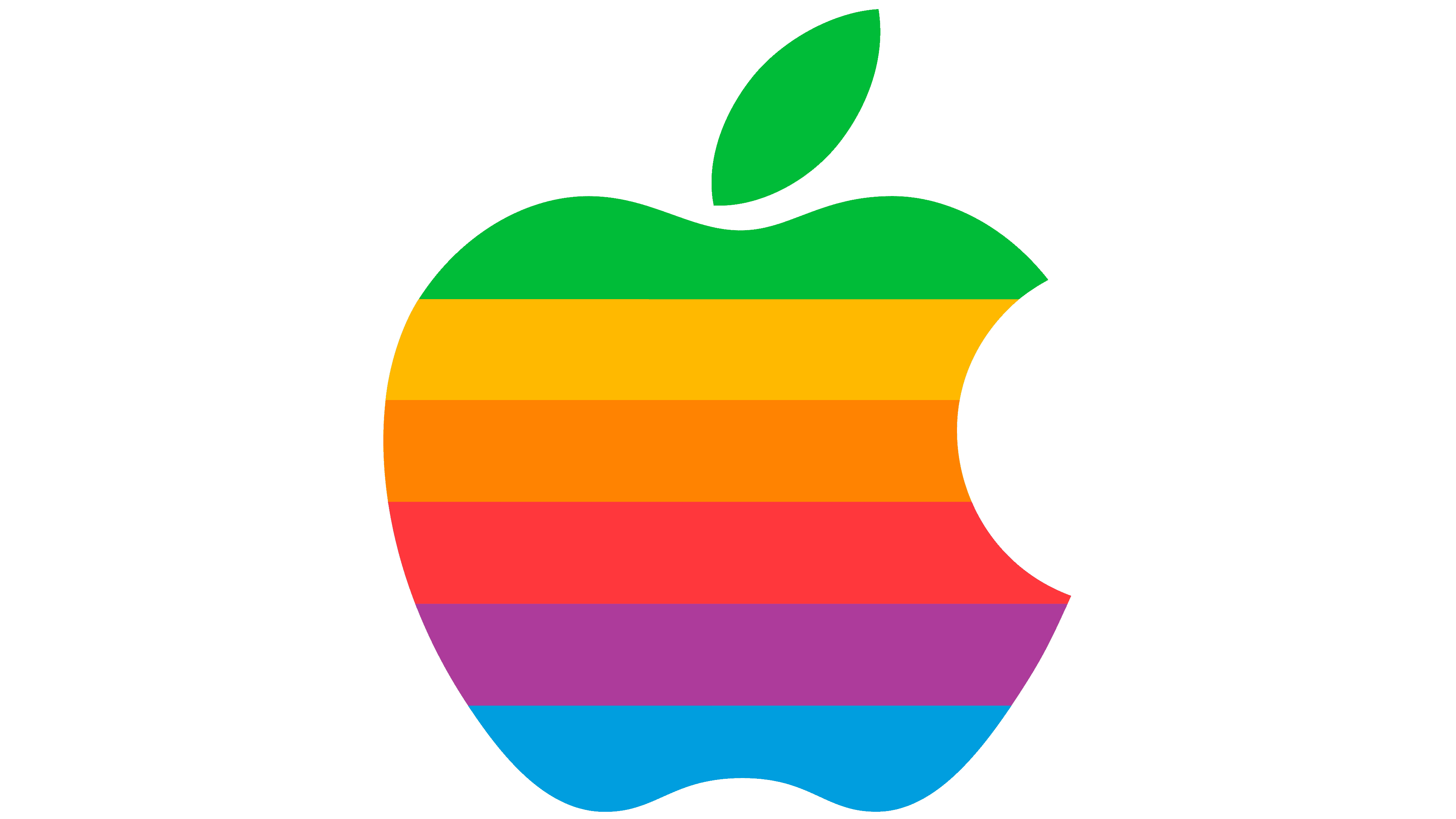
To redefine the company’s image, Jobs turned to the Regis McKenna advertising agency. The project was assigned to Art Director Rob Janoff. Janoff’s creation would become one of the most enduring graphic designs in history and would serve as Apple’s official logo for over two decades.
Janoff stripped away the surplus details of the Wayne design. He focused on the literal name of the company: an apple. There would be no trees, no Isaac Newton, and no poetry. Just the fruit. The result was a silhouette of an apple with a bite taken out of the right side, adorned with six horizontal colored stripes.
The Architecture of the Design
The creation of this logo was not arbitrary. Janoff approached the task with a focus on geometry and recognizability. He famously bought a bag of apples, sliced them, and stared at them for hours to understand their form. The resulting shape was simple yet distinct.
The addition of the rainbow spectrum—green, yellow, orange, red, violet, and blue—was a deliberate strategic choice. In 1977, the Apple II was the first personal computer capable of displaying color graphics on a monitor. The rainbow logo was a direct signal to consumers about the machine’s unique selling point. Furthermore, Steve Jobs wanted to “humanize” the computer. At the time, tech was seen as cold and intimidating; the vibrant colors made the brand appear accessible, friendly, and educational, appealing specifically to the school market Apple was targeting.
The “Bite” and the “Byte”
Perhaps the most discussed element of the logo is the bite mark. Over the years, a romanticized myth emerged suggesting the bite was a tribute to Alan Turing, the father of modern computing who died after eating a cyanide-laced apple. While a poetic narrative, Rob Janoff has repeatedly debunked this theory.
The true reason for the bite was strictly functional. In an interview, Janoff explained that without the bite, the silhouette looked too much like a cherry or a tomato. The bite provided a sense of scale, unmistakably identifying the shape as an apple. The fact that “bite” sounded like the computer term “byte” was, according to Janoff, a “happy accident” that he only realized after the design was presented to Jobs.
1998: The Return of Jobs and the Translucent Blue

By the late 1990s, Apple was in financial turmoil. The brand had lost its way, and its visual identity—the rainbow logo—had begun to look dated and childish alongside the sleek, corporate identities of competitors like IBM and Microsoft. When Steve Jobs returned to the company in 1997, he initiated a massive rebranding effort to save the sinking ship.
The release of the original iMac (the iMac G3) in 1998 marked a turning point. The computer itself was a translucent “Bondi Blue” egg-shaped device that defied the beige box standards of the era. The rainbow logo, with its clashing colors, would have looked out of place on the iMac’s casing.
Apple moved away from the rainbow stripes to a translucent, monochromatic blue logo. This logo was embossed directly onto the hardware. This shift communicated a new maturity. Apple was no longer just a “friendly” computer for schools; it was a designer object. This marked the beginning of Apple’s transition from a computer manufacturer to a lifestyle brand.
1998-2000: The Monochrome Black

Following the brief stint with the translucent blue logo, Apple transitioned to a solid black logo. This iteration appeared heavily in software, packaging, and print advertising. The move to solid black was a masterstroke in minimalist branding. It signaled luxury, sophistication, and premium quality.
This period coincided with the launch of the PowerBook G3 and later the PowerBook G4. The target audience had shifted from hobbyists and educators to creative professionals. A sleek, black silhouette communicated that this was serious hardware for serious work. The silhouette remained identical to Janoff’s 1977 design, proving that a strong shape can withstand drastic changes in palette.
2001-2007: The Aqua Era and Skeuomorphism

With the release of Mac OS X, Apple introduced a design language known as “Aqua.” This interface was characterized by water-like buttons, glossy finishes, and reflections. Steve Jobs famously said of the interface, “We made the buttons on the screen look so good you’ll want to lick them.”
The logo followed suit. For the next several years, the Apple logo was rendered with a glassy, three-dimensional gradient. It appeared to be made of crystal or chrome, with a distinct “shine” across the upper half. This style is often referred to as skeuomorphism—a design concept where digital items mimic real-world textures to make them feel familiar to users.
This “Glass Apple” represented the hub of the digital lifestyle. It was during this era that Apple released the iPod and the iPhone. The logo needed to look high-tech and futuristic, reflecting the pristine hardware of the aluminum PowerBooks and the glossy white MacBooks.
2013-Present: Flat Design and Minimalism
As the 2010s approached, the design world began to suffer from skeuomorphic fatigue. The realistic textures that once helped users understand touch interfaces were becoming cluttered and unnecessary. Under the design leadership of Jony Ive, Apple executed a massive overhaul of its visual language with the release of iOS 7 in 2013.
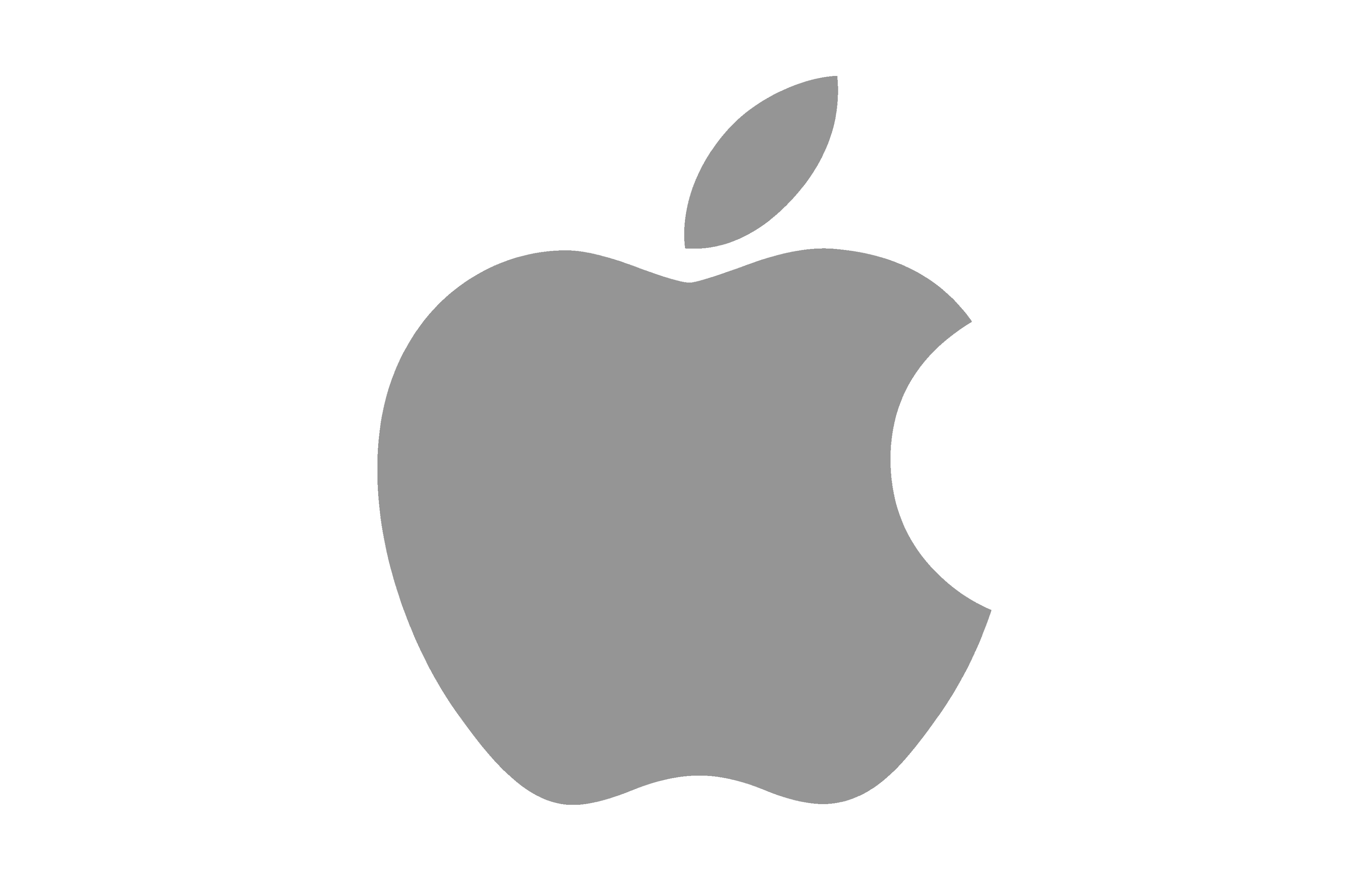
The interface was flattened. Gradients, drop shadows, and glossy textures were eliminated in favor of solid colors and clean typography. The corporate logo underwent a similar simplification. Apple returned to a flat, solid-color logo—usually black, white, or grey, depending on the background context.
The Strength of Adaptability
The current iteration of the Apple logo is the pinnacle of flexible branding. Because the shape is so universally recognized, it can be treated as a “container.” It can be white on the back of a space-grey iPhone, black on a letterhead, or even engraved into aluminum. This flexibility is essential for a brand that exists across hardware, software, streaming services, and credit cards.
The flat design ensures that the logo remains legible at any size, from the tiny favicon on a browser tab to a massive billboard in Times Square. It represents the ethos of “less is more” that defines modern Apple hardware.
The Golden Ratio and Design Psychology
A persistent topic of debate among graphic designers is the Apple logo’s adherence to the Golden Ratio (or Fibonacci sequence). The Golden Ratio is a mathematical ratio of 1.618, often found in nature and art, which is believed to create aesthetically pleasing compositions.
Diagrams frequently circulate online overlaying circles of varying sizes (based on the Fibonacci sequence) over the Apple logo, suggesting that the curve of the apple, the size of the bite, and the angle of the leaf align perfectly with these mathematical proportions. While Rob Janoff has stated that he did not intentionally use the Golden Ratio when sketching the original design, later refinements by Apple’s internal design teams (specifically during the shift to vector graphics in the 1980s and 90s) likely tuned the curves to be mathematically precise.
Psychologically, the logo works because of its organic curves. Humans are naturally drawn to curved lines over sharp angles, associating them with safety and comfort. The combination of the organic shape with the “unnatural” bite creates a visual tension that makes the image memorable.
Frequently Asked Questions (FAQ)
Is the Apple logo a reference to Adam and Eve?
No. While the concept of the “fruit of the tree of knowledge” fits the company’s ethos, Rob Janoff has confirmed that the biblical story was not the inspiration. The focus was on a simple, recognizable image of a fruit.
Did the Apple logo change shape over the years?
The silhouette has remained remarkably consistent since 1977. While there have been minor tweaks to the geometry and symmetry—mostly to clean up the curves for modern digital displays—the overall shape, the leaf’s position, and the bite have not changed fundamentally.
Why is the leaf detached from the apple?
Visually, detaching the leaf allows for a cleaner silhouette. If the leaf were attached, it might muddy the outline when the logo is viewed at small sizes. The negative space between the fruit and the leaf aids in definition.
What does the current Apple logo represent?
Today, the logo represents a lifestyle of premium simplicity. It stands for a closed ecosystem of products that work seamlessly together. It is a seal of quality that justifies a higher price point in the consumer electronics market.
Conclusion: The Legacy of the Bitten Fruit
The history of the Apple logo is a testament to the power of iteration and the importance of aligning visual identity with corporate strategy. From the overly complex Newton crest to the vibrant rainbow apple, and finally to the sleek minimalist icon of today, the logo has evolved alongside the company’s ambitions.
What makes the Apple logo the “world’s most recognizable symbol” is not just its design, but what the design signifies. It survived the departure of its founder, near-bankruptcy, and the complete transformation of the tech industry. For business owners and designers, the lesson is clear: a great logo doesn’t need to explain what the company does (Apple sells computers, not fruit); it needs to identify the company in a way that is distinct, memorable, and adaptable.
As Apple moves into new frontiers like augmented reality and artificial intelligence, the logo may undergo subtle refinements, but the core silhouette—the apple with the bite—is likely to remain. It is a symbol that has transcended language and culture, becoming a universal hieroglyph for the digital age.