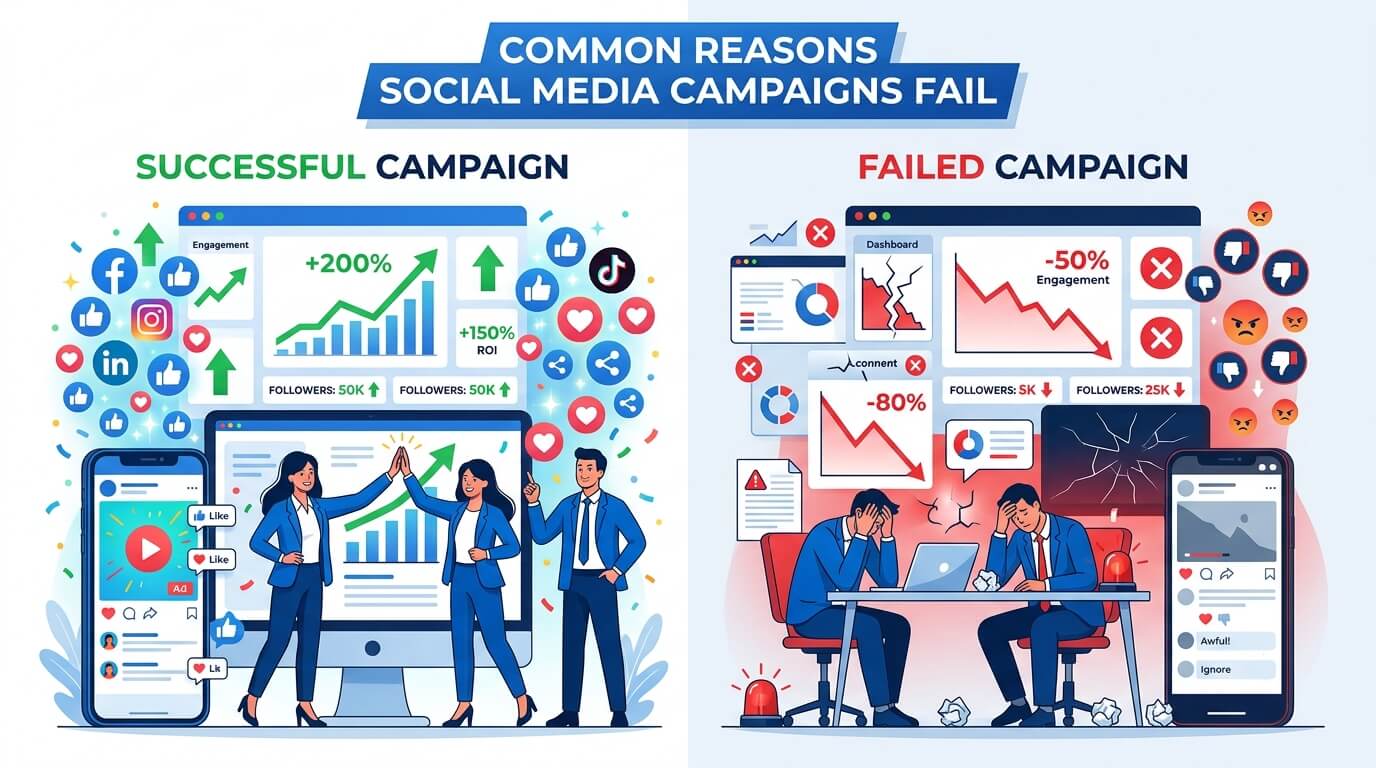
Social media has become one of the most influential marketing channels available to businesses of every size. From startups trying to establish their presence to multinational corporations launching global campaigns, almost every brand relies on social media to reach customers, build trust, and increase sales. Platforms like Facebook, Instagram, LinkedIn, TikTok, Pinterest, and X (formerly Twitter) allow businesses to communicate directly with audiences in real time, making marketing more interactive and measurable than ever before. With billions of active users across these platforms, the opportunity to grow a brand has never been greater.
However, simply having a social media presence does not guarantee success. Every day, thousands of campaigns are launched with high expectations, creative visuals, and carefully planned budgets, yet many of them fail to achieve meaningful results. Some campaigns receive very little engagement, while others generate traffic but fail to convert visitors into customers. In many cases, businesses spend significant amounts on paid advertising without seeing a satisfactory return on investment. This often leaves marketers wondering why campaigns that looked promising failed to deliver.
The truth is that successful social media marketing involves much more than posting attractive images or publishing content regularly. Effective campaigns require a deep understanding of the target audience, clear business objectives, high-quality content, consistent branding, and ongoing analysis. Even a single overlooked factor can reduce campaign performance, while multiple mistakes can prevent a campaign from reaching its full potential. Social media platforms also evolve constantly, meaning strategies that worked a year ago may no longer produce the same results today.
Understanding why campaigns fail is just as valuable as knowing what makes them successful. Learning from common mistakes allows businesses to improve future marketing efforts, avoid unnecessary expenses, and create stronger connections with their audiences. Whether your goal is increasing brand awareness, generating leads, promoting products, or building customer loyalty, recognizing these common pitfalls can dramatically improve your chances of success.
This article explores the most common reasons social media campaigns fail, explains why these problems occur, and provides insights into how businesses can avoid them while building more effective digital marketing strategies.
Common Reasons Social Media Campaigns Fail at a Glance
| Common Mistake | How It Affects Campaigns | Better Approach |
| No clear objectives | Confusing strategy and poor measurement | Set specific, measurable goals before launching |
| Weak audience research | Low engagement and poor conversions | Build detailed customer personas |
| Poor content strategy | Inconsistent messaging and reduced interest | Plan content around audience needs |
| Low-quality visuals | Users ignore posts quickly | Invest in professional graphics and videos |
| Inconsistent branding | Weak brand recognition | Maintain consistent colors, fonts, and messaging |
| Posting irregularly | Reduced reach and visibility | Follow a structured content calendar |
| Ignoring analytics | Repeating ineffective tactics | Monitor performance and optimize regularly |
| Excessive promotion | Audience loses interest | Balance educational and promotional content |
Lack of Clear Campaign Objectives
One of the biggest reasons social media campaigns fail is the absence of clear objectives. Many businesses begin posting content simply because they know they “should be active” on social media, but they never define what they actually want to accomplish. Without a specific destination, every marketing decision becomes reactive rather than strategic. A campaign without objectives often produces random content, inconsistent messaging, and disappointing results because there is no roadmap guiding the effort.
For example, a company may want to “increase engagement,” but engagement alone is not a business goal. Does the business want more comments? More website visitors? More product sales? More newsletter subscriptions? These outcomes require completely different strategies. A campaign designed to generate sales will differ significantly from one focused on brand awareness. Without identifying the primary objective from the beginning, marketers often create content that tries to achieve everything at once and ultimately accomplishes very little.
Setting measurable goals also makes it possible to evaluate campaign performance accurately. Businesses should establish specific key performance indicators (KPIs) before launching a campaign. These may include website traffic, lead generation, conversion rates, reach, engagement rate, click-through rate, or return on advertising spend. When these metrics are clearly defined, marketers can determine whether a campaign is succeeding or requires adjustments. Without measurable objectives, even a campaign that generates thousands of likes may actually fail if it does not support broader business goals.
Clear objectives also improve collaboration within marketing teams. Designers, copywriters, social media managers, and advertising specialists all understand what they are working toward when goals are defined from the outset. This alignment leads to more focused messaging, stronger creative assets, and better overall campaign execution. Businesses that consistently establish realistic and measurable objectives before launching campaigns are far more likely to achieve meaningful and sustainable results.
Poor Understanding of the Target Audience
No matter how creative a campaign may be, it is unlikely to succeed if it is directed toward the wrong audience. One of the most common mistakes businesses make is assuming they already know their customers without conducting proper research. As a result, they produce content that reflects their own assumptions instead of addressing the actual interests, challenges, and motivations of their audience. Social media users are constantly exposed to new content every day, so if a post fails to capture their attention immediately, they simply continue scrolling.
Understanding the target audience requires much more than identifying age or location. Businesses should examine customer behaviors, purchasing habits, interests, online activity, preferred social platforms, income levels, professional backgrounds, and common pain points. For instance, a campaign targeting small business owners should communicate differently than one aimed at university students or corporate executives. Even within the same industry, different audience segments respond to different messaging styles, visuals, and content formats.
Creating detailed buyer personas helps marketers better understand who they are trying to reach. These fictional profiles represent ideal customers and include information such as demographics, goals, frustrations, preferred communication channels, and buying behavior. When marketers create content with a specific person in mind rather than a broad audience, their messaging becomes more relevant and engaging. Customers are far more likely to interact with content that speaks directly to their needs instead of generic promotional messages.
Audience research should also be an ongoing process rather than a one-time activity. Consumer behavior changes over time, and new trends emerge regularly across different social media platforms. Businesses that continuously analyze customer feedback, monitor engagement patterns, and study audience insights remain better equipped to create content that resonates. By understanding what customers genuinely value, businesses can build stronger relationships and significantly improve campaign performance.
Weak Content Strategy
Many businesses fail on social media because they focus on posting frequently instead of posting strategically. Simply publishing content every day does not guarantee engagement or business growth. Without a well-defined content strategy, posts often appear disconnected, repetitive, or inconsistent, making it difficult for audiences to understand the brand’s purpose. A successful campaign is built around thoughtful planning rather than random posting.
A strong content strategy begins with understanding what type of information audiences actually want to consume. People visit social media to learn something useful, solve problems, stay entertained, discover trends, or interact with communities. They rarely log in hoping to see endless advertisements. Businesses that focus exclusively on selling products often experience declining engagement because followers quickly lose interest in promotional content that offers little value.
The most effective content strategies combine multiple content types to maintain audience interest. Educational posts help establish expertise, while behind-the-scenes content humanizes the brand. Customer success stories build trust, industry insights demonstrate authority, and entertaining videos encourage sharing. Product promotions remain important, but they should be balanced with informative and engaging content that nurtures long-term relationships instead of pushing immediate sales. This balanced approach creates a healthier relationship between the brand and its audience.
Planning content in advance also improves consistency and creativity. Rather than rushing to publish something every day, marketers can develop campaigns around themes, seasonal events, product launches, or customer interests. A structured content calendar ensures that every post supports broader campaign goals while maintaining a consistent publishing schedule. Businesses with strong content strategies rarely struggle to find ideas because every piece of content serves a specific purpose within the overall marketing plan.
Poor Quality Visual Content
Social media is a visually driven environment where users make decisions within seconds. Before reading a caption or clicking a link, people notice images, videos, colors, typography, and overall design quality. If visual content appears outdated, cluttered, or unprofessional, audiences often ignore it regardless of how valuable the accompanying message may be. This makes visual presentation one of the most important elements of any successful social media campaign.
Many businesses underestimate the impact of high-quality visuals. They may use blurry product photos, inconsistent graphics, pixelated logos, or poorly edited videos simply to maintain a posting schedule. Unfortunately, low-quality visuals immediately reduce credibility. Customers often associate poor design with poor products or services, making them less likely to engage or make purchases. In contrast, professionally designed graphics and well-produced videos create a positive first impression that encourages further interaction.
Visual consistency is equally important. Successful brands maintain recognizable design elements across all posts, including colors, fonts, layouts, and image styles. This consistency strengthens brand identity and helps customers instantly recognize content while scrolling through busy social feeds. Over time, repeated exposure to consistent visuals improves brand recall and builds trust among audiences.
Video content deserves particular attention because it has become one of the highest-performing content formats across nearly every social media platform. Short-form videos, tutorials, demonstrations, customer testimonials, and behind-the-scenes footage often generate significantly higher engagement than static images alone. Businesses that invest in improving visual quality while adapting content to modern platform preferences are more likely to capture attention and sustain audience interest over time.
Inconsistent Brand Identity
Brand consistency is one of the foundations of successful marketing, yet many social media campaigns fail because businesses overlook its importance. Every interaction a customer has with a brand contributes to their overall perception. When logos, colors, fonts, messaging, or tone of voice change frequently, audiences become confused and may struggle to recognize the brand. Consistency creates familiarity, and familiarity is one of the key factors that influence trust and purchasing decisions.
Many businesses unintentionally create inconsistent branding by allowing different team members to design posts without following clear brand guidelines. As a result, one post may appear modern and professional while the next looks completely different in style. This inconsistency weakens the company’s visual identity and makes it difficult for customers to associate content with the brand. Even if individual posts perform well, the overall campaign loses its ability to build long-term recognition.
Brand identity extends beyond visual design. The language used in captions, responses, advertisements, and customer interactions should also remain consistent. A company that communicates professionally in one post but casually in another may create confusion about its personality and values. Successful brands establish a clear tone of voice that reflects their identity, whether that is friendly, informative, authoritative, or inspirational. Maintaining this tone across every platform helps audiences develop a stronger emotional connection with the brand.
Consistency also strengthens customer confidence. When people repeatedly encounter familiar branding across Facebook, Instagram, LinkedIn, websites, email marketing, and advertisements, they perceive the business as more reliable and established. This consistent experience reinforces credibility and increases the likelihood that potential customers will remember the brand when making purchasing decisions. Strong branding is not created through one successful campaign—it is built through continuous consistency over time.
Posting Without a Content Calendar
One of the most overlooked reasons social media campaigns fail is the absence of a structured content calendar. Many businesses rely on spontaneous posting, creating content only when they have time or when they suddenly think of an idea. While this approach may seem flexible, it usually leads to inconsistent publishing schedules, rushed content, and campaigns that lack direction. Social media success is built on consistency, and consistency is difficult to maintain without proper planning.
A content calendar helps businesses organize their marketing efforts weeks or even months in advance. Instead of scrambling to create posts every day, marketers can schedule content around product launches, seasonal events, holidays, industry trends, and promotional campaigns. This organized approach ensures that every piece of content contributes to a larger marketing objective rather than existing as an isolated post. Planning ahead also provides enough time to design better graphics, write stronger captions, and review content before publication.
Consistency is another major advantage of using a content calendar. Social media algorithms generally reward accounts that publish regularly because they provide a better user experience. Businesses that disappear for several weeks and then suddenly publish multiple posts often struggle to maintain visibility. Regular posting keeps the audience engaged while signaling to platform algorithms that the account remains active. Over time, this consistency can improve organic reach and audience engagement.
A content calendar also improves collaboration within marketing teams. Designers, writers, photographers, and social media managers can coordinate their work more effectively when everyone knows what content is scheduled. This reduces last-minute stress and results in higher-quality campaigns. Businesses that invest time in planning their content are far more likely to create cohesive campaigns that deliver measurable results.
Ignoring Platform Differences
A common mistake many businesses make is treating every social media platform exactly the same. They create one piece of content and publish it across Facebook, Instagram, LinkedIn, TikTok, Pinterest, and X without making any adjustments. While this may save time, it significantly reduces campaign effectiveness because every platform has its own audience, culture, and content preferences.
Each social media platform serves a different purpose. LinkedIn users generally expect professional insights, industry news, and business discussions. Instagram users are drawn to visually appealing images, short videos, and lifestyle content. TikTok audiences prefer entertaining and authentic short-form videos, while Facebook users often engage with community discussions, local updates, and longer posts. Publishing identical content everywhere ignores these differences and often leads to lower engagement.
Content should be adapted to suit the behavior of users on each platform. A detailed article may perform well on LinkedIn but attract little attention on Instagram. Likewise, a humorous short video that becomes popular on TikTok may not receive the same response from a professional LinkedIn audience. Successful marketers understand that the same message can be presented in different formats depending on where it is being shared.
Businesses should also consider platform-specific features such as Stories, Reels, Carousels, Live videos, and interactive polls. These features are designed to encourage engagement and often receive additional algorithmic support. Brands that embrace the strengths of each platform create more relevant experiences for their audiences. Instead of copying and pasting content across every channel, successful campaigns adapt their approach while maintaining consistent branding and messaging.
Overly Promotional Content
One of the quickest ways to lose audience interest is by turning every social media post into a sales pitch. Many businesses believe that social media exists solely to promote products or services, so their content becomes a continuous stream of advertisements, discounts, and promotional messages. While occasional promotional posts are necessary, excessive selling often pushes followers away instead of attracting them.
People use social media for entertainment, education, inspiration, and connection. They want to discover useful information, enjoy interesting stories, and interact with brands that provide genuine value. When every post focuses on encouraging immediate purchases, audiences begin to ignore the content because it feels repetitive and self-serving. Over time, engagement decreases, organic reach declines, and even paid campaigns become less effective because audiences have lost interest.
Successful brands understand the importance of balancing promotional and non-promotional content. Educational articles, industry insights, customer success stories, behind-the-scenes videos, tutorials, and helpful tips provide value while gradually building trust. Once that trust has been established, promotional content becomes more effective because customers already view the brand as helpful and credible.
Another benefit of value-driven content is that it encourages sharing. People are much more likely to share an informative guide, an inspiring story, or a useful tip than a straightforward advertisement. Increased sharing expands organic reach and introduces the brand to new audiences without additional advertising costs. Businesses that prioritize helping their audience before selling to them often build stronger communities and achieve better long-term marketing results.
Lack of Audience Engagement
Social media is fundamentally different from traditional advertising because it is designed for conversation rather than one-way communication. Unfortunately, many businesses continue to treat social media like a digital billboard, publishing content without interacting with the people who respond. This lack of engagement weakens relationships and reduces campaign effectiveness over time.
Customers appreciate brands that acknowledge their comments, answer their questions, and respond to feedback promptly. A simple reply to a comment or a thoughtful response to a direct message can significantly improve customer satisfaction. These interactions show that the business values its audience rather than viewing followers merely as potential buyers. In contrast, ignoring comments or leaving customer questions unanswered creates the impression that the brand is uninterested or unavailable.
Engagement also influences social media algorithms. Platforms often reward posts that generate conversations by showing them to larger audiences. Every comment, reaction, and share sends positive signals that increase visibility. Businesses that actively encourage discussions through polls, questions, quizzes, or interactive posts often achieve much higher organic reach than those that simply publish promotional updates.
Building relationships should always be considered part of a successful campaign. Social media provides businesses with an opportunity to develop genuine connections that traditional advertising cannot easily achieve. Brands that consistently communicate with their audiences build stronger communities, increase customer loyalty, and create long-term advocates who willingly recommend their products or services to others.
Ignoring Analytics and Performance Data
One of the greatest advantages of digital marketing is the ability to measure nearly every aspect of campaign performance. Unlike traditional advertising, social media provides detailed insights into impressions, engagement, clicks, audience demographics, conversions, watch time, and customer behavior. Despite having access to this valuable information, many businesses fail to analyze it properly.
Some marketers focus only on vanity metrics such as likes and follower counts without considering whether those numbers contribute to actual business goals. A post may receive thousands of likes but generate very few website visits or product purchases. On the other hand, a post with moderate engagement may produce high-quality leads and significant revenue. Understanding the difference requires careful analysis of performance data rather than relying on surface-level statistics.
Analytics help businesses identify which content formats perform best, which audiences respond most positively, and which campaigns deliver the highest return on investment. This information allows marketers to refine future strategies based on real evidence instead of assumptions. Businesses can adjust posting schedules, improve targeting, modify advertising budgets, and optimize creative assets to achieve better outcomes.
Continuous monitoring is equally important. Campaigns should not be evaluated only after they have ended. Regular analysis allows marketers to identify underperforming advertisements early and make adjustments before significant budgets are wasted. Businesses that embrace data-driven decision-making consistently outperform those that rely solely on intuition or guesswork.
Failure to Adapt to Trends and Algorithm Changes
Social media is one of the fastest-changing areas of digital marketing. Platforms frequently update their algorithms, introduce new features, and modify the way content is distributed. Businesses that continue using outdated strategies often experience declining reach and engagement without understanding why their campaigns are becoming less effective.
Several years ago, static image posts dominated many platforms. Today, short-form videos, interactive stories, live broadcasts, and user-generated content often receive greater visibility. Consumer preferences also change rapidly. Audiences increasingly expect authentic content, personalized experiences, and interactive communication rather than highly polished corporate advertisements. Brands that ignore these evolving expectations risk appearing outdated and disconnected.
Successful marketers remain informed about industry developments and experiment with new content formats before competitors fully adopt them. They test emerging features, monitor performance, and adjust strategies based on audience behavior. This willingness to adapt enables businesses to maintain visibility while taking advantage of new opportunities as platforms evolve.
Adaptation should never mean abandoning brand identity or chasing every trend blindly. Instead, businesses should evaluate whether a new feature or trend aligns with their audience and marketing objectives. Combining innovation with strategic planning allows campaigns to remain relevant without losing consistency or authenticity.
Conclusion
Social media campaign failures rarely result from a single mistake. Instead, they usually occur because several small issues combine to reduce overall performance. Unclear objectives, poor audience research, inconsistent branding, weak content strategies, irregular posting, excessive promotion, lack of engagement, ignoring analytics, and failure to adapt to changing trends all contribute to disappointing results. Fortunately, each of these challenges can be addressed through better planning, continuous learning, and a stronger understanding of audience needs.
The most successful social media campaigns are built on strategy rather than chance. Businesses that focus on providing value, maintaining consistency, analyzing performance, and building genuine relationships with their audiences are far more likely to achieve long-term success. Social media is not simply a place to advertise products—it is a powerful platform for creating trust, strengthening brand identity, and developing lasting customer connections. Organizations that approach it with patience, creativity, and a commitment to continuous improvement will consistently outperform those that rely on shortcuts or assumptions.
Frequently Asked Questions
Q1. Why do most social media campaigns fail?
Most campaigns fail because they lack clear goals, proper audience research, consistent content, and regular performance analysis.
Q2. How important is audience research in social media marketing?
Audience research is essential because it helps businesses create relevant content that connects with the right people and improves engagement.
Q3. Can posting too much promotional content hurt a campaign?
Yes. Excessive promotional content often reduces engagement because audiences prefer valuable, educational, and entertaining posts over constant sales messages.
Q4. Why should businesses monitor social media analytics?
Analytics reveal what is working, what needs improvement, and how campaigns can be optimized for better results and higher return on investment.
Q5. How can businesses improve underperforming social media campaigns?
They can improve results by setting clear objectives, understanding their audience, creating high-quality content, engaging consistently, monitoring analytics, and adapting to platform changes.