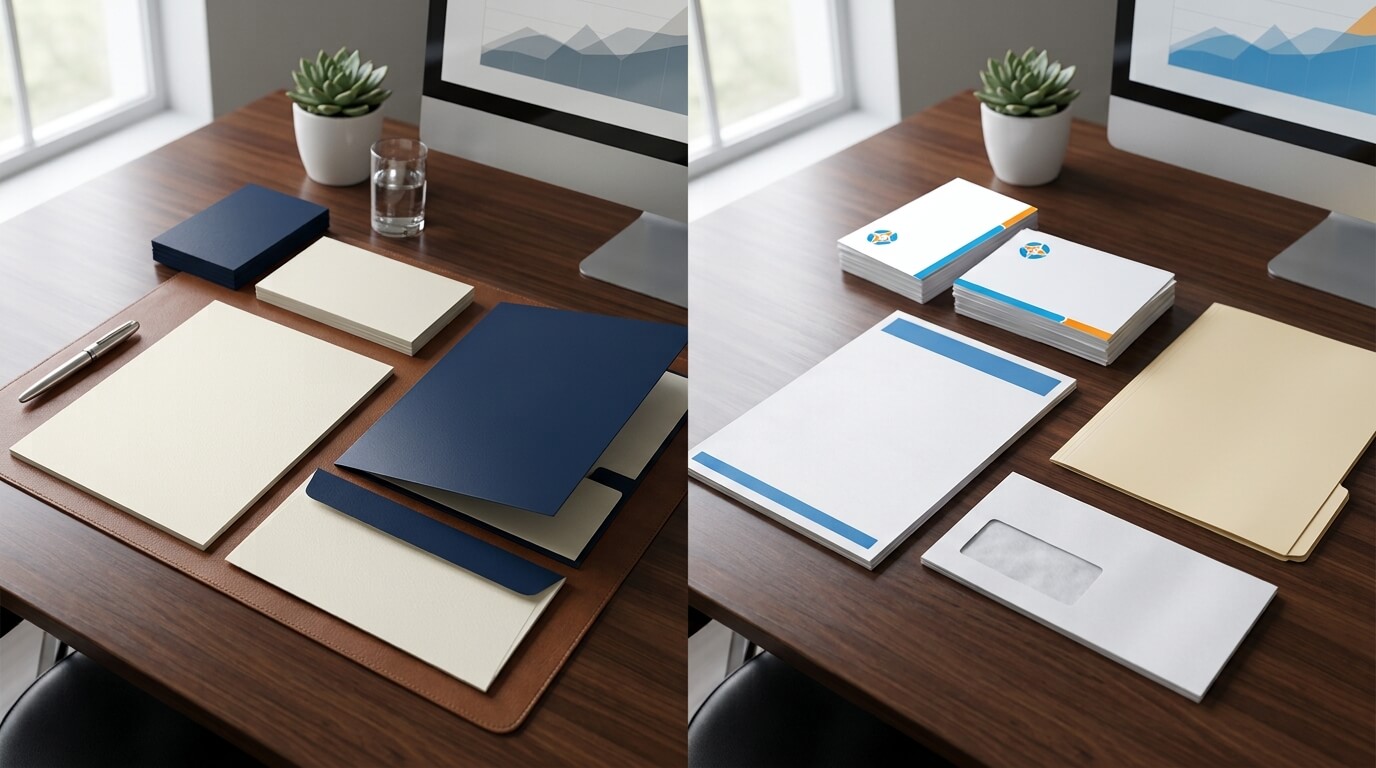
Business stationery may seem like a small part of a company’s overall branding, but it can have a surprisingly strong influence on how a business is perceived. Every letterhead, business card, envelope, invoice, presentation folder, or branded document represents the organization behind it. When these materials are thoughtfully designed, they communicate professionalism, consistency, and attention to detail. When they look generic or disconnected from the brand, they can make even an established business appear less distinctive.
This is where the choice between custom stationery and generic templates becomes important. Generic templates are widely available, inexpensive, and convenient. They allow businesses to create professional-looking documents without investing heavily in design. Custom stationery, on the other hand, is developed specifically around a company’s identity, audience, communication style, and visual branding. It requires more planning and often a larger initial investment, but it can provide a stronger and more recognizable brand experience.
For small businesses, startups, professional service providers, established companies, and organizations trying to strengthen their visual identity, understanding the difference between these two approaches can make stationery decisions much easier. The right choice is not simply about appearance. It involves branding, flexibility, consistency, cost, customer perception, usability, and long-term value.
Understanding Custom Business Stationery
Custom stationery is created specifically for an individual business rather than being adapted from a design made for a broad audience. Instead of selecting a pre-existing layout and replacing the sample logo or text, the design process begins with the company’s identity. Brand colors, typography, logo usage, imagery, spacing, messaging, and overall personality can all influence the final stationery design.
Custom stationery can include many different materials. Letterheads are perhaps the most familiar example, but businesses may also use custom envelopes, business cards, compliment slips, folders, invoices, notepads, presentation materials, appointment cards, thank-you cards, and other printed or digital documents.
The goal is not necessarily to make every item visually complicated. In fact, effective custom stationery is often simple. Its strength comes from making sure that every visual element has a purpose and works naturally with the company’s wider identity.
How Custom Stationery Supports Brand Identity
A strong brand is built through repeated visual and emotional experiences. Customers may encounter a company through its website, social media accounts, advertisements, packaging, emails, presentations, or printed documents. When these different touchpoints share a recognizable visual language, customers begin to associate those characteristics with the business.
Custom stationery contributes to that consistency. A letterhead can use the same typography and color system found on the company website. A business card can reinforce the same visual identity. An envelope can continue the experience before the recipient even opens the correspondence.
This consistency helps create familiarity. Instead of every document looking like an isolated piece of communication, stationery becomes part of a larger brand system.
Custom Does Not Mean Overdesigned
One common misunderstanding is that custom stationery needs to be elaborate. It does not. A custom design can be extremely minimal while still being distinctive.
For example, a professional consulting company might use a clean white letterhead with a carefully positioned logo, subtle brand colors, and refined typography. A creative agency might use stronger colors and more expressive typography. A law firm might prefer a restrained layout that communicates authority and professionalism.
The important factor is relevance. Custom stationery should reflect the organization rather than simply trying to attract attention.
What Are Generic Stationery Templates?
Generic stationery templates are pre-designed layouts that are created for general use. They can be found through design platforms, office software, printing companies, document applications, and various online resources. Users typically choose a template, replace placeholder information with their own details, and make basic adjustments such as changing colors, fonts, or logos.
Templates have become popular because they make design more accessible. A business owner without professional design experience can produce a letterhead or business card relatively quickly.
For organizations with limited budgets or straightforward stationery requirements, templates can provide a practical starting point. However, convenience can come with limitations, particularly when a company wants to establish a distinctive identity.
Why Businesses Choose Templates
The biggest advantage of a generic template is accessibility. A business does not need to begin the design process from scratch. The structure, spacing, typography, and visual arrangement have already been created.
Templates can also reduce the amount of time required to produce basic stationery. A startup preparing its first invoice or a freelancer who needs a simple letterhead may not want to spend weeks developing a complete stationery system.
Cost is another major consideration. Many templates are inexpensive or even free, while custom design services may require a larger initial investment. For businesses operating with extremely limited resources, templates can appear to be the obvious choice.
However, the cheapest option is not always the most valuable option over the long term.
Custom Stationery vs Generic Templates
The main difference between custom stationery and generic templates is the level of personalization. Custom stationery is built around the business, while generic templates are designed to accommodate many different users.
A template may look attractive on its own, but that does not necessarily mean it is appropriate for a particular company. Another business may use the exact same design, or a very similar version, which reduces its ability to create a distinctive visual identity.
Custom stationery gives a company greater control over the design process. Elements can be adjusted according to the brand’s needs rather than forcing the brand to fit an existing layout.
The following table provides a practical comparison between the two approaches.
| Factor | Custom Stationery | Generic Templates |
| Brand personalization | Designed specifically for the brand | Limited to available template options |
| Originality | Highly distinctive | May be used by many businesses |
| Design flexibility | High | Usually limited |
| Initial cost | Generally higher | Usually lower |
| Development time | Requires more planning | Can be created quickly |
| Brand consistency | Easier to maintain | May require manual adjustments |
| Scalability | Can be expanded into a full system | Depends on available templates |
| Professional differentiation | Strong potential | Usually moderate |
| Long-term branding value | High | Limited to moderate |
| Ease of use | May require professional support | Generally easy for beginners |
The Role of Professionalism in Stationery Design
Stationery is often used in situations where trust matters. A proposal, contract, business letter, invoice, quotation, or formal announcement can influence how recipients view the organization.
Imagine receiving an important business proposal that uses inconsistent fonts, poor spacing, mismatched colors, and a logo that appears stretched. Even if the company provides excellent services, the document may create unnecessary doubt about its attention to detail.
Now consider the same proposal presented on a professionally designed letterhead with clear hierarchy, balanced spacing, appropriate typography, and consistent branding. The content has not changed, but the presentation creates a different impression.
This does not mean custom stationery automatically makes a company more trustworthy. Poorly designed custom stationery can be just as ineffective as a generic template. The real advantage comes from thoughtful design that supports the company’s professional positioning.
First Impressions Matter
Stationery can become part of the first physical interaction a customer has with a company. A business card exchanged during a meeting, a printed quotation sent after a consultation, or a branded letter received in the mail can all contribute to a first impression.
Generic templates can still look professional, but they often lack the subtle details that make a brand memorable. Custom designs can be structured to emphasize the characteristics that matter most to the intended audience.
For a luxury business, that might mean understated elegance. For a technology company, it could mean a modern and precise visual system. For a creative business, the stationery might express originality and personality.
Custom Stationery Creates Greater Brand Recognition
Brand recognition is built through repetition. When customers repeatedly see the same colors, typography, logo treatment, layouts, and visual characteristics, those elements become easier to associate with a particular company.
Custom stationery can support this process by extending the brand beyond digital platforms. Many businesses invest heavily in websites and social media but overlook physical communication materials. This can create a disconnect between what customers see online and what they receive offline.
A well-developed stationery system closes that gap.
If the company’s website uses a particular typeface, color palette, and design language, its printed materials can reflect the same approach. Over time, customers become more familiar with the visual identity.
Consistency Is More Important Than Complexity
A recognizable stationery system does not require dozens of decorative elements. Consistency is usually more valuable than complexity.
A company may use a single color accent across its letterhead, business cards, envelopes, and invoices. The logo may appear in the same general position. Typography can remain consistent across documents. These small decisions create a unified experience.
Generic templates can also be customized to some extent, but maintaining consistency becomes more difficult when different templates are used for different materials.
Flexibility and Scalability
Another important difference is how easily stationery can grow with the company.
A small business may initially need only a letterhead and business card. As it grows, it might require invoices, presentation folders, envelopes, thank-you cards, employee stationery, certificates, packaging inserts, and other branded materials.
With custom stationery, these items can be developed as part of one visual system. The original design principles can be carried across different formats.
Templates do not always offer the same level of scalability. A business may find one suitable template for a letterhead but struggle to find matching designs for its other materials.
Building a Complete Stationery System
A professional stationery system should feel connected without making every item identical. A business card can have a different layout from a letterhead while still sharing the same visual language.
This approach creates variety within consistency. Each item performs its own function while remaining recognizably part of the same brand.
For growing companies, this can be particularly valuable because new materials can be added without having to reinvent the brand every time.
Cost: Is Custom Stationery Worth the Investment?
Cost is one of the strongest arguments in favor of templates. A business can often access inexpensive designs and quickly adapt them for basic use. For someone who only needs a simple document and has no immediate branding requirements, this can make sense.
However, stationery should be evaluated as a branding investment rather than only as a design expense.
A custom stationery system can continue to be used across many different materials and over an extended period. Once the core visual system has been established, additional materials can be created using the same design principles.
The value also comes from consistency. If professionally designed stationery helps a business present itself more confidently during proposals, client meetings, correspondence, and sales interactions, its value extends beyond the printing cost.
When a Template May Be Enough
Not every business needs a fully customized stationery system immediately. A new freelancer, temporary project, student-led organization, or very small business may reasonably begin with a template.
The key is to avoid treating a temporary solution as a permanent brand strategy.
If the business begins growing and interacting with larger clients, investors, partners, or corporate customers, upgrading to custom stationery may become worthwhile. At that stage, the company usually has a clearer understanding of its identity and audience.
The Problem of Template Similarity
One of the biggest weaknesses of generic templates is similarity. A template can be downloaded by thousands of people. Even if users change the logo, company name, and colors, the underlying layout may remain recognizable.
This can be particularly problematic in competitive industries.
Imagine ten businesses within the same sector using similar template-based letterheads. None of them necessarily looks unprofessional, but none has a strong visual advantage either.
Custom stationery provides an opportunity to establish visual ownership. The design can be developed around the company’s positioning instead of borrowing a structure intended for a general audience.
Digital and Printed Stationery
The custom-versus-template discussion is not limited to physical printing. Businesses increasingly use digital letterheads, branded proposals, invoices, presentations, PDF documents, email signatures, and other electronic materials.
This makes stationery consistency even more important.
A company may send dozens of digital documents every week without printing a single page. If those documents use inconsistent branding, the company can still appear fragmented.
Custom digital stationery can help establish a consistent appearance across electronic communication. Templates can also work digitally, but businesses need to make sure that the designs remain readable, accessible, and consistent across devices and document formats.
Choosing the Right Approach for Your Business
The best choice depends on the company’s stage, goals, audience, budget, and branding needs.
A business that is just getting started may prioritize speed and affordability. A template can provide a temporary solution while the company establishes its identity.
An established business, however, may have more to gain from custom stationery. If the company already has a logo, brand guidelines, defined colors, and a clear target audience, custom stationery can extend those elements into everyday communication.
Companies operating in competitive professional industries can also benefit from customization because presentation often influences perceived credibility.
Think Beyond the Immediate Cost
Instead of asking only how much a stationery design costs, businesses should consider what the stationery needs to accomplish.
Does it need to make the brand recognizable? Does it need to support a premium image? Will it be used across multiple departments? Will the design need to work for printed and digital documents? Does the company expect to expand its stationery range?
If the answer to several of these questions is yes, custom stationery may provide better long-term value.
How to Make Custom Stationery Effective
Custom stationery works best when design decisions are connected to a clear brand strategy. The logo should be used appropriately, typography should remain readable, and colors should support the company’s identity rather than overwhelm the document.
White space also deserves attention. Businesses sometimes assume that more design elements will make stationery appear more professional. In reality, excessive graphics, decorative borders, multiple fonts, and crowded layouts can make documents harder to read.
Effective stationery gives important information enough room to breathe.
Contact details should also be easy to locate. A customer should not have to search through decorative elements to find a phone number, email address, website, or business address.
Design for Real-World Use
Stationery needs to work outside the design software. A beautiful letterhead may look impressive on a screen but create problems when printed on different paper sizes or used with standard office printers.
Businesses should consider how the design will work in actual situations. Documents may be printed in black and white, photocopied, converted into PDFs, viewed on mobile devices, or printed by different suppliers.
A good stationery system anticipates these situations.
When Generic Templates Can Become a Problem
Templates become problematic when businesses depend on them for too long without developing a coherent identity. Over time, different employees may select different templates. Someone may change the colors, another person may replace the font, and another may download a completely different design.
The result is a collection of documents that all belong to the same company but do not look like they belong together.
This inconsistency can weaken brand recognition and make internal communication less professional.
The issue is not that templates are inherently bad. The problem is uncontrolled variation.
Making the Transition From Templates to Custom Stationery
Businesses do not necessarily have to replace everything at once. The transition can happen gradually.
A company can begin by defining its core brand elements, including logo usage, colors, typography, spacing, and basic layout principles. The letterhead and business card can then become the foundation for other materials.
Once these core items are established, invoices, envelopes, presentation documents, folders, and digital documents can follow the same system.
This approach makes the transition more manageable while gradually creating a stronger visual identity.
Custom Stationery Is About More Than Appearance
The most important point in the custom-versus-template debate is that stationery is not simply decoration. It is a communication tool.
Every business document carries information about the organization behind it. The design affects readability, recognition, credibility, and the overall experience of interacting with the company.
A generic template can perform the basic function of presenting information. Custom stationery can do that while also reinforcing the identity of the organization.
That distinction becomes especially important when a company wants to be remembered rather than simply recognized as another business.
Conclusion
Custom stationery and generic templates both have their place in business communication. Templates offer speed, affordability, and convenience, making them useful for startups, freelancers, temporary projects, and businesses with very basic requirements. They can provide a professional starting point without requiring a major design investment.
Custom stationery, however, offers greater control, originality, consistency, flexibility, and long-term branding potential. It allows businesses to create materials that genuinely reflect who they are and how they want customers to perceive them.
For businesses focused on building a recognizable and professional brand, custom stationery is generally the stronger long-term choice. The objective should not simply be to create something that looks good. The objective should be to create a stationery system that communicates the company’s identity consistently every time it is used.
Frequently Asked Questions
Q1. Is custom stationery better than a generic template?
For long-term branding, custom stationery is generally more effective because it is designed specifically around a company’s identity. Generic templates can still be useful when affordability and speed are the primary concerns.
Q2. Is custom stationery expensive?
The cost varies depending on the number of materials, complexity of the design, designer, printing requirements, and customization involved. Although the initial investment can be higher than using templates, custom stationery can provide greater long-term branding value.
Q3. Can a generic template still look professional?
Yes. A well-designed template can look clean and professional. The main limitation is that the design may not be unique to the business and may not integrate perfectly with the company’s wider visual identity.
Q4. What should custom stationery include?
Custom stationery can include letterheads, business cards, envelopes, invoices, presentation folders, notepads, thank-you cards, digital documents, and other communication materials. The exact selection depends on how the business communicates with customers and partners.
Q5. When should a business switch from templates to custom stationery?
A business should consider making the switch when it begins focusing more seriously on brand recognition, works with larger clients, expands its communication materials, or finds that different documents lack visual consistency. At that stage, a custom stationery system can provide a stronger and more professional foundation.