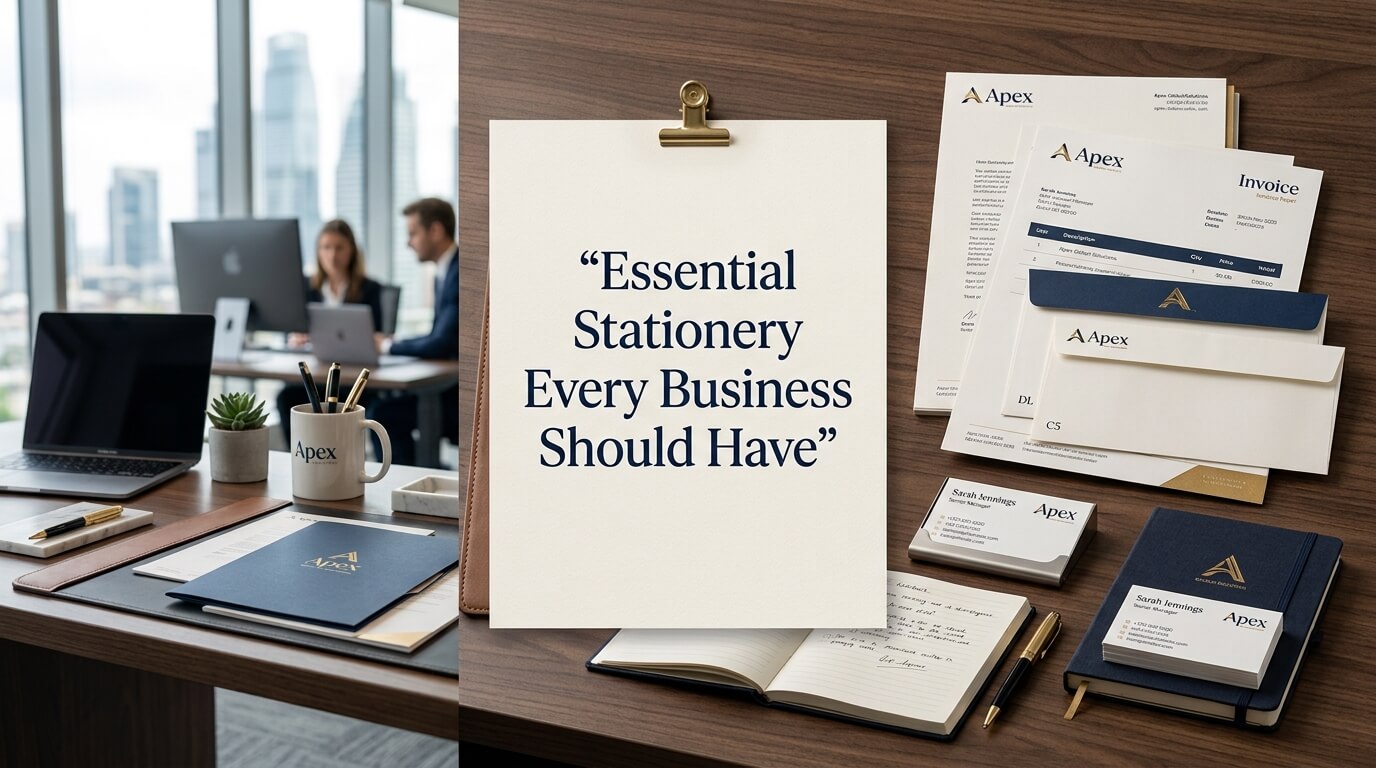
In a business world dominated by emails, video meetings, digital proposals, and online invoices, it can be easy to assume that printed stationery is no longer important. Yet professional stationery continues to play a valuable role in how a company presents itself. A business card exchanged during a meeting, a letterhead used for an official document, or a branded envelope carrying important paperwork can communicate professionalism in a way that a digital message often cannot.
Business stationery is more than paper printed with a company logo. It is part of a business’s visual identity and can create consistency across everyday communications. When business cards, letterheads, envelopes, folders, invoices, notepads, and other materials share the same design language, customers and partners receive a more recognizable and professional impression. Current printing guidance and business stationery providers continue to emphasize coordinated stationery as an important branding touchpoint.
The right stationery collection will vary depending on the type and size of a business. A consulting firm may need elegant letterheads and presentation folders, while a retail company may benefit more from branded packaging inserts, receipts, and thank-you cards. However, there are several stationery essentials that are useful for almost every organization.
Why Business Stationery Still Matters
Professional stationery helps a company appear organized, established, and prepared. Even when most communication takes place online, businesses still have occasions when physical materials are necessary. Contracts, formal correspondence, proposals, invoices, certificates, client documents, and printed presentations can all benefit from consistent branding.
There is also a psychological advantage to creating a consistent visual experience. When customers see the same logo, colors, typography, and design elements across different materials, the company becomes easier to recognize. This consistency can strengthen brand familiarity and make communications feel more deliberate.
A recent corporate stationery guide describes letterheads, envelopes, business cards, and other printed materials as brand touchpoints because they accompany real interactions between businesses and their customers. This is particularly useful for companies that want their physical communications to feel as professional as their websites and digital marketing.
Stationery can also help establish credibility. A professionally designed document generally feels more official than an ordinary sheet of paper with information typed at the top. This does not mean that expensive paper or elaborate finishes are necessary. Good design, accurate information, readability, and consistency are usually more important than excessive decoration.
Essential Business Stationery Every Company Needs
Business Cards
Business cards remain one of the most recognizable forms of business stationery. They provide a simple way to exchange contact information during meetings, networking events, conferences, client appointments, and other professional situations.
A well-designed business card should contain the information a recipient actually needs. This commonly includes the person’s name, position, company name, telephone number, email address, website, and other relevant contact information. Depending on the business, social media details or a QR code can also be incorporated.
The design should be clean enough that the information can be understood quickly. A card that uses too many fonts, excessive graphics, or tiny text may look creative but become difficult to use.
Paper quality also matters. Business cards are handled frequently, so flimsy material can make them feel less substantial. Many professional printers offer heavier card stocks, textured papers, coatings, rounded corners, embossing, foil details, and other finishes. These options can add personality, although the best choice depends on the brand and audience. Local printing providers in Pakistan, for example, commonly offer business cards alongside coordinated letterheads, envelopes, folders, and other corporate stationery.
Letterheads
A professional letterhead is one of the most important stationery items for formal business communication. It provides a recognizable framework for letters, agreements, notices, proposals, certificates, and other documents.
A letterhead normally includes the company logo, business name, contact details, website, and sometimes the physical address or registration information. The layout should leave sufficient space for the actual document content.
A common mistake is making the letterhead so visually dominant that it competes with the message. Effective letterhead design should support the content rather than overpower it.
Letterheads can also be created as digital templates. This allows employees to produce professional documents electronically while maintaining the same visual identity as printed stationery. Businesses should ensure that the digital version uses the correct logo, fonts, colors, and contact details so that documents remain consistent.
Government-backed graphic design training material in Pakistan also identifies business cards, letterheads, and corporate envelopes as core business stationery items, highlighting their role in professional communication and brand consistency.
Envelopes
Envelopes are sometimes overlooked because they are primarily used to carry other documents. However, they are often the first branded element a recipient sees when receiving physical correspondence.
A branded envelope can include the company logo, business name, return address, website, or other appropriate details. The design should remain practical because postal information, recipient addresses, labels, and stamps still need sufficient space.
Matching envelopes with letterheads creates a more complete stationery experience. Instead of receiving an ordinary envelope containing a branded document, the recipient encounters the company’s identity before even opening the correspondence.
For businesses that regularly send contracts, invoices, official notices, marketing materials, or client documents, professionally printed envelopes can therefore become a useful part of the overall brand presentation.
Compliment Slips
Compliment slips are smaller pieces of branded paper designed for short messages. They are useful when a full letterhead would feel excessive.
A company might use a compliment slip when sending a brief thank-you note, a document, a sample, a small gift, or another item to a customer. Because the format is simple, the recipient can immediately understand that the message came from the business.
Compliment slips can also add a personal element to customer communication. A short handwritten message can feel more thoughtful than a standard automated email, particularly when it accompanies a delivery or client gift.
Notepads
Branded notepads can serve both internal and external purposes. Employees can use them during meetings, brainstorming sessions, interviews, training sessions, and client appointments. Customers can also receive them as useful promotional items.
A notepad does not need to be heavily branded. A logo in the header or footer, along with the company’s colors and contact details, may be enough.
The practical value of notepads is part of their appeal. Unlike promotional materials that may be discarded quickly, a useful notebook can remain on someone’s desk for weeks or months. Every time it is used, the brand has another opportunity to be noticed.
Stationery for Financial and Administrative Documents
Invoices and Receipt Books
Businesses that sell products or services need professional documentation for financial transactions. Invoices and receipt books are therefore essential stationery for many organizations.
Printed invoice books can be especially useful for businesses that still conduct transactions in environments where paper records are necessary. Carbonless NCR forms are also available for creating duplicate or triplicate copies without traditional carbon paper. Printing companies commonly provide invoice books, receipt books, and NCR forms alongside other corporate stationery.
The design should prioritize clarity. Important information such as invoice numbers, dates, customer details, descriptions, quantities, prices, taxes, payment terms, and totals should be easy to locate.
Businesses using accounting software can also create branded digital invoice templates. The goal is not necessarily to eliminate paper but to ensure that both physical and digital financial documents look like they belong to the same organization.
Quotation and Estimate Templates
Quotation and estimate documents are often among the first formal documents a potential customer receives from a business. This makes them both administrative tools and branding opportunities.
A professional quotation should communicate the scope of work, pricing, terms, validity period, and relevant company information clearly. Branding should support that information rather than distract from it.
Creating a standardized quotation template can also save employees time. Instead of designing every proposal or estimate from scratch, staff can work from an approved format that already contains the correct logo, colors, typography, and business details.
Presentation Folders
Presentation folders are particularly useful for businesses that regularly meet clients or submit proposals. They provide a professional way to organize several documents in one place.
A branded folder can hold proposals, brochures, price sheets, contracts, business cards, company profiles, and other materials. When all these documents are presented together, the folder creates a more cohesive experience.
Folders are especially valuable for professional services, real estate companies, law firms, consulting businesses, agencies, financial firms, and corporate sales teams. They can make a collection of separate documents feel like one carefully prepared presentation.
A simple folder design is often more effective than an overloaded one. The front cover may only need the logo, company name, and a subtle visual element. The interior can provide pockets for documents and a designated space for a business card.
Company Profiles and Brochures
Although brochures and company profiles are sometimes classified as marketing materials rather than stationery, they can form an important part of a business’s printed communication system.
A company profile explains who the organization is, what it does, what it offers, and why customers or partners should consider working with it. It can be used during meetings, sales presentations, exhibitions, proposals, and networking opportunities.
Brochures, meanwhile, can focus on particular products or services. Their purpose is usually more promotional and customer-oriented.
Both should follow the same visual identity as the company’s core stationery. If a business card uses one color palette while the brochure uses completely different fonts and imagery, the brand can feel inconsistent.
Stamps and Administrative Stationery
Business stamps remain useful for many organizations, particularly where physical documentation and administrative processes are common.
A company stamp may contain the business name, registration information, address, or other approved details. It can be used on documents where organizational identification or internal processing requires it.
Other administrative stationery can include receipt pads, order forms, delivery notes, appointment cards, file labels, and internal forms. These items may not be visible to customers as often as business cards, but they can make everyday operations more organized.
The important principle is to distinguish between stationery that is genuinely useful and stationery that exists only because it looks professional. Businesses should invest first in materials employees and customers actually use.
The Role of Digital Stationery
Modern business stationery is no longer limited to printed materials. Digital templates are now an important part of maintaining a consistent brand.
A company may need branded email signatures, proposal templates, invoice templates, presentation slides, digital letterheads, quotation documents, and PDF forms. These materials should use the same visual system as printed stationery.
This creates continuity between physical and digital interactions. A customer might receive a business card at a meeting, an email afterward, a PDF proposal the next day, and an invoice later. When every touchpoint looks connected, the business feels more organized.
Digital stationery is especially important for remote teams. Employees working from different locations can use standardized templates instead of creating their own versions of company documents.
Choosing the Right Stationery for Your Business
Not every business needs every possible stationery item. The best stationery collection should be based on how the company communicates, sells, invoices, and interacts with customers.
| Stationery Item | Primary Purpose | Best For | Branding Priority |
| Business Cards | Sharing contact information | Almost every business | High |
| Letterheads | Formal correspondence | Professional and corporate businesses | High |
| Envelopes | Mailing documents | Businesses sending physical correspondence | High |
| Compliment Slips | Short messages and notes | Client-focused businesses | Medium |
| Notepads | Meetings and everyday writing | Offices and service businesses | Medium |
| Invoices | Financial documentation | Product and service businesses | High |
| Receipt Books | Transaction records | Retail and service businesses | High |
| Presentation Folders | Organizing client materials | Sales and professional services | High |
| Company Profiles | Business introduction | B2B and corporate businesses | High |
| Brochures | Product or service promotion | Sales-focused businesses | Medium to High |
| Stamps | Administrative identification | Businesses using physical documents | Medium |
A startup may begin with business cards, letterheads, envelopes, invoices, and a digital document template. As the company grows, it can add presentation folders, notepads, brochures, compliment slips, packaging inserts, and other materials.
The key is to build a stationery system rather than purchasing random individual items.
Creating a Consistent Stationery Design
Start With Brand Guidelines
Every stationery item should follow the company’s existing brand guidelines. This includes logo usage, colors, fonts, imagery, spacing, and general visual style.
If the business does not have formal brand guidelines, stationery design can be a good opportunity to establish them. Once the core visual identity is defined, it becomes much easier to create consistent materials.
Keep Information Accurate
A beautiful stationery design becomes ineffective if it contains an outdated telephone number, incorrect address, old website, or obsolete logo.
Before printing large quantities, businesses should carefully check every detail. Printed errors can be expensive to correct because an entire batch may need to be replaced.
This is especially important after a rebrand or office relocation. Businesses should review their stationery inventory whenever important company information changes.
Choose Materials That Match the Brand
Paper quality influences how stationery feels. A luxury consultancy may want a heavier textured stock, while a modern technology company may prefer a clean, smooth paper.
There is no universal best paper. The right choice depends on the company’s audience, budget, industry, and personality.
Businesses can also explore finishes such as embossing, foil, spot UV, or special cuts. Local printing providers commonly offer these options alongside different paper weights and textures. However, decorative finishes should support the brand rather than become the main attraction.
Think About Sustainability
Businesses are increasingly expected to consider the environmental impact of their printed materials. Choosing appropriate quantities can reduce unnecessary waste. Recycled or responsibly sourced paper may also be appropriate depending on the company’s goals and supplier options.
Sustainability does not necessarily mean eliminating stationery. It can mean printing intelligently, avoiding excessive quantities, choosing practical formats, and using materials thoughtfully.
Common Business Stationery Mistakes
One of the most common mistakes is inconsistency. A company may have one version of its logo on business cards, another on invoices, and completely different colors on envelopes. These differences can make the organization look less established.
Another mistake is overcrowding. Businesses sometimes attempt to place every possible detail on a business card or letterhead. The result can be difficult to read. Good stationery should provide essential information while leaving enough visual space.
Poor-quality printing is another problem. Even a strong design can look unprofessional when colors are inaccurate, text is blurry, or paper quality is unsuitable.
Businesses should also avoid printing huge quantities without reviewing their future needs. Contact details, addresses, employees, services, and branding can change. Ordering manageable quantities can reduce the risk of having outdated materials sitting in storage.
How Much Stationery Does a Business Really Need?
The answer depends on the business’s communication habits. A small consultancy with a mostly digital workflow may only need a modest supply of business cards, letterheads, envelopes, and occasional folders.
A larger organization with multiple departments may need separate stationery for different functions while still maintaining one overall brand system.
The best approach is to examine how often each item is used. If a company sends hundreds of letters every month, investing in professionally printed letterheads and envelopes makes sense. If physical correspondence is rare, a smaller quantity may be more practical.
Businesses should also consider whether printed stationery is being used internally, externally, or both. This can help determine which materials deserve premium treatment and which can remain simple.
Conclusion
Essential business stationery is not about filling an office with branded paper. It is about giving important communications a consistent, professional identity. Business cards, letterheads, envelopes, invoices, notepads, presentation folders, brochures, and digital templates can all contribute to a stronger and more recognizable business presence.
The most effective stationery is practical, readable, consistent, and aligned with the company’s brand. A business does not need the most expensive paper or the most elaborate printing techniques. What matters is creating a cohesive system that works across everyday communication.
In a world where so much business happens digitally, thoughtful physical stationery can still make an impression. When every document, card, envelope, and presentation reflects the same professional identity, even small interactions can reinforce the credibility of the brand.
Frequently Asked Questions
Q1. What is the most essential business stationery?
Business cards, letterheads, envelopes, and professional invoice or document templates are among the most essential stationery items for most businesses.
Q2. Does every business need printed stationery?
Not necessarily. Businesses with highly digital workflows may need fewer printed materials, but digital letterheads, invoices, proposals, and email signatures can still maintain brand consistency.
Q3. Should business stationery use the company logo?
Yes. The logo should normally appear consistently across core stationery, although its size and placement can vary depending on the item.
Q4. What paper is best for business stationery?
There is no single best paper. The appropriate stock depends on the stationery item, brand image, printing method, budget, and intended use.
Q5. How can a business make its stationery look professional?
Use consistent branding, readable typography, accurate contact information, appropriate spacing, high-quality printing, and materials that suit the company’s industry and audience.