In the pantheon of automotive excellence, few symbols command as much immediate respect and recognition as the Cavallino Rampante, or the Prancing Horse. For design enthusiasts and automotive historians alike, understanding the Ferrari Logo History: The Prancing Horse and Italian Legacy is about more than just analyzing a graphic; it is about tracing the lineage of Italian motorsport, the grief of war, and the unyielding ambition of one man: Enzo Ferrari. This emblem is not merely a brand identifier; it is a cultural artifact that represents the pinnacle of luxury, speed, and mechanical artistry.
The evolution of the Ferrari logo is a masterclass in brand consistency. While other manufacturers have radically altered their visual identities to suit changing trends, Ferrari has remained remarkably faithful to its original vision. This article provides a comprehensive, deep-dive exploration into the origins, evolution, and design semantics of the world’s most famous automotive badge.
The Genesis: A Hero, A Mother, and A Promise (1923)
To fully grasp the Ferrari Logo History: The Prancing Horse and Italian Legacy, one must look back before the company even existed, to the turbulent skies of World War I. The story begins not in a design studio, but on the fuselage of a fighter plane flown by Italy’s most celebrated airman, Count Francesco Baracca.
Francesco Baracca was an ace pilot who claimed 34 aerial victories before his untimely death in 1918. Painted on the side of his SPAD S.XIII biplane was a rearing black horse. Historians have debated the origin of the horse on Baracca’s plane—some suggest it was a tribute to his former cavalry regiment, the “Piemonte Reale,” while others suggest it was taken from the coat of arms of the city of Stuttgart after Baracca shot down a German pilot from that region (which, coincidentally, is why the Porsche logo also features a horse).
The pivotal moment for Enzo Ferrari occurred on June 17, 1923. Enzo, then a young racing driver for Alfa Romeo, had just won the Circuito del Savio in Ravenna. In the crowd were Count Enrico Baracca and Countess Paolina, the parents of the fallen war hero. Impressed by Enzo’s courage and skill, Countess Paolina approached him with a request that would change automotive history. She reportedly told him: “Ferrari, put my son’s prancing horse on your cars. It will bring you good luck.”
Enzo accepted the gift, but he made a crucial stylistic alteration. Baracca’s horse was originally red (on a white cloud), but Enzo chose to paint the horse black as a sign of mourning for the fallen pilot. He then added a canary yellow background, the historical color of his hometown, Modena. This combination created the foundation for the visual identity we recognize today.
Deconstructing the Design Elements
Before analyzing the chronological evolution, it is essential to understand the four core components that make up the Ferrari visual identity. Each element carries significant weight in the Ferrari Logo History: The Prancing Horse and Italian Legacy.
1. The Cavallino Rampante (Prancing Horse)
The central figure is the horse itself. In heraldry, a “rampant” animal is one rearing on its hind legs with its forelegs raised. This pose signifies power, aggression, and unbridled energy. Over the decades, the anatomical details of the horse have been refined—muscles have become more defined, and the silhouette has been streamlined—but the aggressive stance remains unchanged.
2. The Canary Yellow Background
While the horse represents the Baracca family and the Italian nation, the background is deeply personal to Enzo Ferrari. The specific shade of yellow, known as “Giallo Modena,” is the official color of the city of Modena, Italy. By anchoring the black horse in a field of yellow, Enzo ensured that his company would forever be tied to his local roots.
3. The Tricolore (Italian Flag)
Crowning the logo is a horizontal strip featuring green, white, and red. This represents the Italian flag. Its inclusion signifies that Ferrari is not just a company; it is an ambassador for Italy. In the context of the Ferrari Logo History: The Prancing Horse and Italian Legacy, this top band serves as a constant reminder of the brand’s national heritage.
4. The Typography
The font used for the word “Ferrari” (or the letters “S F”) is a custom slab serif typeface. The most distinctive feature is the elongated upper stroke of the letter “F,” which extends over the rest of the word, visually sheltering the brand name. This typographic choice exudes stability and tradition.
Chronological Evolution of the Ferrari Logo
While the core elements have remained consistent, the logo has undergone subtle refinements to adapt to different applications, from the hoods of race cars to the grilles of luxury grand tourers.
1929 – 1931: The Scuderia Ferrari Shield

The first official iteration of the logo appeared in 1929, but not on a car manufactured by Ferrari. At this time, Enzo Ferrari was managing a racing team for Alfa Romeo, known as “Scuderia Ferrari” (Ferrari Stable). The logo designed for this era was shield-shaped (the Scudetto).
This design featured the black horse on the yellow background, topped with the Italian tricolor. However, instead of the full name, the bottom of the shield contained the letters “S F” in a bold, black serif font. This stood for Scuderia Ferrari. The horse in this early version was somewhat thinner and less muscular than the modern interpretation, often depicted with the tail pointing downward.
1932: The Debut on the Track
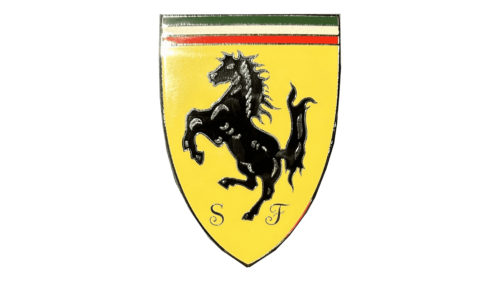
The shield made its physical debut on a vehicle at the 1932 Spa 24 Hours. The Alfa Romeo cars managed by Enzo bore the yellow shield on their side panels. It was a triumphant debut, as the cars finished first and second, immediately cementing the association between the Prancing Horse and victory.
1947: The Birth of the Manufacturer and the Rectangular Badge
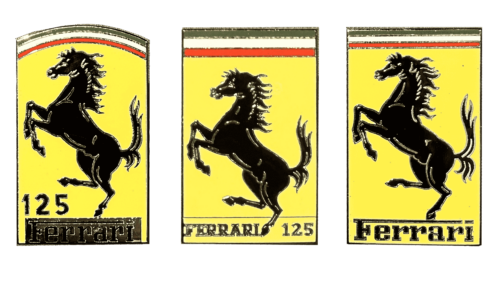
After World War II, Enzo Ferrari decided to stop managing teams for others and started manufacturing his own cars. This marked a significant shift in the Ferrari Logo History: The Prancing Horse and Italian Legacy. With the launch of the Ferrari 125 S in 1947—the first car to bear the Ferrari name—a new logo variant was required.
While the shield remained (and still remains) the symbol of the racing team, the production cars required a badge for the nose of the vehicle. Enzo introduced the rectangular logo. In this version, the “S F” was replaced by the full name “Ferrari” at the bottom. The font was stylized with the iconic elongated “F.” The horse was redesigned to be more robust, and the tail was adjusted to point upward, symbolizing optimism and forward momentum.
1950s – 1960s: Refinement and Standardization
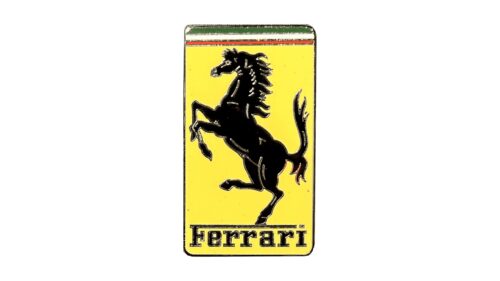
During the golden age of sports car racing, the logo saw minor adjustments. The horse’s silhouette was cleaned up to make it more legible at high speeds and on smaller badges. The yellow became brighter and more standardized. During this era, the distinction between the “Scudetto” (Shield) for the front fenders and the Rectangular Badge for the hood became a strict design hierarchy that exists to this day. The shield implies racing pedigree, while the rectangle denotes the manufacturer.
1994: The Digital Transition
As the world entered the digital age, brands needed logos that could be reproduced clearly on screens and printed materials. Ferrari updated the logo in 1994 to clean up the linework. The horse’s features were smoothed out, removing some of the intricate jagged edges of earlier hand-drawn versions. The “Ferrari” typography was slightly refined to improve legibility, ensuring the slab serifs were sharp and distinct.
2002 – Present: The Modern Masterpiece
The most recent major update occurred in 2002, spearheaded by the Seidlcluss design agency. This update was subtle but effective, aimed at modernizing the brand for the 21st century while respecting the Ferrari Logo History: The Prancing Horse and Italian Legacy.
- Lighting and Depth: The yellow background was given a slightly glossier, flatter appearance to look premium in digital formats.
- Anatomical Correction: The horse was redrawn with precise geometric attention. The eye of the horse, the position of the hooves, and the flow of the mane were tweaked to look more aerodynamic and powerful.
- Typography: The lettering was spaced slightly further apart, and the lines of the “F” were straightened to convey modern precision engineering.
- The Tricolor: The green, white, and red bands were removed of any dividing lines, creating a seamless transition of colors.
The Psychology of the Prancing Horse
Why does this logo resonate so deeply? From a design psychology perspective, the Ferrari logo is a perfect storm of emotional triggers.
Color Psychology: The combination of yellow and black is one of the most high-contrast pairings in color theory. In nature, this combination signals danger (think bees or wasps). In branding, it demands attention. The red of the tricolor (and the cars themselves) evokes passion, excitement, and blood.
Symbolism of the Horse: Horses have served humanity for millennia as engines of transport and weapons of war. They represent untamed freedom. By placing a rearing horse on a machine, Ferrari suggests that the car has a soul—that it is a living, breathing beast that the driver must tame. This aligns perfectly with the brand’s reputation for producing cars that are challenging and rewarding to drive.
The Scudetto vs. The Rectangle: Knowing the Difference
A common point of confusion in the Ferrari Logo History: The Prancing Horse and Italian Legacy is the usage of the two main logo shapes. True enthusiasts know the distinction:
- The Rectangular Badge: This is the corporate logo. It appears on the nose (hood) of every production car, on corporate stationery, and at the factory entrance. It represents Ferrari as an automobile manufacturer.
- The Scudetto (Shield): This is the racing logo. It appears on the side fenders of the cars. Historically, it was reserved for the racing team (Scuderia Ferrari). On modern road cars, the fender shields are often an optional extra—a nod to the car’s race-bred technology. Having the shields on the fender is considered a highly desirable aesthetic feature for collectors.
Key Takeaways
- Origin in Aviation: The Prancing Horse was originally painted on the WWI fighter plane of Francesco Baracca, Italy’s top ace.
- A Mother’s Gift: The logo was suggested to Enzo Ferrari by Countess Paolina Baracca in 1923 as a good luck charm.
- Color Significance: The black horse symbolizes mourning for Baracca; the yellow background represents the city of Modena; the tricolor represents Italy.
- Two Distinct Logos: The “Scudetto” (shield) with the letters “S F” represents the racing team, while the rectangular badge with the name “Ferrari” represents the manufacturer.
- Consistency is Key: Unlike many other brands, Ferrari has never radically changed its logo, only refining it for clarity and modernization.
Frequently Asked Questions (FAQ)
Why is the Ferrari horse black?
While Francesco Baracca’s original horse on his plane was red, Enzo Ferrari chose to paint the horse black on his logo. This was done as a sign of mourning and respect for the fallen pilot, who was killed in action in 1918.
What do the letters “S F” stand for on the Ferrari logo?
The letters “S F” found on the shield-shaped logo stand for Scuderia Ferrari. Translated from Italian, this means “Ferrari Stable.” It refers to the racing division of the company, which existed before Ferrari began manufacturing its own road cars.
Did Porsche and Ferrari use the same horse?
Technically, yes. The city of Stuttgart, Germany, features a rearing horse in its coat of arms. It is believed that Francesco Baracca may have painted the horse on his plane after shooting down a German pilot from Stuttgart. Porsche, being based in Stuttgart, uses the city’s coat of arms as the center of its logo. Therefore, both automotive legends share a heraldic ancestor.
When did the Ferrari logo first appear on a car?
The Prancing Horse shield first appeared on the Alfa Romeo cars managed by Enzo Ferrari at the Spa 24 Hours race in July 1932. The rectangular badge featuring the “Ferrari” name debuted in 1947 with the launch of the Ferrari 125 S.
Has the Ferrari logo ever been changed?
The logo has never undergone a radical redesign, but it has evolved. Significant refinements occurred in 1947 (introduction of the rectangle), 1994 (digital cleanup), and 2002 (modern styling and anatomical corrections). However, the core elements—horse, yellow field, and tricolor—have remained constant.
Conclusion
The Ferrari Logo History: The Prancing Horse and Italian Legacy serves as a powerful reminder that great brand identity is built on storytelling. Enzo Ferrari did not simply commission a graphic designer to draw a fast animal; he adopted a symbol of national heroism, grounded it in his local heritage, and imbued it with the spirit of competition.
Today, the Cavallino Rampante is more than a trademark; it is a seal of quality that promises performance without compromise. Whether displayed on the side of a Formula 1 car screaming down the Monza straight or sitting quietly on the nose of a vintage 250 GTO, the logo tells a story of triumph, tragedy, and the relentless pursuit of perfection. It remains, undeniably, one of the most potent symbols in the history of design.