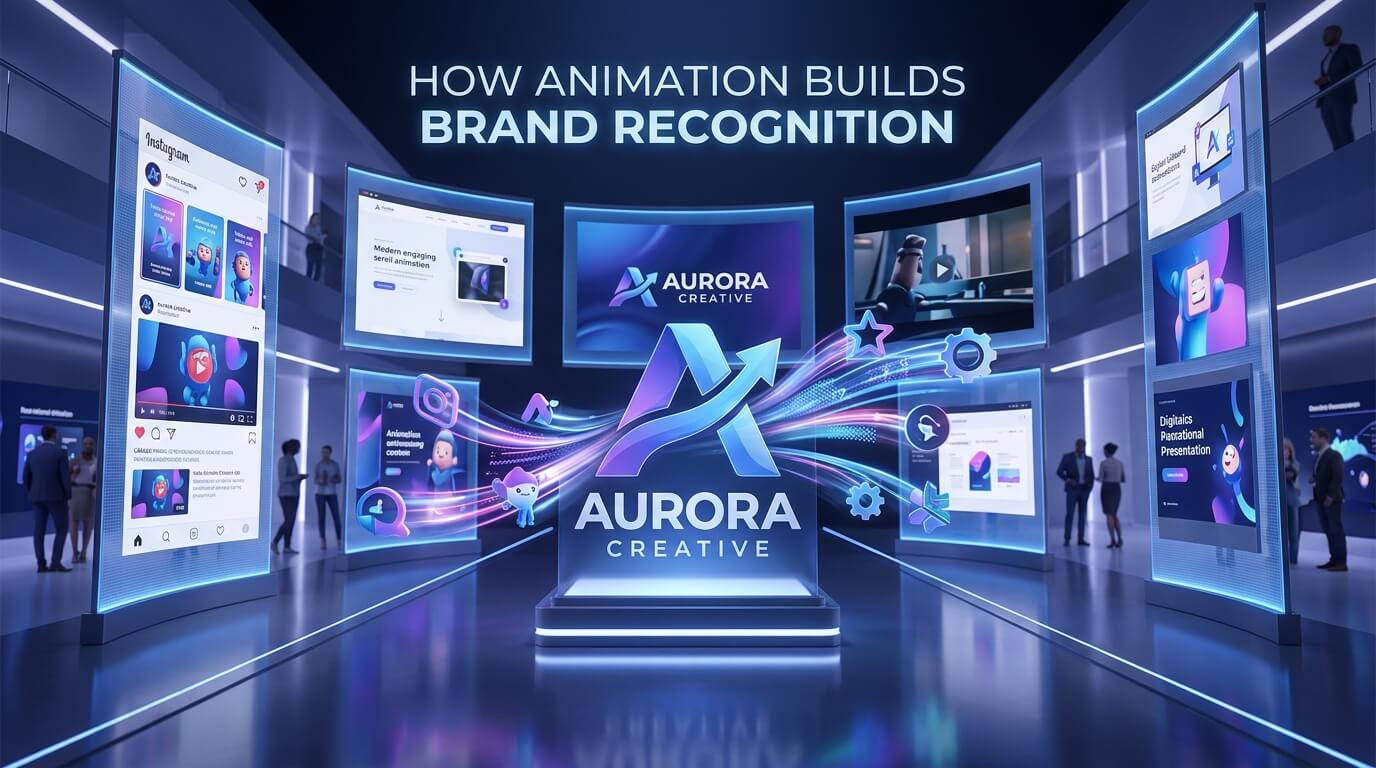
In a crowded digital marketplace, brand recognition has become one of the most valuable assets a business can develop. Customers are exposed to thousands of messages, advertisements, social media posts, videos, websites, and product promotions every day. Because of this constant exposure, businesses cannot rely on a logo or company name alone to remain memorable. Brands need distinctive ways to capture attention, communicate personality, and create recognizable experiences. Animation has emerged as one of the most effective visual tools for achieving these goals.
Animation gives a brand something that static design often cannot provide: movement, rhythm, personality, and storytelling. A logo can be transformed, characters can interact with products, abstract ideas can become visual stories, and brand colors can move consistently across different platforms. Research into animated brand logos has found that certain forms of animation can increase attention and influence brand attitudes, particularly when the movement fits the personality of the brand.
The real value of animation, however, is not simply that it looks attractive. Effective animation creates recognizable visual patterns that audiences can begin to associate with a particular company. When those patterns appear consistently across advertisements, websites, social media, presentations, and other marketing materials, they can strengthen the mental connection between the visual experience and the brand behind it. Brand consistency is important because repeated and coherent exposure helps reinforce brand associations over time.
Why Brand Recognition Matters
Brand recognition is the ability of consumers to identify a business when they encounter its visual identity, name, product, communication style, or other distinctive characteristics. It is different from simply knowing that a company exists. Recognition occurs when customers see something and immediately connect it with a particular brand.
Imagine watching a short video without seeing the company name until the final second. If the colors, character style, movement, typography, sound, and visual language already make you think of the company, that business has achieved a strong level of recognition. Animation can contribute to this effect by giving brands additional elements that audiences can identify.
A strong brand identity is generally built through multiple connected elements. Logos, colors, typography, photography, packaging, messaging, and other visual assets work together to create a recognizable identity. Animation adds another dimension by introducing motion and behavior. Contemporary branding discussions increasingly recognize that a brand is not defined only by what it looks like but also by how it behaves, including its pace, rhythm, personality, and movement.
This makes animation particularly useful for modern businesses that communicate primarily through digital channels. A website visitor, social media user, or video viewer can experience a brand through motion before they consciously read the company’s name.
Animation Makes a Brand More Visually Distinctive
One of the biggest challenges businesses face is differentiation. Many companies use similar colors, stock photography, fonts, layouts, and advertising formats. Even when these designs are professionally produced, they can blend together because competitors are using comparable visual approaches.
Animation creates an opportunity to develop a more distinctive visual language.
A company might establish a particular style of movement, such as smooth transitions, playful character movements, geometric transformations, hand-drawn illustrations, or sophisticated 3D sequences. Over time, these characteristics can become associated with the company. Instead of customers recognizing only a logo, they may begin recognizing the way the brand moves.
This is especially important on social media, where users scroll rapidly through a continuous stream of content. A distinctive animation can interrupt that pattern and create a moment of visual attention. The objective is not to add movement simply for decoration. The movement should reinforce the identity and message of the brand.
For example, a technology company positioned around innovation may use clean geometric animations, fluid transitions, and futuristic visual effects. A children’s education company may use colorful characters, expressive movements, and playful transitions. A luxury company might use restrained motion, elegant transitions, and subtle animation. Each approach creates a different impression.
Motion Can Become a Brand Asset
Businesses traditionally think of brand assets as logos, colors, fonts, icons, and imagery. Motion can also become a brand asset.
A recognizable animation style can be used repeatedly across marketing channels. A logo may appear through the same signature movement at the end of videos. Icons can animate using a consistent transition. Text can enter the screen using a particular rhythm. Characters can move according to a recognizable style.
When these elements are repeated appropriately, the audience gradually becomes familiar with them.
This does not mean every piece of content should look identical. Effective consistency allows variation while maintaining recognizable characteristics. Marketing research on repetition and variation has explored how brands can preserve recognition while introducing enough creative variation to maintain attention and avoid fatigue.
Animation Captures Attention Quickly
Attention is the starting point of recognition. If people do not notice a brand, they have little opportunity to remember it.
Movement naturally provides a strong visual signal because the human eye is sensitive to changes within the visual environment. In digital advertising, animation can therefore help a business create an immediate point of focus.
An animated headline can attract attention to a key message. A moving product illustration can demonstrate how something works. A character can guide viewers through a story. A logo can transform into a recognizable symbol at the end of a video.
Research examining animated brand logos has found evidence that animated treatments can influence attention and cognitive responses, although their effectiveness depends on the type and context of animation.
The important lesson is that movement should have a purpose. Excessive motion can become distracting and may weaken the message. Strong brand animation uses movement strategically, helping viewers understand where to look and what the business wants them to remember.
Animation Helps Communicate Brand Personality
Every recognizable brand has a personality, whether it is intentionally designed or not. Some brands feel energetic and adventurous. Others appear professional, sophisticated, friendly, humorous, reliable, or innovative.
Animation provides a powerful way to express that personality because movement can communicate characteristics that static imagery cannot.
A fast, energetic animation can make a brand feel active and youthful. Slow and controlled movement can create a sense of sophistication. Bouncy character animation can communicate friendliness. Precise geometric transitions can create an impression of professionalism and technological expertise.
This makes animation more than a visual technique. It becomes a behavioral expression of the brand.
Research into animated brand logos has found that animated elements can influence attitudes toward brands, but the response depends on whether the animation is consistent with the brand’s other cues and perceived personality.
Consistency Between Animation and Brand Identity
A major mistake is choosing an animation style simply because it is trendy. A colorful cartoon animation may be visually impressive, but it may not suit a financial institution that wants to communicate stability and authority.
Likewise, an extremely formal animation style might feel inappropriate for a youthful entertainment company.
The animation should therefore support the existing brand identity. Its colors, typography, characters, pacing, transitions, sound, and overall visual language should feel like natural extensions of the brand.
This principle is closely connected to brand consistency. A consistent identity helps consumers develop familiar associations with a company, while inconsistent communication can create confusion.
Animation Strengthens Brand Storytelling
People often remember stories more easily than isolated information. Animation gives businesses an opportunity to turn ordinary marketing messages into visual narratives.
A software company can show a character struggling with a business problem before introducing its solution. A healthcare company can use animation to explain a complicated process in a simple sequence. An educational brand can create recurring characters that represent different concepts. A consumer brand can build short stories around its products.
These stories help audiences understand not only what a company sells but also why the product or service matters.
Animation is particularly useful when the product itself is difficult to show through traditional video. Software, financial systems, artificial intelligence platforms, cloud services, technical processes, and abstract concepts can be difficult to demonstrate physically. Animation allows marketers to visualize invisible processes and turn complicated ideas into understandable experiences.
This can indirectly support recognition because customers are more likely to connect the brand with a particular explanation, character, visual metaphor, or story.
Animation Creates Memorable Visual Experiences
Recognition and memory are closely connected. A customer needs to retain some association with a brand before recognition can occur later.
Animation can create stronger experiences by combining several forms of communication. A viewer may simultaneously process color, movement, typography, imagery, sound, and narrative. When these elements are coordinated, they can create a more distinctive experience than a plain static advertisement.
This is particularly valuable when a company develops recurring visual elements.
For example, a brand might use the same animated mascot in social media videos, website explainers, advertisements, product tutorials, and presentations. After repeated exposure, the character can become strongly associated with the company.
The same principle can apply to motion patterns. A particular transition, logo reveal, animation style, or opening sequence can become part of a brand’s recognizable signature.
Animation Makes Logos More Dynamic
The logo remains one of the most important components of a brand identity, but digital platforms have changed how logos can be presented. Instead of appearing only as static graphics, logos can now move, transform, assemble, rotate, unfold, or interact with other visual elements.
Animated logos are particularly useful for video intros, website loading experiences, social media content, presentations, advertisements, and digital product interfaces.
The objective is not necessarily to make the logo complicated. In many cases, a simple movement can be more effective because it remains easy to recognize.
A well-designed logo animation can create a short visual signature. When viewers repeatedly see that signature, the movement can become associated with the brand just as strongly as the static logo itself.
However, research suggests that animated logos work best when their movement fits the brand’s personality and other brand cues rather than existing as an unrelated visual effect.
Animation Improves Social Media Brand Recognition
Social media has made visual consistency more important than ever. Businesses publish content across Instagram, Facebook, LinkedIn, TikTok, YouTube, and other platforms, often competing with thousands of other posts for attention.
Animation gives businesses a flexible way to maintain brand identity across these channels.
A single visual concept can become a short video, animated infographic, product demonstration, social media advertisement, story, or educational clip. By maintaining consistent colors, typography, characters, transitions, and motion behavior, the brand can create a recognizable presence even when the content changes.
This is especially useful for businesses that publish frequently. Instead of creating every piece of content from scratch with a completely different visual style, companies can establish an animation system that provides creative flexibility while preserving recognizable characteristics.
Animation Supports Emotional Connections
Brand recognition is not only about visual identification. The strongest brands are often connected to feelings and associations.
Animation can help create those emotional connections because movement has the ability to communicate mood. Music, timing, expressions, transitions, and visual storytelling can make an advertisement feel exciting, comforting, humorous, inspirational, or serious.
Consider the difference between a character slowly appearing on screen with soft movement and the same character suddenly entering with energetic motion and upbeat sound. The visual information may be similar, but the emotional experience is different.
When a brand repeatedly creates a particular emotional experience through animation, viewers may begin associating that feeling with the company.
This is one reason animation can become especially valuable for brands that want to appear approachable. Characters and illustrated environments can create a sense of warmth that may be difficult to achieve with highly technical communication.
Animation Can Make Complex Brands Easier to Understand
Recognition becomes easier when people understand what a company does. If a business has a complicated product or service, customers may struggle to remember it because they never fully understand its value.
Animation can simplify complicated ideas by breaking them into visual stages.
A financial company can animate how a transaction works. A technology company can visualize data moving through a platform. A medical company can explain a process through illustrated sequences. A logistics company can demonstrate how an order travels from warehouse to customer.
By making the concept easier to understand, animation gives the audience a clearer association between the company and the solution it provides.
This is particularly useful for B2B brands, where products and services may involve technical systems, professional processes, or abstract benefits.
Where Animation Can Strengthen Brand Recognition
| Brand Touchpoint | Animation Opportunity | Recognition Benefit |
| Website | Animated logo, icons, transitions and illustrations | Creates a consistent digital experience |
| Social Media | Short animated posts, reels and stories | Builds recurring visual familiarity |
| Advertising | Animated product demonstrations and campaigns | Connects memorable visuals with the brand |
| Presentations | Motion graphics and animated diagrams | Makes business communication more distinctive |
| Product Interface | Micro-animations and interactive elements | Extends brand personality into the user experience |
| Video Content | Branded intros, characters and transitions | Creates recognizable video signatures |
| Email Marketing | Animated graphics and visual storytelling | Adds consistency to customer communication |
| Explainer Videos | Characters, illustrations and motion graphics | Associates the brand with clear explanations |
Animation Helps Create a Consistent Brand System
A successful animation strategy should not depend on individual videos. Businesses should think about motion as part of their broader brand system.
A brand can establish guidelines for animation just as it establishes guidelines for colors and typography. These guidelines can define how quickly objects move, how transitions behave, how characters express emotions, how logos appear, and how different elements interact.
This creates consistency without eliminating creativity.
For example, a brand may decide that its animations should always feel smooth and optimistic. Another company might use fast transitions and energetic movement. A premium brand could use restrained motion and carefully timed reveals.
The goal is to make the animation feel unmistakably connected to the company.
Animation Supports Long-Term Brand Recall
Brand recognition does not usually happen after one advertisement. It develops through repeated exposure and consistent experiences.
Animation can support this long-term process because it creates reusable visual assets. A character, motion pattern, logo animation, illustration style, or transition can appear repeatedly across campaigns.
Over time, these repeated elements can become familiar.
This is especially important as businesses expand into new platforms. A company may change its advertising message, introduce new products, or target different customer segments while maintaining its core visual language. Animation provides a flexible framework for doing this without completely abandoning recognizable brand characteristics.
Strong branding is therefore not about repeating exactly the same content. It is about creating recognizable patterns within changing content.
Common Animation Mistakes That Can Hurt Brand Recognition
Animation is not automatically effective simply because it moves. Poorly designed animation can make a brand appear inconsistent, outdated, confusing, or overly complicated.
One common mistake is using too many visual styles. If every campaign uses different characters, colors, transitions, and animation techniques, audiences may struggle to identify a consistent brand personality.
Another problem is excessive movement. When everything moves simultaneously, there is no clear focal point. The audience may notice the animation but fail to remember the message or brand.
Poor timing can also weaken professional credibility. Animation that feels too slow, too fast, or disconnected from the message can create the wrong emotional impression.
Businesses should also avoid copying competitors too closely. Trends can provide inspiration, but recognizable branding requires distinctive characteristics. In an environment where AI and digital design tools make polished visuals increasingly accessible, differentiation depends increasingly on meaning, consistency, and memorable identity rather than attractive visuals alone.
How Businesses Can Use Animation Strategically
The most effective approach is to begin with the brand rather than the animation.
Businesses should first define what they want customers to associate with them. Are they trying to appear innovative, trustworthy, friendly, premium, energetic, practical, or creative? Once these characteristics are clear, animation can be designed to express them.
The next step is to identify repeatable visual elements. These might include a specific color palette, illustration style, character system, typography, transition style, logo movement, or sound identity.
The animation should then be adapted to different channels without losing its essential characteristics. A long explainer video and a short social media clip do not need to look identical, but both should feel like they belong to the same brand.
Businesses should also measure performance. Brand recognition can be evaluated through surveys, direct audience feedback, branded search behavior, engagement patterns, recall studies, and comparisons between branded and non-branded campaigns. The objective is to understand whether animation is actually strengthening the association between the content and the company.
The Future of Animation in Branding
As digital content continues to expand, animation is likely to become an increasingly important part of brand identity. Businesses already use motion across websites, social media, advertisements, applications, presentations, and video platforms. As technology makes animation easier to create and distribute, the opportunity for brands to develop distinctive motion identities will continue to grow.
The challenge will be maintaining originality and consistency. When everyone has access to sophisticated design tools, simply producing polished animation will not be enough. Brands will need to develop motion that communicates something distinctive about who they are.
This is why animation should be treated as a strategic branding asset rather than an occasional decorative feature.
A memorable animation style can help customers recognize a business before they see its name. A recurring character can become associated with a particular product. A distinctive logo reveal can create a recognizable opening or closing signature. Consistent motion can reinforce the personality of a brand across multiple platforms.
Ultimately, animation gives brands another language through which they can communicate.
Conclusion
Animation builds brand recognition by combining visual identity, movement, storytelling, emotion, and repetition into a memorable experience. It can make brands more distinctive, help them capture attention, communicate personality, simplify complex ideas, and create recognizable visual signatures across digital platforms.
The strongest results come when animation is consistent with the wider brand identity. Movement should not be added simply because it looks impressive. It should have a clear purpose and reinforce the qualities that a business wants customers to remember.
In an increasingly competitive digital environment, recognizable branding can make the difference between being noticed and being forgotten. Animation gives businesses an opportunity to make their identity not only visible, but dynamic, expressive, and memorable.
FAQ
Q1. How does animation improve brand recognition?
Animation improves brand recognition by giving businesses distinctive motion, visual styles, characters, transitions, and storytelling elements that audiences can repeatedly associate with the brand.
Q2. Can a small business use animation for branding?
Yes. Small businesses can use simple logo animations, social media videos, animated icons, explainers, and branded motion graphics without needing large-scale animation campaigns.
Q3. Does an animated logo work better than a static logo?
An animated logo can add attention and personality, but it should complement the static logo rather than replace it. Research indicates that the effectiveness of animated logos depends partly on how well their movement fits the brand’s personality and surrounding cues.
Q4. What types of animation are useful for brand recognition?
Animated logos, motion graphics, character animation, explainer videos, animated typography, product demonstrations, and branded social media animations can all contribute to recognition when used consistently.
Q5. Why is consistency important in animated branding?
Consistency helps customers connect recurring visual and motion characteristics with the same company. When animation maintains recognizable elements while allowing creative variation, it can strengthen familiarity without making content feel repetitive.