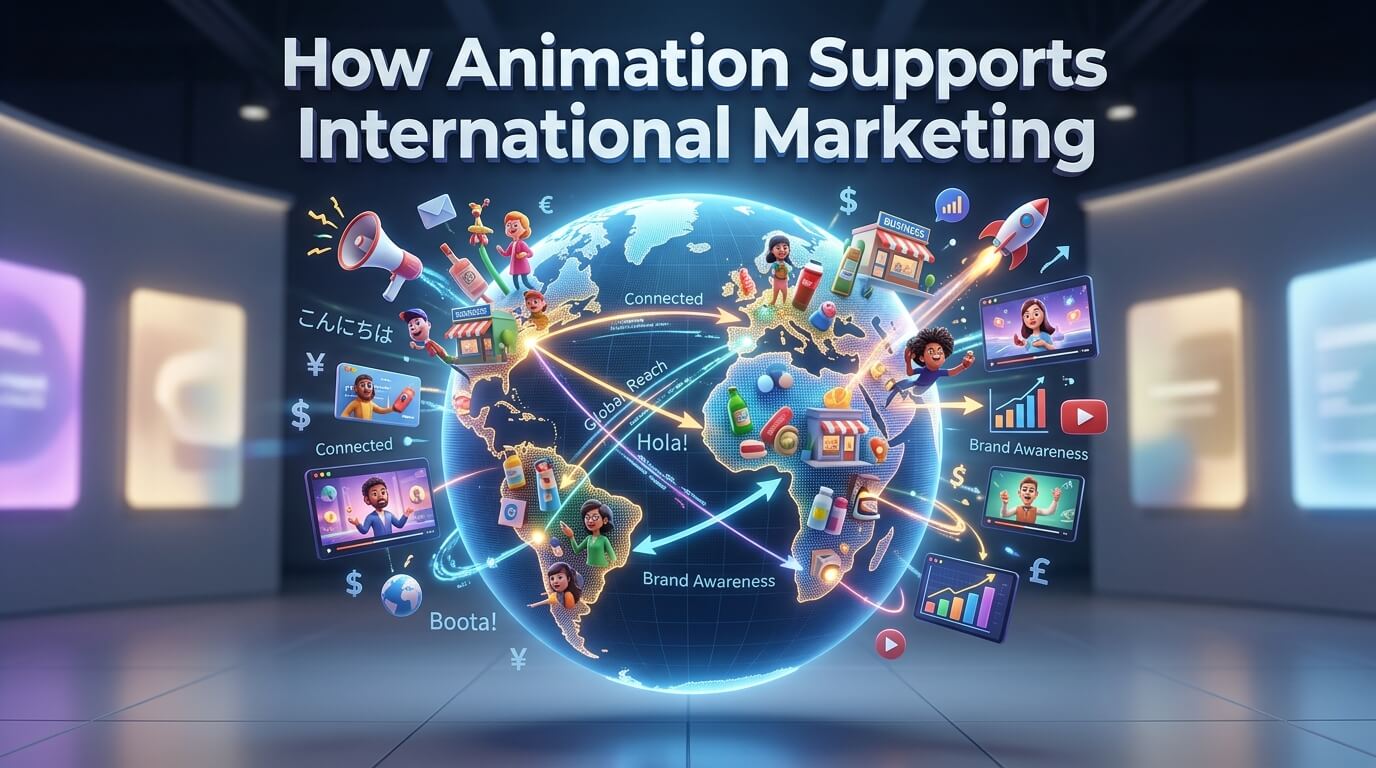
International marketing has changed dramatically as businesses gain access to customers across borders. A company no longer needs a physical office in every country to introduce its products to new audiences. Websites, social media, e-commerce platforms, mobile applications, and digital advertising allow brands to reach people almost anywhere. Yet reaching an international audience is only the first step. The real challenge is communicating a message in a way that people from different languages, cultures, and backgrounds can understand and appreciate.
This is where animation has become an increasingly valuable marketing tool. Animated videos can explain products, demonstrate services, communicate brand stories, and simplify complicated ideas without relying entirely on spoken language. When thoughtfully designed, animation can also be adapted for different countries without requiring an entirely new production for every market. Modern video localization practices increasingly focus not only on translation but also on adapting visuals, tone, cultural references, audio, and on-screen text for specific audiences.
Animation is particularly useful in international marketing because it offers a flexible visual language. Characters, movement, icons, diagrams, colors, and storytelling can communicate concepts that may otherwise become difficult to explain through lengthy written content. At the same time, animation is not automatically universal. Cultural preferences, humor, gestures, colors, symbols, and language still matter. Successful international animation therefore combines globally understandable storytelling with carefully localized details.
Why International Marketing Requires Clear Communication
Language Barriers Can Limit Marketing Effectiveness
Language is one of the most obvious challenges faced by companies entering international markets. A marketing message that works perfectly in one language may become awkward, confusing, or even meaningless when translated directly into another. A literal translation can preserve the words while losing the original intention, humor, emotion, or persuasive quality.
Animation can reduce some of this dependence on language because visual storytelling can demonstrate an idea rather than simply describe it. For example, an animated video for a software platform can show a character struggling with an inefficient process, introduce the software, and visually demonstrate how the problem is solved. Even if the viewer does not understand every spoken word, the sequence of actions can provide valuable context.
This does not mean businesses can simply create an English animation and distribute it worldwide. Localization remains important. Current video-localization guidance emphasizes adapting spoken language, subtitles, graphics, visuals, cultural references, and regional formats rather than relying on word-for-word translation.
Cultural Differences Influence Consumer Response
International audiences do not interpret marketing messages in exactly the same way. A gesture, joke, color, character, image, or social situation that seems completely ordinary in one market may have a different meaning somewhere else.
Animation gives marketers considerable control over these elements. Characters can be redesigned, backgrounds can be changed, clothing can be adapted, and visual references can be replaced without rebuilding an entire live-action production. This flexibility makes animation especially useful when a brand needs to maintain a consistent identity while making its communication feel appropriate to different audiences.
The goal should not be to make every version completely different. Instead, international animation should preserve the central brand message while allowing culturally important details to change. Research and localization guidance increasingly treats global video adaptation as cultural adaptation rather than simple translation.
Animation Creates a More Universal Visual Language
Visual Storytelling Can Cross Language Boundaries
One of the strongest advantages of animation in international marketing is its ability to communicate through visual sequences. A written explanation may require extensive translation, but an animated demonstration can often communicate the basic concept through movement.
Imagine an international company selling a mobile payment application. Instead of explaining every feature through paragraphs of text, an animation can show a customer opening an application, selecting a payment option, scanning a code, completing a transaction, and receiving confirmation. The viewer can understand the basic process from the visual sequence before considering the supporting narration.
This approach is especially useful for explainer videos, product demonstrations, tutorials, onboarding content, and technology marketing. Animation allows marketers to turn abstract or technical concepts into visible experiences.
Symbols and Icons Reinforce Understanding
Icons, diagrams, arrows, charts, and visual transitions can provide additional context. A complicated business process can be represented as a sequence of simple animated stages. A financial service can visualize money moving between accounts. A logistics company can show products moving through a supply chain. A software company can illustrate information flowing between systems.
These techniques help reduce the amount of information that must be communicated through language alone. However, marketers should still check whether symbols have the same meaning in their target markets. A symbol that feels intuitive to one audience may not be equally familiar to another.
Animation Makes Localization More Flexible
One Master Concept Can Support Multiple Versions
A major advantage of animation is that the original project can be structured as a reusable creative asset. Instead of producing a completely separate campaign for every country, a company can create a master animation and develop localized versions from it.
For example, the central animation may contain the same characters, story structure, product demonstration, and brand identity. The company can then replace the voiceover, subtitles, on-screen text, currency, examples, and selected visual details for each market.
This modular approach can make international campaigns easier to manage. Recent localization workflows emphasize creating adaptable source files, separate text layers, clean audio, and reusable creative assets so localized versions can be produced more efficiently.
Animation Can Reduce the Need for Reshoots
Live-action international campaigns can become complicated when every market requires a different actor, location, wardrobe, product setup, or scene. Animation eliminates many of these physical limitations.
If a character needs different clothing for a particular audience, the design can be changed digitally. If the background needs to represent a different city, it can be redesigned. If the dialogue becomes longer after translation, scenes can be adjusted or extended. If a product interface needs to appear in another language, the relevant screen can be recreated.
This flexibility can make animation particularly attractive to businesses planning campaigns across several regions.
Animation Supports Multilingual Marketing
Voiceovers and Dubbing Expand Reach
Animation works well with multiple voiceover tracks because the visuals do not depend on a specific performer speaking on camera. A brand can create one visual production and record different narrations for different languages.
The voice should still sound natural and appropriate for the market. A technically accurate translation can lose effectiveness if the voice feels unnatural or if the pacing does not match the culture and context. Multilingual video strategies therefore increasingly focus on natural spoken language rather than treating subtitles as the only localization solution.
Subtitles Improve Accessibility and Flexibility
Subtitles provide another way to adapt animation internationally. They can be particularly useful when brands want to offer several languages without producing completely separate audio versions.
However, translated text may take up more or less space than the original. A short English phrase can become significantly longer in another language, affecting the animation’s composition. This is why international animation should be designed with localization in mind from the beginning.
Text should be placed in editable layers, and important visual information should not depend on a fixed amount of screen space. This allows designers to adjust layouts when translated text expands.
Animation Helps Brands Explain Complex Products Globally
Technical Products Become Easier to Understand
International businesses often sell products that are difficult to explain. Software, cybersecurity services, financial platforms, medical technologies, engineering systems, and industrial products may involve processes that customers cannot easily visualize.
Animation provides an opportunity to simplify these subjects. Instead of overwhelming customers with technical terminology, a video can introduce the problem, demonstrate the process, and show the outcome through a clear narrative.
This is particularly important in international marketing because technical language becomes even more challenging when it crosses languages. Visual explanations give customers another layer of understanding.
Abstract Concepts Can Become Visual Experiences
Some products do not have an obvious physical appearance. A cloud computing platform, data analytics service, artificial intelligence system, or digital security product may be difficult to represent through conventional photography.
Animation can turn these invisible processes into visual stories. Data can become moving particles. Networks can become connected pathways. Security threats can be represented as obstacles. A digital platform can be illustrated through animated interfaces.
This makes the message easier to communicate across international markets while giving the brand greater creative freedom.
Animation Strengthens International Brand Consistency
Consistent Characters Can Build Recognition
International companies need to balance two competing priorities: consistency and localization. Customers in different countries should recognize the same brand, but they should also feel that the brand understands their market.
Animation can support both goals. A company can maintain its logo, typography, visual identity, character style, storytelling approach, and overall tone while changing selected elements for each audience.
A recurring animated character can become particularly powerful. When the same recognizable character appears across campaigns, the character can function as a visual representation of the brand. At the same time, the character’s environment, clothing, language, or supporting characters can be adapted for different regions.
Visual Identity Remains Under Brand Control
Live-action content can vary considerably depending on actors, locations, lighting, and production conditions. Animation provides more precise control over the visual environment.
Colors, shapes, transitions, illustrations, typography, and character movements can be standardized across a global campaign. This helps maintain a recognizable identity even when multiple localized versions are created.
The result can be a campaign that feels connected rather than fragmented.
Animation Makes Social Media Marketing More Adaptable
Short Animated Content Works Across Platforms
International customers spend significant amounts of time on social platforms, but different markets may favor different channels and content formats. Animation can be resized, shortened, reformatted, and repurposed for different platforms.
A longer explainer can become a series of short animated clips. A product demonstration can be turned into vertical social content. A brand story can be divided into several episodes. Animated graphics can also be incorporated into advertisements, website content, presentations, and email campaigns.
This gives international marketers more opportunities to reuse the same core creative concept while adjusting the execution for individual platforms and markets.
Animation Can Capture Attention Quickly
Digital audiences often decide very quickly whether content deserves their attention. Animation can create movement immediately, making it useful for advertisements and social media content where the opening seconds are particularly important.
Movement can highlight a product feature, reveal a message, introduce a character, or create visual curiosity. Because every element is designed rather than simply recorded, marketers can control exactly what appears on screen and when.
Animation Supports Emotional International Storytelling
Stories Create Human Connections
International marketing is not only about communicating information. It is also about creating emotional connections.
Animation can tell stories about problems, aspirations, families, businesses, communities, and personal experiences. These themes can often be adapted across cultures because they address broadly recognizable human emotions.
A story about saving time, protecting a family, growing a business, overcoming frustration, or achieving a goal can connect with people in many countries. The cultural setting can change while the emotional foundation remains consistent.
Characters Make Brands More Relatable
Characters allow brands to create situations that feel personal. Instead of showing a product in isolation, an animation can show a person using it and experiencing a meaningful outcome.
For international audiences, character design should be handled thoughtfully. Representation should reflect the target audience when appropriate, while avoiding stereotypes. Cultural consultants and native reviewers can help identify visual choices that may unintentionally create problems.
Animation localization is therefore most effective when creative adaptation and cultural understanding work together.
How Animation Supports Different International Marketing Goals
| International Marketing Goal | How Animation Helps | Localization Opportunity |
| Brand awareness | Creates memorable visual identities and characters | Adapt characters, language, and cultural references |
| Product education | Demonstrates features and processes visually | Translate narration and product terminology |
| Lead generation | Explains value propositions quickly | Adapt CTAs and market-specific messaging |
| E-commerce | Shows products and usage scenarios | Localize prices, currency, measurements, and language |
| B2B marketing | Simplifies technical or complex concepts | Adapt industry terminology and examples |
| Customer onboarding | Demonstrates processes step by step | Provide regional language versions |
| Social media marketing | Creates short, engaging visual content | Adjust format, captions, pacing, and platform style |
| Brand storytelling | Builds emotional connections | Adapt cultural settings and references |
Designing Animation for International Audiences From the Beginning
Plan for Localization During Pre-Production
One of the biggest mistakes businesses make is treating localization as something that happens after the animation is finished. International adaptation should ideally be considered during concept development and scriptwriting.
Writers should avoid unnecessary idioms, culturally specific jokes, and expressions that will be difficult to recreate in another language. Designers should leave enough space for text expansion. Animators should structure scenes so timing can be adjusted for different voiceovers.
This approach makes the final production more adaptable and can prevent expensive revisions later.
Use Transcreation Instead of Literal Translation When Necessary
Translation and transcreation serve different purposes. Translation focuses on transferring meaning between languages, while transcreation adapts the creative message so it produces a similar response in another culture.
For international advertising, transcreation can be especially important. A slogan or humorous line may have no natural equivalent in another language. Recreating the intended emotional effect can be more effective than translating the original wording.
Modern localization workflows increasingly emphasize this distinction because successful international video requires adaptation of intent, tone, cultural context, and persuasive language.
Measuring the Performance of International Animation
Engagement Should Be Evaluated by Market
A global campaign should not be evaluated only through overall performance. Different markets can respond differently to the same animation.
Marketers can compare completion rates, watch time, click-through rates, conversions, engagement, and other relevant metrics across localized versions. If one country’s version performs substantially better, marketers can investigate whether the difference comes from the language, opening hook, cultural adaptation, voiceover, CTA, platform, or audience targeting.
This creates a continuous improvement process. International animation should not be treated as a one-time creative asset. It can become a source of market-specific learning.
Testing Helps Identify Cultural Preferences
A visual approach that performs well in one country may not necessarily perform equally well elsewhere. Testing different characters, pacing, storytelling structures, voice styles, and calls to action can reveal what individual audiences prefer.
The most successful international marketers therefore combine a consistent global brand framework with enough flexibility to respond to local performance.
The Role of Technology in Global Animation Marketing
Faster Localization Is Expanding Possibilities
Technology has made multilingual video production increasingly scalable. AI-assisted translation, voice generation, automated captioning, and digital editing can reduce the time required to produce multiple versions.
However, speed should not replace human review. Cultural nuance is difficult to automate perfectly, particularly when content involves humor, social conventions, sensitive topics, or regional differences. Current localization approaches increasingly emphasize a combination of technology and human oversight to maintain quality and cultural accuracy.
Modular Animation Creates Long-Term Value
A well-organized animation project can become a reusable international marketing asset. Instead of creating one video and moving on, businesses can maintain editable character files, backgrounds, text layers, audio tracks, and visual components.
When a company enters a new market, these assets can be adapted rather than recreated from scratch. This can make animation a long-term investment rather than a single-use campaign.
Common Mistakes to Avoid in International Animation
Assuming One Version Works Everywhere
The biggest mistake is assuming that a successful domestic animation will automatically succeed internationally. Even when the central message is strong, cultural expectations and communication preferences can differ.
A global strategy should therefore begin with research into the target audience.
Relying Entirely on Automatic Translation
Automated translation can accelerate production, but it should not be treated as a substitute for native-language review. Awkward phrasing, incorrect terminology, inappropriate humor, or culturally unsuitable expressions can damage credibility.
Human review remains particularly important for campaigns where brand reputation and conversion matter.
Ignoring Visual Localization
Changing the voiceover while leaving every other element untouched is not always enough. Currency, measurements, interfaces, examples, characters, clothing, gestures, typography, and settings may also require adaptation.
Effective localization considers the entire viewing experience rather than just the spoken words.
Conclusion
Animation offers international marketers a flexible way to communicate across languages, cultures, and markets. Its greatest strength is the ability to combine visual storytelling with adaptable creative assets. Products can be demonstrated, complex concepts can be simplified, emotional stories can be told, and brand identities can remain consistent while individual elements are localized.
The key is to remember that animation is not automatically universal. Successful global campaigns require cultural research, thoughtful writing, native-language adaptation, appropriate visual choices, and careful quality control. When these elements work together, animation can help a business turn one core marketing idea into a flexible global communication strategy.
In an increasingly connected marketplace, the strongest international brands are not simply those that speak to more countries. They are the ones that make audiences in different countries feel that the message was created with them in mind.
Frequently Asked Questions
Q1. Why is animation useful for international marketing?
Animation communicates ideas visually, making complex products and concepts easier to understand while allowing businesses to adapt language, characters, graphics, and storytelling for different markets.
Q2. Does animation eliminate the need for translation?
No. Animation can reduce dependence on spoken language, but professional translation, localization, or transcreation is still important for narration, subtitles, on-screen text, and culturally specific messaging.
Q3. Can one animated video be used in multiple countries?
Yes. A master animation can often be adapted into different versions using localized voiceovers, subtitles, graphics, characters, currencies, examples, and calls to action.
Q4. How does animation help maintain global brand consistency?
Animation gives businesses control over characters, colors, typography, movement, storytelling, and visual identity, allowing localized campaigns to retain a recognizable global brand style.
Q5. What is the most important factor when localizing animation?
Cultural relevance is one of the most important factors. Localization should go beyond literal translation and consider the target audience’s language, customs, communication style, expectations, and cultural context.