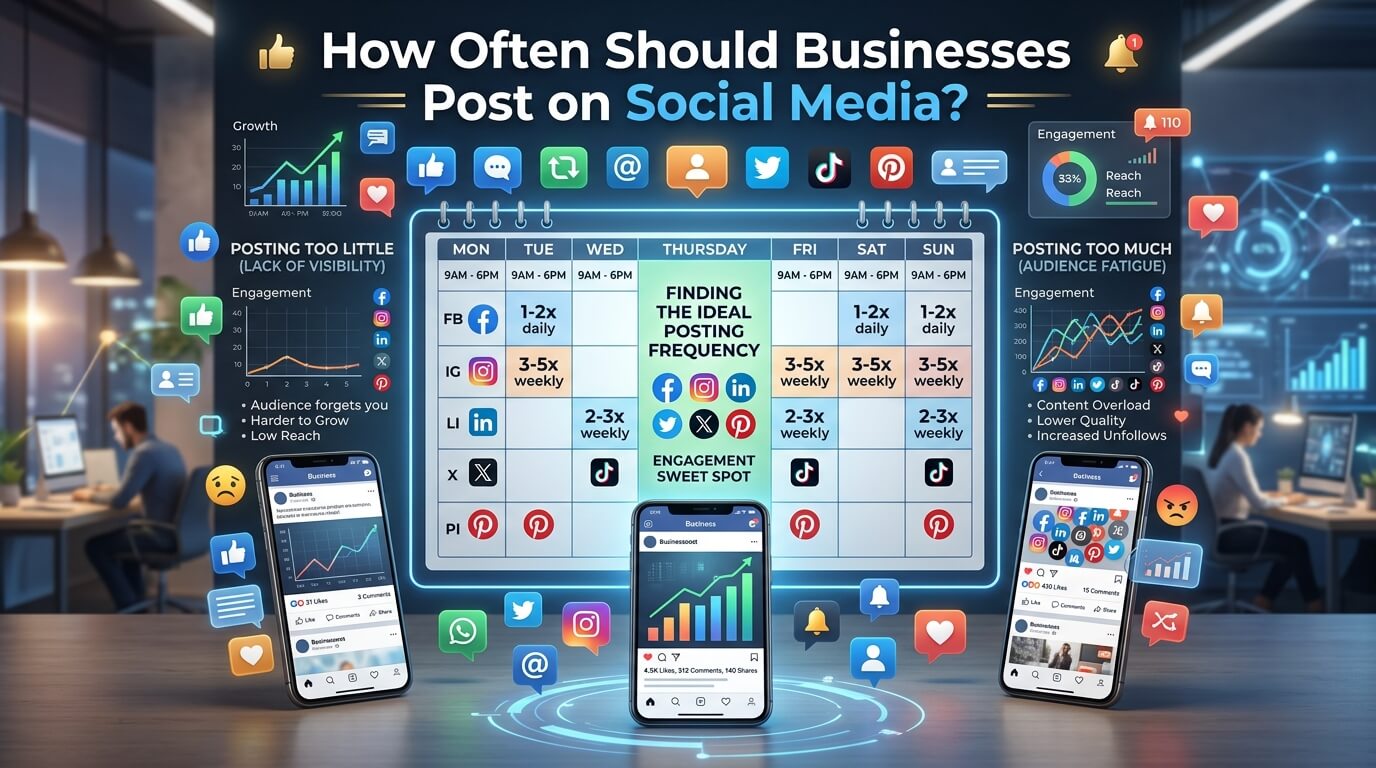
Social media has become one of the most important channels for businesses that want to stay visible, connect with customers, build credibility, and generate leads. Yet one question continues to confuse business owners and marketing teams: How often should a business post on social media?
There is no single number that works for every company. A local service business, an e-commerce brand, a B2B company, and a personal brand can all need different posting schedules. What matters most is finding a frequency that keeps the business visible without sacrificing content quality or overwhelming the audience.
Current 2026 guidance from major social media management platforms generally places Instagram around three to five posts per week, Facebook around one to two posts per day, TikTok around two to five posts per week, and LinkedIn around two to five posts per week. These figures are useful starting points, but they should not be treated as universal rules.
For most businesses, the better approach is to start with a realistic schedule, maintain it consistently, and then use analytics to determine whether posting more or less improves results. In other words, the goal is not to post as often as possible. The goal is to post often enough to remain relevant while making every piece of content worthwhile.
Why Posting Frequency Matters for Businesses
Social media works differently from traditional advertising. A customer may not see a company’s post immediately after it is published, and even followers do not necessarily see every piece of content. Platform algorithms decide what appears in users’ feeds based on factors such as relevance, engagement, relationships, content format, and user behavior.
This makes consistency particularly important. A business that posts once every few weeks may struggle to remain recognizable, while a company that maintains a steady presence has more opportunities to appear in front of its target audience.
Consistency also helps businesses build familiarity. Customers rarely decide to purchase from a company simply because they saw one social media post. Instead, they may encounter a brand several times before they become interested enough to visit its website, follow the account, request information, or make a purchase.
Posting regularly allows a company to communicate its personality, expertise, products, services, customer experiences, and values over time. It creates a larger body of content that potential customers can explore when they are considering whether the business is trustworthy.
However, frequency alone does not create engagement. Buffer’s 2026 analysis emphasizes that frequency and timing can amplify successful content, but they do not automatically make weak content perform well.
So, How Often Should a Business Post?
For many businesses, a practical starting point is three to five quality posts per week on their primary social media platforms. This gives a company enough opportunities to stay visible without creating an unrealistic production workload.
Some platforms can support more frequent publishing. Facebook, for example, is commonly recommended at one to two posts per day, while X can support several posts per day because of its fast-moving feed. Instagram generally works well with three to five feed posts per week, while TikTok can benefit from two to five posts per week. LinkedIn is often suitable for two to five posts per week for businesses that are focused on professional audiences.
These numbers should be considered starting points rather than strict requirements. A small business with one person managing its marketing may achieve better results with three excellent posts per week than with seven rushed posts. Similarly, a company with a dedicated content team may be able to publish much more frequently without lowering quality.
Recommended Posting Frequency by Platform
| Social Media Platform | Practical Starting Frequency | Best Approach |
| 3–5 posts per week | Mix Reels, carousels, images, and Stories | |
| 1–2 posts per day | Focus on useful, community-oriented content | |
| TikTok | 2–5 posts per week | Prioritize engaging short-form video |
| 2–5 posts per week | Share expertise, insights, and business stories | |
| X | 2–4 posts per day | Use conversations, opinions, updates, and timely content |
| Several times per week | Focus on evergreen visual content | |
| YouTube | About 1 video per week | Prioritize useful, searchable video content |
These ranges reflect current industry guidance, but the ideal frequency depends heavily on audience behavior, available resources, content quality, and business goals.
How Often Should Businesses Post on Instagram?
Instagram is one of the most important platforms for businesses that depend on visual communication. Product brands, restaurants, fashion companies, creative businesses, service providers, and personal brands can all use Instagram to showcase what they offer.
For most businesses, three to five feed posts per week is a strong starting point. These posts can include Reels, carousels, photographs, educational graphics, customer stories, or other formats that suit the brand.
Instagram Stories can be used more frequently because they have a different role from feed posts. Stories are useful for behind-the-scenes content, quick updates, polls, questions, reminders, and informal conversations. Hootsuite’s current guidance suggests around two Stories per day as a starting point.
The important thing is not to turn Instagram into a repetitive sales catalogue. If every post tells followers to buy something, the account can quickly become predictable. Educational content, customer experiences, demonstrations, company culture, and useful tips can make the feed more valuable.
How Often Should Businesses Post on Facebook?
Facebook continues to be useful for businesses that want to build communities, share updates, promote events, distribute articles, and communicate with established customers.
A common 2026 recommendation is one to two posts per day, although many smaller businesses can achieve a sustainable presence with fewer posts.
The type of business matters considerably. A restaurant might have several daily updates involving specials, customer experiences, events, and photographs. A consulting firm may have little reason to publish twice every day.
Instead of forcing a high frequency, businesses should focus on whether each post gives people a reason to stop scrolling. Useful information, local stories, customer questions, company updates, educational content, and timely posts can all perform well when they are relevant to the audience.
How Often Should Businesses Post on LinkedIn?
LinkedIn is particularly valuable for B2B companies, professional service providers, recruiters, consultants, agencies, technology companies, and organizations focused on professional audiences.
For most businesses, two to five posts per week is a practical range. Buffer’s 2026 guidance recommends two to five posts per week, while other current industry guidance suggests that LinkedIn can support more frequent posting for teams with enough high-quality material.
The key to LinkedIn is expertise. Businesses can use the platform to explain industry developments, share lessons, discuss customer problems, introduce employees, publish original insights, and demonstrate their knowledge.
A company that posts every day but simply repeats promotional messages may achieve less value than one that publishes three thoughtful posts each week.
How Often Should Businesses Post on TikTok?
TikTok operates differently from platforms where followers are the primary source of reach. Its discovery-driven environment gives businesses opportunities to reach people who do not already follow them.
For businesses beginning with TikTok, two to five posts per week is a reasonable starting range.
Video quality and audience retention are especially important. A business should not create five videos simply to reach a number. It should create videos that answer questions, entertain viewers, demonstrate products, tell stories, explain processes, or respond to common customer concerns.
Businesses that have the resources to produce more content can experiment with higher frequency. But if producing daily videos results in repetitive or poorly planned content, a lower and more sustainable schedule may be better.
Quality Matters More Than Posting Every Day
One of the biggest mistakes businesses make is assuming that daily posting automatically means better marketing.
It does not.
Imagine a business publishes seven posts every week. If those posts are repetitive, poorly designed, overly promotional, or irrelevant to its audience, increasing the frequency may simply give customers seven reasons to ignore the account.
Now imagine another business publishes three carefully planned posts each week. One teaches something useful, another demonstrates a product or service, and another tells a compelling customer or company story. That account may create significantly more value despite publishing less often.
Current social media guidance repeatedly emphasizes that consistency should be balanced with quality and sustainability. Hootsuite’s 2026 recommendations specifically note that businesses should choose a frequency they can realistically maintain rather than trying to produce an unrealistic volume of content.
The best posting schedule is therefore not necessarily the busiest schedule. It is the schedule that a business can maintain while continuing to produce content people actually want to see.
Posting Frequency Depends on Business Goals
A business should determine its social media frequency based partly on what it wants social media to accomplish.
A company focused on brand awareness may benefit from publishing regularly across several formats because repeated exposure can help build recognition. A company focused on lead generation may publish fewer but more targeted pieces that demonstrate expertise and encourage prospects to take the next step.
An e-commerce brand may need more product demonstrations and customer-generated content, while a B2B consulting company may concentrate on educational LinkedIn posts and industry insights.
The goal should influence the content, and the content should influence the frequency.
Businesses Focused on Brand Awareness
When awareness is the main objective, consistent visibility is essential. A company should aim to appear regularly without flooding its audience. Three to five quality posts per week on a primary platform can provide a strong foundation.
Businesses Focused on Lead Generation
Lead-generation content needs to be purposeful. Instead of simply increasing the number of posts, businesses should publish content that answers buying questions, addresses objections, demonstrates expertise, and establishes credibility.
Businesses Focused on Sales
Sales-focused businesses may post more frequently around launches, promotions, seasonal campaigns, or special offers. However, constant promotional content can create audience fatigue. A balanced content strategy should continue providing value between sales campaigns.
How Audience Size Can Affect Posting Frequency
A business with 500 followers does not necessarily need the same posting strategy as a company with 500,000 followers.
Smaller businesses often need to experiment more because they have less historical data. Consistent publishing gives them more opportunities to discover which subjects, formats, and messages resonate with their target audience.
Larger organizations may have enough data to identify specific patterns in engagement, reach, traffic, and conversions. They can use this information to fine-tune their schedules.
However, follower count should never be the only factor. A small account with a highly engaged niche audience can generate more meaningful business results than a large account with passive followers.
How to Find the Right Posting Frequency for Your Business
The most effective approach is to treat posting frequency as something to test rather than something permanently decided.
Start with a manageable schedule. For example, a business might publish four Instagram posts, three LinkedIn posts, and three TikTok videos per week. Maintain that schedule consistently for several weeks while tracking performance.
The business can then compare reach, engagement, profile visits, website traffic, leads, and conversions.
If increasing frequency improves results without lowering quality, the company can experiment with publishing more. If performance begins declining or the team struggles to maintain standards, reducing frequency may be appropriate.
This process turns posting frequency into a measurable marketing decision instead of a guess.
Why Consistency Is Better Than Posting in Bursts
One common pattern is the “social media sprint.” A company becomes enthusiastic and publishes every day for two weeks, then becomes busy and disappears for a month.
This creates an inconsistent customer experience.
A better approach is to build a schedule that can survive busy periods. If a company can realistically produce three strong posts every week, it is better to commit to three than to promise daily publishing and repeatedly miss the target.
Current research and industry guidance consistently point toward sustainable consistency rather than extreme volume. Buffer’s analysis of more than 100,000 users found a strong relationship between regular posting and engagement, reinforcing the value of maintaining a predictable publishing rhythm.
How Content Calendars Make Posting Easier
A content calendar can make consistent posting considerably easier because businesses do not have to decide what to publish every morning.
Instead, marketing teams can plan topics in advance, prepare creative assets, write captions, schedule posts, and leave room for timely content.
A simple monthly calendar might include educational content, product or service content, customer stories, company culture, industry insights, seasonal content, and promotional posts.
Planning also prevents repetition. When businesses can see several weeks of content at once, they can identify whether they are talking about the same product too often or neglecting important topics.
Should Businesses Post the Same Content on Every Platform?
Repurposing content is useful, but businesses should avoid blindly copying and pasting the exact same post everywhere.
Each platform has a different audience and communication style. A detailed LinkedIn insight may need to become a shorter Instagram carousel. A long educational article could become several short videos. A customer story might work as a Facebook post, Instagram Reel, and LinkedIn case study with different wording and presentation.
Repurposing allows businesses to increase efficiency without requiring completely new ideas for every platform.
The goal is to reuse the underlying idea while adapting the format and message to the platform.
Signs That You Are Posting Too Little
Posting too little can make a business appear inactive. If customers visit a social profile and see that the last meaningful update was several weeks ago, they may question whether the business is still active.
Low frequency can also reduce the number of opportunities a company has to test ideas and reach new audiences.
However, posting once a week is not automatically ineffective. Buffer’s current strategy guidance notes that one post per week per platform can be a reasonable starting point for businesses that are building their capacity.
The key issue is whether the current frequency is helping the business achieve its objectives.
Signs That You Are Posting Too Much
Posting too frequently can also create problems. Audiences may become tired of seeing the same brand repeatedly, particularly when the content lacks variety.
Another warning sign is declining quality. If the marketing team has to rush captions, reuse outdated graphics, or create weak ideas simply to meet a daily target, the schedule may be too aggressive.
Businesses should pay attention to engagement quality rather than focusing only on how many posts they publish.
If frequency rises while meaningful engagement, clicks, leads, or conversions decline, it may be time to reassess the schedule.
The Importance of Engagement Between Posts
Social media marketing is not only about publishing.
A business can have an excellent posting schedule and still struggle if it ignores comments, questions, mentions, and direct messages. Engagement helps turn social media from a broadcasting channel into a relationship-building channel.
When someone comments on a post, responding thoughtfully can create a stronger connection than simply publishing another post. Businesses should therefore reserve time for community management alongside content creation.
This is especially important for service businesses because customers may use social platforms to ask questions before contacting the company directly.
A Practical Social Media Schedule for Most Businesses
For a small or medium-sized business starting from scratch, a realistic approach is to focus on two or three platforms rather than trying to dominate every network.
For example, a company might publish three to five Instagram posts per week, three LinkedIn posts per week, and several Facebook updates throughout the week. If the business has strong video capabilities, it could add two to five TikTok videos per week.
This approach creates enough activity to build momentum without requiring an enormous content team.
After several months of consistent publishing, the business can use its analytics to decide which channels deserve greater investment.
How Often Should Businesses Review Their Posting Strategy?
A posting schedule should not be permanent.
Businesses should review performance regularly, especially after major campaigns, changes in audience behavior, or changes in the type of content being produced. Analytics can reveal which formats are attracting attention and which are being ignored.
A useful review should consider more than likes. Reach, comments, shares, saves, profile visits, website clicks, leads, and sales can all provide important information.
If a particular content format consistently produces stronger business outcomes, the company can increase its presence. If another format requires considerable effort but produces little value, it may deserve less attention.
Conclusion
There is no universal answer to the question of how often businesses should post on social media. For many businesses in 2026, three to five quality posts per week on major visual and professional platforms is a practical starting point, while platforms such as Facebook and X can support more frequent publishing.
The most important principle is consistency. Businesses should choose a schedule they can maintain, create content that genuinely helps or interests their audience, and use performance data to refine their approach.
Posting more is not always better. Posting less is not automatically wrong. The right frequency is the point where visibility, content quality, audience interest, business resources, and measurable results come together.
Frequently Asked Questions
Q. How many times a week should a small business post on social media?
For many small businesses, three to five quality posts per week per active platform is a strong starting point, although one or two posts per week can be appropriate when resources are limited.
Q. Is it better to post every day on social media?
Not necessarily. Daily posting can work for some platforms and businesses, but consistent, valuable content is generally more important than simply meeting a daily posting target.
Q. How often should a business post on Instagram?
A practical starting point is three to five Instagram feed posts per week, supplemented by Stories when the business has useful or engaging content to share.
Q. How often should a business post on LinkedIn?
Most businesses can start with two to five LinkedIn posts per week and adjust the frequency according to audience engagement and business results.
Q. What is the biggest mistake businesses make with posting frequency?
The biggest mistake is focusing on quantity while ignoring quality and consistency. A sustainable schedule that delivers useful content is usually more effective than publishing large volumes of rushed or repetitive posts.