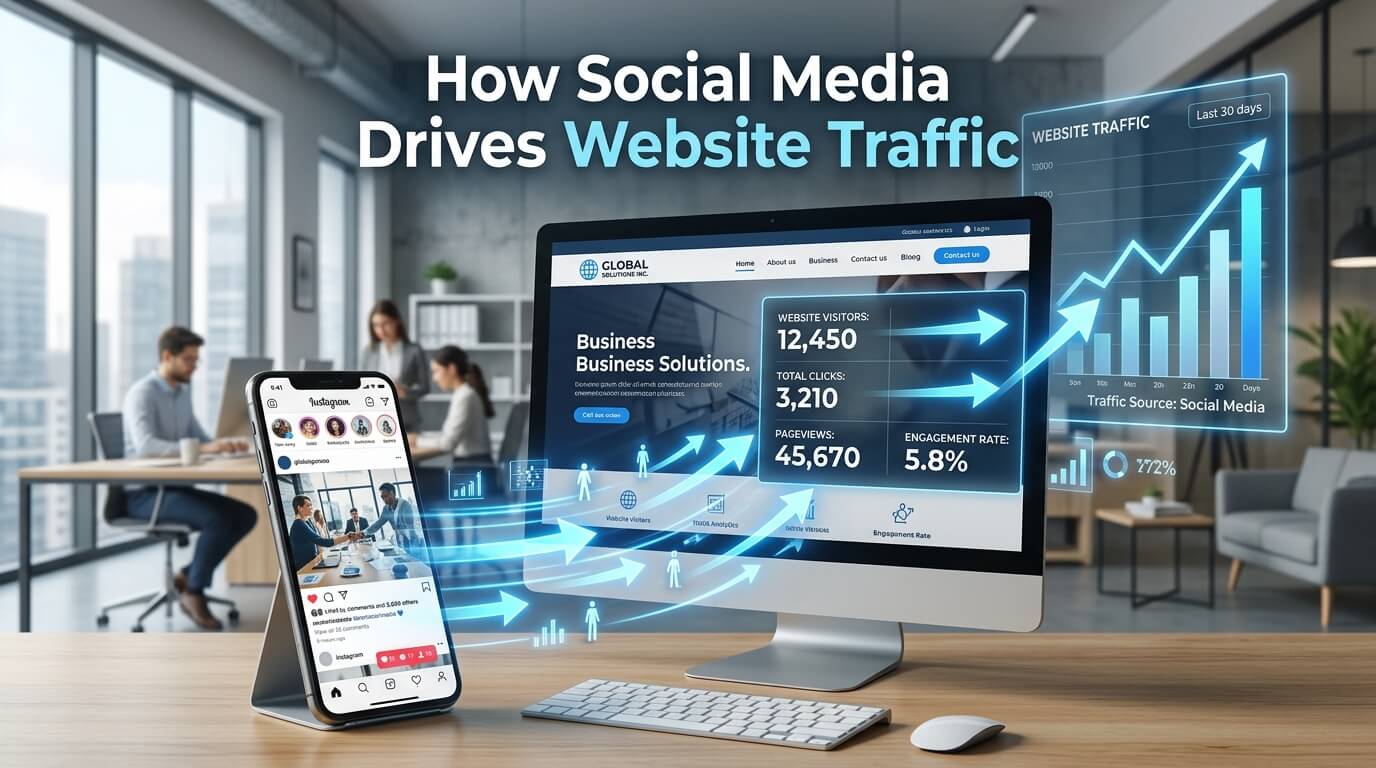
Social media has become one of the most powerful channels for businesses that want to attract people to their websites. While websites remain the central destination for detailed information, online sales, lead generation, bookings, and brand communication, social media provides the distribution network that helps people discover those websites in the first place.
A strong social media presence does more than increase likes and followers. When planned properly, it can encourage people to read blog posts, explore product pages, download resources, sign up for newsletters, request information, or make purchases. Social platforms can introduce a business to audiences that may never have discovered it through traditional search alone.
Social media traffic is also measurable. Businesses can track where visitors come from, which posts generate clicks, what content keeps visitors engaged, and which campaigns eventually lead to conversions. Social clicks are generally treated as their own traffic channel in analytics platforms, even though the underlying mechanism is a visitor arriving through a link from another platform.
The key, however, is understanding that simply posting links is not enough. Successful social media traffic strategies combine useful content, strong visuals, compelling messages, consistent publishing, audience engagement, and clear calls to action. When these elements work together, social media can become a reliable source of qualified website visitors rather than simply a place where a business collects followers.
Understanding the Connection Between Social Media and Website Traffic
Social Media Creates the First Point of Discovery
Many people discover brands while scrolling through social platforms rather than actively searching for a particular company. A user might encounter a short video explaining a problem, see an interesting image, read an educational post, or come across a recommendation from another person. That initial interaction can create curiosity about the brand.
The website then becomes the natural next destination for people who want more information. A social media post might provide a useful introduction, while the website provides the complete article, service information, product details, case study, or contact opportunity.
This makes social media particularly valuable at the discovery stage of the customer journey. It introduces a business to people who may not yet know the brand exists. Instead of waiting for someone to search for the company, social media allows the company to actively appear in front of potential customers.
Social Media Turns Content Into Distribution
Creating excellent website content is only half of a content marketing strategy. Even a highly informative blog post can receive limited traffic if nobody knows it exists.
Social media gives businesses a way to distribute that content repeatedly. A single article can become a LinkedIn post, Instagram carousel, short video, Facebook update, X post, or discussion topic. Each version can encourage people to visit the original page.
This is one reason social media and content marketing work so effectively together. The website acts as the content library, while social media acts as a distribution and discovery system.
How Social Media Actually Sends Visitors to a Website
Links Give People a Direct Path
The simplest way social media drives website traffic is through links. Depending on the platform and format, a business can direct users toward its homepage, blog, landing page, product page, portfolio, service page, or another destination.
The important principle is reducing friction. If someone sees an interesting social post but has no obvious next step, the opportunity may disappear. A clear call to action can turn curiosity into a website visit.
For example, a business publishing an article about website design might create a social post explaining one important design mistake. Instead of providing the entire explanation within the post, it can invite interested readers to visit the website for the complete guide.
That creates a simple journey: social discovery, curiosity, click, website visit, and potentially conversion.
Compelling Content Encourages Clicks
People rarely click simply because a business tells them to. They click when they believe the destination contains something useful, interesting, entertaining, or valuable.
This means the quality of the social post matters enormously. A vague caption such as “Read our latest blog” provides little motivation. A more specific message that identifies a problem and promises useful information gives the audience a reason to continue.
The social post should create enough interest to make the website feel like the logical next step. This is particularly important because social feeds are crowded. Businesses compete with friends, creators, competitors, advertisements, news, entertainment, and countless other pieces of content.
Different Platforms Create Different Traffic Opportunities
Not every social network behaves in the same way. LinkedIn can be particularly useful for professional and B2B content, while Instagram and TikTok can be powerful for visually driven businesses. Facebook can support communities and broad audience engagement, while YouTube can combine discovery, education, and long-form content.
The best platform depends on where a company’s audience spends time and what type of content the business can consistently produce.
| Social Platform | Strong Content Types | Website Traffic Opportunity | Best Use |
| Articles, videos, community posts | Blog and service pages | Broad audiences and community engagement | |
| Reels, carousels, visual posts | Product, service, and landing pages | Visual discovery and brand awareness | |
| Articles, insights, professional posts | Blogs, case studies, service pages | B2B and professional audiences | |
| TikTok | Short-form videos, educational clips | Landing pages and profile destinations | Discovery and younger audiences |
| YouTube | Tutorials, reviews, explainers | Product pages, blogs, resources | Education and high-intent discovery |
| X | Commentary, updates, discussions | Articles and timely resources | Conversations and content discovery |
The table illustrates why businesses should avoid treating every platform identically. A piece of content that performs well on LinkedIn may need a completely different presentation on Instagram or TikTok.
Social Media Helps Businesses Promote Blog Content
Blog Posts Become Traffic Assets
A well-written business blog can answer customer questions, demonstrate expertise, support search visibility, and create opportunities for conversions. Social media can increase the number of people who discover those articles.
For example, suppose a company publishes an article titled “How Much Does a Professional Website Cost?” Rather than simply publishing the article and waiting for visitors, the company can create several social posts around the subject.
One post could discuss the major factors that influence website costs. Another could explain common budgeting mistakes. A short video could address one misconception about website pricing. Each piece can direct interested users toward the full article.
This approach gives the blog post multiple opportunities to attract traffic rather than relying on a single promotional announcement.
Repetition Is Not Necessarily a Problem
Businesses sometimes avoid resharing content because they worry that audiences will become bored. In reality, social feeds move quickly, and many followers will never see a particular post the first time it is published.
A useful evergreen article can therefore be promoted multiple times, provided the presentation changes. One social post might focus on a statistic, another on a question, and another on a practical takeaway.
The underlying website page remains the same, but the social entry points are different.
Visual Content Can Increase Website Interest
Images Make Social Posts More Noticeable
Social media is highly visual. An attractive graphic, useful carousel, photograph, or short video can stop users while they scroll and encourage them to read the accompanying message.
Visual content is especially effective when it communicates an idea quickly. A business can turn a long article into several visual concepts that introduce individual points and then encourage viewers to explore the complete resource on its website.
Recent marketing guidance continues to emphasize visual content as an important part of social engagement and referral strategies.
Short Videos Create Curiosity
Short-form video has changed how businesses approach traffic generation. Instead of asking people immediately to visit a website, a company can first provide a small piece of useful information through video.
For instance, a digital marketing company might create a 30-second video explaining why a website receives visitors but few inquiries. The video can introduce the problem and provide one solution while directing viewers to a detailed article on the website.
This creates a curiosity gap without withholding genuine value. The audience receives something useful immediately but has a reason to visit the website for a deeper explanation.
Social Media Builds Brand Awareness Before the Click
People Often Need Multiple Interactions
Not every social media user who sees a brand post will immediately visit the website. Some people need to see a company several times before they become interested enough to click.
A person might first see a short video, later encounter an educational carousel, then notice a customer testimonial, and eventually visit the website when they have a relevant need.
This means social media traffic should not always be judged solely by immediate clicks. Social platforms can influence the earlier stages of the customer journey by building familiarity and credibility.
Research and industry guidance increasingly recognize that modern customer journeys can involve multiple digital touchpoints before a final action.
Trust Makes Traffic More Valuable
Website traffic is useful, but qualified website traffic is much more valuable. Someone who visits because they already understand the business and trust its content may be more likely to read several pages, submit an inquiry, subscribe, or purchase.
Consistent social media activity can help establish that trust before the visitor arrives on the website. Educational content, customer experiences, behind-the-scenes material, expert commentary, and useful advice can make the eventual website visit more meaningful.
Social Proof Encourages Website Visits
Reviews and Testimonials Influence Curiosity
People naturally look for evidence before committing their attention or money to a business. Social media provides an excellent environment for showcasing testimonials, customer experiences, completed projects, and success stories.
When potential customers see other people discussing a business positively, they may become curious enough to investigate further.
A testimonial post can therefore serve two purposes. It provides social proof and creates a pathway toward the website where visitors can learn more about the company and its services.
User-Generated Content Can Expand Reach
Customers can also become informal promoters. When people share their experiences with a brand, they expose the business to their own networks.
This can produce a powerful secondary effect. Someone sees a customer’s post, becomes interested, searches for the business, and eventually reaches the website.
Social media therefore does not always drive traffic only through a company’s own posts. Conversations, shares, mentions, and recommendations can create additional discovery paths.
Social Media and Search Visibility Work Together
Social Media Is Not a Replacement for SEO
Social media and search engine optimization are different channels. A business should not assume that simply posting social links will directly produce higher search rankings.
However, social media can support broader visibility by helping content reach more people. When useful content is discovered and discussed, it may earn attention from bloggers, journalists, creators, industry publications, and other website owners.
Those external mentions can create additional referral opportunities.
Google has also expanded its understanding of how content appears across different platforms. In 2026, Google Search Console introduced platform properties that allow creators and site owners to examine how content from platforms such as Instagram, TikTok, X, and YouTube performs in Google Search and Discover.
This reflects a broader digital environment in which audiences discover content across websites, social networks, video platforms, and search engines rather than following one single path.
Social Content Can Support Wider Content Discovery
A successful social post may lead to more than direct website visits. It can inspire people to search for the brand, share an article, reference a company in another publication, or return to the website later.
This is why businesses should think of social media as part of a larger digital ecosystem rather than an isolated marketing channel.
Using Calls to Action to Increase Traffic
Give People a Clear Reason to Click
A call to action should tell people what to do next and why doing it is worthwhile. “Visit our website” is functional but weak. A more effective CTA can explain the benefit.
For example, “Read the complete guide to learn how to improve your website conversion rate” gives the user a specific reason to click.
The strongest calls to action connect directly with the content being promoted. If the social post discusses website costs, the CTA should lead to a resource about website costs rather than an unrelated homepage.
Match the Landing Page to the Social Post
The destination also matters. Sending every social visitor to the homepage can create unnecessary friction.
If a post discusses a particular service, send the visitor to that service page. If the post promotes a blog article, send them directly to the article. If an advertisement promotes an offer, send visitors to a dedicated landing page.
The closer the relationship between the social message and the website destination, the more natural the visitor experience becomes.
Tracking Social Media Website Traffic
Measure More Than Likes
Likes and follower counts can provide useful context, but they do not tell the complete story. Businesses interested in website growth should pay attention to metrics such as link clicks, sessions, engaged sessions, landing-page performance, conversions, and revenue where applicable.
Tracking can reveal which platforms actually contribute meaningful business results.
For example, Instagram might generate thousands of interactions but relatively few website visits, while LinkedIn might produce fewer engagements but significantly more qualified leads. Without measurement, a business could mistakenly invest most of its effort in the platform with the largest visible audience.
Use UTM Tracking
UTM parameters can make social campaigns easier to analyze by identifying the source, medium, campaign, and sometimes specific content associated with a visit.
This becomes particularly useful when a company promotes the same article across multiple platforms. Instead of seeing only overall traffic, marketers can determine which campaigns and social channels generated those visits.
Tracking tools and UTM codes are widely used to identify where referral and social visitors originate.
Creating a Sustainable Social Traffic Strategy
Focus on Value Before Promotion
One of the biggest mistakes businesses make is treating social media as a constant stream of advertisements.
People generally do not follow a company because they want to see promotional messages every day. They follow because the account provides information, entertainment, inspiration, education, or something relevant to their interests.
A strong strategy therefore balances promotional content with genuinely useful material. When an audience learns to expect value from a brand, website links become more effective because the audience has a reason to trust the source.
Maintain Consistency
Consistency matters because website traffic from social media usually develops over time. One successful post can produce a spike, but sustainable traffic requires repeated exposure and continued content distribution.
A consistent publishing schedule helps a business remain visible and gives it more opportunities to discover which subjects and formats generate website visits.
This does not mean posting as frequently as possible. Quality, relevance, and audience fit are more important than simply increasing volume.
Repurpose High-Performing Content
Businesses do not need to create completely new content for every social post. Existing website content can be repurposed into multiple formats.
A detailed blog article can become a video script, carousel, infographic, quote graphic, discussion post, or series of short updates. This approach extends the life of existing content and creates several routes back to the website.
It also makes social media management more efficient because the business is building multiple assets around ideas that have already been developed.
Why Social Media Traffic Is Valuable for Growing Businesses
Social media can be especially useful for smaller businesses that are still building search visibility. A new website may take time to establish authority and attract consistent organic search traffic. Social platforms provide another way to reach potential customers while the website’s broader digital presence develops.
Social media can also help businesses test ideas. If a particular topic generates strong engagement and website clicks, that may indicate that the subject deserves a more detailed article, guide, service page, or campaign.
In this way, social media can become a source of audience intelligence. Instead of guessing what people want, businesses can observe which questions, themes, formats, and messages generate meaningful responses.
The Future of Social Media and Website Traffic
The relationship between social media and websites will continue to evolve as search, video, social discovery, and digital communities become increasingly interconnected.
People may discover a company through a short video, investigate it through search, read a website article, return through a social link, and eventually make a purchase through the website. The journey may involve several platforms and several days or weeks.
Google’s recent expansion of Search Console into social and video platform performance is one indication of this increasingly connected environment.
For businesses, the lesson is straightforward: social media should not be viewed simply as a place to publish updates. It can function as a discovery engine, content distribution channel, relationship-building platform, and pathway to owned digital properties.
Conclusion
Social media drives website traffic by connecting businesses with audiences where they already spend their time. Through useful content, compelling visuals, short-form videos, links, social proof, conversations, and strong calls to action, social platforms can turn casual attention into meaningful website visits.
The most successful strategies do not focus exclusively on generating clicks. They build familiarity and trust first, provide genuine value, and then give users a logical reason to continue to the website. Businesses should also track traffic quality, engagement, conversions, and campaign performance rather than relying only on follower counts or likes.
Ultimately, social media works best when it supports the website rather than competing with it. The website remains the place where detailed information and business transactions happen, while social media helps bring the right people through the door.
FAQ
Q1. How does social media increase website traffic?
Social media increases website traffic by distributing content, sharing links, building brand awareness, and encouraging users to visit relevant website pages.
Q2. Which social media platform drives the most website traffic?
There is no single best platform for every business. The most effective platform depends on the target audience, industry, content format, and marketing objectives.
Q3. Does social media improve SEO?
Social media should not be treated as a direct substitute for SEO, but it can increase content exposure, brand discovery, and opportunities for external mentions and links.
Q4. How can businesses track social media website traffic?
Businesses can use website analytics platforms, platform analytics, referral reports, conversion tracking, and UTM parameters to identify traffic sources and campaign performance.
Q5. How often should businesses promote their website on social media?
Businesses should promote their website consistently but avoid making every post promotional. A mixture of educational, engaging, visual, community-focused, and promotional content generally creates a stronger long-term strategy.