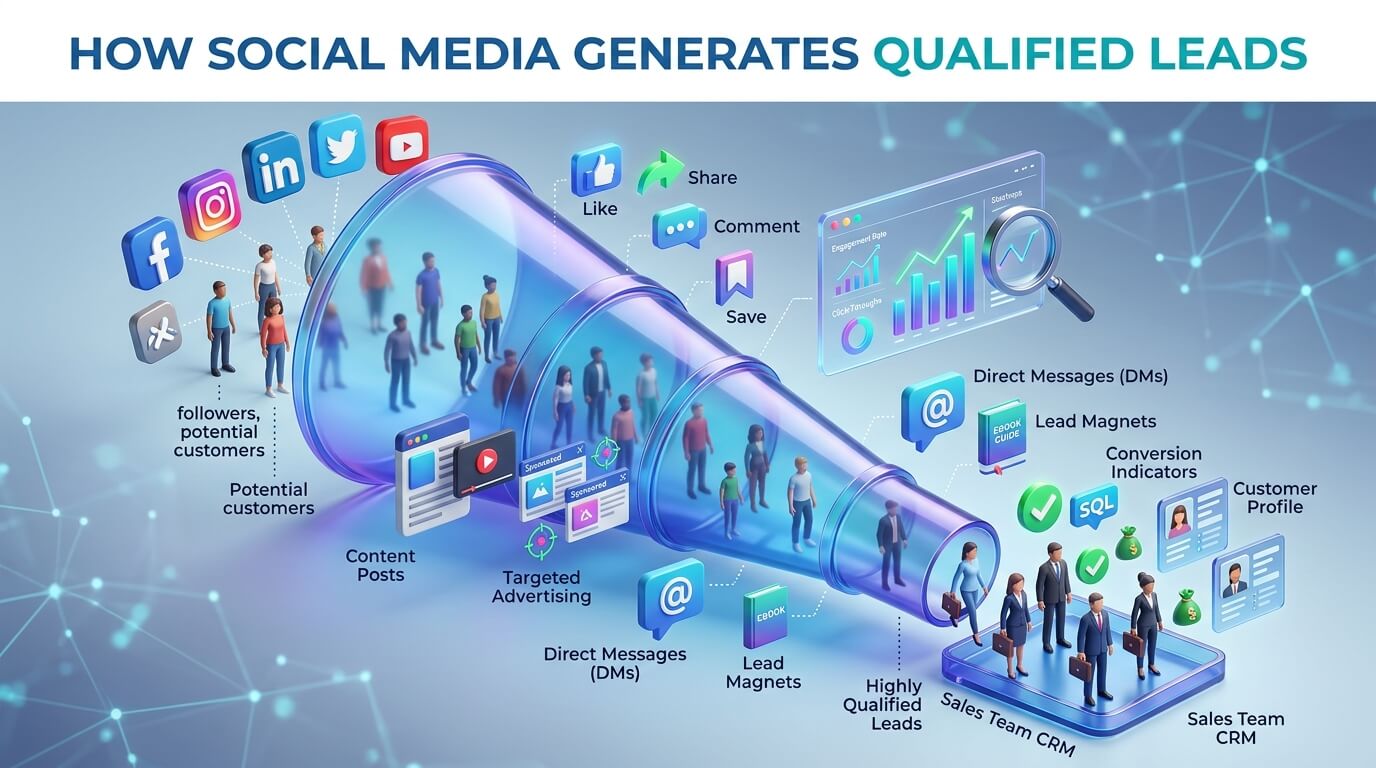
Social media has evolved far beyond a platform for sharing updates, photos, and entertainment. For modern businesses, it can function as a powerful lead-generation channel that connects brands with people who are already interested in their products, services, or expertise. The real value, however, is not simply generating a large number of followers or collecting likes. The greater opportunity lies in attracting qualified leads—people who have a genuine need, fit the target audience, and have a reasonable possibility of becoming customers.
Social media lead generation combines content, audience targeting, conversations, advertising, trust building, and carefully designed calls to action. When these elements work together, social platforms can move prospects from initial awareness to meaningful interaction and eventually to a sales conversation.
Research from HubSpot shows that many sales professionals view social media as an effective channel for finding prospects, researching businesses, and generating high-quality leads. This makes social media especially valuable for businesses that want to build relationships before asking customers to make a purchase.
What Is a Qualified Lead?
A qualified lead is more than someone who has interacted with a social media post. A person who watches a video, likes an image, or follows a page may be interested in a topic without having any intention of buying. Qualification happens when there is stronger evidence that the person matches the business’s ideal customer and has a relevant need.
For example, imagine a web design company publishes a post explaining the signs of an outdated business website. Hundreds of people may view the post, but a business owner who comments asking about website redesign services is more valuable as a potential lead. If that person then visits the company’s website, requests pricing, or schedules a consultation, the buying intent becomes even clearer.
This distinction matters because businesses can easily become focused on vanity metrics. A post with thousands of views may look impressive, but a smaller post that generates ten serious inquiries could have considerably more commercial value.
Social media lead generation therefore works best when businesses measure not only reach and engagement but also the quality of the people entering the sales pipeline.
Why Social Media Is Effective for Lead Generation
Social media creates an environment where businesses can reach people according to interests, professional characteristics, behaviors, demographics, and previous interactions. Instead of presenting the same message to everyone, businesses can create content and campaigns designed for specific audiences.
The other major advantage is that social media allows businesses to build familiarity before asking for a sale. A potential customer may discover a brand through a video, read several educational posts, watch a testimonial, visit the profile, and eventually send a direct message. By the time the conversation begins, the prospect may already understand the business and have some level of trust in it.
This is particularly important for services that require consideration before purchase. A person may not hire a marketing agency after seeing one advertisement, for example. But repeated exposure to useful marketing advice, case studies, client results, and industry insights can gradually establish credibility.
Social media essentially shortens the distance between awareness and conversation.
How Social Media Attracts the Right Audience
Audience Targeting Makes Lead Generation More Relevant
One of the strongest features of social media marketing is its ability to target specific audiences. Businesses can define who they want to reach based on factors such as location, interests, professional information, behaviors, and previous interactions with the brand.
For organic content, audience targeting begins with the content itself. A business that understands its ideal customer can create posts around that customer’s questions, problems, goals, and purchasing concerns.
A software company targeting small business owners, for instance, might create content about managing customer relationships, reducing administrative work, or improving sales processes. The content naturally attracts people who experience those problems.
Paid social advertising can make the process even more precise. Instead of waiting for the right person to discover a post, businesses can place relevant offers in front of selected audience segments.
Buyer Intent Matters More Than Follower Count
A large audience is not necessarily a valuable audience. Ten thousand unrelated followers may generate fewer sales opportunities than one thousand followers who closely match the company’s ideal customer profile.
Qualified lead generation therefore requires businesses to ask an important question: Are we attracting people who can actually benefit from what we sell?
The answer should influence content topics, advertising audiences, creative formats, landing pages, and calls to action. When these elements are aligned with the ideal customer, social media becomes much more than an awareness channel.
Content Turns Attention Into Interest
Content is at the center of most successful social media lead-generation strategies. People rarely become qualified prospects simply because a company tells them to buy something. They become interested when the business demonstrates that it understands their problems and can help solve them.
Educational Content Builds Authority
Educational content can attract potential customers who are actively researching a problem. Articles, videos, carousels, demonstrations, tutorials, interviews, and informative posts can all help a business answer questions before a prospect contacts the sales team.
Suppose an accounting firm publishes content explaining common financial mistakes made by growing businesses. A business owner searching for answers may discover that content and begin following the firm. Later, the owner may download a guide or send a message about accounting services.
The original social media post did not necessarily produce an immediate sale. Instead, it established the first stage of a relationship.
Problem-Solving Content Creates Intent
Problem-focused content is especially effective because it connects directly with the customer’s current situation.
A business might publish content such as an explanation of why online advertisements are not converting, how to recognize poor website performance, or what mistakes companies make when managing their social media accounts.
When a prospect recognizes their own problem in the content, the business becomes relevant. That relevance is an important step toward qualification.
Case Studies and Results Increase Trust
Potential customers want evidence before making purchasing decisions. Case studies, testimonials, before-and-after examples, customer stories, and demonstrations help reduce uncertainty.
A service provider can use social media to show how a particular challenge was addressed and what changed afterward. This gives prospects something more concrete than a generic promotional statement.
Social proof is particularly useful for expensive or high-consideration services because prospects often want reassurance that the provider has successfully helped people or businesses in similar situations.
Social Media Conversations Help Qualify Prospects
One of the most valuable aspects of social media is the ability to communicate directly with potential customers. Comments, direct messages, Messenger conversations, LinkedIn messages, and other social interactions can become the beginning of a sales relationship.
A prospect may ask a simple question such as, “How much does this service cost?” That question provides valuable information about intent. Another person may ask whether a product is available in their location. Someone else might request a consultation.
These conversations give businesses an opportunity to understand the prospect before presenting an offer.
Direct Messages Create Warmer Sales Opportunities
A direct message can feel more natural than a traditional sales interaction because the prospect initiates or participates in the conversation within a familiar platform.
The business can respond to questions, clarify requirements, explain services, and determine whether the person is a suitable customer. If the prospect is qualified, the conversation can move toward a consultation, quotation, demonstration, or purchase.
This is one reason social selling has become increasingly important. HubSpot reports that sales professionals use social media to discover prospects and research potential customers, while a significant share also considers social media a source of high-quality leads.
Comments Can Reveal Buying Signals
Comments are another source of useful information. A comment such as “Where can I order this?” indicates a different level of intent than a simple “Nice post.”
Businesses should pay attention to these signals rather than treating every engagement equally. Questions about pricing, availability, specifications, delivery, implementation, or appointments can indicate that a prospect is moving closer to a purchasing decision.
Paid Social Advertising Accelerates Lead Generation
Organic social media can build an audience over time, but paid advertising allows businesses to accelerate reach and target specific groups.
Platforms such as Facebook, Instagram, LinkedIn, YouTube, and TikTok provide different advertising opportunities. The appropriate platform depends on the audience, industry, offer, and buying process.
Lead-generation campaigns can direct prospects toward forms, websites, messaging conversations, consultations, product pages, or other conversion points.
Lead Forms Reduce Friction
Social platforms can allow prospects to submit information without leaving the platform. This reduces the number of steps required to express interest.
For example, a business offering professional consulting could advertise a free consultation and ask interested prospects for their name, email address, company information, and a brief description of their needs.
The form should not request unnecessary information. Too many questions can discourage submissions. The goal is to collect enough information to determine whether the prospect is relevant while keeping the experience simple.
Retargeting Reconnects With Interested Prospects
Not every person converts during the first interaction. Someone might watch a video, visit a website, or interact with a social profile and then leave.
Retargeting allows businesses to reconnect with people who have already shown interest. Because these prospects have interacted with the brand previously, they can be more familiar with the company than a completely cold audience.
A retargeting campaign might show a testimonial to someone who previously visited a service page or present a consultation offer to someone who engaged with several educational posts.
This creates a more connected customer journey rather than treating every prospect as a stranger.
Different Platforms Support Different Types of Leads
Social media platforms should not all be treated identically. Each platform has different user behaviors and strengths.
| Social Media Platform | Strong Lead Generation Opportunity | Suitable Content | Typical Lead Action |
| B2B and professional services | Industry insights, case studies, expert content | Consultation or business inquiry | |
| Local businesses, communities, broad audiences | Educational posts, offers, testimonials | Message, form submission, website visit | |
| Visual brands and consumer services | Reels, stories, demonstrations, testimonials | DM, profile visit, purchase | |
| YouTube | Education-heavy and high-consideration products | Tutorials, reviews, explainers | Website visit or consultation |
| TikTok | Discovery and consumer-focused brands | Short videos, demonstrations, trends | Profile visit, DM, website action |
The best platform is not necessarily the one with the largest audience. It is the one where the target customers are most likely to discover, evaluate, and interact with the business.
Lead Magnets Turn Interest Into Contact Information
A lead magnet gives potential customers a reason to exchange their contact information for something useful. This could be a guide, checklist, template, report, consultation, webinar, educational resource, or other valuable asset.
The important point is relevance.
A generic free download may attract many people who never intend to buy. A highly specific resource can attract a smaller but more appropriate audience.
For example, a digital marketing agency could offer a “Website Conversion Audit Checklist for Small Businesses.” Someone who downloads it is likely to have an interest in improving a business website. That person has demonstrated a stronger connection to the agency’s area of expertise.
The lead magnet therefore acts as a qualification mechanism as well as a lead-generation tool.
Social Proof Helps Move Leads Toward Conversion
Trust is one of the biggest factors influencing purchasing decisions. Social media gives businesses numerous ways to demonstrate credibility.
Customer testimonials, reviews, project examples, user-generated content, expert interviews, media mentions, and behind-the-scenes content can all make a company appear more authentic.
User-generated content can be particularly powerful because it shows real customers interacting with a product or service. HubSpot’s research has highlighted the role of user-generated content in increasing brand awareness and sales.
When prospects see other people benefiting from an offering, uncertainty can decrease. They may feel more comfortable asking questions or taking the next step.
Social Listening Helps Identify Potential Leads
Social media also generates leads through conversations that do not directly mention a business.
People regularly discuss problems, ask for recommendations, compare products, and request advice online. Businesses that monitor relevant conversations can identify potential opportunities.
For example, someone might ask their professional network for recommendations for a reliable web designer. A web design company or salesperson who notices the conversation may be able to provide a helpful response.
The key is to be useful rather than aggressively promotional. Social listening works best when businesses contribute genuinely relevant information and allow the relationship to develop naturally.
Nurturing Leads Is Just as Important as Generating Them
Generating a lead is only the beginning. Some prospects are ready to buy immediately, while others need weeks or months of education before making a decision.
Social media can support this nurturing process by continuing to provide useful content.
A prospect who initially downloads a guide may later see educational videos, customer testimonials, product demonstrations, and answers to common questions. Each interaction can reinforce the company’s expertise.
This is particularly valuable for businesses with longer sales cycles. Instead of disappearing after the first interaction, the company remains visible while the prospect evaluates options.
How Businesses Can Measure Qualified Social Media Leads
Measuring social media lead generation requires looking beyond likes and followers. Businesses should connect social activity with actual commercial outcomes.
Important measurements can include the number of inquiries, form submissions, qualified prospects, booked consultations, sales opportunities, conversion rates, cost per qualified lead, and eventual revenue.
A campaign generating 500 leads may initially appear successful. But if only five are suitable customers, the campaign may be less valuable than one generating 100 leads with 30 qualified opportunities.
The goal should therefore be to understand the entire journey from social media interaction to revenue.
Common Mistakes That Reduce Lead Quality
Focusing Only on Engagement
Likes and comments can be useful indicators of audience interest, but they do not automatically translate into sales. Businesses should connect engagement metrics with lead and revenue metrics.
Using Generic Content
Content that attempts to appeal to everyone often becomes too vague to attract high-intent prospects. Specific audiences respond better to specific problems and solutions.
Making Every Post Promotional
Constantly asking people to buy can damage trust. Businesses should balance promotional content with education, entertainment, expertise, customer stories, and useful information.
Ignoring Social Conversations
A potential customer who sends a message or asks a question expects a response. Slow or generic replies can cause valuable opportunities to disappear.
Sending Everyone to the Same Landing Page
Different audiences may have different needs. A business should create landing pages and offers that match the content and audience responsible for the click.
Building a Social Media Lead Generation System
A successful social media strategy should connect several stages. First, the business needs to understand its ideal customer. Next, it should create content that addresses that customer’s problems and interests. Paid campaigns can then expand reach and target specific audience segments.
Once prospects interact with the brand, businesses should provide clear next steps. These might include downloading a resource, sending a message, booking a consultation, requesting pricing, or visiting a relevant product page.
The final stage is follow-up. Leads should be contacted promptly, evaluated according to their needs and fit, and moved into an appropriate sales or nurturing process.
This system turns social media from a collection of individual posts into a structured customer-acquisition channel.
Conclusion
Social media generates qualified leads by bringing the right people into contact with the right message at the right stage of their buying journey. Educational content creates awareness, targeted campaigns attract relevant audiences, social conversations reveal intent, lead magnets capture contact information, and testimonials build confidence. Retargeting and ongoing content can then nurture prospects until they are ready to take action.
The most successful businesses do not measure social media only by followers or engagement. They focus on whether their activity attracts people who genuinely need their products or services and whether those people eventually become meaningful sales opportunities. When strategy, content, targeting, conversation, and follow-up work together, social media can become a reliable source of qualified leads and long-term business growth.
Frequently Asked Questions
Q1. What is a qualified social media lead?
A qualified social media lead is a person who matches a business’s target customer profile and has demonstrated genuine interest or buying intent.
Q2. Which social media platform is best for generating qualified leads?
The best platform depends on the audience and industry. LinkedIn is often valuable for B2B businesses, while Instagram, Facebook, YouTube, and TikTok can be effective for different consumer and service-based audiences.
Q3. Does organic social media generate qualified leads?
Yes. Consistent educational, problem-solving, and trust-building content can attract relevant prospects and encourage them to start conversations with a business.
Q4. Are paid social media ads better for lead generation?
Paid advertising can accelerate lead generation and provide precise targeting, but it works best when combined with strong offers, relevant content, effective landing pages, and follow-up.
Q5. How can businesses improve the quality of social media leads?
Businesses can improve lead quality by clearly defining their ideal customer, targeting relevant audiences, creating specific content, using appropriate lead forms or offers, and qualifying prospects based on their needs and intent.