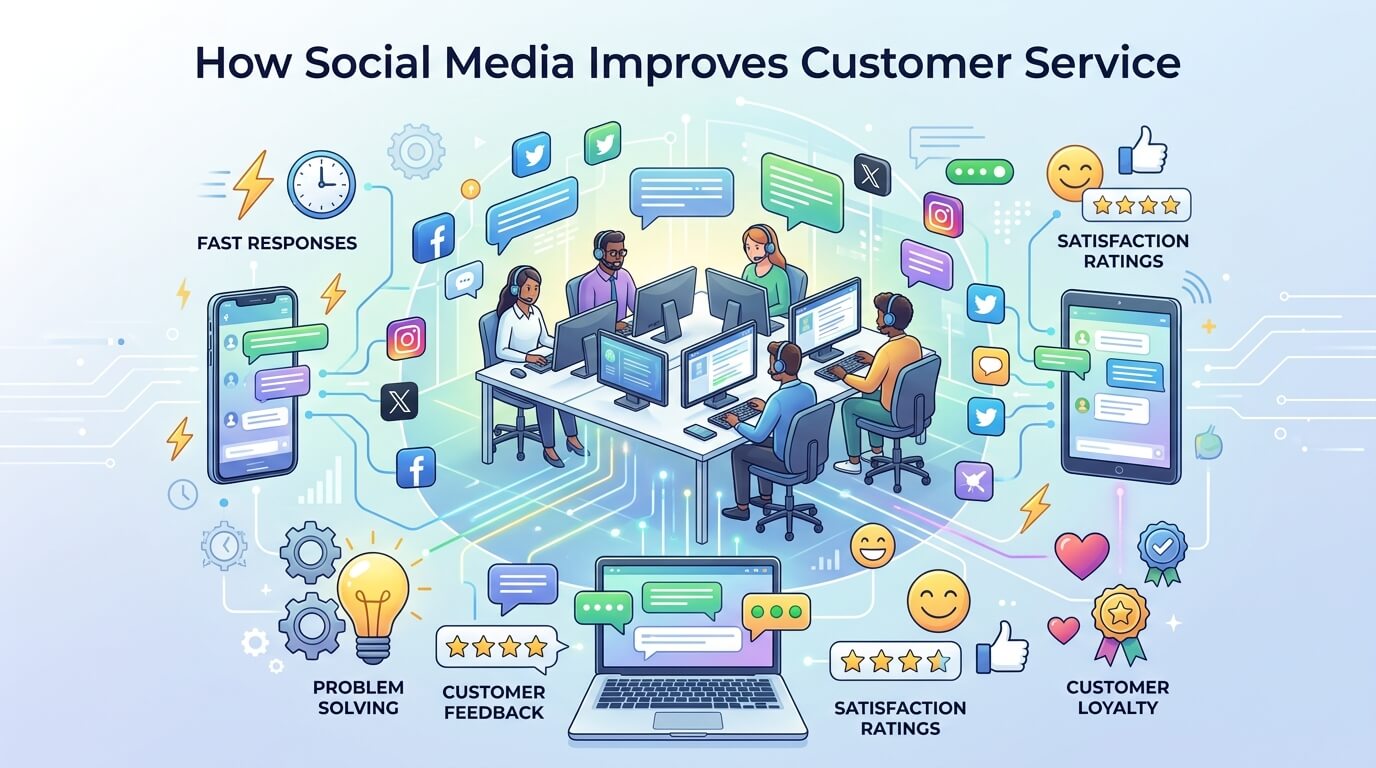
Customer service has changed dramatically in the digital age. Customers no longer expect to contact a business only through phone calls, emails, or support tickets. They increasingly use social media to ask questions, report problems, share feedback, check order information, and communicate their experiences with brands. Platforms such as Facebook, Instagram, LinkedIn, TikTok, and X have therefore become more than marketing channels. They are now important customer service touchpoints.
Social media improves customer service by making communication faster, more accessible, and more personal. Instead of waiting in a phone queue or sending an email and wondering when someone will respond, customers can often send a direct message or leave a comment and receive assistance through a channel they already use every day. Research has also found that response speed can influence satisfaction with complaint handling, while effective responses can create opportunities to rebuild relationships with unhappy customers.
For businesses, social media creates an opportunity to listen to customers in real time, identify recurring problems, provide public answers, and demonstrate that customer concerns matter. When managed properly, social customer service can strengthen trust and loyalty while also giving businesses valuable information about what customers actually need.
What Is Social Media Customer Service?
Social media customer service is the process of providing assistance to customers through social networking platforms. It can include responding to comments, answering direct messages, addressing complaints, helping customers understand products or services, resolving problems, and responding to reviews or public mentions.
Unlike traditional customer service, social media support often takes place in a highly visible environment. A customer may ask a question publicly beneath a company’s post, tag the business in a complaint, or publish a post describing a service experience. The company response can therefore be seen not only by the original customer but also by existing customers and potential buyers.
This public nature makes social media both an opportunity and a responsibility. A thoughtful response can demonstrate professionalism and transparency, while an ignored complaint can remain visible and potentially influence other people’s perceptions of the business. Research into social-media complaint handling has found that effective responses can help organizations demonstrate their willingness and ability to solve customer problems.
Social media customer service also includes private communication. Customers can move conversations from public comments into direct messages when an issue requires personal information or detailed troubleshooting. This combination of public and private communication gives businesses flexibility while allowing customers to receive help through a convenient channel.
Social Media Makes Customer Communication Faster
Customers Can Reach Businesses Instantly
One of the biggest advantages of social media customer service is speed. Customers can contact a business without searching for a phone number, navigating complicated websites, or waiting for an email response.
Speed matters because a customer who is experiencing a problem usually wants reassurance before anything else. Even when a business cannot solve an issue immediately, acknowledging the customer’s message can show that someone has noticed the problem and is working on it.
Research examining complaints on Facebook and Twitter found that quicker first responses and quicker final responses were associated with greater satisfaction with complaint handling.
This does not mean every question must be answered within minutes. Instead, businesses should establish realistic response expectations based on their audience, industry, staffing, and platform. What matters most is creating a reliable system in which customers do not feel that their messages have disappeared into a digital void.
Faster Responses Reduce Customer Frustration
A delayed response can make a small problem feel much bigger. Imagine a customer who has received the wrong product. If the company responds quickly, explains what happened, and provides a solution, the customer may remain satisfied despite the original mistake.
If the company ignores the complaint for several days, however, frustration can grow. The customer may post again, contact the company through multiple channels, or share the experience publicly.
Social media allows companies to intervene earlier. By monitoring comments, mentions, direct messages, and relevant conversations, customer service teams can identify problems before they escalate.
Social Media Makes Customer Service More Accessible
Customers Can Use Their Preferred Channels
People have different communication preferences. Some prefer email, while others would rather send a direct message on Instagram or Facebook. Social media gives customers another way to communicate without forcing everyone into the same support process.
Modern social customer service can include public comments, mentions, direct messages, reviews, and other platform-specific interactions.
This flexibility can remove friction from the customer experience. A person who is already using Instagram may find it much easier to send a message there than to leave the platform, locate a support page, and complete a separate form.
For businesses, this means customer service should not be treated as something that exists separately from social media marketing. Customers often see the social account as an extension of the company itself. If the brand is active on a platform, customers may reasonably expect someone to respond there.
Social Media Creates Convenient Two-Way Communication
Traditional advertising is usually one-directional. A business publishes a message and the audience receives it. Social media changes that relationship by allowing customers to respond immediately.
A customer can ask a question about product availability, request clarification about a service, share an experience, or suggest an improvement. The company can then respond directly.
This two-way communication makes customer service feel more interactive. Instead of treating customers as passive recipients, businesses can engage with them as participants in an ongoing conversation.
Social Media Helps Businesses Understand Customers Better
Customer Feedback Happens in Real Time
One of the most valuable benefits of social media is the amount of customer information businesses can gather naturally. Customers frequently discuss products, services, packaging, delivery, pricing, website experiences, and support interactions online.
Not every customer will complete a formal survey. Many people are more likely to leave a quick comment or mention a brand in a social post. These spontaneous conversations can reveal issues that traditional research may not uncover.
For example, a company might discover that customers repeatedly ask the same question about delivery times. That information can suggest that the website needs clearer shipping information. Similarly, repeated complaints about a particular product feature may indicate an opportunity for product improvement.
Social Listening Reveals Recurring Problems
Social listening allows businesses to monitor conversations involving their brand, products, services, and relevant topics. Rather than waiting for customers to contact customer support directly, companies can identify discussions and respond proactively.
This can turn customer service from a reactive activity into a more proactive one. Research has found that customers can learn about a company’s service channel by observing how the business helps other customers publicly, meaning visible service interactions can also increase awareness of available support.
The result is a valuable feedback loop. Customers communicate their experiences, businesses identify patterns, and those insights can be used to improve products, processes, and communication.
Social Media Allows Businesses to Solve Problems Publicly
One Answer Can Help Many Customers
A major advantage of public social media customer service is that one useful response can help more than one person.
Suppose a customer asks why an order is taking longer than expected. If the business explains the situation clearly, other customers with the same concern can see the answer. The company may therefore reduce repetitive questions while demonstrating transparency.
Public responses can also provide useful information about policies, product features, operating hours, delivery procedures, or service updates.
The key is to provide enough information without exposing private customer details. Sensitive issues should generally move into direct messages or another secure support channel.
Public Responses Demonstrate Accountability
Customer service interactions on social media are often visible to an audience. This can create pressure for businesses to take customer concerns seriously, but it can also provide an opportunity to demonstrate accountability.
When a company responds calmly to a complaint, acknowledges the customer’s frustration, explains the next step, and follows through, observers can see how the organization behaves when something goes wrong.
This matters because customers do not judge a business only by its perfect moments. They also judge how it responds to mistakes.
Social Media Makes Customer Service More Personal
Human Responses Build Stronger Connections
Customers generally do not want to feel as though they are communicating with a machine. Automated systems can be useful for simple questions, but complex or emotional situations often require empathy and human judgment.
A social media response can feel personal because it occurs within a conversational environment. A thoughtful message can acknowledge the customer’s specific situation instead of sending them through a generic sequence of instructions.
Businesses should therefore develop a consistent brand voice while allowing customer service representatives enough flexibility to sound natural. A professional response does not have to sound robotic.
Empathy Matters During Complaints
Complaints are often emotional. A customer may be disappointed, frustrated, confused, or angry. Responding with a defensive tone can make the situation worse.
Research on social-media complaint handling has found that response approaches involving corrective action, thanking the customer, and connecting the customer with someone who can solve the problem can improve satisfaction.
The strongest social customer service therefore combines speed with empathy. A fast response that dismisses the customer is not necessarily good service. The goal is to make the customer feel heard and move the conversation toward a solution.
How Different Social Media Activities Improve Customer Service
| Social Media Activity | Customer Service Benefit | Typical Customer Need |
| Comments | Provides quick public answers | Questions and basic information |
| Direct Messages | Enables private conversations | Account or order-related support |
| Social Listening | Identifies concerns proactively | Complaints and feedback |
| Reviews | Reveals customer satisfaction | Experience evaluation |
| Stories and Updates | Communicates timely information | Service announcements |
| Live Sessions | Allows real-time interaction | Complex questions and education |
| Public Replies | Demonstrates transparency | Questions and complaints |
| Community Posts | Encourages customer discussion | Advice, feedback, and engagement |
Social Media Helps Turn Complaints Into Opportunities
Negative Feedback Can Become Positive Service
Negative feedback is uncomfortable for businesses, but ignoring it rarely makes it disappear. Social media gives companies the opportunity to respond directly and demonstrate that they care about resolving problems.
A complaint can reveal a weakness in a product, service process, communication strategy, or customer experience. When businesses treat complaints as information rather than simply as criticism, they can use them to improve.
For example, repeated complaints about confusing booking instructions might lead a company to redesign its booking process. Complaints about delayed responses might encourage management to establish a dedicated social customer care team.
The important point is that customer service should not stop when the complaint is answered. The underlying issue should be examined whenever possible.
Recovery Can Strengthen Trust
A service failure does not automatically mean the customer relationship is lost. How the company responds can influence what happens next.
An effective response acknowledges the problem, communicates clearly, provides an appropriate solution, and follows up when necessary. Social media makes this process visible and allows businesses to demonstrate their commitment to customer satisfaction.
That visibility can work in the company’s favor when service recovery is handled professionally.
Social Media Supports Proactive Customer Service
Businesses Can Address Problems Before Customers Ask
Customer service does not always have to begin with a complaint. Businesses can use social media to answer common questions before customers need to contact support.
For example, a company can publish information about delivery delays, holiday schedules, product changes, maintenance periods, return procedures, or frequently misunderstood features.
This reduces uncertainty and can prevent unnecessary support requests.
Proactive communication is particularly useful during unusual situations. If a service interruption affects many customers, a clear social media update can communicate the situation to a large audience at once.
Educational Content Can Reduce Support Volume
Helpful social media content can also function as customer service.
A software company might publish tutorials explaining how to use a feature. A retailer might explain how to choose the right product size. A service provider might answer common questions through short videos.
This type of content gives customers the information they need while reducing repetitive questions for customer service representatives.
Social Media Strengthens Customer Loyalty
Good Service Creates Positive Experiences
Customer loyalty is influenced by more than product quality and price. The way a business communicates with customers can shape whether people want to return.
Social media gives businesses frequent opportunities to create positive interactions. A quick answer, helpful explanation, thoughtful response, or sincere thank-you can make customers feel valued.
When these experiences happen consistently, social media can become part of a broader customer relationship strategy.
Customers Notice How Businesses Treat Others
The public nature of social media means customers can observe interactions that do not involve them personally. Someone researching a company may read its comments and see how it responds to complaints.
This creates an important distinction between customer service that is merely functional and customer service that strengthens the brand.
A business that consistently responds respectfully, provides useful information, and takes responsibility when appropriate can create a stronger impression among both current and potential customers.
Social Media Can Improve Internal Customer Service Processes
Customer Conversations Reveal Process Weaknesses
Social media feedback can reveal problems inside a business. If customers repeatedly complain about delivery, billing, website navigation, or communication, the issue may not belong to the customer service team alone.
It may point toward a problem in operations, marketing, product development, logistics, or technology.
Businesses can use social media feedback as an internal source of intelligence. Instead of simply measuring how many complaints were received, teams can examine why customers are complaining and whether the same issues appear repeatedly.
Better Coordination Creates Better Experiences
Social media customer service works best when marketing, customer support, sales, and operations understand their responsibilities.
A social media manager may receive a complaint, but they may not have the authority to resolve it. A clear internal workflow ensures that the message reaches the right person without making the customer repeat the entire story.
Modern social customer service increasingly uses unified inboxes, social listening, automation, and AI-supported workflows to help teams manage large volumes of conversations.
Technology can improve efficiency, but it should support rather than replace good judgment. Customers still need human assistance when their problems are complicated or emotionally sensitive.
How Businesses Can Improve Their Social Media Customer Service
Choose the Right Platforms
A business does not necessarily need to provide the same level of customer service on every social platform. The right approach depends on where customers actually communicate.
Businesses should identify the platforms where their customers ask questions, leave reviews, and mention the brand. Monitoring every platform without sufficient resources can result in slow or inconsistent responses.
A smaller number of well-managed channels is often more effective than having a presence everywhere but responding nowhere consistently.
Set Clear Response Standards
Businesses should establish internal expectations for response times, escalation procedures, tone of voice, and complaint handling.
A social customer service policy can help employees understand when they should answer publicly, when they should move a conversation to private messaging, and when a problem needs to be escalated to another department.
The goal is consistency. Customers should not receive completely different experiences depending on which employee happens to answer their message.
Measure Customer Service Performance
Businesses should measure more than follower growth and engagement. Customer service metrics can provide a clearer picture of whether social media is actually helping customers.
Important measurements can include average response time, resolution time, customer satisfaction, number of unresolved conversations, response rate, and recurring complaint categories.
The objective is not simply to produce impressive statistics. Measurements should help the business identify where customer service is working and where improvements are needed.
The Future of Social Media Customer Service
Social media customer service will continue to evolve as customers become more comfortable communicating with businesses digitally. AI-powered tools, automated responses, social listening, unified inboxes, and integrated customer service systems are making it easier for businesses to manage large numbers of conversations.
However, technology alone will not create excellent customer service. Customers still value empathy, clarity, accountability, and genuine problem-solving.
The strongest businesses will likely combine automation for simple and repetitive requests with human support for situations that require judgment. This approach can make customer service faster without making it feel impersonal.
Social media is also likely to become increasingly integrated with the broader customer journey. A customer may discover a product through a social post, ask a question through a comment, purchase through a website, and later request support through a direct message. Businesses need to view these interactions as connected parts of one customer experience rather than isolated activities.
Conclusion
Social media has transformed customer service by making communication faster, more accessible, interactive, and visible. Customers can reach businesses through familiar platforms, while companies can respond to questions, resolve complaints, collect feedback, and provide useful information in real time.
The greatest value of social media customer service comes from combining technology with genuine human communication. Businesses that listen carefully, respond promptly, show empathy, and use customer feedback to improve their processes can turn social media into a powerful customer experience channel.
Ultimately, social media is not simply another place to promote products. It is a place where customers form opinions about how a business listens, communicates, and solves problems. When companies treat every interaction as an opportunity to help, social media can strengthen satisfaction, trust, and long-term customer relationships.
Frequently Asked Questions
Q1. How does social media improve customer service?
Social media improves customer service by giving customers faster and more convenient ways to ask questions, report problems, provide feedback, and communicate directly with businesses.
Q2. Why is fast response important on social media?
Customers generally expect social interactions to be relatively quick. Research has found that faster first and final responses to social-media complaints can improve satisfaction with complaint handling.
Q3. Can social media help businesses handle complaints?
Yes. Social media allows businesses to acknowledge complaints publicly, move sensitive discussions into private channels, provide solutions, and demonstrate their commitment to resolving customer problems.
Q4. Can social media reduce customer service workload?
Yes. Public answers, educational content, automated responses, and proactive updates can address common questions and reduce repetitive support requests, allowing employees to focus on more complex problems.
Q5. How can businesses provide better social media customer service?
Businesses should monitor relevant platforms, respond promptly, communicate with empathy, establish clear escalation procedures, provide useful information, and regularly analyze customer feedback to identify areas for improvement.