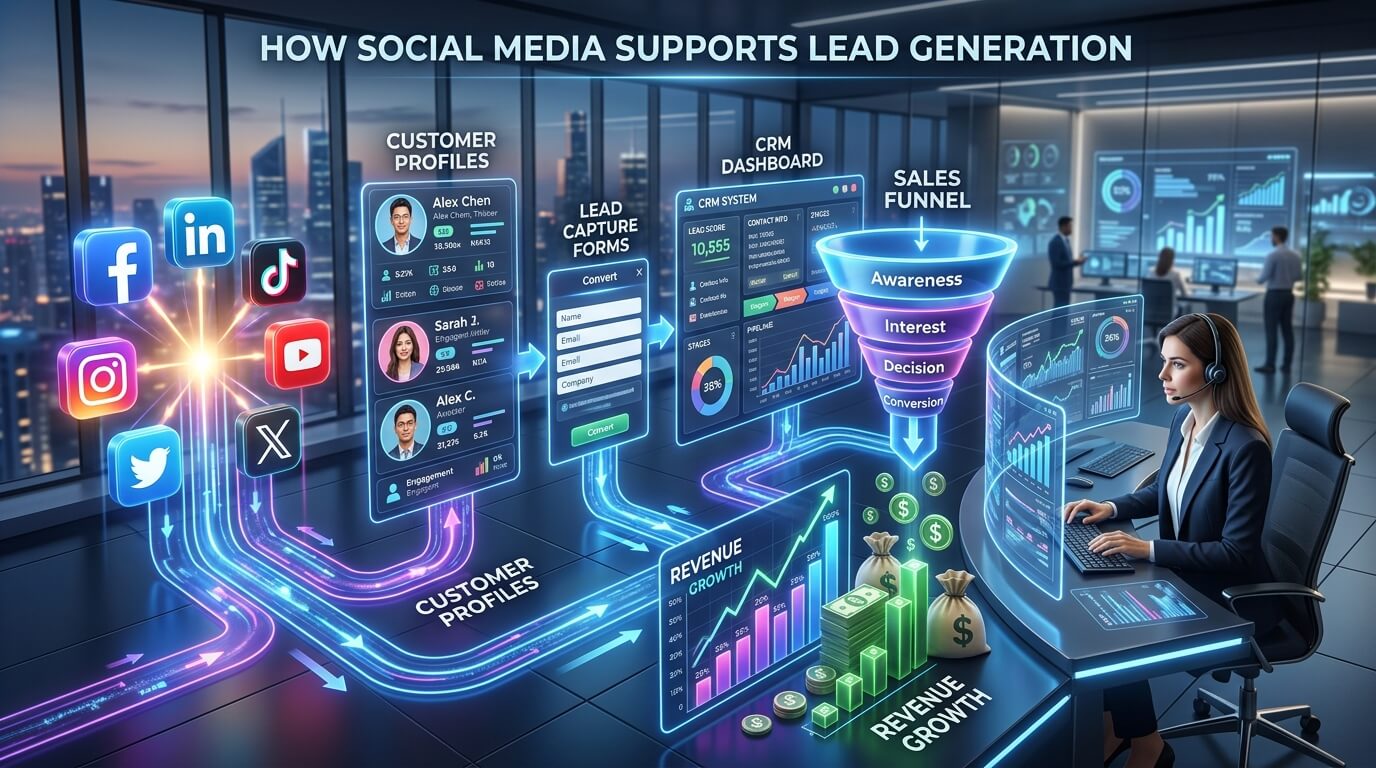
In today’s digital marketplace, businesses need more than visibility to grow. They need a reliable way to attract people who are genuinely interested in their products or services and guide those people toward becoming customers. This is where lead generation becomes important. While websites, email marketing, search engines, and paid advertising all contribute to lead generation, social media has become one of the most flexible and interactive channels for finding potential customers.
Social media lead generation is the process of using platforms such as Facebook, Instagram, LinkedIn, TikTok, and YouTube to attract prospects, encourage interaction, capture their information, and move them toward a purchase decision. A lead might be someone who fills out a form, sends a direct message, downloads a resource, signs up for an offer, requests a quote, or visits a website after engaging with social content.
The major advantage of social media is that it combines audience reach with communication. A business can introduce itself to thousands of potential customers, demonstrate expertise, answer questions, build credibility, and invite interested people to take the next step without relying entirely on traditional advertising.
Understanding the Connection Between Social Media and Lead Generation
Social media marketing and lead generation are closely connected, but they are not exactly the same thing. Social media marketing is often focused on increasing awareness, engagement, community, and brand recognition. Lead generation takes those activities further by creating opportunities for identifiable prospects to enter the sales process.
For example, a company may publish an educational Instagram post explaining how its service solves a common customer problem. Someone sees the post, visits the profile, clicks the website link, and fills out a consultation form. The social media post created awareness, the profile created interest, and the form converted that interest into a lead.
This journey demonstrates why businesses should not judge social media only by likes or follower counts. Engagement can be valuable, but the ultimate business impact often comes from what happens after someone engages. A well-designed social media strategy creates a path from attention to interaction and from interaction to inquiry.
Social media can also support different stages of the buyer journey. Someone discovering a brand for the first time may respond to an educational video, while someone who already knows the brand may respond to a testimonial or limited-time offer. This makes social platforms useful for both attracting new prospects and nurturing people who are not ready to buy immediately.
Social Media Increases Brand Visibility
Reaching Potential Customers Where They Spend Time
One of the first ways social media supports lead generation is by expanding a brand’s visibility. Potential customers cannot become leads if they never discover the business. Social platforms give companies an opportunity to appear in front of people who may already be interested in their industry, products, services, or solutions.
Unlike traditional advertising, social media allows businesses to communicate repeatedly with audiences. A person might see a short video one day, read an educational post the next week, and later encounter a customer testimonial. Each interaction increases familiarity.
This repeated exposure can be particularly valuable for businesses with longer buying cycles. Customers rarely make major purchasing decisions after a single interaction. They often research, compare options, read reviews, and look for evidence that a business is trustworthy. Social media gives brands an ongoing presence throughout this process.
Building Awareness Before Asking for a Sale
Effective lead generation does not always begin with a sales pitch. In many situations, the strongest first step is providing useful information.
Educational content can introduce a business to potential customers while demonstrating its knowledge. A web design company, for instance, could explain common website mistakes. A marketing agency could discuss ways to improve conversion rates. A professional service provider could answer frequently asked questions about its industry.
When people find this information useful, they have a reason to remember the business. Later, when they need the service themselves, the company may already be familiar to them.
Social Media Builds Trust With Potential Leads
Human Interaction Makes Brands More Approachable
Trust plays an important role in lead generation. People want to know who they are dealing with before sharing personal information or spending money. Social media provides a more human environment where businesses can communicate in a conversational way.
Behind-the-scenes content, employee introductions, customer stories, educational videos, and responses to comments can make a company feel more accessible. Instead of seeing a business as an anonymous website, potential customers can begin to understand its personality, expertise, and values.
This matters because people often make decisions based not only on what a company sells but also on whether they feel comfortable doing business with it.
Social Proof Reduces Purchase Hesitation
Customer reviews, testimonials, case studies, user-generated content, and success stories can also strengthen lead generation. When potential customers see evidence that other people have had positive experiences, uncertainty can decrease.
Social proof is particularly useful when a prospect is comparing several companies. A strong testimonial may provide the reassurance needed to move from research to inquiry.
Businesses can incorporate customer experiences into videos, posts, stories, and other formats. Rather than simply claiming that a product or service works, they can demonstrate how it helped a real customer solve a problem.
Social Media Creates Direct Communication Opportunities
Direct Messages Can Become Valuable Leads
One of the most important differences between social media and many traditional marketing channels is the ability to communicate directly with prospects.
A potential customer might comment on a post asking about pricing. Another might send a direct message asking whether a service is available in their area. Someone watching a video may click a contact option and begin a conversation.
These interactions can become leads because they demonstrate active interest.
Direct messaging can also remove friction. Instead of requiring a prospect to search for a phone number or navigate through multiple website pages, the business can begin the conversation directly on the platform where the prospect is already active.
Conversations Help Businesses Understand Customer Needs
Social media conversations provide another valuable benefit: customer insight. Prospects often reveal their concerns through questions and comments.
A business can learn what customers find confusing, which features they value, what prices they expect, and what objections prevent them from purchasing. These insights can then influence future content, advertising, product development, and sales messaging.
In this way, social media does not simply generate leads. It can also help businesses understand the people behind those leads.
Social Media Drives Traffic to Conversion Pages
A social media post can generate interest, but businesses often need a destination where prospects can take a measurable action. This might be a landing page, service page, product page, consultation form, newsletter signup, or downloadable resource.
For example, a business could publish a post explaining a common industry challenge and invite readers to visit a detailed guide. The guide could then include a consultation form. Someone who completes the form becomes a measurable lead.
This connection between social content and website conversion is important because it creates a more complete customer journey. Social media attracts attention while the website provides additional information and a structured conversion opportunity.
According to HubSpot, social media can support lead generation by increasing brand awareness, engagement, and website traffic.
Social Media Advertising Improves Lead Targeting
Reaching Specific Audiences
Organic social media content can reach new people, but paid advertising gives businesses additional control over who sees their campaigns.
Social platforms allow advertisers to create audiences based on characteristics such as location, demographics, interests, behaviors, and previous interactions. This makes it possible to move beyond simply showing an advertisement to a large audience.
For example, a local service provider might target people within a specific geographic area. A B2B company could focus on professionals in particular industries. An online retailer might reach people who have previously interacted with its products.
The goal is not necessarily to reach the largest possible audience. It is to reach people who are more likely to have a genuine need for what the business offers.
Lead Generation Ads Reduce Friction
Some social platforms provide advertising formats designed specifically for lead collection. These can allow users to submit information without going through a lengthy external process.
A campaign might ask for a name, email address, phone number, or other relevant information. Once the information is submitted, the business can follow up with the prospect.
The simpler the process, the easier it can be for interested users to respond. However, businesses should avoid asking for unnecessary information because excessive form fields can discourage prospects.
Social Media Supports Different Types of Lead Generation
Social media lead generation does not depend on one specific tactic. Different businesses can create different conversion paths depending on their audience and goals.
| Social Media Approach | How It Supports Lead Generation | Typical Conversion Opportunity |
| Educational content | Builds awareness and demonstrates expertise | Website visit or consultation |
| Customer testimonials | Builds trust and reduces hesitation | Inquiry or purchase |
| Short-form video | Captures attention and explains solutions quickly | Profile visit or direct message |
| Lead-generation ads | Captures prospect information directly | Form submission |
| Direct messages | Creates personal conversations | Quote request or consultation |
| Social offers | Creates urgency and encourages action | Sign-up or purchase |
| Website-focused posts | Moves interested users toward detailed information | Contact form |
| Webinars and events | Provides value while identifying interested prospects | Registration |
The strongest strategy usually combines several approaches rather than depending entirely on one type of content.
Social Media Helps Nurture Leads
Generating a lead is only the beginning. Not every person who shows interest is ready to purchase immediately. Some prospects may need additional information before making a decision.
Social media provides an opportunity to continue communicating with these prospects.
Someone who downloads a resource may continue seeing the company’s content. A person who follows the business after asking a question may later see testimonials, product demonstrations, educational posts, or announcements. Each interaction can strengthen familiarity.
This nurturing process is important because purchasing decisions often develop gradually. Hootsuite describes social media lead generation as part of a broader process that includes lead nurturing and eventual conversion.
The key is to avoid overwhelming prospects with constant sales messages. Useful, relevant content is more likely to keep people interested than repetitive promotional posts.
Social Media Makes Content a Lead Generation Tool
Educational Content Attracts Problem-Aware Customers
People often use social media to find solutions to problems. This creates opportunities for businesses to publish content that answers questions their target audience is already asking.
A software company might explain how to automate a repetitive task. A fitness business might discuss common training mistakes. A financial service company might explain a complicated concept in simple language.
When content directly addresses a problem, it can attract people who are already somewhere within the buying journey.
Video Makes Complex Ideas Easier to Understand
Short-form video has become an important format for social media marketing because it can communicate information quickly. Businesses can use videos to demonstrate products, explain services, answer questions, introduce team members, or share customer experiences.
Video can also help prospects understand a company’s personality. This is particularly valuable for service businesses where customers are buying expertise, experience, or communication rather than a physical product.
A well-created video can therefore perform several jobs simultaneously: attract attention, educate the viewer, build trust, and encourage an inquiry.
Social Media Helps Businesses Generate Qualified Leads
Not every lead has the same value. A person who casually likes a post is different from someone who requests a quotation.
Social media can help businesses identify stronger prospects by tracking the actions people take. Someone who watches a product demonstration, visits a website, downloads a guide, and then sends a message may show considerably more buying intent than someone who simply follows an account.
This is why businesses should define what a qualified lead means for their particular sales process. For one company, a qualified lead may be someone who schedules a consultation. For another, it may be someone who requests pricing information.
Clear definitions help marketing and sales teams understand which social activities are actually contributing to business growth.
Social Media Provides Measurable Lead Generation Data
Tracking What Works
Another major advantage of social media is measurement. Businesses can analyze content performance, audience engagement, advertising results, website traffic, inquiries, and conversions.
Instead of simply asking whether a post performed well, marketers can ask more useful questions. Did the content generate website visits? Did visitors complete forms? Did advertisements produce qualified inquiries? Which audience produced the best results?
This information can be used to improve future campaigns.
Analytics also help businesses identify inefficient spending. If a campaign generates hundreds of clicks but very few qualified leads, the problem may be the audience, offer, landing page, or message.
Improving Campaigns Over Time
Lead generation should be treated as an ongoing process rather than a one-time campaign. Businesses can test different headlines, visuals, offers, audiences, calls to action, and content formats.
Over time, these tests reveal what motivates the target audience.
The result is a more efficient marketing system. Instead of guessing what customers want, businesses can make decisions based on measurable behavior.
Social Media Creates Opportunities for Retargeting
Not everyone converts during their first interaction with a business. Someone may visit a website, watch a video, or interact with an advertisement and then leave without taking action.
Retargeting gives businesses an opportunity to reconnect with some of these audiences.
A person who has already demonstrated interest may be more receptive to a second message than someone who has never encountered the brand. A retargeting campaign might show a testimonial, a product demonstration, an offer, or an invitation to request more information.
This can help businesses stay visible during the decision-making process without relying entirely on reaching new audiences.
Social Media Supports Both B2B and B2C Lead Generation
Social media lead generation is not limited to consumer brands. Business-to-business companies can also use social platforms to attract potential clients.
LinkedIn is particularly relevant for professional audiences, while Facebook, Instagram, YouTube, and TikTok can support different stages of awareness and consideration depending on the industry.
For B2B businesses, thought leadership can be especially useful. Articles, videos, industry insights, case studies, research discussions, and expert commentary can demonstrate knowledge and establish credibility before a sales conversation begins.
For B2C companies, visual demonstrations, customer reviews, product content, short-form videos, and promotional campaigns can create faster opportunities for engagement and conversion.
The best platform depends on where the target audience spends time and how that audience makes purchasing decisions.
Turning Social Media Attention Into Real Leads
A common mistake is assuming that good content automatically produces leads. Content is important, but there needs to be a clear next step.
A strong lead-generation strategy connects content with a relevant call to action. After learning something useful, a prospect should understand what they can do next.
That next step could be visiting a website, requesting a quote, booking a consultation, sending a message, downloading a resource, joining a webinar, or signing up for updates.
The call to action should match the prospect’s level of interest. Asking a person who has just discovered a brand to make a major purchase may be too aggressive. Inviting that person to learn more may be more appropriate.
As trust develops, stronger conversion opportunities can be introduced.
Common Mistakes That Limit Social Media Lead Generation
One of the biggest problems is focusing too heavily on follower numbers. A large audience can be useful, but followers do not automatically become customers. A smaller audience with strong buying intent can be much more valuable.
Another mistake is publishing content without understanding the target customer. If a business does not know its audience’s problems, motivations, objections, and preferences, its content may attract attention without generating meaningful inquiries.
Businesses also sometimes make the conversion process too complicated. If someone needs to click through several pages, complete a lengthy form, and wait days for a response, interest may disappear.
Slow follow-up is another challenge. A lead is most valuable when interest is active. Businesses should establish a reliable process for responding to inquiries and moving qualified prospects into the next stage of the sales process.
Finally, businesses should avoid treating every platform identically. Content that works well on LinkedIn may not have the same effect on TikTok or Instagram. Each platform has its own audience expectations, content styles, and communication patterns.
Building a Sustainable Social Media Lead Generation Strategy
A sustainable strategy starts with understanding the target audience and defining measurable goals. From there, businesses can create content that addresses customer needs while connecting naturally to relevant offers.
The strategy should include a combination of awareness content, educational material, social proof, promotional messages, direct-response opportunities, and ongoing engagement.
Businesses should also create a clear process for handling leads after they arrive. A social media campaign can generate hundreds of inquiries, but if those inquiries are not organized, followed up, and evaluated, much of the potential value can be lost.
The strongest social media strategies therefore connect marketing, sales, customer service, analytics, and follow-up. Social media becomes much more powerful when it is treated as part of the entire customer journey rather than as a separate publishing activity.
Conclusion
Social media supports lead generation by helping businesses attract attention, build trust, communicate directly with prospects, drive website traffic, collect contact information, and nurture potential customers. Its value goes far beyond likes and followers. When content, advertising, calls to action, landing pages, messaging, and follow-up work together, social media can become a consistent source of qualified business opportunities.
The most successful approach is not simply to post more frequently. It is to create content with a clear purpose and provide prospects with a natural path from discovery to engagement and eventually to conversion. With consistent strategy, relevant content, careful targeting, and measurable goals, social media can play a central role in building a stronger and more sustainable lead-generation system.
Frequently Asked Questions
Q1. How does social media generate leads?
Social media generates leads by attracting potential customers through content and advertising, then encouraging them to take actions such as sending a message, completing a form, visiting a website, downloading a resource, or requesting a quote.
Q2. Which social media platform is best for lead generation?
There is no single best platform for every business. LinkedIn can be highly useful for B2B companies, while Facebook and Instagram can work well for many consumer and service businesses. The best platform depends on the target audience and business goals.
Q3. Can organic social media generate leads?
Yes. Educational content, customer testimonials, videos, product demonstrations, helpful posts, and strong calls to action can generate leads without requiring paid advertising. However, organic results usually depend on consistency and audience relevance.
Q4. Are social media followers considered leads?
Not necessarily. A follower becomes a more meaningful lead when they demonstrate identifiable interest or provide information that allows the business to continue the sales conversation. Follower growth is useful, but it should not be confused with lead generation.
Q5. How can businesses improve the quality of social media leads?
Businesses can improve lead quality by targeting the right audience, creating relevant offers, using clear calls to action, qualifying prospects, tracking campaign performance, and following up quickly with people who demonstrate genuine buying interest.