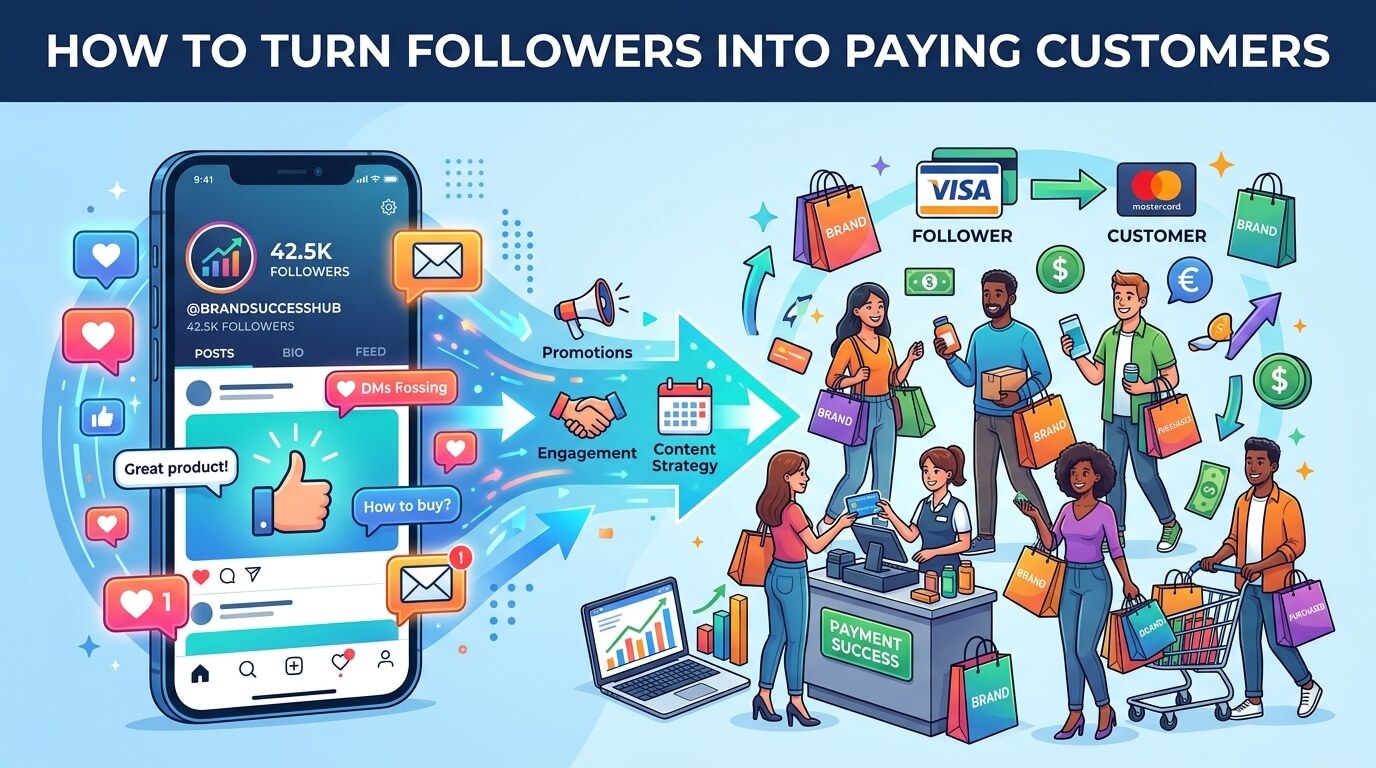
Building a large social media following can feel like a major business achievement. More followers often mean more visibility, engagement, comments, shares, and opportunities to get your brand in front of new people. However, a large audience does not automatically translate into revenue. A business can have thousands of followers and still struggle to generate consistent sales if those followers have no clear reason or opportunity to become customers.
The real value of social media lies in what happens after someone presses the “Follow” button. A follower represents interest, but interest is only the beginning of the customer journey. People may follow a business because they enjoy its content, find its advice useful, like its personality, or simply want to keep up with future updates. They may not be ready to buy immediately. The job of a strong social media strategy is to gradually move interested followers from awareness to trust, from trust to consideration, and finally from consideration to purchase.
Turning followers into paying customers is therefore less about constantly selling and more about creating a well-designed path toward a purchase. That path needs valuable content, a clear offer, social proof, effective calls to action, personal interaction, and a simple buying experience. When these elements work together, social media becomes more than an awareness channel. It becomes a meaningful part of the sales process.
Understand That Followers Are Not Automatically Customers
One of the biggest mistakes businesses make is assuming that every follower is a potential customer who is ready to purchase. Following a social media account requires very little commitment. Buying a product or service requires money, trust, time, and confidence. The difference between those two actions is where your conversion strategy needs to work.
Someone might discover your business through an educational post and follow you because the information was useful. At that stage, they may not even fully understand what you sell. Another person might follow after seeing a customer testimonial but still have questions about quality, pricing, delivery, or results. Someone else may already understand your offer but simply be waiting for the right moment to buy.
This is why businesses should think about followers as people at different stages of the buying journey rather than one single audience. Some need education. Some need reassurance. Some need proof. Others are already interested and simply need a clear next step.
Recent guidance on social conversion consistently emphasizes the importance of connecting content with the buyer journey rather than treating follower growth as the end goal.
Identify What Your Audience Actually Wants
Before trying to sell more, understand why people followed you in the first place. Look at the posts that receive meaningful engagement. Pay attention to the questions people ask in comments and messages. Notice which topics generate saves, shares, replies, or conversations.
These interactions reveal what your audience cares about. If followers repeatedly ask how your service works, create content explaining your process. If they ask about pricing, create helpful content that explains what influences your pricing. If they are uncertain about whether your product is right for them, address that concern directly.
Your social media content should reflect your audience’s actual problems rather than simply promoting whatever your business wants to sell.
Make Your Offer Impossible to Misunderstand
A follower cannot become a customer if they do not understand what your business offers. This sounds obvious, but many social media profiles make visitors work too hard to figure out what the business actually does.
Your profile should communicate what you offer, who you help, and what someone should do if they are interested. Your bio, pinned content, highlights, website, and promotional posts should reinforce the same message.
For example, instead of simply saying that you are a “creative agency,” explain the specific value you provide. A clearer message might communicate that you help small businesses create professional websites that improve their online presence. The second version immediately gives the audience more context.
Clarity reduces hesitation. When people understand your product or service and know how to access it, there are fewer obstacles between interest and action.
Create a Strong First Impression
Your social media profile is often one of the first places a potential customer encounters your business. If the profile looks outdated, confusing, inconsistent, or incomplete, people may question whether the business itself is reliable.
Use consistent branding, professional visuals, clear descriptions, and current information. Make sure your contact details work and your links lead to the right destinations. If you are selling a product, make it easy to find the product. If you provide services, make it easy to learn about those services or request a consultation.
Your goal is to eliminate unnecessary searching. A potential customer should not have to scroll through dozens of posts to understand how to work with you.
Build Trust Before Asking for the Sale
People rarely buy simply because a business tells them to buy. They buy when they believe the product or service can solve their problem and that the company is trustworthy.
Trust is especially important online because followers cannot physically examine many products or personally meet the people behind a service. They rely on content, reviews, testimonials, demonstrations, conversations, and the overall credibility of the brand.
This means your social media strategy should consistently provide evidence that supports your claims. Instead of repeatedly saying that your business is excellent, demonstrate why customers should believe it.
Show Real Customer Experiences
Testimonials and customer stories can be powerful because they show potential buyers that other people have already taken the risk of purchasing from you. A well-presented testimonial can answer questions that promotional content cannot.
Instead of sharing a vague statement such as “Great service,” explain the customer’s original problem, what they purchased, and what changed afterward. A detailed customer story gives followers something concrete to evaluate.
User-generated content can also strengthen credibility because it allows customers to see your product or service through someone else’s experience. Recent conversion guidance highlights testimonials, user-generated content, and other forms of social proof as important tools for reducing uncertainty.
Show What Happens Behind the Scenes
Behind-the-scenes content can make a business feel more authentic and transparent. Show how products are created, how services are delivered, how your team works, or how you solve customer problems.
This type of content is particularly useful for businesses where quality is difficult to judge before purchase. Showing the process gives followers additional reasons to believe that your business takes its work seriously.
Create Content That Moves People Toward Buying
Not every social media post should be a sales pitch. If every post says “Buy now,” followers may eventually stop paying attention. At the same time, a feed that never promotes anything can build engagement without generating revenue.
The solution is to create content with different purposes.
| Content Type | Primary Purpose | Example | Customer Stage |
| Educational content | Solve problems and demonstrate expertise | Tips, tutorials, guides | Awareness |
| Engagement content | Encourage interaction and learn about followers | Questions, polls, discussions | Awareness |
| Trust content | Establish credibility | Testimonials, reviews, case studies | Consideration |
| Product or service content | Explain the offer | Features, benefits, demonstrations | Consideration |
| Promotional content | Encourage immediate action | Discounts, launches, limited offers | Conversion |
| Follow-up content | Address hesitation | FAQs, objections, comparisons | Conversion |
The strongest strategy combines these different forms of content instead of relying on one category. Educational content can attract attention, trust-building content can reduce uncertainty, and promotional content can give interested followers a reason to act.
SCORE similarly recommends balancing educational, proof-oriented, and sales-focused content so that businesses can build authority while still giving audiences a clear path toward action.
Give Followers a Clear Reason to Buy
Even when followers like your content and trust your business, they may not purchase unless there is a compelling reason to do so.
That reason does not always have to be a discount. Depending on the business, it could be convenience, better quality, a useful feature, personalization, expert support, exclusivity, or a solution to a specific problem.
The key is to communicate the value of the purchase rather than simply describing what the customer receives.
Instead of saying that a service includes “five consultations,” explain what those consultations help the customer accomplish. Instead of describing a product as having “premium materials,” explain how those materials improve durability, comfort, appearance, or performance.
Customers want to understand what the purchase does for them.
Use Offers Strategically
Special offers can help move hesitant followers toward action, particularly when they are designed specifically for your social audience. Exclusive discounts, early access, limited-time promotions, bundles, or bonuses can give followers a tangible reason to act.
However, constant discounting can weaken perceived value. If customers learn that another discount is always around the corner, they may simply wait. Offers work best when they complement a strong value proposition rather than replace it.
For some businesses, an exclusive offer for followers can also reinforce the relationship by making the audience feel recognized and appreciated.
Use Calls to Action That Tell People What to Do
A social media post can be informative and persuasive but still fail to generate action if the audience does not know what to do next.
A call to action, or CTA, provides that direction. Instead of ending a post without guidance, tell followers exactly what action makes sense.
The CTA should match the content and the customer’s level of interest. Someone who has just discovered your business may be more comfortable downloading a guide or visiting your website. Someone who has already asked questions may be ready to book a consultation or make a purchase.
Make the Next Step Simple
Avoid asking followers to complete several unnecessary steps. If a customer is ready to buy, send them directly to the relevant product or checkout page. If they need advice, invite them to send a message. If they want more information, direct them to a useful landing page.
“Click here to learn more about our website design packages” is more useful than simply saying “Visit our website.”
Specific CTAs reduce guesswork and make the transition from social media to the next stage of the buying journey easier.
Turn Comments and DMs Into Conversations
Social media gives businesses something traditional advertising often cannot provide as easily: direct conversation.
A follower who comments on a product, responds to a Story, or sends a message may be signaling interest. That interaction should not be treated as just another engagement metric. It can be an opportunity to understand what the person needs.
Instead of immediately sending a sales pitch, ask questions. Find out what they are looking for. Identify their concerns. Explain how your product or service could help.
Direct messages are particularly valuable for businesses that sell customized services or products that require explanation. A personal conversation can make the buying process feel less intimidating.
Social conversion guidance also emphasizes the role of DMs and personalized conversations in moving warmer followers toward a purchase.
Respond Like a Human
People can usually tell when a response feels automated or copied. Even when automation is useful for managing large audiences, the conversation should eventually become relevant and personal.
Respond to questions thoughtfully. Acknowledge concerns instead of ignoring them. If someone is not ready to buy, do not pressure them. Helpful conversations can create goodwill that leads to a purchase later.
Move Followers to Channels You Control
Social platforms are useful for discovery and engagement, but businesses should avoid relying entirely on an algorithm-driven platform to maintain customer relationships.
Encouraging followers to join an email list, visit your website, register for an event, download a resource, or create an account gives you additional ways to communicate with them.
This is especially important because someone can follow your account without seeing every post. Social media reach can fluctuate, while an email list or customer database gives your business a more direct communication channel.
A useful lead magnet can make this transition easier. A business consultant might offer a free guide. A designer might provide a checklist. An online store might offer a first-purchase incentive. The resource should be genuinely useful and connected to the products or services you eventually want to sell.
Create Landing Pages That Match Your Content
One common conversion problem occurs when a social media post promises one thing but the link leads somewhere completely different.
Imagine a follower sees a post about a particular service and clicks the link, only to arrive at a generic homepage. They now have to search for the service, find the relevant information, and figure out how to proceed. Each additional step creates an opportunity for them to leave.
A dedicated landing page can create a smoother experience. The headline should connect with the original social media message, the benefits should be clear, trust signals should be visible, and the desired action should be obvious.
The transition should feel natural: social post, relevant offer, useful information, clear action.
Address Objections Before They Stop the Sale
Potential customers often have questions they do not publicly ask. Is the product worth the price? Will it work for someone like me? How long does delivery take? What happens if I am unhappy? Is this service suitable for a small business?
If you address these questions before customers have to ask, you remove some of the uncertainty surrounding the purchase.
Create posts, videos, Stories, FAQs, and comparison content that answer common objections. If customers repeatedly ask the same question in DMs, consider turning that question into a permanent piece of content.
Objection-handling content is particularly useful for higher-priced products and services because customers usually need more confidence before making a significant financial commitment.
Create a Sense of Community
Customers are more likely to connect with brands that feel human. A social media account should not feel like a digital billboard where the company talks and everyone else listens.
Ask questions. Share customer stories. Celebrate milestones. Respond to comments. Invite opinions. Show the people behind the business.
Community-building is not merely about increasing engagement numbers. It creates familiarity. Over time, followers can develop a stronger relationship with the brand, making future promotional messages feel more natural.
Forbes Agency Council contributors have similarly emphasized relationships, connection, and community as important parts of turning social attention into customer relationships.
Measure Sales Instead of Only Followers
Follower growth is useful, but it should not be the only metric you track.
A business needs to know whether social media is producing meaningful commercial outcomes. Track website visits from social platforms, inquiries, leads, bookings, purchases, conversion rates, and revenue where possible.
You should also identify which content generates actual business results. A post with thousands of likes may produce fewer customers than a smaller post that reaches a highly relevant audience.
This distinction is important because engagement and revenue are not the same thing. Conversion-focused measurement helps businesses understand which content deserves more investment and which activity may simply be producing vanity metrics.
Test and Improve Your Strategy
There is no universal formula that guarantees the same conversion rate for every business. Different audiences respond to different messages, offers, formats, and purchasing experiences.
Test different CTAs, offers, landing pages, content topics, and promotional approaches. Look at what happens after someone interacts with your content rather than stopping at likes and comments.
Over time, these observations can turn social media from a collection of individual posts into a predictable marketing system.
Avoid Selling Too Aggressively
The goal of conversion is not to pressure every follower into buying immediately. Aggressive selling can damage trust and make people disengage.
Instead, focus on timing and relevance. A follower who has just discovered your brand may need educational content. Someone who has watched several product demonstrations may need a testimonial. Someone who has asked about pricing may be ready for an offer.
When the content matches the follower’s level of interest, selling feels less intrusive because the offer solves a problem the person is already thinking about.
Be Consistent With Follow-Up
Not every interested follower will purchase after the first interaction. Someone may visit your website today and return two weeks later. Another person may ask a question but need time to make a decision.
Follow-up helps keep your business visible during this period.
Follow-up might happen through email, social media content, retargeting campaigns, DMs, or additional educational material. The objective is not to repeatedly pressure the customer but to remain useful and relevant while they evaluate their options.
Consistency is particularly important for businesses with longer sales cycles. A follower may need multiple interactions with a brand before feeling confident enough to spend money.
Turn Customers Into Repeat Customers and Advocates
The conversion process does not end when a follower makes their first purchase. A successful customer experience can turn that buyer into a repeat customer and eventually an advocate for your business.
After a purchase, continue communicating. Provide useful information about the product or service. Ask for feedback. Encourage customers to share their experiences. Offer relevant products or services when appropriate.
Satisfied customers can become one of your strongest marketing assets because their experiences provide authentic social proof. Their reviews, recommendations, photographs, videos, and stories can help future followers feel more confident about buying.
The result is a cycle: social content attracts followers, followers become customers, customers generate experiences and proof, and that proof helps attract and convert more people.
Conclusion
Turning followers into paying customers requires much more than increasing your follower count. It requires a clear understanding of your audience, a compelling offer, consistent trust-building content, strong social proof, specific calls to action, meaningful conversations, and a simple path from interest to purchase.
The most effective approach is to stop viewing followers as numbers and start viewing them as people moving through different stages of a buying journey. Some need information, some need reassurance, and some simply need a clear opportunity to act.
When your social media strategy provides value, establishes credibility, communicates your offer clearly, and makes purchasing easy, followers have a much better reason to become customers. Ultimately, successful social media marketing is not about collecting the largest audience. It is about building the right audience and creating relationships that lead to sustainable business growth.
Frequently Asked Questions
Q1. How long does it take to turn followers into customers?
The timeframe varies depending on the industry, product price, audience trust, and sales cycle. Low-cost products may convert quickly, while expensive services can require weeks or months of relationship building.
Q2. Do I need thousands of followers to generate sales?
No. A smaller audience that closely matches your ideal customers can often be more valuable than a large but poorly targeted following.
Q3. How often should I promote my products or services?
There is no universal posting ratio, but your content should balance education, engagement, trust, and promotion rather than making every post a sales pitch.
Q4. Are discounts the best way to convert followers?
Not necessarily. Discounts can encourage action, but strong value propositions, testimonials, convenience, exclusivity, and clear solutions can also motivate customers without reducing your prices.
Q5. What is the most important step in converting followers?
The most important step is creating a clear path from social media attention to purchase. Followers need to understand what you offer, trust your business, and know exactly what to do next.