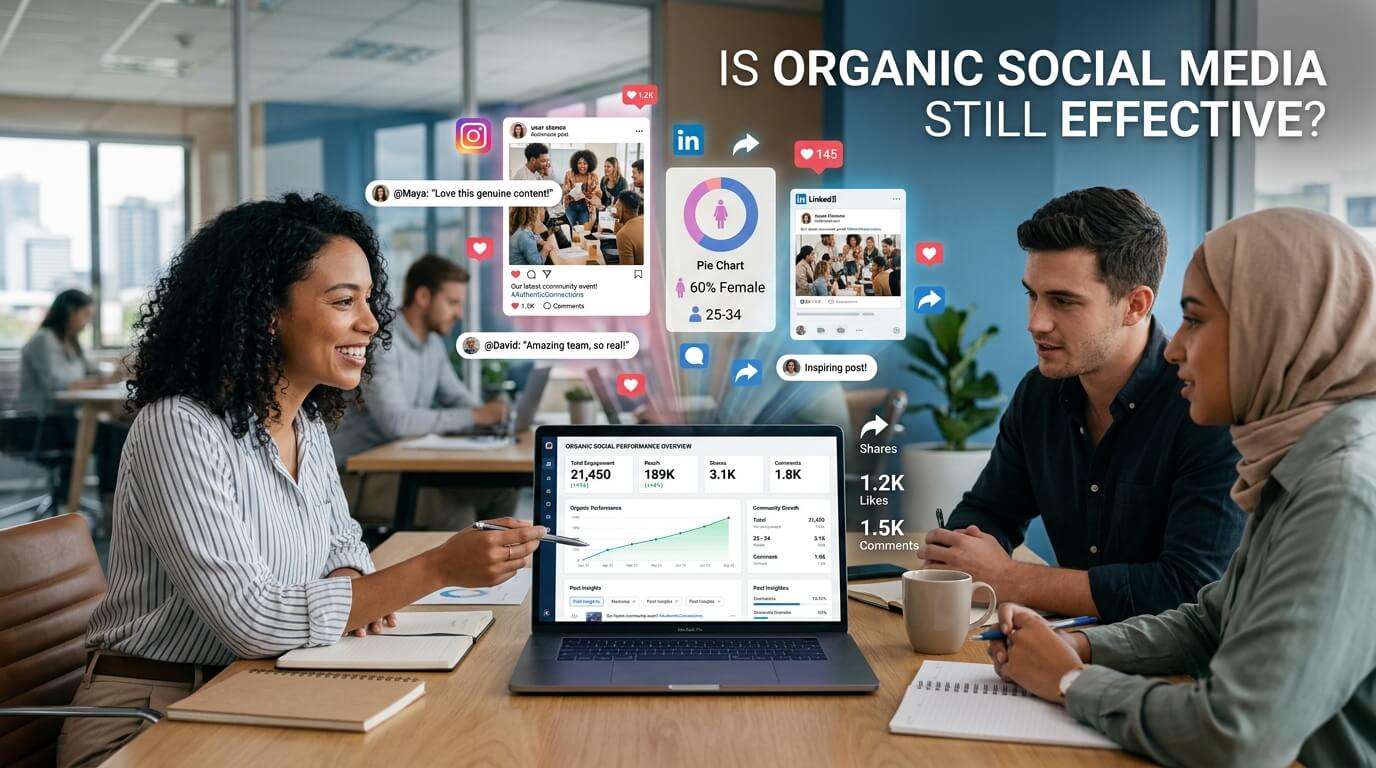
Social media has changed dramatically over the past decade. What once felt like a simple way for businesses to publish updates and connect with followers has become a crowded digital environment where brands compete with creators, influencers, advertisements, news, entertainment, and personal content for attention. With paid advertising becoming an important part of many digital marketing strategies, businesses often wonder whether organic social media is still worth the time and effort.
The short answer is yes, but organic social media works differently today than it did in the early days of Facebook, Instagram, LinkedIn, and other platforms. Simply posting promotional content and waiting for followers to engage is unlikely to produce consistent results. Organic social media is now more dependent on relevance, consistency, authenticity, community interaction, useful content, and a strong understanding of what an audience actually wants to see.
For businesses, the real question is not whether organic social media can work. It is how organic social media should be used alongside other marketing activities. A thoughtful organic strategy can strengthen brand awareness, build credibility, support customer relationships, and provide valuable insights into audience interests. It can also create a foundation that makes paid campaigns and other marketing efforts more effective.
What Is Organic Social Media?
Organic social media refers to activity on social platforms that does not rely on paid advertising or sponsored distribution. It includes regular posts, videos, stories, comments, community interactions, educational content, behind-the-scenes material, customer conversations, and other forms of unpaid engagement.
When a company publishes a LinkedIn article, shares an Instagram Reel, responds to a customer comment, posts a product demonstration, or answers a question in its community, those activities can be considered organic social media marketing.
The purpose is not always to generate an immediate sale. Organic social media often plays a broader role in helping people become familiar with a brand. Someone might discover a company through a useful post, follow the account, interact with several pieces of content, visit the website later, and eventually become a customer.
This longer customer journey is one reason organic social media can be difficult to measure using simple metrics such as clicks or direct conversions. Its value may appear through repeated exposure, stronger brand recognition, customer trust, and ongoing relationships.
Why Organic Social Media Has Become More Challenging
Organic social media has not disappeared, but the environment has become considerably more competitive. Most major platforms receive enormous volumes of content every day. Users are constantly presented with new posts, videos, recommendations, advertisements, and conversations.
As a result, having a social media account is no longer enough. Even having thousands of followers does not guarantee that every post will reach those followers.
Algorithms Influence Content Visibility
Social platforms use recommendation and ranking systems to determine which content users are most likely to see. These systems consider different signals depending on the platform and content format. Engagement, relevance, viewing behavior, relationships, content quality, and other factors can influence distribution.
This means a business cannot assume that publishing a post automatically puts it in front of its entire audience.
At the same time, algorithmic distribution can create opportunities. A useful or entertaining piece of content can reach people who do not already follow the business, particularly when the platform recommends it beyond the account’s existing audience.
The challenge is therefore not simply gaining followers. Businesses need to create content that gives people a reason to stop scrolling, watch, read, respond, save, share, or visit the brand’s profile.
Users Expect More Authentic Content
People have become increasingly familiar with polished marketing content. Highly designed graphics and promotional statements can still have a place in a social strategy, but audiences often respond strongly to content that feels genuine and relevant.
Behind-the-scenes posts, employee perspectives, educational videos, customer experiences, practical explanations, industry insights, and conversations can make a business feel more human.
This does not mean every company needs to become an influencer. It means social media works better when communication feels like communication rather than a continuous stream of advertisements.
The Benefits of Organic Social Media
Organic social media continues to provide several advantages for businesses that approach it strategically.
| Area | How Organic Social Media Can Help | Typical Long-Term Value |
| Brand awareness | Keeps the business visible to existing and potential audiences | Stronger recognition |
| Trust | Provides useful information and authentic communication | Greater credibility |
| Community | Encourages conversations and relationships | Stronger customer connection |
| Customer service | Gives customers a direct communication channel | Better relationship management |
| Content discovery | Allows valuable posts to reach new audiences | Additional organic exposure |
| Audience insights | Reveals questions, interests, and reactions | Better content and marketing decisions |
| Brand personality | Shows the people and values behind the business | More relatable identity |
| Website support | Drives interested users toward relevant pages | Additional traffic opportunities |
Organic Social Media Helps Build Brand Recognition
One of the strongest uses of organic social media is maintaining brand visibility. Customers rarely make decisions based on a single interaction with a company. They may encounter a brand several times before remembering it or considering its products and services.
Regular social media activity can create these repeated points of contact.
For example, a web design company might publish content explaining common website mistakes, share examples of design principles, answer questions about user experience, and discuss website performance. Even when someone does not immediately hire the company, repeated exposure can help establish familiarity.
This is particularly useful for businesses selling services that require consideration. A potential client may need time to compare providers, understand the problem, secure a budget, or gain confidence before making contact.
Organic content can support that process without requiring every post to make a direct sales pitch.
It Can Strengthen Trust and Credibility
Trust is especially important when customers are deciding whether to spend money or share personal information with a company. Organic social media gives businesses an opportunity to demonstrate knowledge and transparency over time.
A company can explain how its process works, introduce team members, answer common questions, share useful industry information, and discuss customer concerns. This creates a larger picture of the organization than a traditional advertisement usually can.
Educational content can be particularly valuable. Instead of simply saying that a company provides a high-quality service, the brand can demonstrate its knowledge by explaining relevant topics in a clear and useful way.
Over time, this can help position the business as a credible source of information within its field.
Organic Social Media Supports Community Building
Social media is fundamentally designed around interaction. Businesses that only publish content without participating in conversations may miss one of its most valuable features.
Responding to comments, acknowledging questions, joining relevant discussions, and encouraging customers to share their experiences can make an account feel active and approachable.
Community does not necessarily mean having a massive audience. A smaller group of genuinely interested followers can be more meaningful than a large audience that rarely interacts with the brand.
For some businesses, especially local companies and specialized B2B brands, a focused community can become an important source of referrals, conversations, feedback, and repeat customers.
Organic Content Can Support Paid Advertising
The choice between organic and paid social media does not have to be either-or. In many cases, the two approaches can support each other.
Organic content can help a company understand which subjects generate interest before the business invests heavily in paid promotion. If a particular educational topic receives strong engagement, the company may decide to develop the subject further or use a related piece of content in a paid campaign.
Paid campaigns can then provide additional reach while organic content continues to maintain the relationship with the audience.
This combination can be particularly useful because paid advertising is designed to buy distribution, while organic social media can provide ongoing communication and community building.
The Role of Different Social Media Platforms
Organic social media effectiveness also depends on choosing platforms that match the audience and the type of content a business produces.
Facebook can still be useful for community-oriented communication, local businesses, customer conversations, educational content, video, and groups. Its effectiveness depends heavily on the audience and industry rather than simply maintaining a company page.
Businesses that understand where their target customers spend time on the platform can use organic content to encourage conversations and maintain visibility.
Instagram is strongly visual, making it useful for brands that can communicate through photographs, short-form video, demonstrations, design work, educational visuals, or personality-driven content.
Reels, Stories, carousels, and other formats give businesses different ways to present information. The important consideration is whether the content suits the audience rather than simply following every trend.
LinkedIn can be particularly valuable for professional services, B2B companies, recruiters, consultants, technology companies, and individual professionals.
Organic content on LinkedIn can include industry observations, educational explanations, professional experiences, case discussions, company updates, and practical advice. Thoughtful content can help businesses and professionals establish expertise without relying entirely on advertising.
TikTok
TikTok has made short-form video a central part of social media culture. Businesses that can communicate ideas quickly, demonstrate products, answer questions, or create entertaining educational content may find opportunities for organic discovery.
However, businesses should not join a platform simply because it is popular. The platform needs to match the audience, resources, communication style, and goals of the organization.
What Makes Organic Social Media Effective Today?
The biggest change is that businesses need to think beyond posting frequency. Publishing five posts a week does not automatically produce better results than publishing three thoughtful posts.
Relevance Matters More Than Volume
A business should understand the questions, frustrations, interests, and goals of its audience. Content becomes more useful when it addresses those areas directly.
For example, a cybersecurity company could create posts explaining common security mistakes instead of repeatedly telling followers that its services are reliable. A fitness business could explain how beginners can structure a workout rather than simply posting promotional offers.
Useful content gives audiences a reason to return.
Consistency Builds Familiarity
Consistency remains important, but it should not be confused with posting as frequently as possible. A realistic schedule that a business can maintain is generally more useful than an aggressive schedule that becomes impossible to sustain.
Consistency also applies to brand voice. When a company communicates with a recognizable style and focuses on clear subject areas, followers can develop a better understanding of what they can expect from the account.
Engagement Should Be Two-Way
Social media becomes more valuable when businesses participate rather than simply broadcast.
A post that receives comments presents an opportunity for conversation. Questions can reveal customer concerns. Suggestions can inspire future content. Criticism can highlight areas where the company needs to improve its communication or service.
This makes engagement more than a vanity metric. It can become a source of market insight.
Why Some Organic Social Strategies Fail
Organic social media often fails when businesses treat it as a publishing requirement rather than a communication channel.
Posting generic promotional graphics every day can make an account repetitive. Content that focuses exclusively on the company’s services may give audiences little reason to follow. Irregular posting can make the business appear inactive, while copying trends without considering relevance can make content feel disconnected from the brand.
Another problem is unrealistic expectations. Organic social media generally takes time to develop. A business may need months of consistent experimentation before it understands which topics, formats, and messages consistently attract its target audience.
Measurement can also become a problem when companies focus only on follower numbers. Followers can be useful, but they do not tell the entire story. Engagement quality, profile visits, website activity, inquiries, content saves, shares, and audience sentiment can provide additional context.
How Businesses Can Measure Organic Social Media
Measuring organic social media should begin with the business objective.
If the goal is awareness, reach, impressions, video views, profile visits, and audience growth may be relevant. If the objective is engagement, comments, shares, saves, and meaningful conversations may be more useful.
For lead generation, businesses may monitor website visits, inquiries, form submissions, direct messages, and other conversion actions connected to social activity.
The key is to avoid treating one metric as a complete representation of success. A post with relatively few likes may still generate valuable website traffic or a qualified inquiry. Likewise, a highly viewed post may attract attention without producing meaningful business results.
Analytics should therefore be interpreted in relation to the purpose of the content.
How Businesses Can Improve Their Organic Strategy
A strong organic strategy begins with audience understanding. Businesses should know who they are trying to reach and what information that audience actually finds useful.
Content can then be organized around several broad themes that reflect customer needs. Educational material can answer questions, authority-building content can demonstrate expertise, brand content can reveal personality, and customer-focused content can address experiences and concerns.
Visual quality still matters, but usefulness and clarity should remain central. A beautifully designed post that says very little may have less value than a simple video that answers a question customers frequently ask.
Businesses should also review performance regularly. Looking at which topics generate meaningful engagement can help identify patterns. Over time, these insights can guide content planning and reduce the need to create posts based purely on guesswork.
Is Organic Social Media Still Worth the Investment?
Organic social media is still relevant, but expectations need to be realistic. It is not a replacement for every other marketing channel, and it is not guaranteed to produce immediate sales.
Its value is often cumulative.
A useful post can introduce someone to a business. A second post can demonstrate expertise. A customer response can build confidence. A video can answer a question that has been preventing someone from making a decision. Several months of consistent communication can create familiarity that a single advertisement cannot easily reproduce.
The strongest strategy is therefore usually not about choosing organic over paid social media. It is about understanding what each approach contributes.
Paid social media can provide targeted distribution, while organic social media can support ongoing communication, credibility, community, and brand identity. Businesses that combine these functions thoughtfully can create a more complete social media presence.
Conclusion
Organic social media is still effective, but the definition of effectiveness has changed. Businesses can no longer rely on simply publishing promotional posts and expecting their followers to see them. Competition for attention is intense, algorithms influence distribution, and audiences have become more selective about the content they engage with.
At the same time, organic social media provides something that paid promotion alone cannot fully replace: an ongoing opportunity to communicate with people, demonstrate expertise, answer questions, build familiarity, and develop a recognizable brand personality.
The businesses most likely to benefit from organic social media are those that approach it as a long-term relationship-building channel rather than a daily posting obligation. When content is relevant, useful, authentic, consistent, and connected to broader business goals, organic social media can remain an important part of a modern digital marketing strategy.
Frequently Asked Questions
Q. Is organic social media still effective for small businesses?
Yes. Small businesses can use organic social media to build local awareness, communicate directly with customers, demonstrate expertise, and develop relationships without paying for every interaction. Results depend on the audience, platform, content quality, consistency, and business objectives.
Q. How often should a business post on social media?
There is no universal posting frequency that works for every business. A consistent schedule that allows a company to maintain useful, relevant content is generally more practical than publishing large amounts of repetitive material.
Q. Is organic social media better than paid social media?
Organic and paid social media serve different purposes. Organic activity can support relationships, credibility, community, and ongoing communication, while paid campaigns can provide additional targeted reach. Businesses can use both depending on their objectives and available resources.
Q. What type of organic social media content works best?
Useful content that addresses audience questions and interests can perform well. Educational posts, practical advice, demonstrations, behind-the-scenes content, customer-focused information, industry insights, and engaging short-form videos can all be effective when they are appropriate for the audience and platform.
Q. How long does it take to see results from organic social media?
The timeframe varies significantly by business, audience, platform, and content strategy. Organic social media is generally a long-term activity rather than a channel where businesses should expect immediate and consistent results from every post.