The Enduring Legacy of the Kansas City Chiefs Visual Identity
In the high-stakes world of the National Football League, few symbols are as instantly recognizable as the interlocking “KC” inside a white arrowhead. While players, coaches, and stadiums change, the visual identity of a franchise serves as the anchor for generations of fans. The Chiefs Logo History: Design, Colors, and Team Heritage is a fascinating study in brand consistency, minimalist design, and the evolution of American sports iconography. Unlike many franchises that undergo radical rebrands every decade to spur merchandise sales, the Kansas City Chiefs have maintained a steadfast commitment to a design established in the early 1960s.
This article provides a comprehensive deep-dive into the origins of the franchise, the artistic decisions made by founder Lamar Hunt, and the subtle yet significant evolution of the team’s colors and uniforms. We will explore how a sketch on a napkin became a global symbol of excellence and how the team has navigated the complexities of its heritage in the modern era.
The Dallas Texans Era (1960–1962): The Gun-Toting Origin

To fully understand the Chiefs Logo History: Design, Colors, and Team Heritage, one must look back to the birth of the American Football League (AFL). Before they were the Kansas City Chiefs, the franchise was known as the Dallas Texans. Founded by Lamar Hunt in 1960, the team required a visual identity that would appeal to the Texan market and compete directly with the NFL’s Dallas Cowboys.
The “Gun-Toting Texan” Design
The original logo for the Dallas Texans was a product of its time—illustrative, cartoonish, and heavily detailed. This was a common trend in the 1950s and 60s sports branding, where logos were often literal representations of the team name rather than abstract icons.
The design featured a football player wearing a cowboy hat and boots, running with a football tucked under one arm. In his other hand, the character brandished a pistol, firing it into the air. The figure was superimposed over an outline of the state of Texas. A star marked the location of Dallas, anchoring the team to its geography. The color palette was already established: a rich red and gold (often referred to as yellow in early prints), combined with white.
Design Analysis of the Texans Logo
From a graphic design perspective, the Dallas Texans logo was complex. It contained multiple elements that made reproduction on helmets and small merchandise difficult.
- Complexity: The inclusion of the state map, a full-body character, and accessories (hat, gun, boots) created visual clutter.
- Color Usage: The logo utilized the red and gold scheme, but the “gold” was often rendered as a bright, standard yellow to ensure visibility against the red jersey.
- Symbolism: The gun and cowboy hat were direct nods to the “Western” identity, attempting to out-cowboy the rival NFL franchise.
Despite the team’s success—including winning the 1962 AFL Championship—the franchise struggled to gain a foothold in Dallas against the Cowboys. Realizing the market could not sustain two professional teams, Lamar Hunt made the decisive move to relocate the franchise to Kansas City in 1963.
1963: The Transition to Kansas City and the Birth of the Arrowhead
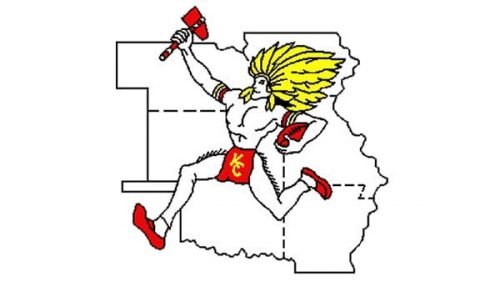
The relocation marked a pivotal moment in the Chiefs Logo History: Design, Colors, and Team Heritage. Upon moving to Missouri, Hunt renamed the team the “Chiefs.” The name was popularly selected through a fan contest, but it was also a tribute to H. Roe Bartle, the Mayor of Kansas City, who was nicknamed “The Chief” due to his long history with the Boy Scouts and his founding of the Tribe of Mic-O-Say.
The Bob Taylor “Running Chief” Concept
Initially, the team considered maintaining the illustrative style of the Dallas Texans. An artist named Bob Taylor was commissioned to create a logo for the newly named Chiefs. His design featured a Native American figure running with a tomahawk and a football, set against the backdrop of the states of Missouri and Kansas. This design mirrored the layout of the Texans logo almost exactly.
However, Lamar Hunt sought something different. He wanted a logo that was cleaner, more iconic, and easier to recognize from a distance—specifically on the side of a football helmet. This desire for simplicity led to one of the most famous design decisions in NFL history.
Lamar Hunt’s Napkin Sketch
The genesis of the current logo is the stuff of NFL legend. Reportedly, Lamar Hunt sketched the initial concept of the interlocking “KC” inside an arrowhead on a napkin during a flight. His vision was inspired by the logo of the San Francisco 49ers, which featured an interlocking “SF” inside an oval.
Hunt wanted to replace the oval with a shape that represented the region and the team name. The arrowhead was the natural choice. He provided his sketch to a professional designer (whose identity remains a topic of debate, though often attributed to the team’s equipment staff or promotional artists at the time) to refine the geometry. The result was a masterclass in minimalist sports branding.
Deconstructing the Iconic Arrowhead (1963–Present)

Since its debut in 1963, the Chiefs’ primary logo has remained virtually unchanged. This stability is rare in professional sports and speaks to the strength of the original design. Let us deconstruct the elements that make this logo a staple of Chiefs Logo History: Design, Colors, and Team Heritage.
The Geometry of the Arrowhead
The container of the logo is a white arrowhead sketched with a thick, undulating black outline. Unlike a perfect geometric triangle, the lines of the arrowhead are organic. The top edge curves slightly downward, and the bottom edge bows upward before meeting at the point. This irregularity gives the logo a sense of hand-drawn authenticity and movement, distinguishing it from computer-generated vectors of the modern era.
The Interlocking “KC” Typography
Inside the arrowhead lies the “KC” monogram in red, outlined in black. The typography is unique to the franchise:
- Serif Style: The letters are blocky serifs, conveying strength and stability.
- The Interlock: The “K” and the “C” are intertwined. The “C” loops through the legs of the “K,” creating a unified single shape rather than two separate letters.
- Open Design: The “C” is notably open, almost resembling a horseshoe, which some design historians suggest was a subtle nod to the western heritage of the team, though this is speculative.
The Use of Negative Space
One of the strongest features of the design is the use of white space (negative space). By making the background of the arrowhead white, the red letters pop vividly. This ensures that the logo is visible against the red helmets the team wears. If the arrowhead had been filled with gold or red, the contrast would have been diminished. The thick black border serves to contain the energy of the design and separates it from the red helmet shell.
Color Psychology and Palette Evolution
Colors are a critical component of the Chiefs Logo History: Design, Colors, and Team Heritage. The official colors are Red and Gold (specifically designated as PMS 186 C Red and PMS 1235 C Gold), accompanied by White and Black.
Chiefs Red
Red is the dominant color of the brand. In color psychology, red represents passion, aggression, energy, and danger. For a football team, it is an assertive color that commands attention. The shade of red used by the Chiefs has remained consistent—a bright, scarlet hue rather than the darker burgundy used by teams like the Washington Commanders or the Arizona Cardinals.
Chiefs Gold
The gold accents (primarily used in the uniforms and merchandise rather than the primary logo itself) represent excellence, tradition, and high value. It links the team to its original “Texans” roots. Over the decades, the specific shade of gold has shifted slightly from a lemon yellow in the 1960s to a richer, warmer marigold yellow in the modern era to better align with high-definition broadcasting standards.
The Absence of Gold in the Primary Logo
An interesting anomaly in the Chiefs’ branding is that while “Gold” is a primary team color, it does not appear in the primary helmet logo. The logo is strictly Red, White, and Black. The gold appears on the helmet stripes and the facemask (in certain eras), but the logo keeps a stricter, two-color plus black palette. This restraint prevents the logo from becoming muddy or overly busy.
Uniforms and Brand Heritage
While the logo has remained static, the canvas upon which it sits—the uniform—has seen subtle shifts that contribute to the overall visual history.
The Helmet Evolution
The Chiefs are famous for their red helmets. However, the details have shifted:
- 1963–1973: The team wore grey facemasks, which was standard for the NFL at the time.
- 1974–Present: The facemasks were changed to white. This brightened the overall look of the helmet and made the white arrowhead logo feel more integrated with the hardware.
Jersey Consistency
The Chiefs’ jerseys are among the most traditional in the league. The home jersey is red with white numbers and gold/white sleeve stripes. The road jersey is white with red numbers and red/gold stripes. Unlike other teams that have introduced black alternate jerseys or radical piping designs, the Chiefs have stuck to the classic “AFL style” aesthetic. This refusal to chase trends has cemented their look as “classic” rather than “dated.”
The “Running Chief” Alternate Logo Controversy and Usage
No discussion of Chiefs Logo History: Design, Colors, and Team Heritage is complete without addressing the secondary imagery. While the Arrowhead is the primary mark, the team utilized a secondary logo for many years, often referred to as the “Running Chief.”
This logo featured a silhouette or detailed illustration of a Native American figure running with a football. While it appeared on merchandise and promotional materials throughout the 1960s and 70s, it was never used on the helmet. As cultural awareness regarding Native American imagery in sports evolved, the organization slowly phased out this character-based imagery in favor of the abstract Arrowhead.
In recent years, the Chiefs have taken steps to address the cultural sensitivity of their brand heritage. This includes:
- Retiring “Warpaint”: The team retired their pinto horse mascot, Warpaint, and the associated cheerleader imagery.
- Banning Headdresses: The organization prohibited fans from wearing ceremonial headdresses and face paint to games.
- The Drum Deck: The team shifted focus to the “Spirit of the Leader” and invited genuine tribal leaders to participate in the pre-game drum ceremony, attempting to move from caricature to respectful homage.
The Arrowhead logo itself has largely avoided the intense scrutiny that forced the Washington Commanders to rebrand, primarily because an arrowhead is an inanimate object and an artifact rather than a caricature of a person. This distinction has allowed the Chiefs to maintain their visual identity while adjusting their peripheral branding.
The Value of Brand Stability
In the corporate world, brand equity is built through consistency. The Kansas City Chiefs are a prime example of this principle. By refusing to alter the logo for over 60 years, they have created a symbol that is multi-generational. A grandfather, father, and son can all wear Chiefs merchandise from their respective eras, and the logo remains the same. This builds a deep emotional connection to the symbol.
When the Chiefs won Super Bowl IV in 1970, they wore the Arrowhead. When they returned to glory in Super Bowl LIV and LVII under Patrick Mahomes, they wore the exact same Arrowhead. This visual thread connects the eras of Len Dawson and Hank Stram to the modern dynasty of Andy Reid and Travis Kelce.
Key Takeaways
- Origin: The franchise began as the Dallas Texans (1960–1962) with a “Gun-Toting Texan” logo before moving to Kansas City.
- Designer: The iconic Arrowhead logo was conceptually sketched by founder Lamar Hunt on a napkin, inspired by the 49ers’ oval design.
- Consistency: The primary Arrowhead logo has not changed since its introduction in 1963, making it one of the most enduring marks in sports.
- Design Elements: The logo features an interlocking “KC” in red with a black outline, set inside a white arrowhead with a thick black border.
- Color Palette: The official colors are Red and Gold, representing passion and tradition, though the primary logo utilizes only Red, White, and Black.
- Cultural Evolution: The team has moved away from caricature imagery (the “Running Chief”) while maintaining the abstract Arrowhead iconography to navigate modern cultural sensitivities.
Frequently Asked Questions (FAQ)
Who designed the Kansas City Chiefs logo?
The concept was created by team founder Lamar Hunt, who sketched the interlocking “KC” inside an arrowhead on a napkin. The final professional rendering was likely done by a member of the team’s equipment or promotional staff in 1963, though a specific graphic designer is rarely credited in official records.
Why is the Chiefs logo an arrowhead?
The arrowhead was chosen to honor the region’s history and the team’s name, which was selected to honor Mayor H. Roe Bartle, nicknamed “The Chief.” Lamar Hunt also wanted a shape that was distinct from the ovals and circles used by other NFL teams at the time.
Have the Chiefs ever changed their logo?
Since becoming the Kansas City Chiefs in 1963, the primary helmet logo has never changed. There have been very minor tweaks to the specific shade of red used in printing and merchandising to match changing textile technologies, but the design geometry has remained constant.
What does the “KC” stand for in the logo?
The “KC” stands for Kansas City. The letters are interlocked to symbolize the unity between the team and the city. It is worth noting that the Chiefs represent the Kansas City metropolitan area, which spans both Missouri and Kansas.
Why do the Chiefs wear red and gold?
Lamar Hunt chose Red and Gold for the Dallas Texans in 1960. When the team moved to Kansas City, they kept the colors to maintain the franchise’s history. Hunt reportedly liked the combination because it was vibrant and distinct from the blue and silver of the rival Dallas Cowboys.
Conclusion
The Chiefs Logo History: Design, Colors, and Team Heritage is a testament to the power of simple, effective graphic design. In an era where sports franchises frequently reboot their identities to capture fleeting trends, the Kansas City Chiefs have stood their ground. The interlocking “KC” and the Arrowhead have transcended their origins as a sketch on a napkin to become a global symbol of American football excellence.
The logo’s longevity is not just a matter of stubbornness; it is a matter of design success. The clean lines, the bold contrast of red against white, and the unique silhouette of the arrowhead allow it to be instantly recognizable whether it is on a helmet, a flag, or a smartphone screen. As the franchise continues to build its legacy in the 21st century, the Arrowhead remains the constant visual anchor, linking the past, present, and future of Chiefs Kingdom.