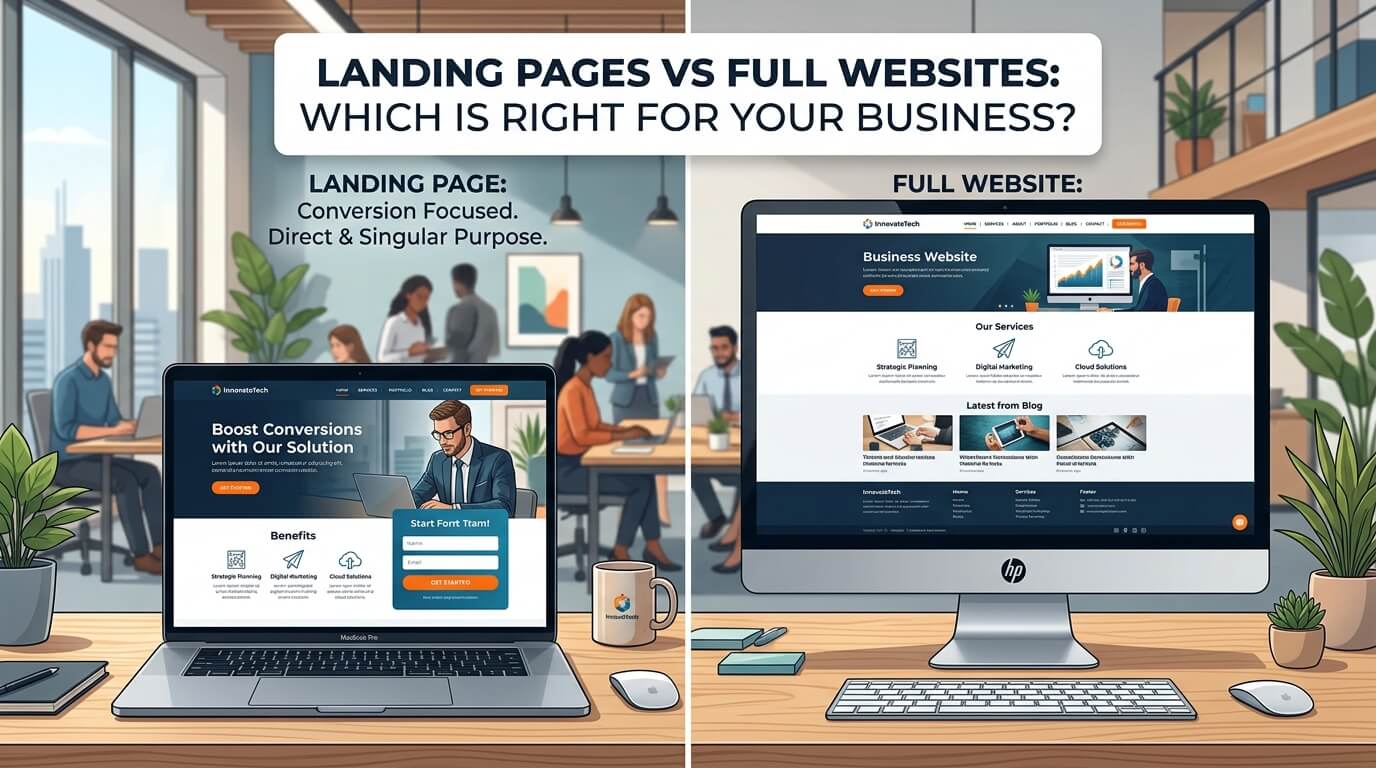
In today’s digital marketplace, having an online presence is no longer optional for most businesses. Customers often search online before contacting a company, purchasing a product, booking a service, or even deciding whether a business appears trustworthy. However, building an online presence does not always mean creating a large, multi-page website. Depending on your goals, a focused landing page may be enough to support a specific campaign or generate leads.
This creates an important question for business owners: should you invest in a landing page or build a full website?
The answer depends on what you want your online presence to accomplish. Landing pages and full websites serve different purposes, even though they may appear similar at first. A landing page is usually designed around one specific goal, such as collecting leads, promoting an offer, encouraging registrations, or driving sales. A full website provides a broader digital home for a business, allowing visitors to explore services, products, company information, resources, contact details, and other content.
Understanding the differences between the two can help you spend your time and budget more effectively. The right choice depends on your business stage, marketing strategy, audience, goals, and the amount of information your customers need before taking action.
What Is a Landing Page?
A landing page is a standalone web page created with a specific marketing or conversion objective. Unlike a traditional website, it generally focuses on one offer, campaign, product, service, or action. The page is often connected to advertising campaigns, email marketing, social media promotions, search campaigns, or other marketing activities.
The structure of a landing page is intentionally focused. Instead of giving visitors many navigation options, the page guides them toward a particular action. That action could involve completing a contact form, requesting a consultation, downloading a resource, purchasing a product, registering for an event, or signing up for a newsletter.
For example, a web design agency running an advertising campaign for small-business website packages might create a landing page specifically for that offer. The page could explain the service, present its benefits, provide examples, answer common concerns, and finish with a consultation form. Visitors do not necessarily need to explore the company’s entire business history or every service it provides.
This focused structure can make landing pages particularly useful for campaigns where the primary goal is conversion rather than broad information discovery.
What Is a Full Website?
A full website is a broader digital presence containing multiple interconnected pages. Depending on the business, it might include a homepage, about page, service pages, product pages, contact page, blog, portfolio, frequently asked questions, testimonials, case studies, and other resources.
The purpose of a full website is generally to provide a complete picture of the business. Visitors can learn what the company does, understand its expertise, explore its offerings, compare services, read educational content, and determine how to get in touch.
A full website also provides more opportunities to build organic search visibility. Different pages can target different topics and search queries, while blog articles and resources can provide additional opportunities to attract visitors through search engines.
For businesses that expect customers to research them before making a decision, a full website can provide the depth of information needed to support that process.
Landing Pages and Full Websites Serve Different Purposes
The most important distinction between a landing page and a full website is not simply the number of pages. It is the purpose behind those pages.
A landing page typically has a narrow objective. A full website has a broader role. One is often campaign-focused, while the other functions as a long-term digital home for the business.
Imagine a company launching a limited-time service promotion. A landing page can immediately communicate the offer, explain its value, establish trust, and direct visitors toward an inquiry or purchase. There may be little reason to send those visitors through a large website.
Now consider a professional consulting firm with several services, different customer groups, years of experience, case studies, and educational resources. Visitors may need to understand the company’s background and expertise before contacting it. A full website can organize this information in a way that allows visitors to explore according to their individual needs.
Neither format is automatically better. They solve different business problems.
When a Landing Page Makes Sense
You Are Promoting One Specific Offer
Landing pages are particularly useful when your marketing activity revolves around one clearly defined offer. If a business is advertising a free consultation, seasonal promotion, downloadable guide, online course, or specific service package, a focused page can keep attention on that offer.
Instead of asking visitors to navigate through several pages to find what an advertisement promised, the landing page can deliver the relevant information immediately. This creates a more direct connection between the marketing message and the destination page.
The more closely the landing page matches the promise made in the advertisement or promotional message, the easier it can be for visitors to understand what they are being offered.
You Want to Generate Leads
Lead generation is another common use for landing pages. Businesses can create pages specifically designed to encourage visitors to provide contact information.
A lead-generation landing page might offer a consultation, quote, assessment, downloadable resource, demonstration, or another valuable incentive in exchange for information such as a name and email address.
Because the page has one primary purpose, its content can be structured around removing hesitation and encouraging the visitor to complete the desired action.
You Are Running Paid Advertising
Paid advertising campaigns often benefit from dedicated landing pages. Sending every advertisement to a generic homepage can create a disconnect between the advertisement and the visitor’s expectations.
Suppose someone clicks an advertisement promoting “Custom Ecommerce Website Design.” If they arrive at a homepage containing information about branding, SEO, social media, video production, and several unrelated services, they may have to search for the service that attracted them.
A dedicated landing page can continue the same message from the advertisement. This can create a more consistent user journey from the initial click to the final conversion.
You Need Something Fast and Focused
Landing pages can also be practical when a business needs a focused online presence quickly. A startup launching its first service, an event organizer promoting registration, or an established company testing a new offer may not need a complete website immediately.
A landing page can provide a professional destination while the broader website is being developed.
When a Full Website Makes More Sense
Your Business Offers Multiple Services
If your business provides several services, a full website can make it easier to organize and explain those offerings. Each service can have its own page, allowing visitors to find information that is relevant to their specific needs.
For example, a digital marketing company might provide SEO, paid advertising, content marketing, social media management, and email marketing. Putting all of that information on one landing page could make the page excessively long and difficult to navigate.
A full website allows each service to receive appropriate attention while keeping the overall structure organized.
Customers Need to Research Your Business
Some purchasing decisions happen quickly. Others require significant research.
When customers are considering a high-value service, professional relationship, long-term contract, or complex product, they may want to investigate the business before contacting it. They might look for information about experience, previous work, team members, processes, customer experiences, and areas of expertise.
A full website provides room for this information.
The website can function as a digital resource where prospective customers gradually build confidence rather than being asked to make an immediate decision.
You Want Long-Term Organic Visibility
A full website can also support a broader search engine optimization strategy. Multiple pages allow a business to create content around different services, questions, industries, locations, and customer needs.
For example, a web design company could have dedicated pages for ecommerce web design, small-business websites, responsive design, website redesign, and custom development. It could also publish educational articles addressing common questions about website costs, speed, navigation, SEO, and maintenance.
This creates a larger content ecosystem than a single landing page can typically provide.
Your Brand Needs a Long-Term Digital Home
A website is more than a sales tool. It can become the central destination for a company’s digital identity.
Social media profiles, advertisements, email campaigns, business listings, referrals, and other channels can direct people back to the website. Once there, visitors can explore the business on their own terms.
For an established company, this long-term role can be especially important because the website can evolve as the business grows.
Landing Pages vs Full Websites: Key Differences
| Factor | Landing Page | Full Website |
| Primary purpose | Focused campaign or conversion | Complete business presence |
| Typical structure | One main page | Multiple interconnected pages |
| Navigation | Limited or minimal | Broader navigation |
| Content | Focused on one offer or action | Covers multiple topics and services |
| Lead generation | Highly focused | Possible across multiple pages |
| SEO opportunities | More limited | Broader |
| Marketing campaigns | Highly suitable | Suitable but less focused |
| Brand storytelling | Limited | Extensive |
| Service information | Usually focused on one service | Multiple services can be covered |
| Long-term scalability | Limited | Highly scalable |
| Customer research | Basic to moderate | More comprehensive |
| Maintenance | Generally simpler | Requires ongoing management |
The Role of Conversion in the Decision
One of the biggest advantages of a landing page is its ability to focus attention. When visitors have fewer distractions, the page can guide them toward a clearly defined action.
However, focus does not mean that every business should use only landing pages. Conversion also depends on the complexity of the customer’s decision.
A visitor buying a relatively straightforward product may need only a focused page with strong information and a clear purchase button. A potential client considering a major business service may want to explore multiple pages before making contact.
This is why businesses should consider the customer journey rather than simply asking which format has a higher conversion potential.
The right question is: What information does the customer need before taking action?
If the answer is limited, a landing page may work well. If the answer involves extensive research, a full website may provide a better environment.
Can a Business Use Both?
Absolutely. In many cases, the choice does not have to be either-or.
A business can have a full website as its primary digital presence while using separate landing pages for individual marketing campaigns.
This approach can provide the benefits of both formats. The main website can establish the brand, explain the business, support search visibility, and provide comprehensive information. Landing pages can then be created for specific campaigns, advertisements, promotions, lead magnets, or service offers.
For example, a company could have a complete website containing its services and resources while creating a separate landing page for a Google Ads campaign promoting one particular service. Social media advertisements could direct visitors to another landing page designed around a different offer.
This combination allows the website to serve as the broader foundation while landing pages support specific marketing objectives.
What Should Be Included in a Landing Page?
A successful landing page should provide enough information to help visitors understand the offer and decide what to do next. The exact structure depends on the audience and purpose, but the content generally needs to establish relevance, explain value, reduce uncertainty, and make the desired action obvious.
The headline is especially important because it immediately tells visitors what the page is about. Supporting copy should explain the offer without overwhelming the reader.
Trust elements can also be valuable. Testimonials, customer experiences, statistics, guarantees where appropriate, portfolio examples, certifications, or case studies can help address concerns.
The call to action should be clear and consistent with the purpose of the page. If the goal is consultation requests, the page should make it easy to request a consultation. If the goal is registration, the registration process should be straightforward.
The design should support the message rather than compete with it.
What Should Be Included in a Full Website?
A full website requires a broader content strategy. The homepage should quickly communicate what the business does and who it serves. Service or product pages should provide detailed information about individual offerings.
An About page can explain the company’s background, approach, expertise, or team. A Contact page provides a clear path for inquiries. Depending on the business, case studies, testimonials, FAQs, portfolios, blogs, resources, and industry-specific pages may also be useful.
The website’s navigation becomes especially important as the number of pages increases. Visitors should be able to understand where they are and where they can go next without unnecessary effort.
A full website should also maintain consistency in its visual identity, messaging, typography, imagery, and user experience.
How Budget Can Influence Your Choice
Budget is another practical consideration. A landing page usually requires less content and development work than a complete website, although the actual cost can vary considerably depending on design complexity, functionality, integrations, copywriting, and development requirements.
A full website represents a larger investment because there are more pages and more components to plan, design, build, test, and maintain.
However, businesses should avoid looking at cost only from the perspective of the initial project. The more important question is whether the digital asset supports the business’s long-term goals.
A low-cost landing page may be appropriate for a short campaign. A growing company may eventually need a full website because customers require more information and the business needs broader search visibility.
How Your Business Stage Matters
A new business may start with a landing page while validating its offer. This can provide a simple digital presence without requiring a large initial investment.
As the company gains customers, develops additional services, publishes resources, and builds a stronger brand, a full website may become more useful.
An established business, on the other hand, may already have a website but still benefit from landing pages for specific campaigns.
The important point is that digital presence should evolve alongside the business. There is no requirement for every company to begin with the same website structure.
How to Decide Between a Landing Page and Full Website
Start by identifying your immediate business objective. If the goal is to generate leads from one campaign, promote a single service, sell one product, or collect registrations, a landing page may provide the focused environment you need.
If your goal is to establish a comprehensive online presence, support multiple services, build organic search visibility, publish educational content, and give potential customers extensive information, a full website may be more appropriate.
Next, consider how customers make decisions. Think about the questions they ask before contacting you. If they need information about your company, services, experience, pricing approach, process, previous work, and expertise, a full website gives you more room to answer those questions.
Finally, consider the future. If your business is likely to add services, enter new markets, publish content, or develop a larger online marketing strategy, building a scalable website may make sense. If your current objective is highly specific and temporary, a landing page could be sufficient.
Conclusion
Landing pages and full websites are not competing technologies with one universally correct choice. They are different tools designed for different business objectives. A landing page provides focus and is particularly useful for campaigns, lead generation, promotions, and specific offers. A full website provides depth, flexibility, brand information, service details, content, and opportunities for long-term digital growth.
For many businesses, the most practical approach is to use both. A full website can serve as the central online presence, while targeted landing pages can support individual marketing campaigns and conversion goals.
The right choice ultimately depends on what your customers need, what your business is trying to achieve, and how your online presence is expected to develop over time.
Frequently Asked Questions
Q. Is a landing page the same as a website?
No. A landing page is generally a single page designed around a specific objective, while a website usually contains multiple pages that provide broader information about a business.
Q. Can a small business use only a landing page?
Yes. A small business with one primary offer or a focused marketing objective may be able to operate effectively with a well-designed landing page, particularly during its early stages.
Q. Is a full website better for SEO?
A full website generally provides more opportunities for SEO because it can contain multiple service pages, informational resources, and articles targeting different relevant searches. However, SEO performance depends on many factors beyond the number of pages.
Q. Can I create landing pages if I already have a website?
Yes. Businesses commonly use landing pages alongside their main websites for advertising campaigns, promotions, lead-generation campaigns, product launches, and other focused marketing activities.
Q. Should I build a website or landing page first?
It depends on your immediate objective. If you need to promote one specific offer or test a focused campaign, a landing page may be a practical starting point. If you need a comprehensive long-term online presence, a full website may provide a stronger foundation.