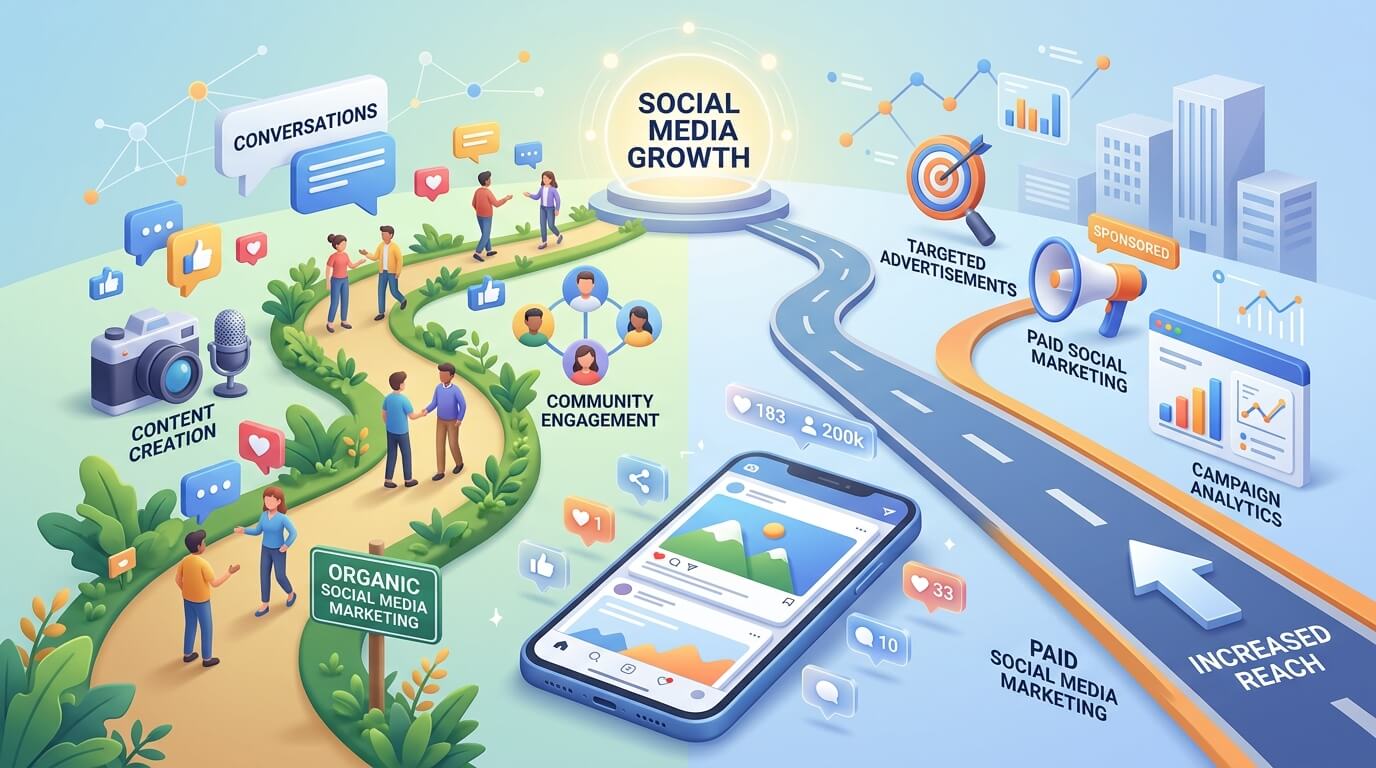
Social media has become an important part of how businesses communicate with customers, build recognition, generate interest, and maintain relationships with their audiences. However, simply having a presence on social platforms does not guarantee that people will see or interact with a brand’s content. Businesses generally use two major approaches to reach audiences on social media: organic social media marketing and paid social media marketing.
Organic and paid social media marketing are often treated as competing strategies, but they serve different purposes. Organic marketing focuses on building an audience and encouraging engagement without directly paying for individual placements. Paid marketing, on the other hand, uses advertising budgets to place content in front of specific audiences. Understanding how each approach works can help businesses make more informed decisions about their social media strategy.
The difference is not simply about whether money is spent. Organic social media is often associated with trust, consistency, community, and long-term visibility, while paid social media can provide controlled reach, audience targeting, testing opportunities, and faster exposure. The most suitable approach depends on factors such as business goals, audience behavior, available resources, content quality, and the stage of a marketing campaign.
What Is Organic Social Media Marketing?
Organic social media marketing refers to activities that generate visibility and engagement without paying a social platform to distribute a specific post as an advertisement. This can include publishing regular posts, creating videos, responding to comments, sharing educational content, participating in conversations, and building a recognizable brand presence.
When a business publishes a post on Instagram, LinkedIn, Facebook, TikTok, or another platform and relies on the platform’s normal distribution mechanisms, that activity is generally considered organic social media marketing. The business may still invest money in content creation, photography, design, software, or social media management, but it is not directly paying the platform for the reach generated by that particular post.
How Organic Social Media Builds an Audience
Organic social media marketing is largely based on consistency. A single post rarely establishes a strong relationship with an audience. Instead, businesses need to repeatedly provide useful, interesting, entertaining, or relevant content.
For example, a web design company might share website tips, explain common design mistakes, discuss mobile usability, and show examples of successful projects. Over time, this content can help potential customers understand the company’s expertise before they ever make an inquiry.
The process can be gradual, but that gradual development can be valuable. People may encounter a business several times before becoming interested in its products or services. Organic content gives the brand opportunities to remain visible during that consideration period.
The Role of Engagement
Engagement is one of the most important parts of organic social media. Comments, direct messages, shares, saves, reactions, and conversations can create opportunities for businesses to interact directly with their audiences.
This makes organic marketing more than simply publishing content. A social media profile can become a place where customers ask questions, provide feedback, discover useful information, and develop familiarity with the brand.
For businesses with strong communities, this relationship-building aspect can become an important part of their broader marketing strategy.
What Is Paid Social Media Marketing?
Paid social media marketing involves paying a social media platform to distribute promotional content to selected audiences. These advertisements can appear in users’ feeds, stories, search results, video environments, or other placements depending on the platform and campaign type.
Paid advertising allows businesses to define specific campaign objectives and audiences. Depending on the platform, advertisers can often target people according to factors such as location, interests, demographics, online behavior, or interactions with previous content.
The exact targeting capabilities and advertising formats vary by platform, and social networks regularly change their advertising systems. For that reason, businesses should evaluate the current advertising options of the platforms most relevant to their audiences rather than assuming that every network offers the same capabilities.
Why Businesses Use Paid Social
One major reason businesses invest in paid social media is to reach people beyond their existing followers. An organic post may primarily reach an existing audience and a portion of additional users through sharing, recommendations, or platform discovery. Paid campaigns can deliberately expand distribution.
Paid social can also be useful when a business has a specific campaign objective. A company launching a new service, promoting an event, collecting leads, driving website traffic, or introducing a product may use advertising to put the offer in front of a defined audience.
Another advantage is measurement. Advertising platforms typically provide campaign data that can help marketers understand impressions, clicks, engagement, conversions, and other available metrics.
Organic vs Paid Social Media Marketing
Although both approaches operate on social platforms, their underlying methods are different. Organic marketing depends primarily on content, consistency, relationships, and platform distribution. Paid marketing depends on advertising investment, targeting, campaign setup, and measurable delivery.
| Factor | Organic Social Media | Paid Social Media |
| Main investment | Time, content, creativity, management | Advertising budget plus campaign management |
| Reach | Develops gradually | Can expand quickly through advertising |
| Audience building | Often relationship-focused | Often targeting and campaign-focused |
| Content lifespan | Can continue generating discovery and engagement | Usually tied to the active campaign |
| Targeting | Relatively limited compared with advertising | More controlled audience targeting |
| Testing | Usually slower and less controlled | Allows structured ad and creative testing |
| Best suited for | Community, awareness, trust, education | Campaigns, reach, leads, traffic, conversions |
| Speed | Generally gradual | Can generate exposure quickly |
| Measurement | Engagement and audience metrics | Detailed campaign and conversion metrics |
| Long-term value | Can build an enduring content library | Can support immediate campaign objectives |
The table highlights an important point: neither approach automatically replaces the other. Their strengths are different, which means businesses can often use them together.
The Benefits of Organic Social Media Marketing
Building Brand Personality
Organic content gives businesses room to develop a recognizable voice. A company can decide how it wants to communicate, what topics it wants to discuss, and how it wants customers to perceive its personality.
A professional services company, for example, may use LinkedIn to publish industry insights and explain complex topics in accessible language. A lifestyle brand might use visual storytelling and short-form videos. The content format can vary, but the goal remains similar: creating a consistent identity that audiences can recognize.
Creating Trust Through Consistency
People often want to understand a business before they decide to purchase from it. Regular social media content can help answer that need by showing expertise, personality, customer interactions, behind-the-scenes activity, or useful information.
Trust does not come from posting frequently alone. The content needs to be relevant and credible. A profile filled with repetitive promotional messages may not create the same relationship as one that consistently provides useful information.
Developing a Long-Term Content Asset
An organic social media presence can gradually become a collection of educational and informative material. Older posts may continue to attract engagement, especially when they answer common questions or address topics that remain relevant.
This is particularly useful for businesses that have expertise to share. Instead of creating promotional content every time, they can turn their knowledge into social posts, videos, discussions, and educational series.
The Benefits of Paid Social Media Marketing
Reaching Specific Audiences
Paid advertising can help businesses reach audiences that may not currently follow their social profiles. Instead of waiting for people to discover an account organically, advertisers can place content in front of selected groups.
This can be particularly useful for businesses entering new markets or promoting a specific offer to a defined audience.
Supporting Time-Sensitive Campaigns
Organic growth generally takes time, which can be challenging when a business has a campaign with a fixed deadline. An event, limited-time promotion, product launch, webinar, or seasonal campaign may benefit from paid distribution because the business can actively allocate budget toward reaching an audience during the relevant period.
Testing Creative Concepts
Paid social can also provide opportunities to test different versions of advertising creative. Businesses can experiment with different headlines, visuals, offers, calls to action, or audience segments and examine the resulting performance.
The value of testing depends on having a clear objective and sufficient data. Simply changing multiple elements at once can make it difficult to understand what caused a performance difference.
Which Strategy Costs More?
The cost comparison between organic and paid social media is more complicated than it first appears.
Organic marketing does not mean completely free marketing. Businesses still need people to plan content, write captions, design graphics, record videos, respond to users, analyze performance, and manage social accounts. Depending on the organization, these activities can require considerable time and resources.
Paid social adds direct advertising costs to those operational expenses. A business may also need specialists to develop audiences, manage campaigns, monitor performance, test creative, and optimize budgets.
Therefore, the real comparison should consider both financial expenditure and internal resources. A small business with limited advertising funds may initially depend heavily on organic content, while a larger company may use paid advertising alongside a dedicated content operation.
When Organic Social Media Makes Sense
Organic social media can be particularly useful when the goal is to establish a brand identity and maintain ongoing communication with an audience. Businesses that have useful knowledge, strong visual material, customer stories, or active communities can create considerable value through consistent organic content.
It is also useful for businesses that want to establish credibility before aggressively promoting products or services. A potential customer who visits a social profile and finds helpful, relevant content may gain a clearer understanding of the business.
Organic marketing is also important because paid advertising does not exist in isolation. People who discover a brand through an advertisement may visit its social profile afterward. A strong organic presence can give those visitors additional information about the company.
When Paid Social Media Makes Sense
Paid social media can be appropriate when a business has a defined campaign objective and needs controlled distribution. For example, a company might want to promote a new service to people in a particular market, generate website visits, collect leads, or support a specific promotional campaign.
Paid social is also useful when businesses need to scale exposure beyond their current audience. Instead of relying entirely on organic discovery, advertising can provide an additional distribution channel.
However, paid advertising cannot automatically compensate for weak messaging or poor creative. Paying to show an unclear offer to more people does not solve the underlying communication problem. The advertisement still needs a clear message, relevant audience, compelling creative, and an effective landing experience when the campaign directs people to a website.
Why Businesses Often Combine Organic and Paid Strategies
The strongest social media strategies frequently treat organic and paid marketing as complementary rather than separate systems.
Organic content can establish the foundation. It can communicate the brand’s personality, demonstrate expertise, answer questions, and maintain relationships with existing followers. Paid campaigns can then amplify selected messages and introduce the brand to additional audiences.
For example, a company might publish an educational video organically and observe that it generates strong engagement. The business could then consider using a paid campaign to distribute a related version of that content to a broader audience.
This approach can create a useful relationship between content and advertising. Organic activity provides insights into what resonates with an existing audience, while paid campaigns provide another way to test and distribute messaging.
Measuring Organic Social Media Performance
Measuring organic social media requires looking beyond follower counts. A growing follower number can be useful, but it does not necessarily indicate that the audience is relevant or engaged.
Businesses can examine metrics such as engagement, shares, saves, comments, profile visits, video views, website visits, and direct inquiries. The appropriate metric depends on the purpose of the content.
An educational post may be valuable because people save or share it. A brand-awareness video may be evaluated primarily through reach and views. A service-focused post may be more closely connected to profile visits or inquiries.
The key is to connect metrics with objectives instead of treating every number as equally important.
Measuring Paid Social Media Performance
Paid social campaigns typically offer a broader set of measurable advertising metrics. These can include impressions, reach, clicks, click-through rate, cost per click, conversions, cost per conversion, and return on advertising spend where reliable revenue data is available.
However, these metrics should be interpreted within the context of the campaign. A campaign designed to generate awareness should not necessarily be evaluated using the same criteria as a lead-generation campaign.
Businesses should also distinguish between platform metrics and actual business outcomes. A large number of clicks may appear impressive, but if those visitors do not complete the desired action, the campaign may require further investigation.
Common Mistakes in Social Media Marketing
One common mistake is expecting organic content to produce immediate results. Building an audience generally requires consistency and experimentation. Businesses may need to test different content formats and topics before identifying what works for their particular audience.
Another mistake is assuming that paid advertising guarantees success. Advertising increases distribution, but it does not guarantee that users will care about the message. Audience selection, creative quality, offer clarity, timing, and the destination experience all matter.
Some businesses also make the mistake of using the same content everywhere without considering platform differences. A long educational LinkedIn post, a short-form video, and an Instagram visual may communicate the same idea but require different presentations.
Creating a Balanced Social Media Strategy
A balanced strategy starts with clear goals. Businesses should determine whether they primarily want awareness, engagement, traffic, leads, sales, customer relationships, or another outcome.
From there, organic and paid activities can be assigned different roles. Organic social media can maintain the brand’s everyday presence, while paid social can support campaigns that require additional reach or specific audience targeting.
Content should remain central to both approaches. Whether a post is distributed organically or promoted through advertising, the message should be relevant to the people receiving it.
Businesses should also review performance regularly. Social media changes quickly, and an approach that performs well in one period may need adjustment later. Reviewing data, audience responses, and campaign outcomes can help marketers make better-informed decisions.
Conclusion
Organic and paid social media marketing are two different approaches to achieving visibility and business goals on social platforms. Organic marketing focuses on consistency, relationships, content, and long-term audience development, while paid marketing provides controlled distribution, audience targeting, and campaign-focused reach.
Rather than treating them as opposing choices, businesses can use each approach according to its strengths. Organic content can establish a credible and recognizable social presence, while paid campaigns can extend selected messages to carefully defined audiences. The most effective strategy depends on the business, audience, budget, objectives, and available resources.
FAQ
Q. Is organic social media marketing free?
Organic social media does not require direct payment to a platform for each post’s distribution, but it still involves costs related to content creation, strategy, management, and time.
Q. Is paid social media better for quick results?
Paid social can provide faster exposure because businesses can pay to distribute advertisements to selected audiences. However, exposure does not automatically translate into engagement, leads, or sales.
Q. Can a small business use both strategies?
Yes. A small business can maintain an organic presence while using a controlled paid budget for specific campaigns, promotions, or audience-growth objectives.
Q. What should businesses post organically?
Organic content can include educational information, industry insights, videos, customer-focused content, company updates, useful tips, and other material that is relevant to the target audience.
Q. How should a business decide between organic and paid social media?
The decision should be based on the campaign objective, audience, available resources, timeline, and desired outcome. In many cases, combining organic and paid activity provides a more complete social media strategy.