
In the pantheon of automotive luxury and performance, few symbols are as instantly recognizable or as deeply evocative as the Porsche crest. It is more than a mere brand identifier; it is a seal of quality, a testament to German engineering, and a historical artifact that bridges the gap between medieval heraldry and modern aerodynamic perfection. Understanding the Porsche Logo History: Heritage, Symbolism, and Automotive Excellence requires a deep dive into the geopolitical history of Germany, the visionary ambition of the Porsche family, and the subtle design evolution that has kept the brand timeless for over seven decades.
While the silhouette of a Porsche 911 is iconic in its own right, the golden shield that adorns its hood tells a story of regional pride and unwavering commitment to performance. Unlike many automotive manufacturers that have radically rebranded over the years, Porsche has maintained a remarkable consistency. The evolution of their logo is not one of reinvention, but of refinement—mirroring the very philosophy applied to their sports cars. This article explores the origins, the heraldic meanings, and the year-by-year nuances that define the legendary Porsche crest.
The Origins: Before the Crest (1948–1951)

To fully appreciate the Porsche Logo History: Heritage, Symbolism, and Automotive Excellence, one must look back to the years immediately following World War II. When the very first Porsche 356 “No. 1” Roadster received its operating permit in 1948, it did not bear the famous crest we know today. Instead, it carried a simple, unadorned logotype.
Ferry Porsche, the son of founder Ferdinand Porsche, initially believed that the name “PORSCHE” famously spaced out in individual metallic letters, was sufficient branding. This minimalist approach was consistent with the Bauhaus movement and the functionalist design philosophy of the era. However, as the brand began to gain traction in international markets, particularly in the United States, the need for a more potent, visual symbol became apparent.
The Max Hoffman Influence
The catalyst for the creation of the crest is often attributed to a dinner meeting in New York in 1952. Ferry Porsche was dining with Max Hoffman, the influential importer who introduced European sports cars to the American market. Hoffman, possessing a keen understanding of American consumer psychology, argued that Porsche needed a seal of quality—something that rivaled the visual impact of the Cadillac crest or the Jaguar leaper. He insisted that a simple logotype was not enough to convey the “Old World” heritage and luxury that American buyers craved.
Legend often suggests that Ferry Porsche sketched the initial design on a napkin during this meal. While this adds a romantic flair to the history, the reality was more calculated and professional. Ferry accepted the idea and commissioned the design work upon his return to Germany.
Deconstructing the Design: Heraldry and Symbolism
The design that eventually emerged was a masterclass in combining local patriotism with corporate identity. The Porsche crest is not an arbitrary collection of shapes; every element is rooted in the history of Stuttgart and the region of Württemberg.
The Prancing Horse of Stuttgart
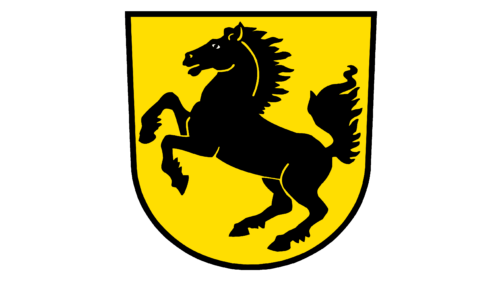
At the center of the crest lies a black horse on a gold background. This is the city seal of Stuttgart, the home of Porsche. The name “Stuttgart” derives from the Old High German word Stuotgarten, which translates to “stud farm” or “mare garden.” The city was founded in the 10th century as a center for breeding cavalry horses. Thus, the prancing horse is a direct reference to the company’s geographical roots and the city’s equine history.
Note on Ferrari: Automotive enthusiasts often note the similarity between the Porsche horse and the Ferrari horse. Both trace their origins to the city of Stuttgart, though via different paths. Ferrari’s horse was adopted from the ace pilot Francesco Baracca, whose plane bore the Stuttgart coat of arms, likely as a trophy of war or a tribute to his adversaries.
The Antlers and Stripes of Württemberg-Hohenzollern
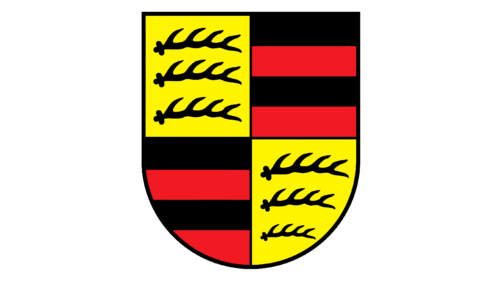
Surrounding the central Stuttgart shield are elements taken from the coat of arms of the Free People’s State of Württemberg-Hohenzollern (a former German state that is now part of Baden-Württemberg):
- The Red and Black Stripes: These represent the state colors of Württemberg. Red symbolizes passion and fortitude, while black signifies strength and determination.
- The Stylized Antlers: In the upper-left and lower-right quadrants, you will find three stag antlers. These are heraldic symbols dating back to the 13th century, representing the House of Württemberg. They signify the rich hunting grounds of the Black Forest and the region’s connection to nature.
The Unifying Text
To bind these regional symbols to the automotive brand, the word “PORSCHE” was placed in a bold, sans-serif typeface across the top, acting as a roof over the shield. The word “STUTTGART” was placed beneath the horse, firmly grounding the manufacturer in its hometown.
Detailed Evolution: A Timeline of Refinement
The Porsche Logo History: Heritage, Symbolism, and Automotive Excellence is defined by subtle evolution. The company understands that their logo is a sacred asset; therefore, changes are measured in millimeters and hues rather than broad strokes. Below is the chronological progression of the crest.
1952: The Prototype and First Application
Designed by Franz Xaver Reimspieß—a highly talented engineer and draughtsman who is also credited with designing the Volkswagen logo—the first Porsche crest was finalized in 1952. It first appeared on the steering wheel hub of the Porsche 356 Pre-A.
Characteristics: The original design featured a somewhat deeper, more orange-gold tone. The lettering of “PORSCHE” was embossed but not as crisp as modern iterations. The red enamel was a dark, blood-red hue (RAL 3002). The horse was muscular but slightly less defined than in later versions.
1954: The Bonnet Handle Integration
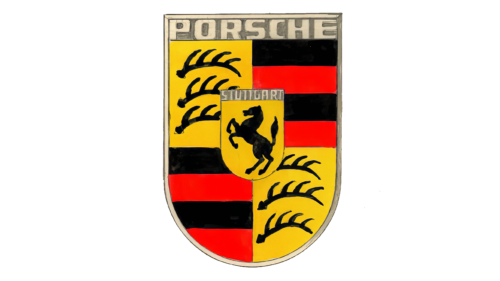
By late 1954 and moving into 1955, the logo migrated from the interior to the exterior. It was integrated into the handle of the front bonnet on the 356. This was a critical move for brand recognition, as the car approached the viewer.
1963: The 911 Era Begins
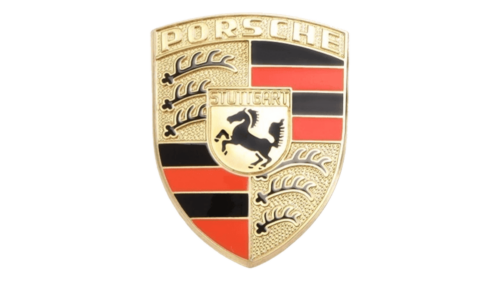
With the launch of the Porsche 901 (later renamed the 911), the logo underwent slight modifications to fit the new aesthetic of the 1960s.
Characteristics: The crest became slightly larger on the bonnet. The gold plating became brighter, moving away from the bronze/orange tint of the early 50s. The “STUTTGART” lettering became more legible, embossed with greater precision to ensure it could be read from a short distance.
1973: Standardization and Color Shifts
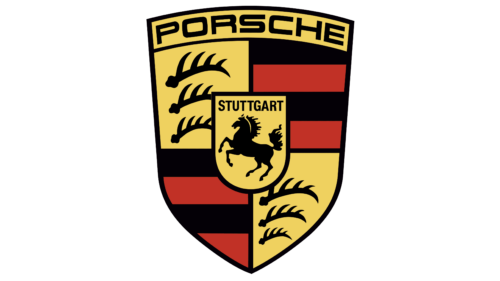
As Porsche grew into a global powerhouse, production consistency became paramount. In 1973, minor adjustments were made to the red enamel.
Characteristics: The red became a brighter, more vibrant shade (closer to RAL 3020). The lettering of “PORSCHE” was widened slightly to increase visibility. The relief of the horse was sharpened to ensure the die-stamping process yielded consistent results across thousands of units.
1994: The Modern Era (The 993)
With the arrival of the Porsche 993—the final air-cooled 911—the logo received a significant cleanup.
Characteristics: The lettering became thinner and more elegant, reflecting a move toward modern luxury. The black lines separating the elements were refined to be thinner, allowing the gold and red to dominate the visual field. This era marked a transition toward a sleeker, more aerodynamic look for the brand identity.
2008: The Digital Age Refinement
As the world moved online, logos needed to look as good on a smartphone screen as they did on a car hood.
Characteristics: The 2008 update brought a slightly more “3D” appearance to the crest. The gold took on a more metallic, cooler tone, moving away from yellow-gold. The red enamel was given a transparent quality, adding depth and texture that mimicked ruby. The horse was redrawn to look more agile and fit, with more defined muscle structure.
2014: The Contemporary Shield
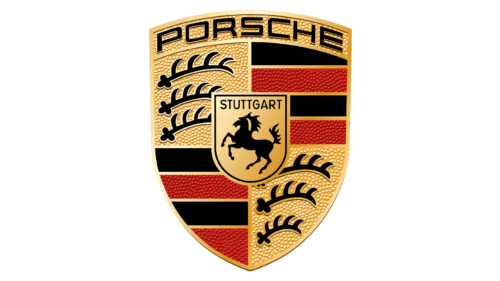
In preparation for the launch of models like the Macan and the 918 Spyder, the logo was updated again.
Characteristics: The most notable change was the background texture. The gold sections, which had previously been pebbled or textured, were smoothed out. This gave the logo a polished, jewelry-like quality. The word “PORSCHE” was painted black for the first time in some applications (marketing materials) but remained embossed gold on the car badge to maintain heritage.
2023: The 75th Anniversary Overhaul
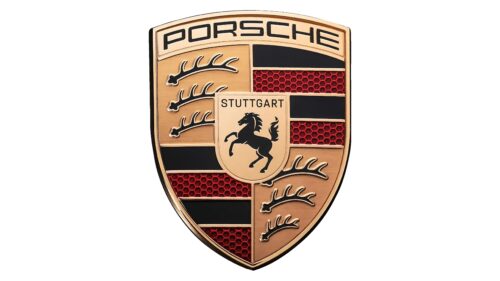
To celebrate 75 years of Porsche sports cars, the brand unveiled its most significant update in nearly 15 years.
Characteristics:
- Brushed Metal: The background gold texture was removed entirely in favor of a smooth, brushed precious metal finish. This serves to highlight the central horse and the red stripes.
- Honeycomb Structure: The red stripes now feature a very subtle honeycomb structure, a nod to the lightweight construction materials used in their race cars.
- The Horse: The animal was redrawn again to appear more rising and dynamic.
- Typography: The “STUTTGART” lettering was reinstated in black to make it pop against the gold, emphasizing the brand’s roots more strongly than before.
- Turbonite: For Turbo models specifically, Porsche introduced a monochromatic grey/black version of the crest (Turbonite) to differentiate the high-performance tier.
The Manufacturing Process: A Badge of Honor
One cannot discuss the Porsche Logo History: Heritage, Symbolism, and Automotive Excellence without mentioning how the physical crest is made. Unlike many mass-market manufacturers that use plastic badges, the Porsche crest is a piece of jewelry.
The production process is a blend of industrial precision and hand-craftsmanship:
- Stamping: The base is stamped out of a copper-zinc alloy using high-pressure hydraulic presses to create the relief of the antlers and horse.
- Punching: The outline of the shield is punched out.
- Enameling: The color is not painted on; it is enameled. A mixture of glass powder and color oxides is applied to the metal.
- Firing: The badge is fired in a kiln at temperatures exceeding 800 degrees Celsius. This melts the glass powder, fusing it to the metal and creating the hard, glossy surface.
- Gold Plating: The badge is electroplated with real gold to ensure the luster withstands the elements for decades.
- Hand Finishing: Finally, the badge is polished by hand and inspected for imperfections.
This laborious process ensures that a 30-year-old Porsche often has a badge that shines as brightly as the day it left the factory.
The “PORSCHE” Logotype: The Parallel History
While the crest is the visual icon, the “PORSCHE” lettering (the logotype) has its own history. Designed in the late 1940s, the font is a custom typeface. It is wide, squared-off, and authoritative.
Throughout the decades, the spacing (kerning) between the letters has shifted. In the 1970s, the letters were spaced widely across the rear decklids of the 911 G-Series. In the 1990s, they were integrated into the reflector strip (the Heckblende). Today, the lettering is often three-dimensional and integrated into the rear light bar design, evolving from a printed label to a structural component of the vehicle’s lighting signature.
Key Takeaways
- Regional Pride: The logo is a combination of the Stuttgart city seal (horse) and the Württemberg coat of arms (antlers/stripes).
- Ferry Porsche & Max Hoffman: The logo was born from a request by US importer Max Hoffman to give the car a stronger identity.
- Franz Xaver Reimspieß: The engineer who designed the VW logo also designed the Porsche crest.
- Consistency is Key: Unlike other brands that drastically change logos, Porsche has only refined the crest, maintaining the same core elements since 1952.
- Craftsmanship: The badge is a physical object of value, made with fired enamel and gold plating, not just molded plastic.
- 2023 Update: The most recent update introduced a brushed metal finish and a honeycomb pattern in the red stripes.
Frequently Asked Questions (FAQ)
Why is there a horse on the Porsche logo?
The horse represents the city of Stuttgart, Germany, where Porsche is headquartered. The city was founded in 950 AD as a stud farm (“Stuotgarten”), and the horse has been part of the city’s seal for centuries.
Is the Porsche horse the same as the Ferrari horse?
Visually, they are very similar, but they have different postures. Historically, they share a root. Ferrari’s prancing horse came from the Italian WWI ace Francesco Baracca, who painted the Stuttgart horse on his plane (likely as a trophy). Porsche uses the horse because they are actually based in Stuttgart.
What do the antlers signify?
The three stag antlers in the crest are taken from the coat of arms of the former state of Württemberg-Hohenzollern. They symbolize the rich hunting traditions and the natural resources of the region.
Has the Porsche logo ever changed completely?
No. Since its introduction in 1952, the logo has never been completely redesigned. It has only undergone evolutionary refinements to typography, color saturation, and surface texture to modernize its appearance while retaining its heritage.
What is the “Turbonite” logo?
Introduced in late 2023, “Turbonite” is a metallic grey tone used exclusively for the badges and trim of Porsche Turbo models. It replaces the traditional gold to distinguish the high-performance Turbo variants as a sub-brand of excellence.
Conclusion
The Porsche Logo History: Heritage, Symbolism, and Automotive Excellence is a fascinating study in brand stewardship. In a world obsessed with the new, Porsche has found power in the old. The crest serves as a guardian of the brand’s identity, ensuring that whether a customer is driving a vintage 356 Speedster or a futuristic Taycan, they are connected to the same lineage of engineering brilliance.
The shield does not merely identify the manufacturer; it tells the story of a family, a city, and a region that changed the automotive world forever. By refusing to abandon its heraldic roots, Porsche ensures that its logo remains one of the few true constants in the ever-changing landscape of luxury automobiles. It stands as a gold, black, and red promise of performance—a promise kept for over 75 years.