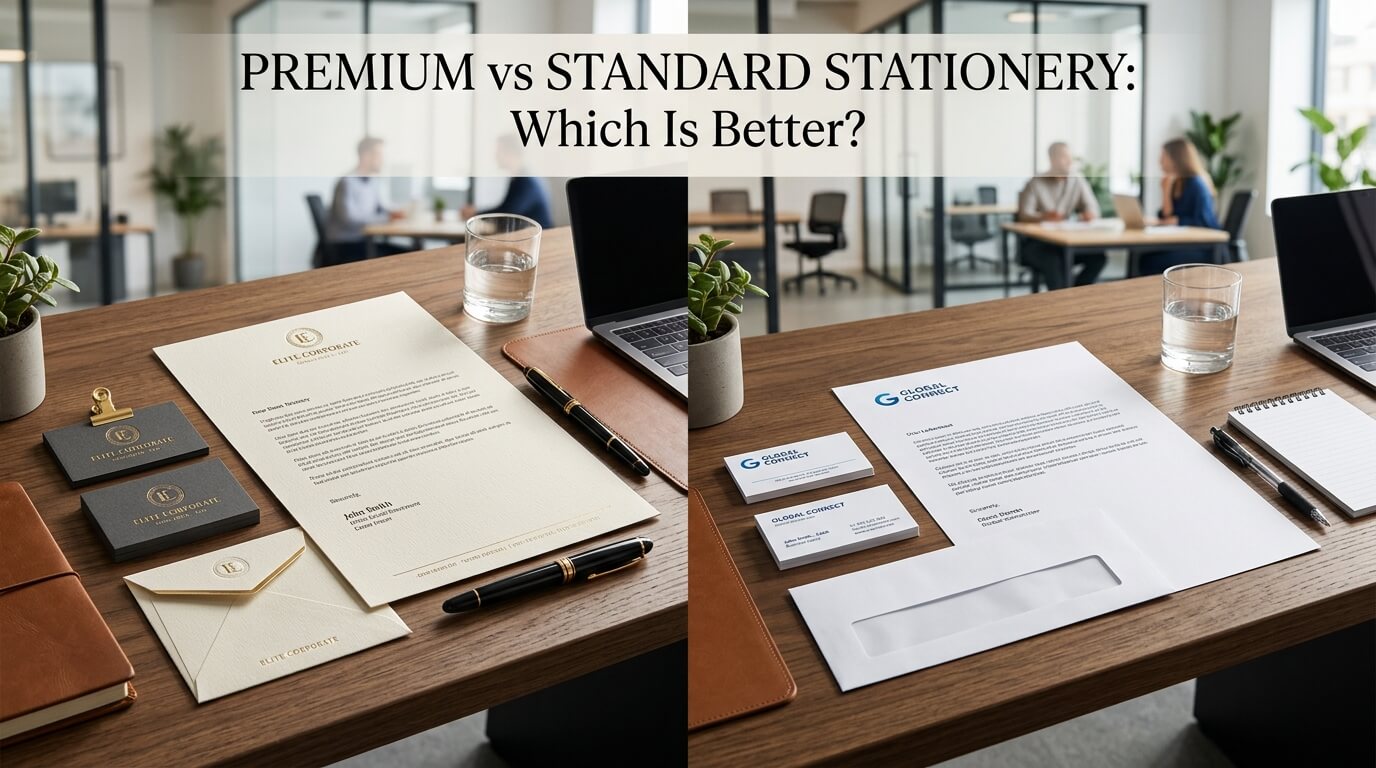
Stationery is often treated as a small detail in business communication, but it can have a surprisingly strong influence on how a company presents itself. A letterhead, business card, envelope, notepad, folder, or presentation sheet may seem like an ordinary printed item. Yet every time one of these materials reaches a client, customer, supplier, employee, or business partner, it contributes to the impression people form about the organization behind it.
The choice between premium and standard stationery is therefore not simply a matter of choosing expensive paper over affordable paper. It involves considering paper quality, printing techniques, durability, appearance, branding, budget, purpose, and the audience receiving the stationery. Premium stationery may create a more refined and memorable experience, while standard stationery can provide practicality and consistency at a manageable cost.
Neither option is automatically appropriate for every business. A startup sending hundreds of routine documents may have very different stationery needs from a luxury property company, law firm, financial consultancy, or design studio. The better choice depends on what the stationery needs to accomplish and how frequently it will be used.
What Is Premium Stationery?
Premium stationery generally refers to printed materials produced with higher-quality paper, more refined finishing, specialized printing techniques, or greater attention to physical details. It may use heavier paper stocks, textured surfaces, distinctive finishes, custom envelopes, embossing, foil accents, or carefully selected typography and layouts.
The defining characteristic of premium stationery is not necessarily that it looks extravagant. In fact, high-end stationery can be extremely simple. A minimalist letterhead printed on a substantial, beautifully textured sheet can feel more premium than a heavily decorated design printed on ordinary stock.
Materials and Paper Quality
Paper is one of the first things people notice when they physically handle stationery. Premium materials may have greater thickness, a smoother or more distinctive texture, and a more substantial feel. Cotton-based papers, textured stocks, and carefully selected uncoated or coated papers can create different experiences depending on the brand and application.
For a business card, for example, thickness can make the card feel more substantial. For letterheads, however, excessive thickness may not always be practical, particularly when documents need to be folded, mailed, scanned, or printed again.
Finishing Techniques
Premium stationery may incorporate finishing techniques such as embossing, debossing, foil stamping, spot finishes, die-cutting, or specialty coatings. These techniques can emphasize a logo, business name, monogram, or other important brand element.
The goal should be purposeful design rather than decoration for its own sake. A subtle embossed logo can communicate refinement without overwhelming the page, while excessive finishing can make routine business documents unnecessarily expensive or difficult to reproduce.
What Is Standard Stationery?
Standard stationery is designed primarily around functionality, consistency, affordability, and everyday use. It can still be professionally designed and visually appealing. The distinction is usually related to material and production choices rather than the quality of the design itself.
Standard stationery often uses commonly available paper stocks, conventional printing processes, and straightforward layouts. It may include a company’s logo, contact information, brand colors, website, address, and other essential details without requiring elaborate finishing.
Practicality for Everyday Communication
Many businesses use stationery for documents that are produced frequently. Letters, invoices, internal notices, quotations, forms, and routine correspondence can quickly consume large quantities of printed materials. In these situations, practical stationery can make more financial sense.
Standard stationery can also be easier to reorder. When the design relies on widely available materials and conventional printing, businesses may have more flexibility when placing future orders.
Professional Appearance Without Excessive Cost
Choosing standard stationery does not mean accepting poor-quality branding. A well-designed letterhead can look professional even when printed on relatively affordable paper. Strong typography, balanced spacing, appropriate logo placement, and consistent brand colors can have a significant visual impact.
This is particularly important for smaller organizations that need to control expenses while establishing a credible identity.
Premium vs Standard Stationery: A Direct Comparison
The differences become clearer when the two approaches are considered across common business requirements.
| Factor | Premium Stationery | Standard Stationery |
| Paper quality | Higher-end, textured, heavier, or specialty stocks | Common professional paper stocks |
| Printing | May include specialized techniques | Usually conventional printing |
| Finishing | Embossing, foil, specialty coatings, or die-cutting may be used | Usually minimal finishing |
| Cost | Higher per item | Lower per item |
| Brand impact | Strong tactile and visual impression | Professional and consistent |
| Best suited for | Client-facing, luxury, executive, or special communications | Everyday business communication |
| Reordering | May require specialized suppliers | Generally straightforward |
| Large-volume use | Can become expensive | More economical |
| Durability | Often higher depending on materials | Suitable for normal handling |
| Design flexibility | Broad range of specialty options | Broad, but fewer physical finishing options |
How Stationery Influences Brand Perception
Stationery is one part of a larger visual identity. When someone receives a professionally designed letterhead or business card, they may associate the physical quality of that material with the company’s attention to detail.
This does not mean that expensive stationery automatically creates trust. The overall experience matters far more. However, physical materials can reinforce an existing brand image when they are thoughtfully designed.
A company positioned around luxury, exclusivity, craftsmanship, or high-value services may find that premium materials support its visual positioning. On the other hand, a technology company that emphasizes simplicity and efficiency may prefer clean standard stationery with a modern digital-first identity.
Consistency Matters More Than Price
One of the most important considerations is consistency. A business can spend heavily on premium business cards while using poorly designed letterheads, inconsistent envelopes, or unrelated presentation materials. The result may feel less professional than a complete stationery system built around standard materials.
Brand consistency means that logos, typography, colors, spacing, imagery, and messaging work together across stationery items. Whether the paper is premium or standard, the design should feel like part of the same brand.
When Premium Stationery Makes Sense
Premium stationery can be particularly useful when physical presentation plays an important role in a business relationship. Certain documents are designed to make an occasion feel more significant, and higher-quality materials can support that objective.
Luxury and High-End Businesses
Luxury hotels, premium real estate companies, private consulting firms, architecture studios, jewelry businesses, and boutique financial services may use premium stationery to reinforce a sophisticated positioning.
For these businesses, the physical experience can form part of the customer journey. A beautifully produced business card or presentation folder may remain with a client long after a meeting has ended.
Important Client Communications
Not every document needs premium treatment. Businesses can reserve premium stationery for proposals, executive correspondence, certificates, invitations, thank-you letters, or other communications where presentation matters particularly strongly.
This approach allows a company to gain some of the benefits associated with premium stationery without paying premium prices across its entire stationery inventory.
Events and Special Occasions
Premium stationery can also work well for conferences, corporate events, invitations, awards, announcements, and other special occasions. A distinctive paper stock or finishing technique can make these materials feel more intentional.
When Standard Stationery Makes More Sense
Standard stationery can be the practical choice when documents are produced frequently, distributed widely, or primarily used for routine communication.
Startups and Small Businesses
New businesses often have many expenses competing for limited resources. Branding is important, but spending heavily on physical stationery may not be the most appropriate allocation of an early-stage budget.
A professionally designed standard stationery system can establish a credible visual identity while leaving more resources available for website development, digital marketing, packaging, customer service, or other business priorities.
High-Volume Printing
Companies that produce hundreds or thousands of documents may need to prioritize cost efficiency. Even a small difference in the per-unit price can become significant at higher volumes.
Standard stationery can be especially useful for internal communication, routine correspondence, forms, and other documents where the tactile experience is less important.
Businesses With a Digital-First Workflow
Many modern companies operate primarily through email, cloud platforms, digital proposals, and electronic documents. In such environments, physical stationery may be used occasionally rather than every day.
A business with a digital-first workflow may therefore prefer to maintain a smaller quantity of well-designed standard stationery rather than investing heavily in large premium print runs.
The Role of Design in Both Options
It is easy to focus on paper and printing and overlook the most important element: design. Premium materials cannot compensate for poor visual communication.
A stationery design should provide a clear hierarchy. The company name or logo should be identifiable without dominating the page. Contact information should be easy to locate, and the overall composition should leave sufficient breathing room.
Standard stationery can look sophisticated when the design is balanced. Similarly, premium stationery can look ordinary when too many elements compete for attention.
Typography and Spacing
Typography can strongly influence the personality of stationery. A professional services company might use restrained typography, while a creative business could introduce more distinctive type choices.
Spacing is equally important. Crowding a letterhead with addresses, phone numbers, social media handles, taglines, and decorative elements can reduce its effectiveness. Premium stationery often succeeds because it gives design elements enough space to breathe.
Cost Should Be Considered Beyond the Price Per Piece
The initial printing price is only one part of the cost equation. Businesses should also consider storage, minimum order quantities, reprinting, design changes, shipping, and waste.
Premium stationery can become particularly costly when branding changes. If a company updates its logo, address, website, or visual identity, existing printed materials may become obsolete.
Standard stationery may be easier to replace and update, particularly when it uses readily available materials and straightforward printing methods.
Consider the Lifetime Value of the Material
A useful way to think about stationery spending is to ask what role the material plays in the customer relationship. A business card that is handed directly to a potential client may deserve more attention than hundreds of internal forms that rarely leave the organization.
This does not mean every client-facing item needs to be premium. It means businesses can assign different levels of investment to different stationery categories.
Can Businesses Combine Premium and Standard Stationery?
Yes. In many cases, a mixed stationery strategy can provide a practical balance between presentation and cost.
A company could use standard letterheads for everyday correspondence while maintaining premium business cards for networking. Premium folders could be reserved for major proposals, while ordinary internal documents use standard printing.
This approach creates a stationery hierarchy based on purpose. Instead of asking whether every piece should be premium or standard, businesses can ask which materials have the greatest influence on important interactions.
Creating a Tiered Stationery System
A tiered system can include everyday stationery, client-facing stationery, and special-event materials. Each category can share the same brand identity while varying in paper, finishing, and production quality.
For example, a standard letterhead and premium presentation folder can use the same logo, typography, and brand colors. The difference is primarily in the physical experience.
Environmental Considerations
Sustainability is another factor worth considering when selecting stationery. Premium does not automatically mean environmentally friendly, and standard does not automatically mean wasteful. The environmental impact depends on factors such as paper sourcing, recycled content, production processes, coatings, packaging, transportation, and how much material is ultimately discarded.
Businesses can look for responsibly sourced paper, recycled stocks, recyclable materials, and printing approaches that reduce unnecessary waste. Choosing the right quantity is also important. Ordering large quantities of stationery that later becomes outdated can create avoidable waste regardless of whether the material is premium or standard.
How to Choose the Right Stationery for Your Business
The best starting point is to identify how the stationery will actually be used. Consider whether the material will be handed directly to customers, mailed with important documents, used internally, or distributed in large quantities.
Next, consider the personality of the brand. A premium tactile experience may complement certain business models, while a clean and economical approach may better support others.
The frequency of use should also influence the decision. If a stationery item is used every day, practical considerations such as cost, storage, printing compatibility, and reorder availability become increasingly important.
Finally, consider whether the stationery design will remain useful over time. Avoiding unnecessary decorative elements can make a design easier to maintain when business information changes.
Is Premium Stationery Always Better?
Premium stationery is not inherently better than standard stationery. It simply provides a different physical experience and may be more appropriate for certain situations.
A beautifully designed standard letterhead can communicate professionalism, clarity, and brand consistency. A premium business card can create a stronger tactile impression in a face-to-face setting. The appropriate choice depends on the communication goal.
The real objective should be to make stationery support the brand rather than allowing the stationery itself to become the focus. Good stationery should feel appropriate to the organization, audience, message, and context.
Conclusion
The choice between premium and standard stationery ultimately comes down to purpose, audience, brand positioning, and budget. Premium stationery can add a distinctive tactile experience and may be valuable for luxury brands, important client communications, special events, and high-value interactions. Standard stationery offers practicality, affordability, and flexibility for everyday and high-volume communication.
For many businesses, the most effective solution may be a combination of both. Premium materials can be reserved for moments where physical presentation matters most, while standard stationery handles routine communication. Regardless of the material selected, thoughtful design, consistent branding, readability, and appropriate production quality remain essential.
Frequently Asked Questions
Q. Is premium stationery worth the extra cost?
Premium stationery can be worthwhile when the physical presentation contributes significantly to a customer or client interaction. For routine, high-volume documents, standard stationery may provide greater practicality.
Q. Does premium paper make stationery look more professional?
Paper quality can influence how stationery feels and appears, but professionalism depends on the complete design. Typography, spacing, branding, printing quality, and consistency are all important.
Q. Can small businesses use premium stationery?
Yes. A small business can use premium stationery selectively for business cards, proposals, presentations, or important client communications instead of using it for every printed item.
Q. Is standard stationery suitable for corporate businesses?
Yes. Standard stationery can be highly professional when it uses a well-developed brand identity and high-quality printing. Many corporate documents prioritize consistency and practicality over specialty finishes.
Q. Should a business use both premium and standard stationery?
A combination can be practical. Businesses can use standard materials for routine communication and premium materials for important meetings, proposals, events, or other situations where the physical experience has greater importance.