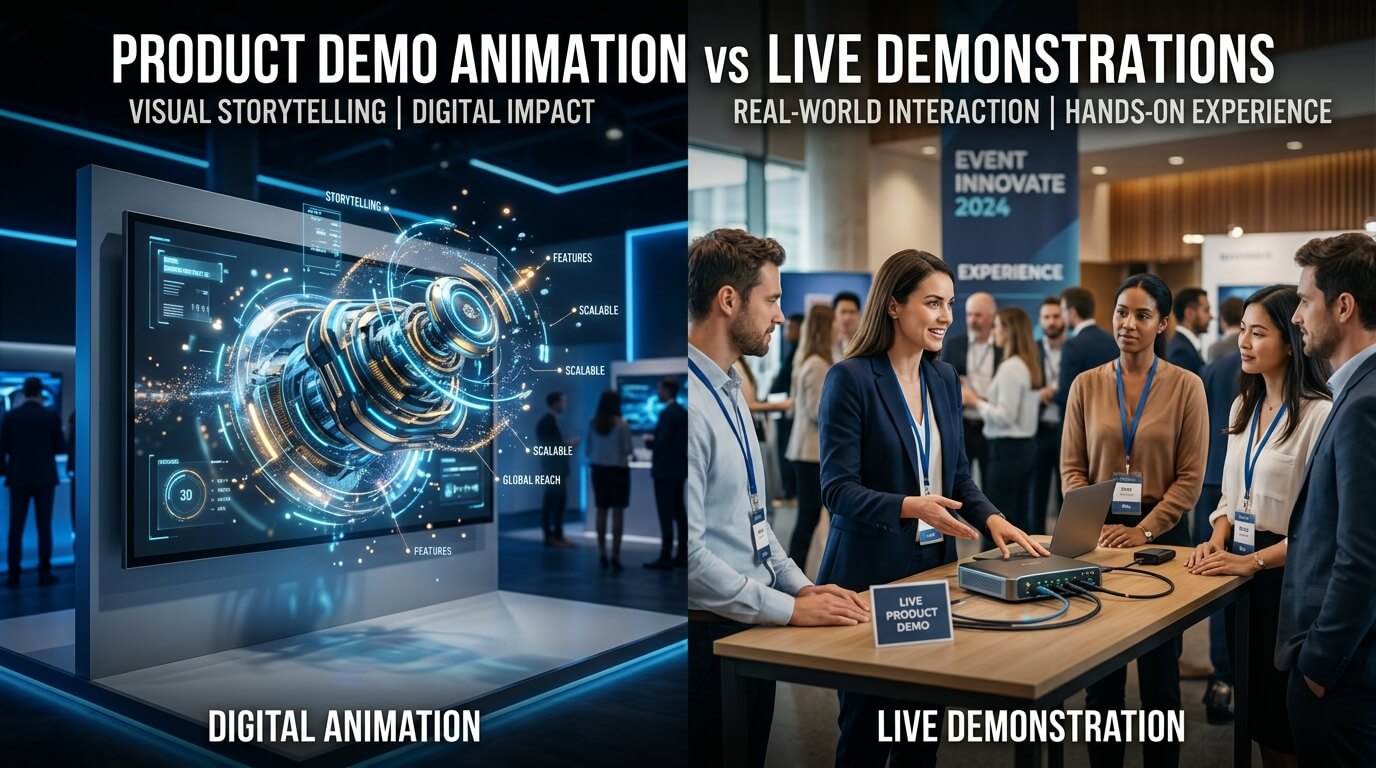
When a business needs to explain a product, showing it in action is often more effective than simply describing what it does. Customers want to understand how a product works, what problem it solves, and why it deserves their attention. Two common ways to provide that experience are product demo animation and live demonstrations. Although both approaches aim to make a product easier to understand, they create very different experiences for viewers.
A live demonstration gives audiences an opportunity to see the actual product operating in real time. It can feel authentic, interactive, and immediate. Product demo animation, on the other hand, uses animation, graphics, narration, motion design, and visual storytelling to explain the product in a controlled and often highly creative way. Animation can show processes that are difficult or impossible to demonstrate physically, including what happens inside a machine, how software processes information, or how an invisible system works.
Choosing between these approaches is not always a matter of deciding which one is universally better. The right choice depends on the product, audience, sales process, budget, distribution channel, and communication goal. In some cases, animation can be the central demonstration. In others, a live demonstration creates the trust and interaction that animation cannot fully reproduce. Many businesses can also benefit from using both.
What Is a Product Demo Animation?
A product demo animation is a visual presentation designed to explain how a product works, how customers use it, or what benefits it provides. It can combine 2D animation, 3D animation, motion graphics, screen recordings, illustrated characters, diagrams, product interfaces, and voiceover narration.
Unlike a conventional advertisement, a product demo animation usually focuses heavily on explanation. Instead of simply telling viewers that a product is useful, it can walk them through the problem, introduce the product as a solution, demonstrate its features, and show the expected user experience.
For software companies, for example, animation can demonstrate the movement from signing into a platform to completing a specific task. For a physical product, 3D animation can show different components and explain how they interact. For technical products, animation can make complex systems easier to understand by turning abstract information into visual sequences.
This makes animated demos particularly useful when the product itself is complicated, small, internal, digital, or difficult to transport.
What Is a Live Demonstration?
A live demonstration involves presenting the actual product and showing how it operates in real time. It may take place in a store, conference, sales meeting, webinar, trade show, classroom, product launch, or one-to-one sales conversation.
The biggest characteristic of a live demonstration is authenticity. Viewers see the real product rather than a designed representation of it. A presenter can explain a feature, answer questions, respond to objections, and adjust the demonstration according to the audience’s reactions.
For example, a company selling professional equipment might demonstrate the equipment in front of potential customers. A software representative might share their screen and guide a prospect through the platform. A consumer electronics company might allow customers to interact directly with a device.
Live demonstrations can therefore turn product education into a two-way experience.
Product Demo Animation vs Live Demonstrations
The main difference between these approaches is control versus interaction. Product demo animation gives the creator extensive control over what the audience sees and how the story unfolds. Every scene, transition, label, voiceover, and visual element can be planned before publication.
A live demonstration has less control because it happens in real time. That can create challenges, but it is also part of its appeal. Customers can ask unexpected questions, request additional demonstrations, and interact with the product.
Animation is generally more repeatable. Once completed, the same video can be shown to thousands of people across websites, presentations, social media, sales emails, and advertising campaigns. A live demonstration requires a presenter, functioning equipment, suitable conditions, and time from both the business and audience.
Neither approach automatically communicates better. Their effectiveness depends on what needs to be communicated.
| Factor | Product Demo Animation | Live Demonstration |
| Presentation control | Very high | Moderate |
| Audience interaction | Limited unless interactive elements are added | High |
| Repeatability | Very high | Lower |
| Physical product required | Not always | Usually |
| Complex processes | Can explain them visually | May be difficult to show |
| Real-time questions | No | Yes |
| Production requirements | Animation, script, design and voiceover | Product, presenter and setup |
| Distribution | Website, social media, email, presentations and ads | Events, meetings, webinars and stores |
| Risk of technical problems during presentation | Low after production | Higher |
| Personal connection | Depends on storytelling | Strong presenter interaction |
| Long-term reuse | High | Depends on event and recording |
| Customization during presentation | Limited | High |
The Visual Advantage of Product Demo Animation
One of the strongest advantages of animation is that it does not have to follow the physical limitations of the real world. A camera can record what is visible, but animation can reveal what is normally hidden.
Imagine a company selling a complex filtration system. A traditional camera can show the exterior of the product and perhaps record water passing through it. An animated sequence could cut through the product and show how particles move through each internal layer. Labels, arrows, diagrams, and visual effects could then explain the process step by step.
This ability is especially valuable for technical industries. Products involving engineering, software infrastructure, medical devices, electronics, manufacturing, cybersecurity, or scientific processes can be challenging to demonstrate visually. Animation gives businesses a way to simplify these subjects without removing the important information.
Animation Can Simplify Complex Ideas
Another important advantage is visual simplification. A product may contain dozens of features, but customers do not necessarily need to understand every technical detail immediately. An animated demo can introduce information gradually.
For example, a software product might have an extensive dashboard containing numerous controls. Instead of showing the entire interface at once, the animation can zoom into one function, highlight it, demonstrate how it works, and then move to the next feature.
This creates a guided learning experience rather than asking the viewer to understand everything independently.
The Authenticity of Live Demonstrations
Live demonstrations have a different strength: they show that the product exists and can perform in real conditions. This can be particularly important when customers need to physically evaluate a product before making a purchase.
Consider a manufacturer selling industrial machinery. Potential buyers may want to see the machine running, hear its operating sounds, inspect its construction, and observe how an employee interacts with it. An animated video can explain the machine, but it cannot completely replace the experience of seeing the physical equipment operate.
Live demonstrations can also build confidence because customers can ask questions immediately. If someone wants to know how a product behaves under a particular condition, the presenter may be able to demonstrate that feature directly.
Real-Time Interaction Builds Engagement
Interaction is one of the most significant differences between animation and live presentations. During a live demonstration, audiences can interrupt with questions, request another example, or ask the presenter to focus on a particular feature.
This makes live demonstrations useful during later stages of a sales process when prospects have specific concerns. The presenter can adapt the discussion rather than forcing every viewer through the same sequence.
This flexibility can be especially valuable for business-to-business products where different customers may use the same solution in different ways.
When Product Demo Animation Makes More Sense
Product demo animation is particularly useful when a product requires explanation rather than physical inspection. Digital products are an obvious example. A SaaS platform, mobile application, artificial intelligence tool, online service, or automation system can often be explained more efficiently through animation and screen-based visuals.
It is also useful when a company needs a demonstration that can reach people in different locations. A sales representative cannot personally demonstrate a product to every website visitor. An animated demo can be embedded on a product page and viewed at any time.
Another situation involves products that are difficult to demonstrate safely or conveniently. Large machinery, complicated infrastructure, internal systems, or products located in specialized facilities may not be practical for frequent live demonstrations.
Animation can also work well when the business wants to communicate a standardized message. Every viewer receives the same explanation, with the same terminology and visual sequence.
When Live Demonstrations Are More Suitable
Live demonstrations are particularly useful when physical interaction matters. If customers need to touch, operate, test, compare, or inspect a product, a live presentation can provide information that animation cannot fully reproduce.
They are also useful when products have many possible applications. A presenter can modify the demonstration according to the audience. A healthcare organization, for instance, might have different questions from a manufacturing company even if both are evaluating the same technology.
Live demonstrations can also be valuable at trade shows, product launches, sales meetings, workshops, and events where personal interaction is already part of the experience.
In these settings, the presenter becomes part of the demonstration. Their explanations, responses, and ability to address concerns can influence how audiences understand the product.
Cost and Production Considerations
The financial difference between the two approaches depends heavily on the product and quality level. A simple live demonstration can require little more than a product, presenter, camera, and suitable location. A sophisticated animated demo may require scriptwriting, storyboarding, illustration, animation, voiceover, sound design, editing, and revisions.
However, production cost should be considered alongside reuse. An animated product demo can potentially be distributed across many channels for a long period. The same video might appear on a website, sales presentation, YouTube channel, social media page, email campaign, and digital advertising campaign.
A live demonstration can also be recorded and reused, creating a hybrid asset. However, a recording of a live presentation may contain background noise, pauses, mistakes, outdated interfaces, or references that become irrelevant over time.
The Role of Storytelling
A good product demonstration is not simply a collection of features. It should help the audience understand why the product matters.
Animation has considerable storytelling flexibility. It can begin with a recognizable problem, introduce the consequences of that problem, present the product, demonstrate its solution, and conclude with the desired action. Visual storytelling can make the sequence easier to follow.
Live demonstrations can use storytelling too, but the experience is less predetermined. The presenter can tell a story around the product while demonstrating it. Audience questions can then influence the direction of the conversation.
The choice therefore depends partly on whether the business needs a carefully structured message or an adaptable conversation.
Product Demo Animation and Brand Consistency
For companies focused on consistent branding, animated demonstrations provide extensive control over visual identity. Typography, colors, illustrations, transitions, voiceover style, music, icons, and product screens can all be designed according to established brand guidelines.
This can be important when several sales and marketing teams are communicating about the same product. Instead of each representative explaining the product differently, the animation provides a consistent foundation.
Live demonstrations can still maintain brand consistency, but presenters may have different communication styles. Training can reduce these differences, although some variation will naturally remain.
Measuring Performance
Digital product demo animations provide opportunities for measurable audience behavior. Depending on the platform, businesses may be able to observe video views, watch time, completion rates, clicks, conversions, or engagement patterns.
This can help marketing teams understand whether audiences are watching the demonstration and where they may lose interest.
Live demonstrations can also be evaluated, but measurement often depends on the context. A sales team might track attendance, questions, follow-up meetings, product trials, or purchases after demonstrations. At an event, representatives may collect leads and record audience responses.
The most useful measurement depends on the business objective. A product video designed for awareness may use different success indicators from a demonstration intended to support sales conversations.
Can Businesses Use Both Approaches?
In many situations, the most practical strategy is not to choose one permanently. Animation and live demonstrations can complement each other.
A company might use an animated demo on its website to provide a quick introduction. Once a prospect becomes interested, a sales representative can conduct a live demonstration tailored to that customer’s needs. The animation handles basic education, while the live session addresses specific questions.
The reverse can work as well. A company may conduct a live product demonstration at a trade show and later distribute an edited or animated version to people who could not attend.
This creates multiple touchpoints without forcing one format to perform every communication task.
How to Choose the Right Demonstration Format
The decision should begin with the product rather than the technology used to present it. Businesses should consider what customers need to see before they understand the value of the product.
If the important information involves an invisible process, complicated system, software workflow, internal mechanism, or conceptual explanation, animation may provide greater flexibility. If customers need physical interaction, real-world testing, or immediate answers, a live demonstration may be more appropriate.
Distribution also matters. If the demonstration needs to reach a large online audience, animation can be easier to distribute consistently. If the objective is to create a personalized sales conversation, a live presentation may provide greater flexibility.
The audience should also be considered. Beginners may benefit from a short, structured animated explanation before speaking with a sales representative. Technical buyers may prefer a detailed live session where they can ask specific questions.
Combining Animation With Live Product Demonstrations
A modern product presentation does not have to separate digital and physical experiences. Businesses can create an animated introduction and follow it with a live demonstration.
For example, an animated video can explain the basic architecture of a product before a salesperson demonstrates the actual interface. This reduces the amount of introductory explanation required during the meeting.
Similarly, a live demonstration can be supported by short animated sequences that explain technical processes the audience cannot see directly. The presenter can pause the demonstration, show the animation, and then return to the physical product.
This combination can make the overall presentation more complete because each format handles the aspects it is naturally suited to explaining.
Conclusion
Product demo animation and live demonstrations serve different communication purposes. Animation provides visual control, repeatability, creative flexibility, and an effective way to explain complicated or invisible processes. Live demonstrations provide authenticity, physical interaction, real-time questions, and personalized communication.
The better choice depends on the product, audience, budget, sales process, and distribution needs. Businesses that need scalable digital education may find animated demos useful, while companies whose products depend heavily on physical interaction may benefit from live presentations. In many cases, combining both formats can create a stronger product education experience.
FAQ
Q. What is the main difference between product demo animation and a live demonstration?
A product demo animation is a pre-produced visual explanation, while a live demonstration presents the actual product in real time. Animation offers greater control and repeatability, while live demonstrations provide more direct interaction.
Q. Is product demo animation suitable for software products?
Yes. Animation can explain software workflows, interfaces, processes, and features in a structured way. It can also simplify complicated functions for audiences who may not have technical knowledge.
Q. Are live demonstrations better for physical products?
Live demonstrations can be particularly useful for physical products when customers need to see, touch, operate, or test the product. However, animation can still supplement the demonstration by explaining internal or difficult-to-see processes.
Q. Can a product demo animation replace a live demonstration?
Sometimes, particularly when the primary goal is basic product education. However, products requiring physical inspection, personalized explanations, or extensive customer interaction may still benefit from live demonstrations.
Q. Can businesses use animation and live demonstrations together?
Yes. An animated demo can introduce the product and explain complex concepts, while a live demonstration can provide hands-on experience and answer audience-specific questions. This combined approach can support different stages of customer education and sales.