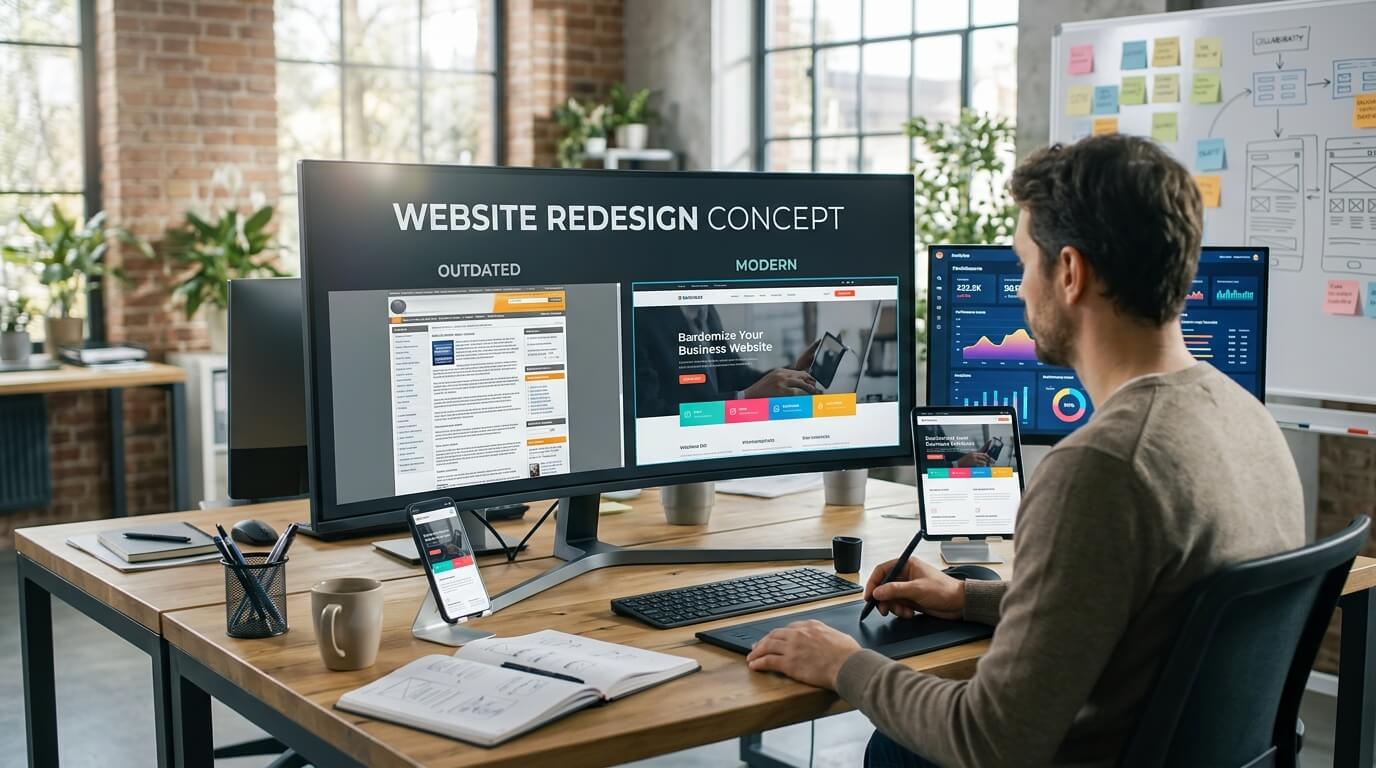
A business website is often the first meaningful interaction a potential customer has with a company. Before making a phone call, sending an email, requesting a quote, or visiting a physical location, many people look online to understand what a business offers and whether it appears trustworthy. That makes a website much more than an online brochure. It is part of a company’s brand identity, customer experience, marketing strategy, and sales process.
However, websites do not remain effective forever. Design trends change, technology develops, customer expectations evolve, and businesses themselves grow. A website that looked modern and performed well several years ago may now feel outdated, difficult to navigate, slow, or disconnected from the company it represents. In some cases, the website may still function technically but quietly lose potential customers because it no longer provides the experience visitors expect.
A redesign does not necessarily mean changing everything. Sometimes a business needs a complete rebuild, while other situations call for improvements to navigation, content, mobile responsiveness, speed, conversion paths, or visual presentation. The important thing is recognizing when the current website is holding the business back.
Why Website Redesign Matters for Modern Businesses
A website redesign can influence how customers perceive a business long before they interact with its employees. People tend to make quick judgments based on visual presentation, clarity, usability, and professionalism. If a website looks neglected, confusing, or difficult to use, visitors may assume that the business operates in the same way.
A modern website should communicate what a company does, who it serves, and why customers should consider it without making visitors work unnecessarily hard for that information. The structure should feel logical, the content should be easy to understand, and important actions should be simple to find. When these elements work together, the website becomes a useful business asset rather than simply an online presence.
Redesigning a website can also provide an opportunity to bring digital experiences in line with current business goals. A company may have introduced new services, entered new markets, changed its branding, or adopted a different customer acquisition strategy. If the website has not evolved alongside those changes, it may be presenting an inaccurate or incomplete picture of the business.
Your Website Looks Outdated
One of the clearest signs that a redesign may be necessary is an outdated visual appearance. Design preferences naturally change over time. Websites that once appeared sophisticated can eventually look cluttered, old-fashioned, or visually inconsistent with contemporary digital experiences.
An outdated design is not simply a matter of aesthetics. Visitors often associate visual quality with credibility. A website with tiny text, excessive decoration, dated graphics, crowded layouts, or inconsistent typography can make the business appear less established, even when the company itself is successful.
Your Website No Longer Reflects Your Brand
Businesses evolve. Logos change, colors are updated, services expand, and companies refine their positioning. If the website still reflects an older version of the brand, there may be a disconnect between the company and its digital identity.
A redesign can bring the website’s typography, imagery, colors, messaging, and overall style into alignment with the current brand. This creates greater consistency across marketing materials, social media, packaging, advertising, presentations, and other customer touchpoints.
Your Website Is Difficult to Use on Mobile Devices
Mobile responsiveness is no longer an optional feature. Customers frequently browse websites using smartphones and tablets, and a website that works well only on a desktop can create an immediate barrier.
A mobile visitor should not have to zoom in repeatedly, scroll sideways, search for buttons, or struggle with forms that were clearly designed for a larger screen. Navigation should remain understandable, text should be readable, images should fit the screen, and interactive elements should be easy to use with touch.
Mobile Problems Can Damage the Customer Experience
Imagine a potential customer discovers a business through social media and clicks through to its website. If the page loads awkwardly and the visitor cannot easily locate pricing, services, contact information, or a booking option, the opportunity can disappear within seconds.
A redesign should therefore consider the entire mobile experience rather than simply shrinking desktop pages. Content hierarchy, menus, buttons, forms, images, and page layouts should all be evaluated from a mobile user’s perspective.
Your Website Loads Slowly
Website speed has a direct relationship with user experience. People generally expect websites to respond quickly, and unnecessary delays can create frustration. A visitor who encounters slow-loading pages may leave before reading the content or completing an important action.
Slow performance can result from large images, excessive scripts, outdated technology, poorly configured hosting, unnecessary plugins, inefficient code, or a combination of these problems. As websites accumulate features over the years, performance can gradually decline.
A redesign provides an opportunity to evaluate the technical foundation rather than repeatedly patching individual problems. Optimized images, cleaner code, modern development practices, efficient hosting, and a carefully considered selection of website features can contribute to a smoother experience.
Your Website Has Poor Navigation
A website can contain excellent information and still fail if visitors cannot find it. Navigation should help people understand where they are, where they can go next, and which information matters most.
If visitors regularly need to click through several unrelated pages before finding a service description or contact option, the website structure may need attention. Similarly, an overloaded menu with too many categories can create confusion instead of providing useful choices.
Visitors Should Not Have to Search for Basic Information
Important information such as services, contact details, company information, locations, frequently requested resources, and calls to action should be reasonably easy to find. The exact structure depends on the business, but the general principle is straightforward: visitors should not have to solve a puzzle to use the website.
A redesign can reorganize existing content into a more logical information architecture. It can also eliminate outdated pages, combine overlapping information, and give priority to content that supports current customer needs.
Your Website Has a High Bounce or Exit Rate
Website analytics can reveal problems that are difficult to notice simply by looking at a website. If visitors frequently leave after viewing one page, or important pages receive traffic but generate very few actions, the experience may not be meeting expectations.
A high exit rate does not automatically mean a redesign is required. Some pages naturally serve as final destinations. However, consistent patterns can provide valuable clues. If visitors arrive on important service pages and leave without contacting the business, requesting information, or exploring additional content, it is worth investigating why.
The problem could involve weak messaging, poor page structure, slow loading, unclear calls to action, irrelevant traffic, or a mismatch between advertising promises and website content. A redesign should address the underlying issue rather than simply changing colors or adding decorative elements.
Your Website Is Not Generating Enough Leads
For many businesses, a website needs to contribute to sales or lead generation. If visitors are arriving but very few people submit inquiries, schedule appointments, request quotes, sign up for consultations, or make purchases, the website may not be guiding users effectively.
Your Calls to Action Are Unclear
Visitors should understand what they can do next. Depending on the business, that could mean requesting a quote, booking a consultation, purchasing a product, downloading a resource, calling the company, or contacting a representative.
If every page ends without a clear next step, visitors may simply leave. A redesign can improve the placement, wording, and context of calls to action without making the website feel overly aggressive or promotional.
Your Content Is Outdated
A website should accurately represent the business today. Old service descriptions, expired offers, former employees, outdated statistics, discontinued products, broken resources, and obsolete company information can reduce credibility.
Outdated content can also create confusion for existing customers. Someone looking for a current service may find an old page and assume that information is still accurate.
Your Business Has Changed but Your Website Has Not
Perhaps the company now offers additional services, serves different industries, operates in new locations, or targets a different audience. If the website still focuses heavily on the company’s previous direction, it may attract the wrong visitors or fail to communicate its current value.
A redesign is an opportunity to reassess the entire content strategy. Instead of simply transferring old text into a new template, businesses can identify what customers actually need to know and build the website around that information.
Your Website Is Difficult to Update
Technology can become a problem when a website requires specialized technical knowledge for every small change. If employees cannot easily update a service description, publish an article, replace an image, or modify basic information, maintaining the site becomes unnecessarily expensive and slow.
A modern content management system can give appropriate team members greater control over routine updates. This does not mean every business needs a highly complicated platform. In many cases, a simpler and more manageable system is preferable.
The goal should be a website that supports the people responsible for maintaining it instead of creating unnecessary dependence on developers for minor changes.
Your Website Has Technical or Security Problems
Technical problems are another important warning sign. Broken links, malfunctioning forms, outdated software, compatibility issues, security vulnerabilities, missing backups, and recurring errors can make a website unreliable.
Security deserves particular attention because a website is part of a company’s broader digital infrastructure. An outdated platform or collection of unsupported plugins can create unnecessary risks.
A redesign can provide an opportunity to modernize the underlying technology, remove unnecessary components, improve maintenance procedures, and establish a more reliable foundation for future development.
Your Website Is Not Supporting SEO
Search engine visibility depends on many factors, including content quality, technical performance, site structure, mobile usability, page experience, internal linking, and how effectively pages address user intent.
If a business website has weak page structures, duplicate content, unclear headings, missing or poorly optimized metadata, slow performance, or an inconsistent internal linking structure, redesigning the site can help create a stronger foundation for search visibility.
However, redesigning a website purely for SEO without considering users can create another set of problems. Search optimization and usability should work together. Pages need to be useful to real people while also being technically understandable to search engines.
Your Competitors Have Better Online Experiences
Competition can reveal gaps that internal teams may overlook. If competing businesses have websites that are easier to navigate, clearer about their services, faster on mobile devices, and more effective at communicating their value, customers may naturally gravitate toward those experiences.
The answer is not necessarily to copy competitors. Instead, businesses should identify what customers appear to value and determine how their own website can communicate its strengths more effectively.
A redesign can help a company differentiate through better content, stronger brand presentation, clearer positioning, useful resources, improved functionality, or a more intuitive customer journey.
Your Website Does Not Build Trust
Trust is particularly important when customers are considering a significant purchase or professional service. A website should provide enough information for visitors to feel comfortable taking the next step.
Professional photography, clear company information, testimonials where appropriate, case studies, transparent service descriptions, contact information, useful resources, and consistent branding can all contribute to credibility.
A redesign can also improve how this information is presented. Trust signals should not be scattered randomly throughout a website. They should appear naturally where customers are likely to have questions or concerns.
Your Website Is Not Aligned With Your Marketing
Marketing campaigns often direct people toward specific website pages. If advertisements, email campaigns, social media posts, and other marketing channels promise one experience while the website delivers another, visitors can become confused.
For example, an advertisement may promote a particular service, but clicking through may take visitors to a generic homepage with little information about that service. This creates friction and can waste marketing spend.
A redesigned website can create stronger connections between marketing channels and landing pages. Each campaign can guide visitors toward relevant content that continues the conversation started by the advertisement or promotional message.
Your Website Has Too Many Features That Nobody Uses
More functionality does not automatically create a better website. Over time, businesses often add plugins, widgets, animations, pop-ups, forms, integrations, and other features without regularly reviewing whether they remain useful.
Unused functionality can increase maintenance requirements and potentially affect performance. A redesign is a good opportunity to distinguish between features that genuinely improve the customer experience and those that simply add complexity.
The most effective websites are not necessarily the ones with the most features. They are the ones where each feature serves a clear purpose.
Website Redesign Warning Signs at a Glance
| Website Issue | Possible Business Impact | Redesign Priority |
| Outdated visual design | Lower perceived credibility | High |
| Poor mobile experience | Lost mobile visitors and leads | High |
| Slow loading pages | Frustration and abandonment | High |
| Confusing navigation | Visitors struggle to find information | High |
| Outdated content | Reduced trust and relevance | Medium to High |
| Weak calls to action | Fewer inquiries or conversions | High |
| Difficult content management | Slower updates and higher maintenance effort | Medium |
| Technical or security issues | Reliability and security concerns | High |
| Poor SEO foundation | Reduced organic visibility | Medium to High |
| Misaligned branding | Inconsistent customer experience | Medium |
| Unused features | Complexity and maintenance problems | Medium |
How to Decide Whether You Need a Redesign
Not every website problem requires a complete rebuild. Some issues can be addressed through targeted improvements. For example, updating content, compressing images, fixing broken links, improving calls to action, or restructuring a few pages may solve specific problems.
A more comprehensive redesign becomes appropriate when several warning signs appear at the same time. If the website is outdated, difficult to use on mobile, slow, poorly structured, difficult to maintain, and disconnected from the current brand, making isolated fixes may only postpone a larger problem.
Businesses should also consider the age and technical foundation of the website. A visually attractive website can still have an outdated backend, while an older-looking website may have a strong technical foundation that can be improved without a complete rebuild.
The best decision comes from evaluating performance, customer behavior, business goals, and technology together.
What a Successful Website Redesign Should Achieve
A successful redesign should do more than make a website look newer. It should create a better experience for the people who use it and a more useful platform for the business that operates it.
The redesigned website should communicate the company’s value clearly, work smoothly across devices, load efficiently, guide visitors toward relevant information, support search visibility, and make important actions easy to complete. It should also be flexible enough to accommodate future content and business growth.
Before beginning a redesign, businesses should establish measurable goals. These might include improving qualified leads, increasing contact form submissions, reducing abandonment, improving mobile engagement, increasing organic traffic, or making content management easier.
When goals are defined in advance, the redesign becomes a strategic project rather than a purely visual exercise.
Conclusion
A website redesign can become necessary when a business outgrows its existing digital presence. Outdated design, poor mobile usability, slow performance, confusing navigation, weak lead generation, outdated content, technical problems, and inconsistent branding are all signs that a website deserves closer attention.
The strongest redesigns focus on both appearance and performance. They consider what customers need, what the business wants to achieve, and how technology can support those goals. Rather than redesigning simply because a website looks old, businesses should look at the complete customer experience and the role the website plays in marketing and growth.
When a website accurately represents the business, provides a smooth experience, and makes it easy for visitors to take meaningful action, it becomes far more than an online presence. It becomes an active part of the company’s long-term growth strategy.
Frequently Asked Questions
Q1. How often should a business redesign its website?
There is no universal schedule for redesigning a website. A business should consider a redesign when its website no longer meets customer expectations, supports current business goals, performs well technically, or accurately represents the brand.
Q2. Does a website redesign improve SEO?
A redesign can create a stronger SEO foundation by improving site structure, mobile usability, page speed, content organization, internal linking, and technical performance. However, SEO results depend on many factors beyond design alone.
Q3. How do I know if my website is too outdated?
Look at its appearance, mobile experience, loading speed, navigation, content, security, technology, and conversion performance. If several of these areas are creating problems, a redesign may be worthwhile.
Q4. Does every website need a complete redesign?
No. Some websites only require targeted improvements. A full redesign is generally more appropriate when multiple structural, technical, content, branding, and usability problems exist together.
Q5. What is the most important goal of a website redesign?
The main goal should be to create a website that better serves both customers and the business. It should be easy to use, communicate value clearly, support business objectives, and provide a reliable foundation for future growth.