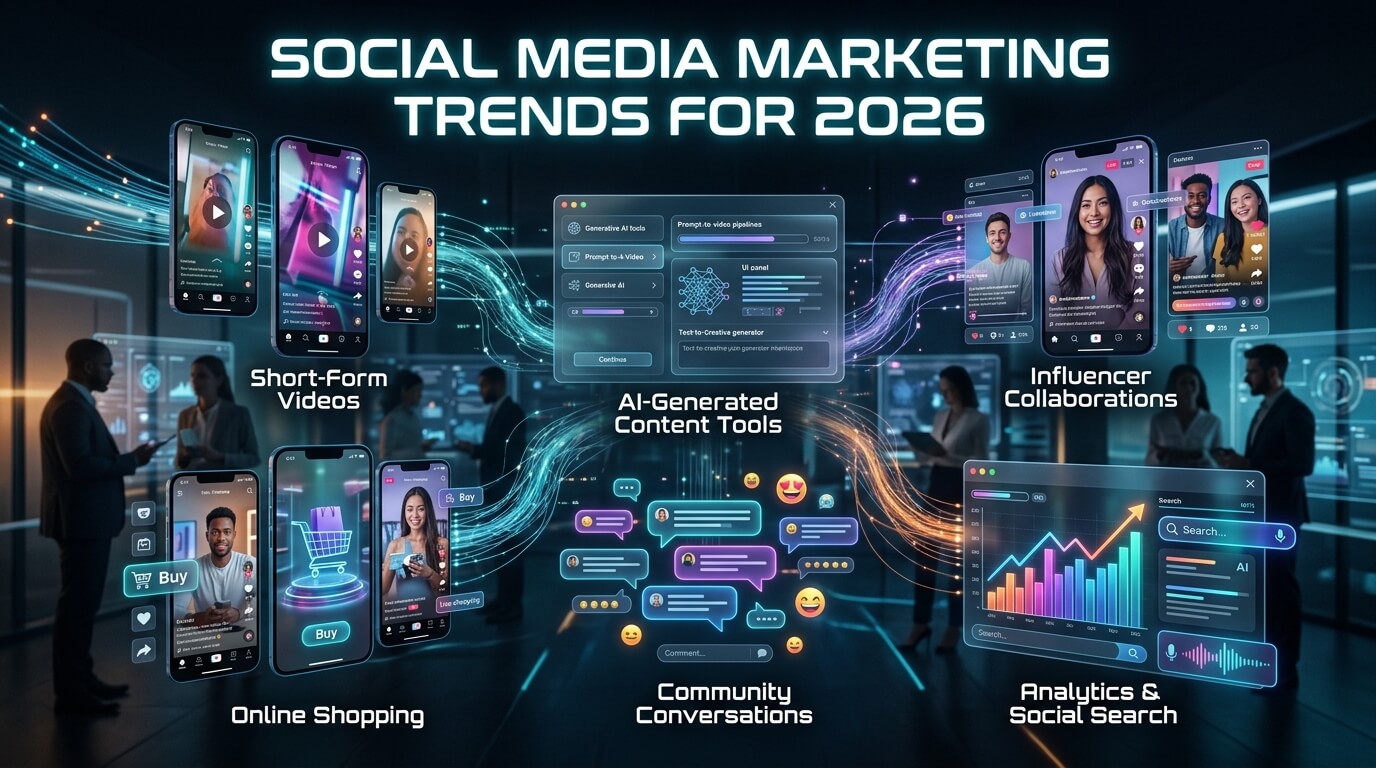
Social media marketing continues to evolve at a remarkable pace. What worked for brands a few years ago is no longer guaranteed to produce the same results, and 2026 is proving to be a year of significant change. Social platforms are no longer simply places where businesses publish updates and wait for likes. They have become discovery engines, search platforms, shopping environments, customer service channels, community spaces, and important sources of brand credibility.
One of the most noticeable changes is the movement from follower-based reach toward interest-based discovery. A brand does not necessarily need a massive audience to reach thousands or even millions of people. Strong content can travel beyond an account’s existing followers when it matches what users are watching, searching for, sharing, and discussing. At the same time, marketers are dealing with more competition, greater content volume, increasingly sophisticated algorithms, and audiences that are more skeptical of overly polished or obviously automated content.
Artificial intelligence is another major influence on social media marketing in 2026. Research from HubSpot indicates that 94% of social media marketers now use AI in some part of their workflow, while 77% say authenticity is more important than production value. The important lesson is that AI is becoming a productivity tool rather than a replacement for human creativity. Brands still need distinctive ideas, genuine voices, useful information, and meaningful relationships with their audiences.
Understanding the major social media marketing trends for 2026 can help businesses make smarter decisions about content, advertising, creators, customer engagement, and overall digital strategy.
Artificial Intelligence Becomes Part of Everyday Social Media Marketing
AI is no longer an experimental technology reserved for large marketing departments. In 2026, it is increasingly integrated into everyday social media workflows. Marketers are using AI to brainstorm ideas, develop captions, analyze performance, create images, edit content, research audiences, identify trends, and improve production efficiency. HubSpot’s 2026 research found that common AI uses include brainstorming, short-form copywriting, image generation, and image editing.
AI Will Assist Marketers Rather Than Replace Them
The most effective approach is likely to be a combination of automation and human judgment. AI can help a social media manager move from an empty page to a workable concept much faster, but it cannot automatically understand every nuance of a brand’s personality, customer relationships, cultural context, or long-term positioning.
This distinction is particularly important because audiences are becoming increasingly familiar with AI-generated content. When every company can produce polished captions, graphics, and videos at scale, simply producing more content does not create an advantage. The advantage comes from having something meaningful to say and presenting it in a way that feels distinctive.
The growing use of AI therefore makes human creativity more valuable, not less. Marketers need to use AI for efficiency while keeping strategy, storytelling, opinions, humor, experience, and final editorial decisions firmly connected to people.
AI-Powered Social Media Analytics Will Become More Useful
AI will also play a larger role in interpreting social media performance. Instead of simply reporting that a video received a certain number of views, intelligent tools can help identify patterns across content, audience behavior, retention, comments, shares, and conversions.
This can make reporting more strategic. A business can potentially identify which subjects generate meaningful engagement, which hooks retain attention, and which types of content are associated with actual business outcomes. Instagram’s Edits app, for example, introduced an AI creative assistant capable of analyzing performance information and providing suggestions related to topics, hooks, captions, audio, and scripts.
Short-Form Video Remains a Dominant Content Format
Short-form video remains one of the strongest social media trends in 2026. TikTok, Instagram Reels, YouTube Shorts, and other short-video environments have changed how people discover brands and consume information.
HubSpot’s 2026 research reports that short-form video is the most-used format among marketers, the format most often associated with high ROI, and a major area of planned investment.
Short Videos Are Becoming Discovery Tools
Short-form video is no longer simply entertainment. Businesses use it to explain products, answer questions, demonstrate expertise, introduce employees, show behind-the-scenes activity, share customer experiences, and respond to cultural conversations.
The strongest videos often communicate their value quickly. Instead of spending the first several seconds introducing a company, marketers increasingly need to give viewers a reason to continue watching. A useful question, surprising observation, practical demonstration, or relatable problem can provide that initial reason.
This does not mean every video needs to be highly dramatic. In fact, current research suggests that authenticity can matter more than expensive production. HubSpot reports that 77% of marketers say authenticity is more important than production value when creating social content.
Authentic Video Will Beat Overproduced Content
Businesses should not assume that every successful social video requires a studio, elaborate animation, or professional commercial production. A knowledgeable employee explaining a common customer problem may be more effective than a highly polished advertisement.
The goal is not to make content look unprofessional. The goal is to make it feel relevant, believable, and appropriate to the platform.
Social Search Is Becoming a Major Discovery Channel
Search behavior is changing. Consumers increasingly use social platforms to find recommendations, products, restaurants, services, tutorials, opinions, and answers. This means businesses need to think about social content as searchable content.
HubSpot’s 2026 research indicates that social search is becoming an important part of the discovery journey, particularly among younger consumers.
Keywords Matter Beyond Traditional Search Engines
Traditional SEO remains important, but social media content also needs discoverable language. Captions, spoken words, on-screen text, video titles, descriptions, and hashtags can help communicate what a piece of content is about.
For example, instead of publishing a generic video about a service, a company might create a video specifically addressing a recognizable customer question. The title, spoken introduction, caption, and on-screen wording can all reinforce that subject.
This creates an opportunity for brands to build a library of social content that answers real questions. Over time, these posts can contribute to visibility when users search within social platforms.
Educational Content Can Drive Long-Term Visibility
Social search also increases the value of educational content. A short video explaining how to choose a service, compare two options, avoid a common mistake, or understand an industry concept can remain useful well after publication.
The most successful social strategies in 2026 therefore need to think beyond immediate engagement. A post can serve several purposes at once: attracting attention, answering a question, establishing expertise, and creating a path toward conversion.
Creator and Influencer Marketing Is Becoming More Strategic
Influencer marketing has moved beyond the traditional model of paying a large account to publish a sponsored post. In 2026, brands are increasingly interested in creators because they can provide cultural relevance, trust, storytelling ability, and access to highly specific communities.
HubSpot reports that 60% of marketers plan to increase influencer investment in 2026, while mid-tier creators have been particularly effective for many marketers.
Micro and Mid-Tier Creators Offer Stronger Connections
A creator with a smaller but highly engaged audience can sometimes provide more value than a celebrity with millions of followers. Smaller creators often operate within clearly defined niches and may have stronger relationships with their communities.
For brands, this can make creator partnerships more relevant and credible. A specialized creator may understand the audience’s questions, frustrations, preferences, and language better than a general celebrity.
The trend is therefore moving toward creator partnerships that feel more like collaborations than advertisements. Current industry examples also show brands integrating creators into broader campaigns, advisory programs, storytelling, and customer acquisition strategies.
Long-Term Creator Relationships Will Matter More
One-off influencer posts can generate temporary attention, but long-term relationships can create greater consistency. When a creator works with a brand repeatedly, the partnership can feel more natural to the audience.
Businesses may increasingly treat creators as ongoing creative partners rather than simply promotional channels. This approach can help produce content that reflects the creator’s authentic style while still meeting the brand’s objectives.
Community Building Becomes a Competitive Advantage
Social media has always included a social element, but many businesses have historically focused too heavily on broadcasting messages. In 2026, community building is becoming increasingly important.
A community is more than a group of followers. It is an audience that recognizes a shared interest, participates in conversations, responds to content, and feels some level of connection with the brand or with other members.
Engagement Needs to Become Two-Way
Businesses should think carefully about how they respond to comments and messages. A comment should not always be treated as an opportunity to promote another product or repeat a sales message.
Meaningful responses can demonstrate that a company is listening. Questions, opinions, customer experiences, and even constructive criticism can provide valuable insight into what audiences actually care about.
Community management can therefore become part of market research. Social conversations reveal language customers use, problems they experience, objections they have, and subjects they want businesses to explain.
Smaller Communities Can Be Valuable
A smaller active community can be more valuable than a large passive audience. This is especially relevant for specialized businesses where trust and expertise are more important than mass reach.
Brands may therefore invest more heavily in private groups, messaging communities, niche discussions, live sessions, and interactive formats that encourage participation rather than passive scrolling.
Social Commerce Continues to Expand
Social media and shopping are becoming increasingly connected. Consumers can discover a product through a video, research it through comments and creator content, ask questions through messaging, and complete a purchase without following the traditional path from search engine to company website.
Shopify identifies creator content, user-generated content, short-form video, conversational commerce, and AI-assisted engagement as important elements of social commerce in 2026.
Product Discovery Is Becoming More Social
People increasingly want to see products being used in real situations. A product demonstration from a creator or customer can sometimes answer practical questions more effectively than a traditional product advertisement.
This makes user-generated content particularly valuable. Reviews, demonstrations, testimonials, unboxing videos, tutorials, and customer stories can provide social proof while simultaneously showing potential buyers how a product fits into real life.
Messaging Can Support the Buying Journey
Social commerce is also expanding through conversations. Customers may ask about product availability, pricing, specifications, delivery, returns, or recommendations through messaging platforms.
Businesses need to consider these conversations as part of the customer journey rather than treating social media as a separate promotional channel. In some markets, messaging platforms are becoming important links between discovery, purchase, and post-purchase support. Meta’s 2026 research on India, for example, highlights WhatsApp’s growing role in connecting these stages of commerce.
Authenticity Will Matter More in an AI-Saturated Environment
Perhaps one of the most interesting trends for 2026 is that increasing automation is making authenticity more valuable.
When businesses can produce hundreds of posts quickly, audiences can become overwhelmed by repetitive content. Generic AI-written captions, stock-looking visuals, recycled trends, and vague corporate messaging can blend together.
Human Experience Becomes a Differentiator
A business owner speaking honestly about a challenge, an employee explaining how a process works, or a customer sharing a genuine experience can create a sense of credibility that automated content struggles to reproduce.
This does not mean brands should avoid AI. Instead, AI should support the creation process while human experience remains visible in the final content.
The same principle is appearing on professional networks as well. Current reporting around LinkedIn suggests that candid photos and unscripted videos are being used to create more authentic professional connections in response to the increasing presence of generic AI content.
Platform-Specific Content Will Become More Important
Cross-posting the exact same content everywhere is becoming less effective. Although businesses can repurpose ideas across platforms, the final execution should reflect how people use each platform.
Instagram may emphasize visual storytelling and Reels. TikTok can reward culturally relevant short-form content. YouTube can support both short and long educational video. LinkedIn can provide opportunities for professional insights and personal expertise. Facebook can remain valuable for community-oriented communication and established audiences.
Quality of Presence Matters More Than Being Everywhere
The pressure to maintain accounts on every major platform can waste resources. A company may achieve better results by developing a strong presence on two or three platforms where its customers actually spend time.
The emerging approach is therefore depth rather than simple platform expansion. Research from 2026 similarly points toward platform fragmentation and the need for marketers to go deeper on the channels that matter instead of spreading themselves too thinly.
Social Media Marketing Will Focus More on Brand Awareness
For several years, social media marketing was often judged primarily through direct response metrics. Clicks, leads, purchases, and conversions were treated as the clearest indicators of success.
In 2026, brand awareness is receiving renewed attention. HubSpot reports that 59% of social media teams identify increasing brand awareness as their number-one goal.
This reflects a broader reality: consumers often encounter a business multiple times before taking action. A useful video today may not produce a purchase immediately, but it can make the brand familiar when the customer is ready to buy later.
Social media therefore needs to contribute to both immediate performance and long-term brand building.
Key Social Media Marketing Trends for 2026
| Trend | What It Means for Businesses | Strategic Opportunity |
| AI-assisted marketing | Faster content creation and analysis | Use AI for efficiency while maintaining human oversight |
| Short-form video | Video remains a major discovery format | Create useful, relatable and platform-native videos |
| Social search | Users increasingly search within social platforms | Optimize captions, spoken content and on-screen text |
| Creator marketing | Creators influence discovery and trust | Build long-term partnerships with relevant creators |
| Community building | Audiences expect two-way interaction | Invest in conversations, groups and direct engagement |
| Social commerce | Discovery and shopping are becoming connected | Combine creator content, UGC, reviews and buying pathways |
| Authentic content | Audiences are more skeptical of generic content | Show people, experiences, expertise and real stories |
| Platform specialization | Different platforms reward different approaches | Focus resources on the channels that matter most |
| Brand awareness | Social contributes to long-term recognition | Balance conversion content with brand-building content |
Measuring Social Media Success in 2026
Social media measurement also needs to become more sophisticated. Likes and follower counts can provide useful context, but they should not be the only indicators of success.
Businesses should consider whether content is generating meaningful conversations, saves, shares, profile visits, website activity, leads, purchases, customer inquiries, and brand recognition. Different campaigns may require different measurements.
For example, an educational video may be successful because people save and share it, while a product campaign may be judged more heavily on qualified traffic and sales. A brand awareness campaign may focus on reach, video completion, mentions, and audience growth.
The important principle is to connect social media metrics with the actual objective of the campaign. A post should not be considered unsuccessful simply because it generated fewer likes if it produced valuable leads or meaningful customer conversations.
How Businesses Can Adapt to Social Media Marketing in 2026
Adapting to these trends does not mean chasing every new feature. The social media environment changes too quickly for businesses to build their entire strategy around temporary platform trends.
A stronger approach begins with understanding the audience. What questions do customers ask? What problems do they experience? What content do they share? Which creators do they trust? Which platforms do they use when researching products or services?
From there, businesses can develop content pillars that combine education, entertainment, credibility, community, product information, and brand storytelling. Short-form video can provide reach, creator partnerships can provide credibility, community management can strengthen relationships, and social commerce can shorten the path from discovery to purchase.
AI can then make the production process more efficient without becoming the identity of the brand.
The most important shift is strategic rather than technological. Businesses need to stop thinking of social media as a publishing calendar and start treating it as an integrated customer experience. Social content can introduce a brand, answer questions, demonstrate expertise, create trust, generate demand, support sales, and maintain relationships after a purchase.
Conclusion
Social media marketing in 2026 is defined by a combination of technology and humanity. AI is making content creation and analysis faster, short-form video continues to dominate discovery, social search is changing how people find information, creators are becoming strategic partners, and social commerce is bringing discovery closer to purchase.
At the same time, audiences are placing greater value on authenticity. The brands most likely to stand out are not necessarily those producing the most content. They are the ones producing useful, relevant, recognizable, and human content consistently.
For businesses, the goal should not be to follow every trend. It should be to understand which trends genuinely affect their customers and use those developments to create better experiences. In 2026, effective social media marketing is less about simply being visible and more about being useful, trustworthy, discoverable, and memorable.
Frequently Asked Questions
Q1. What is the biggest social media marketing trend in 2026?
Short-form video remains one of the biggest trends, while AI-assisted marketing, social search, creator partnerships, community building, and social commerce are also shaping strategies. Current research shows short-form video continues to lead in usage, ROI, and planned investment.
Q2. Will AI replace social media marketers?
AI is unlikely to replace the strategic and creative role of social media marketers. It is increasingly being used to support brainstorming, writing, editing, analysis, and production. Human judgment remains important for brand voice, authenticity, strategy, relationships, and creative direction.
Q3. Is influencer marketing still effective in 2026?
Yes. Influencer marketing continues to grow, but the focus is shifting toward relevant creators, stronger community connections, and longer-term partnerships. Micro- and mid-tier creators can be particularly valuable because of their niche expertise and closer relationships with audiences.
Q4. Why is social search important for businesses?
Consumers increasingly use social platforms to discover products, services, recommendations, tutorials, and answers. Businesses can respond by creating searchable content around real customer questions and using relevant language in captions, videos, titles, and on-screen text.
Q5. Should businesses focus on every social media platform?
Not necessarily. A focused strategy on the platforms where a target audience is most active can be more effective than maintaining weak profiles everywhere. Businesses should prioritize platform relevance, content quality, consistency, and meaningful audience engagement.