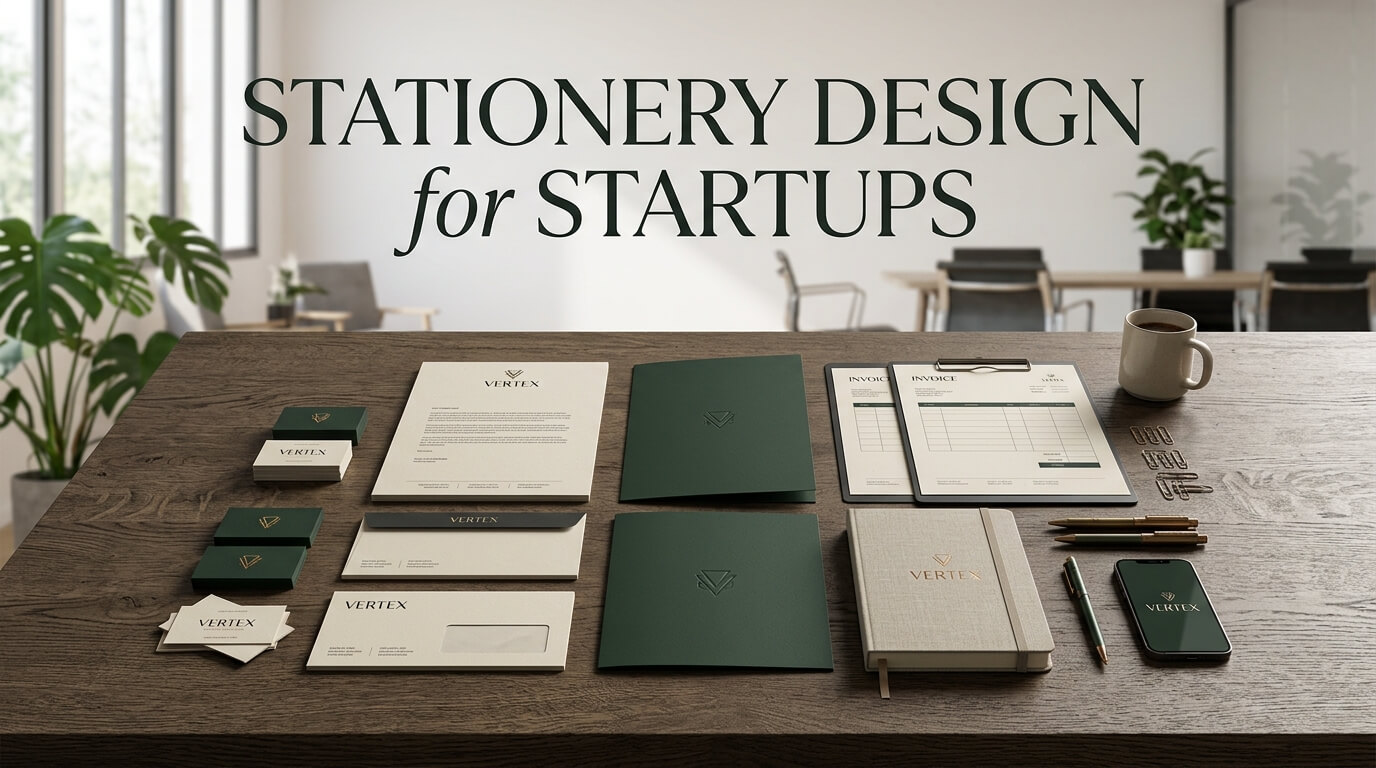
For a startup, first impressions can influence how customers, investors, partners, and potential employees perceive the business. While much of modern branding happens online, physical and digital stationery still play an important role in creating a recognizable and professional identity. Business cards, letterheads, envelopes, invoices, presentation folders, email signatures, and other branded materials can communicate credibility before a customer even begins a conversation with the company.
Stationery design for startups is not simply about placing a logo on a piece of paper. It is about creating a consistent visual language that represents the company’s personality, values, and position in the market. A thoughtfully designed stationery system can make a young business appear organized, established, and trustworthy without making the brand feel unnecessarily complicated.
Startups often work with limited resources, which makes strategic design particularly important. Every printed or digital communication should serve a purpose while remaining consistent with the overall brand. When stationery is designed as part of a larger identity system, even simple documents can reinforce recognition and professionalism.
Why Stationery Design Matters for Startups
A startup may have an excellent product, innovative service, or compelling business idea, but customers do not always judge a company based solely on what it offers. They also notice how the company presents itself. A poorly formatted invoice, inconsistent letterhead, outdated business card, or cluttered email signature can create uncertainty about the level of professionalism behind the business.
Professional stationery provides visual consistency across everyday business communication. When a customer receives an invoice, proposal, letter, business card, or presentation document, familiar colors, typography, logos, and design elements help establish a connection with the brand.
For startups, this consistency can be especially valuable because the company is still building recognition. Large organizations may already be recognizable because of years of market presence, but new businesses have to create that familiarity deliberately. Consistent stationery gives customers more opportunities to encounter the same visual identity.
Stationery also communicates attention to detail. When a startup takes care with small elements such as document margins, typography, spacing, logo placement, and contact information, it suggests that the company takes similar care with its products and services.
Establishing a Strong Startup Brand Identity
Before designing stationery, a startup needs a clear understanding of its brand identity. Stationery should not be designed independently from the logo, website, packaging, social media graphics, or other brand assets. Instead, it should extend the existing identity into professional communication materials.
Defining the Brand Personality
Every startup has a personality, even if it has not formally defined one. A technology company may want to appear innovative and modern, while a legal consultancy may need a more established and authoritative visual presence. A creative studio might prefer expressive typography and unusual layouts, whereas a financial business may benefit from a restrained and sophisticated approach.
The stationery design should reflect these characteristics. Colors, fonts, shapes, imagery, spacing, and paper choices can all influence how the company is perceived.
For example, a startup targeting younger consumers might use contemporary typography and a bold but controlled color palette. A premium consulting business could use understated colors, elegant typography, and generous white space. The important point is that design decisions should have a reason behind them.
Creating a Consistent Visual System
A stationery system becomes more effective when its design elements work together. The logo should have a consistent appearance, typography should follow defined rules, and brand colors should remain stable across materials.
A startup does not necessarily need dozens of design elements. In fact, keeping the system relatively simple can make it easier to maintain. Two or three primary brand colors, a carefully selected typeface family, and a small collection of supporting graphic elements can be enough to create a recognizable identity.
The goal is not to make every document visually identical. Instead, each piece should feel like part of the same brand family.
Essential Stationery Items for Startups
Not every startup needs every possible stationery item. The most useful materials depend on the company’s industry, customers, employees, and communication methods. However, several stationery pieces are commonly valuable during the early stages of business.
| Stationery Item | Primary Purpose | Key Design Consideration |
| Business Card | Networking and contact sharing | Clear hierarchy and memorable branding |
| Letterhead | Formal communication | Professional layout and readable content area |
| Envelope | Sending physical documents | Consistent branding and address placement |
| Invoice | Billing and financial communication | Clarity, organization, and essential information |
| Email Signature | Digital communication | Simple, responsive, and professional design |
| Presentation Folder | Client and partner materials | Strong visual identity and practical layout |
| Notepad | Meetings and internal communication | Brand consistency without excessive decoration |
| Proposal Template | Presenting services and ideas | Readability and scalable brand elements |
Business Cards
Business cards remain useful for networking, meetings, conferences, events, and face-to-face introductions. For startups, a business card can function as a compact representation of the entire brand.
The design should prioritize essential information. The company name or logo, person’s name, role, phone number, email address, and website are usually sufficient. Overloading the card with information can make it difficult to read and weaken its visual impact.
Typography and spacing are particularly important. A clean business card with a strong hierarchy often appears more professional than a heavily decorated design.
Letterheads
A letterhead provides a consistent framework for formal business documents. Startups may use letterheads for proposals, contracts, official correspondence, notices, client communications, and other documents.
The most effective letterheads balance branding with practicality. The logo and contact details should be visible without occupying too much space. The main body of the document needs enough room for substantial text, so excessive graphics can become inconvenient.
Digital letterheads are also important because many business documents are now exchanged electronically. A startup can create a professional template that works for PDFs, word-processing documents, and other digital formats.
Invoices and Business Documents
Invoices are often overlooked as branding opportunities. However, customers may interact with an invoice after receiving a product or service, making it another touchpoint in the customer experience.
A well-designed invoice should prioritize clarity. Payment details, invoice numbers, dates, taxes, item descriptions, totals, and contact information should be easy to locate. Branding should support the document rather than interfere with its financial information.
Choosing Colors for Startup Stationery
Color plays an important role in visual recognition. A startup should select stationery colors based on its broader brand identity rather than choosing colors simply because they look attractive.
Using Brand Colors Consistently
A defined color palette makes stationery easier to manage. If a company uses one shade of blue on its website, a different blue on its business cards, and another shade on invoices, the brand may appear inconsistent.
Color specifications should therefore be established early. Digital and print applications can sometimes display colors differently, so professional stationery design should account for the differences between screen-based and printed materials.
Avoiding Excessive Color
More colors do not automatically create a stronger design. Excessive color can make business stationery appear busy, particularly when combined with multiple fonts, graphics, and decorative elements.
A restrained palette can often produce a more sophisticated result. A startup may use one primary color, a secondary accent, neutral tones, and plenty of white space. This creates flexibility while maintaining recognition.
Typography and Readability
Typography is one of the most influential elements of stationery design because it affects both personality and usability. A font can make a startup appear traditional, modern, friendly, technical, luxurious, or informal.
Selecting Appropriate Fonts
Startups should select fonts that match their brand personality while remaining readable. Decorative typefaces may work well for a creative logo or headline, but they are rarely appropriate for large amounts of business text.
A practical stationery system usually benefits from a primary typeface and one complementary typeface or font family. Using too many fonts can make documents look uncoordinated.
Creating a Clear Information Hierarchy
Good typography helps readers understand information quickly. Names, job titles, contact details, headings, body text, and legal information should have different levels of visual importance.
For example, a person’s name on a business card may be larger or heavier than their job title, while contact information can use a smaller but highly readable size. The same principle applies to invoices, proposals, and letterheads.
Designing Stationery With White Space
White space is one of the most underestimated aspects of professional stationery design. It refers to the empty areas surrounding text, logos, images, and other design elements.
A startup may be tempted to fill every available area because it wants to communicate as much information as possible. However, crowded layouts can make documents difficult to read and can make the company appear less organized.
Strategic white space creates visual breathing room. It helps important information stand out and gives the stationery a more polished appearance.
For startups, this can be particularly useful because a clean design often communicates confidence. The company does not need to fill every space to demonstrate its professionalism.
Balancing Creativity With Professionalism
Startup branding often aims to be distinctive. However, creativity should not come at the expense of clarity.
A unique stationery design can help a startup stand out, but the recipient should still immediately understand who sent the document and what information matters. A creative layout that makes contact details difficult to find is less effective than a simpler design that communicates clearly.
Designing for the Target Audience
The appropriate level of creativity depends heavily on the audience. A design agency may have more freedom to experiment with unusual layouts, illustrations, or typography. A healthcare startup may require a cleaner and more reassuring visual approach.
The best stationery reflects both the company’s personality and the expectations of its customers. Successful design is not about following trends blindly. It is about creating a visual experience that feels appropriate for the business and its audience.
Printed and Digital Stationery
Modern startups often operate across physical and digital environments. This means stationery should be designed for both.
Printed business cards, envelopes, letterheads, folders, and other materials need to account for paper size, printing quality, margins, colors, and finishing techniques. Digital documents require different considerations, including screen readability, file size, responsive formatting, and compatibility.
Creating Digital Email Signatures
An email signature is essentially digital stationery. It appears repeatedly in customer communication and can reinforce brand recognition.
A professional email signature should contain essential contact information and maintain the same visual identity as the company’s other materials. Logos, colors, typography, social links, and contact details should be arranged carefully so the signature remains readable across different devices and email platforms.
A complicated signature with large graphics or excessive information can create usability problems. Simplicity is usually more effective.
Choosing the Right Paper and Printing Finish
For physical stationery, paper selection can influence the perceived quality of the brand. Different paper weights, textures, coatings, and finishes create different impressions.
A startup offering premium services may benefit from a heavier stock or subtle specialty finish. A company focused on sustainability might prioritize recycled or responsibly sourced paper. A modern business may prefer a clean matte finish rather than a highly glossy surface.
The important consideration is alignment. The physical feel of the stationery should support the brand’s positioning rather than exist purely for decoration.
Common Stationery Design Mistakes Startups Should Avoid
One common mistake is trying to include too much information. Startups often want business cards and stationery to communicate every service, social media account, slogan, phone number, address, and promotional message. This can produce cluttered designs.
Another mistake is inconsistency. When different employees use different versions of the logo, fonts, colors, or email signatures, the company can quickly develop an inconsistent identity.
Poor-quality images and low-resolution logos can also damage the appearance of printed materials. A design that looks acceptable on a computer screen may appear blurry when printed.
Ignoring practical requirements is another issue. Letterheads need enough space for content, invoices need clear financial information, and envelopes need appropriate areas for addresses. Good stationery design must work functionally as well as visually.
Creating a Scalable Stationery System
A startup’s stationery should be designed with future growth in mind. The company may begin with a small team and limited materials, but its communication needs can expand quickly.
A scalable system allows new stationery items to be introduced without redesigning the entire identity. Templates for proposals, presentations, invoices, reports, letters, and internal documents can all follow the same visual guidelines.
This approach also makes onboarding easier. New employees can receive approved templates and understand how the brand should appear in their communications.
How Stationery Supports Brand Recognition
Brand recognition develops through repeated exposure. Customers may see a startup’s website one day, receive an invoice another day, attend a meeting and receive a business card later, and eventually receive a formal proposal.
When these touchpoints share recognizable design elements, they strengthen the connection between each interaction.
Stationery therefore becomes part of the broader customer experience. It does not replace a strong product or service, but it reinforces the professionalism surrounding that offering.
The Role of Simplicity in Startup Stationery
Simple stationery design does not mean boring design. It means that every element has a purpose.
A strong logo, carefully selected typography, balanced spacing, restrained color palette, and clear information hierarchy can create a distinctive design without excessive decoration.
Simplicity also makes stationery easier to reproduce. A startup may eventually need to use its identity across websites, mobile interfaces, packaging, signage, social media, documents, and advertising. A flexible stationery system can provide a strong foundation for these future applications.
Conclusion
Stationery design for startups is an important part of building a professional and recognizable brand. From business cards and letterheads to invoices and digital email signatures, each communication material provides an opportunity to reinforce the company’s identity.
The strongest startup stationery balances creativity with clarity. It uses consistent colors, typography, spacing, logos, and layouts while remaining practical for everyday business use. Rather than treating stationery as an isolated design project, startups should consider it part of a broader brand system that can grow alongside the company.
When designed thoughtfully, stationery can make a young business feel organized, credible, and confident. More importantly, it creates consistency across customer touchpoints, helping the startup build recognition and trust as it establishes itself in a competitive market.
Frequently Asked Questions
Q1. What should startup stationery include?
Startup stationery can include business cards, letterheads, envelopes, invoices, proposal templates, presentation folders, notepads, and digital email signatures. The exact selection should depend on the company’s communication needs.
Q2. Should startup stationery match the website?
Yes. Matching key visual elements such as colors, typography, logo usage, and design style helps create a consistent brand identity across physical and digital channels.
Q3. Is expensive stationery necessary for a startup?
Not necessarily. Professional stationery depends more on thoughtful design, clarity, consistency, and appropriate materials than on expensive finishes. Startups can create an impressive identity with a carefully planned budget.
Q4. Should digital and printed stationery look the same?
They should share the same core visual identity, but they do not have to be identical. Print and digital formats have different technical and usability requirements, so layouts may need to be adapted.
Q5. Why is consistency important in startup stationery?
Consistency helps customers recognize the company across different interactions. Using the same visual language across business cards, documents, invoices, emails, and proposals makes the brand appear more organized and established.